Our readers keep the lights on and my smoothie glass nicely filled. As an Amazon Associate, I earn from qualifying purchases.
Machinists, woodworkers, and 3D-printing enthusiasts know the frustration of a caliper that drifts off zero, chews through batteries, or feels flimsy in hand. Choosing the right measuring tool means trusting each reading, whether you’m checking a socket depth, a filament layer, or a dovetail joint — one bad measurement can ruin hours of work.
I’m Mohammad Maruf — the founder and writer behind WellFizz. I’ve spent years analyzing precision tool specifications, comparing build materials, measurement accuracy, and user feedback to separate tools that deliver consistent, repeatable results from those that merely look the part.
This guide breaks down the mechanical and digital options available today, covering accuracy tolerances, build materials, and real-world durability so you can confidently select a caliper measuring tool that matches your work and your budget.
How To Choose The Best Caliper Measuring Tool
The right caliper depends on the environment you work in, the tolerance you need to hold, and whether you prefer analog simplicity or digital convenience. Let’s look at the factors that really matter.
Build Material: Stainless Steel vs. Carbon Fiber vs. Plastic
A full stainless steel body provides the most weight and stability for consistent contact. Carbon fiber or reinforced plastic bodies are lighter and resist thermal expansion, making them a good choice for field use where the tool may be dropped, but they lack the substantial feel that many machinists prefer for repeatable measurement pressure.
Measurement Type: Digital, Dial, or Vernier
Digital calipers offer rapid unit conversion and easy reading but depend on battery power and electronics. Dial calipers are mechanical and need no battery — useful in dusty or oily shops — but reading fractions requires practice. Vernier calipers are the most durable and do not require batteries, though they demand more skill to read and are slower for repeated measurements.
Accuracy and Resolution: What the Numbers Really Mean
Most precision calipers on the market claim ±0.001″ accuracy. That spec is sufficient for most woodworking and 3D-printing tolerance checks. For tight machining tasks, look for tools with demonstrated repeatability — the ability to return to the same reading when measuring the same part multiple times. A good caliper holds zero over days, not just minutes.
Quick Comparison
On smaller screens, swipe sideways to see the full table.
| Model | Category | Best For | Key Spec | Amazon |
|---|---|---|---|---|
| Werka Digital Caliper | Digital | Precision machining & 3D printing | Accuracy ±0.001” | Amazon |
| HARDELL Digital Caliper | Digital | Daily workshop & auto repair | Rechargeable via USB-C | Amazon |
| Clockwise Tools Dial Caliper | Dial | Professional machining | Accuracy ±0.001” | Amazon |
| iGaging Dial Caliper | Dial | Fractional inch work (woodworking) | Resolution 1/64” | Amazon |
| Jiavarry Digital Caliper | Digital | Budget home & hobby use | Plastic/stainless hybrid | Amazon |
In‑Depth Reviews
1. Werka Digital Caliper

The Werka digital caliper delivers consistent ±0.001” accuracy that rivals dial indicators costing three times as much, according to long-term user comparisons and hands-on reviews. Its stainless steel frame slides smoothly with no discernible play, and the thumb roller provides enough resistance to set an exact dimension without overshooting. The large LCD display remains readable under most shop lighting, and the auto-on feature when the slide moves eliminates the annoyance of pressing a power button each time.
Beyond accuracy, the Werka offers four measurement modes — inside, outside, depth, and step — with instant switching between inch, fractional inch, and millimeter units. The fractional mode is particularly useful for woodworking layouts where 1/64” resolution beats converting decimals in your head. A low-battery warning flashes on the screen before performance drops, preventing unexpected failures mid-job.
The included hard plastic storage case with sponge cutouts, spare battery, and miniature screwdriver adds genuine value. Users reported that the tool returns to zero precisely after repeated measurements and feels substantial enough to trust in a machining environment. The only minor criticism is that the display digit size is slightly uneven between whole numbers and hundredths, but this does not affect readability for most tasks.
Why it’s great
- Accuracy matches premium brands at a fraction of the cost
- Smooth slide action with zero play across full 6″ range
- Fractional inch mode saves time on woodworking projects
Good to know
- Display font could be more uniformly weighted
- Battery compartment uses standard LR44 cells (included)
2. HARDELL Digital Caliper

The HARDELL digital caliper eliminates a common pain point for active workshop users: dead batteries at the worst moment. Its built-in rechargeable cell charges completely in about 20 minutes via USB-C and lasts up to three months of regular use, according to manufacturer claims and confirmed by user reports. That means no fiddling with tiny LR44 button cells and no calipers suddenly going dark when you need a critical reading.
Accuracy is rated at ±0.001” with 0.0005” resolution, supported by precision glass grating that provides longer life than standard etched scales. The stainless steel body feels solid and balanced in hand, with polished edges and an ergonomic thumb roller that reduces fatigue during repetitive measurements. Users have tested it against feeler gauges and 1-2-3 blocks with consistent results, noting it holds calibration well between uses.
The large LCD screen remains readable in low-light garages and sunny construction sites, and the auto-off after 5 minutes preserves battery life. The included hard plastic case with USB-C cable provides safe storage. Some users noted the movement lacks the buttery smoothness of top-tier dial calipers, and one review reported uncertainty about long-term battery longevity after heavy use. For daily workshop tasks like automotive repair, 3D printing, and general machining, the rechargeable convenience is a genuine upgrade.
Why it’s great
- USB-C rechargeable battery eliminates button-cell replacements
- Quick 20-minute charge lasts months of normal use
- Stainless steel build feels durable and balanced
Good to know
- Slide action is slightly less smooth than precision dial units
- Long-term rechargeable battery health unproven after years of use
3. Clockwise Tools Dial Caliper
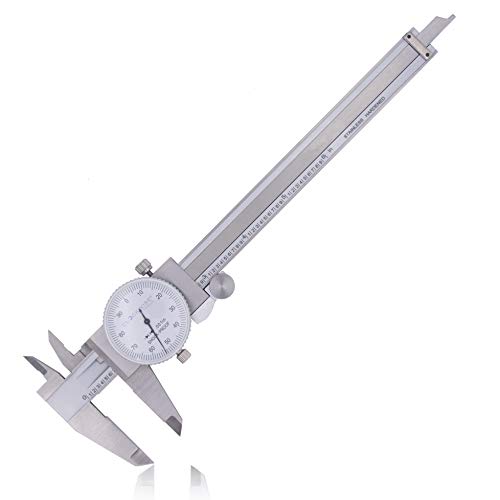
The Clockwise Tools DDLR-0605 dial caliper is built for users who need mechanical reliability without relying on batteries. Its double shock-proof design protects the jeweled movement from sudden impacts, and the hardened stainless steel frame resists wear over years of use. The 1.5” dial is large and high-contrast, making readings easy to spot at a glance — a real advantage in busy machine shops where you’re moving between tool and workpiece quickly.
Each unit ships with a manufacturer calibration certificate, and real-world tests confirm repeatability within 0.0005” across repeated measurements. The thumb wheel is knurled and actually spins freely for fine adjustment — a detail often locked on cheaper dial calipers — and the knurling provides good grip even with oily fingers. Users report the tool has maintained accuracy for 5+ years of moderate use, with one user noting a minor gear jump after two years that was resolved through rapid customer support replacement.
The dial reads in 0.001” increments, which is finer than most digital calipers’ display resolution, and the mechanical action gives tactile feedback that some machinists prefer over a digital readout. The only downsides are that the included depth gauge feels slightly clumsy, and the thumb screw can work loose over time if not periodically snugged. The protective plastic case is adequate but not premium. For those who prioritize mechanical precision and shop-floor durability, this dial caliper is a strong contender.
Why it’s great
- Double shock-proof movement survives drops in busy environments
- Large, easy-to-read dial with 0.001″ increments
- Calibration certificate included with each unit
Good to know
- Depth gauge feels a bit stiff and clumsy
- Thumb screw may loosen after extended use
4. iGaging Dial Caliper
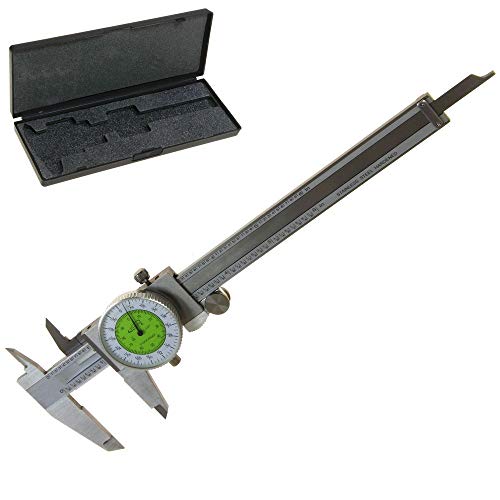
The iGaging dial caliper stands apart with its dual-scale dial that displays both fractional (1/64”) and decimal (0.01”) inch readings simultaneously. This makes it invaluable for woodworking and construction applications where imperial fractions are standard, allowing you to read a board thickness or dowel diameter directly without mental math. The stainless steel body is heavy — nearly 12 ounces — which actually helps stabilize the tool against the workpiece for consistent contact pressure.
Resolution is 0.01” or 1/64”, which is acceptable for general carpentry, fastener sizing, and light machining but not tight enough for precision metalwork where 0.001” matters. The dial bezel is adjustable for zero setting, though some users found it slightly loose, particularly in colder conditions, and susceptible to accidental movement. The sliding action is smooth right out of the box, and the thumb wheel provides decent fine control.
Users commented that the decimal markings are placed on the inner perimeter, with fractions more prominent, which can make decimal readings less convenient for some. The iGaging includes inner/outer/depth measurement capabilities like any standard caliper. It is not a precision machine tool, but for the workshop bench, it offers a quick, battery-free measurement solution that simplifies work in fractional units. If decimal precision is your priority, look elsewhere; if fractions rule your shop, this is a natural fit.
Why it’s great
- Unique dual fractional/decimal dial for shop flexibility
- Heavy stainless steel body provides stable measuring contact
- Battery-free mechanical operation ideal for dusty environments
Good to know
- Zero ring can shift unexpectedly in cold temperatures
- Decimal markings are harder to read than fractions
5. Jiavarry Digital Caliper

The Jiavarry digital caliper is an entry-level option that provides digital measurement capability at a budget-friendly price point. It uses a stainless steel framing with plastic components, keeping weight manageable while offering the core functionality of four measurement modes — inside, outside, depth, and step — with a large LCD that shows inch, millimeter, and fractional inch readings. The included 3 LR44 batteries are factory-installed, and the unit auto-off after 5 minutes prevents accidental drain.
Accuracy is rated at ±0.001” with 0.0005” resolution, which held up during user tests on 1-2-3 blocks and feeler gauges. The sliding action is smooth overall, though one reviewer noted the thumb wheel felt a bit loose. The knurled locking knob allows you to hold a setting for repeated comparisons, a feature usually reserved for pricier tools. The main weakness reported is that the caliper fails to retain its zero setting over days of non-use — you’ll need to zero it each time you start work, which takes only a button press but reduces trust for quick, iterative measurements.
The hybrid construction means the tool feels less substantial than an all-stainless model, and the tiny battery compartment screw requires care when opening. For home DIY, craft work, and occasional 3D-printing filament checks, this caliper delivers accurate measurements at a low investment. If you need a tool that holds zero for weeks in professional use, spend more on the Werka or HARDELL. For budget shoppers, the Jiavarry is a solid entry into precision measurement.
Why it’s great
- Very affordable entry into digital caliper measurements
- Clear LCD with inch, fraction, and millimeter modes
- Locking knob allows repeatable comparison measurements
Good to know
- Does not hold zero over days of storage; requires reset
- Plastic components reduce overall build quality feel
FAQ
What does ±0.001” accuracy mean in real-world terms?
Should I choose a digital caliper or a dial caliper for workshop use?
Why does my caliper lose zero after sitting in a drawer?
Final Thoughts: The Verdict
For most users, the caliper measuring tool winner is the Werka Digital Caliper because it delivers ±0.001” accuracy and smooth build quality that rivals premium brands at a mid-range price. If you want USB-C rechargeable convenience for daily workshop use, grab the HARDELL Digital Caliper. And for mechanical reliability and battery-free operation in professional machining, nothing beats the Clockwise Tools Dial Caliper.

Mo Maruf
I created WellFizz to bridge the gap between vague wellness advice and actionable solutions. My mission is simple: to decode the research and give you practical tools you can actually use.
Beyond the data, I am a passionate traveler. I believe that stepping away from the screen to explore new environments is essential for mental clarity and physical vitality.