Our readers keep the lights on and my smoothie glass nicely filled. As an Amazon Associate, I earn from qualifying purchases.
A dull butcher knife doesn’t just slow you down—it forces you to apply more pressure, increasing the risk of slips and uneven cuts. Whether you’re breaking down primals, portioning steaks, or trimming fat, the difference between a clean slice and a ragged tear comes down to how well your edge is maintained between sharpenings. The right steel rod or guided system restores that aggressive bite without stripping away excessive metal, extending the life of blades that see daily abuse on cutting boards and bone.
I’m Mohammad Maruf — the founder and writer behind WellFizz. I’ve spent years analyzing the hardness ratings, rod geometries, and grit structures that actually matter when matching a sharpener to a professional or home butcher’s workflow.
This guide focuses on the best tools for keeping meat-processing blades in fighting form, featuring traditional honing steels, diamond-coated rods, and precision jig systems built for edge consistency. My goal is to help you identify the right butcher knife sharpener based on your blade steel, volume of use, and preferred sharpening technique.
How To Choose The Best Butcher Knife Sharpener
Butcher knives see heavy, repetitive use on wet, fatty surfaces. The sharpener you choose must match the steel type of your blade, the frequency of your cutting sessions, and your tolerance for manual technique. Three factors dominate the decision: rod material and grit, rod length and profile, and the sharpening method itself.
Rod Material and Grit Surface
A plain steel rod (typically 58–65 HRC) realigns the edge but removes almost no metal—ideal for daily touch-ups between actual sharpenings. A diamond-coated rod or a sapphire-corrugated surface cuts faster, actually removing steel to form a new edge, which is better for restoring knives that have been banged against bone or abused on hard cutting boards. Fine-cut rods suit softer stainless blades, while medium-coarse or diamond surfaces handle high-carbon steel and heavily dulled edges more efficiently.
Rod Length and Shape
Longer rods (12 to 14 inches) provide more surface area per stroke, making it easier to maintain a consistent angle on scimitar and breaking knives that have long curved blades. Oval rods offer a wider bearing surface than round rods, which helps stabilise the blade during the stroke and reduces the chance of rounding the edge. For butchery tasks, a 14-inch rod is the practical minimum; anything shorter forces you to make multiple passes on a single blade section.
Manual Steel vs. Guided System
Traditional honing steels require practice to maintain a consistent 15- to 20-degree angle freehand. A guided V-sharp system, like the Warthog A4, locks the angle mechanically and sharpens both sides simultaneously, removing the guesswork entirely. If you sharpen multiple knives in one session or need to restore very dull blades quickly, a guided system saves time and delivers repeatable results. For daily edge maintenance between deep sharpenings, a plain or diamond steel remains the faster, more portable tool.
Quick Comparison
On smaller screens, swipe sideways to see the full table.
| Model | Category | Best For | Key Spec | Amazon |
|---|---|---|---|---|
| F. Dick DICKORON Classic | Premium Steel | Sapphire-edge finishing on hard steels | 11.8 in, Oval, 65 HRC | Amazon |
| Warthog V-Sharp A4 | Guided System | Setting precise edge angles from 15° to 30° | 4 Angle Settings, Diamond/Steel | Amazon |
| Dexter-Russell DDS-12PCP Diamond | Diamond Rod | Restoring heavily dulled blades quickly | 12 in, Oval, Medium Diamond | Amazon |
| Dexter-Russell 1227-14 Butcher Steel | Classic Steel | Daily honing in high-volume prep | 14 in, Medium Coarse, Wood Handle | Amazon |
| Victorinox Round Finecut Steel | Entry Steel | Weekly maintenance on softer blades | 12 in, Round, Fine Cut | Amazon |
| WÜSTHOF 9″ Honing Steel | Compact Steel | Quick touch-ups for home cooks | 9 in, Grooved, 58 HRC | Amazon |
| VN3 Grihot Sailboat | Pull-Through | Dull knives needing rapid restoration | 3-Action, Tungsten Carbide | Amazon |
In‑Depth Reviews
1. F. Dick DICKORON Classic Sharpening Steel

The F. Dick DICKORON Classic uses a sapphire corrugation surface—a fine, textured cut that smooths the edge without the aggressive bite of a diamond rod. At 65 HRC, the steel is hard enough to sharpen high-carbon blades like Blue Steel or VG-10 without deforming over time. The oval profile provides a wider bearing surface than a round rod, which helps you maintain consistent blade contact during each stroke, especially on longer scimitar knives.
Users report that this steel delivers a noticeably finer edge than standard medium-coarse rods, making it ideal for finishing work where you want a razor’s clean slice through skin and fat. The non-slip synthetic handle includes a finger guard, adding safety during fast-paced prep. At just over 200 grams, it feels substantial but not fatiguing during extended sharpening sessions.
Some users note the oval shape differs from the round rods shown in stock photos, so adjust your technique accordingly. The premium cost reflects German engineering and a sapphire coating that outlasts typical plated diamond surfaces. For anyone who processes meat regularly and wants a steel that both hones and refines, this is a long-term investment in edge quality.
Why it’s great
- Sapphire corrugation produces an exceptionally fine, sharp edge
- 65 HRC hardness handles high-carbon and stainless steels without wear
- Oval shape gives better edge stabilisation than round rods
Good to know
- Oval profile differs from typical round rods—requires slight technique adjustment
- Premium price point makes it a targeted investment for serious users
2. Dexter-Russell 14” Butcher Steel – 1227-14

Dexter-Russell built this 14-inch steel for the professional butcher who needs to hone between every few sides of beef. The medium-coarse high-carbon steel rod is magnetized to collect loose metal particles, keeping your work area cleaner. At 16 ounces, it has enough heft to provide a stable, dead-blow feel against the edge without being unwieldy during rapid strokes.
The hardwood handle is ergonomically shaped and fitted with a hanging ring, so it stays within arm’s reach during prep. Users consistently note that two or three passes on this steel restore a screaming sharp edge to carbon steel knives like the Dexter-Russell Sani-Safe line. The 14-inch length gives you enough travel to work long blades in a single motion, reducing the chance of inconsistent angle pressure halfway down the edge.
A few users mention that the handle can feel slightly large for smaller hands, but the grip remains secure even with wet gloves. Made in the USA, this steel has a proven track record in commercial kitchens and butcher shops. For anyone who needs a durable, no-nonsense daily honing tool, this is the workhorse that keeps production moving.
Why it’s great
- 14-inch length accommodates long butcher blades in one stroke
- Magnetized rod collects metal shavings during sharpening
- Medium-coarse surface efficiently realigns carbon and stainless edges
Good to know
- Hardwood handle may feel bulky for users with smaller hands
- Designed for honing, not heavy metal removal on very dull blades
3. Dexter-Russell DDS-12PCP Diamond Sharpener
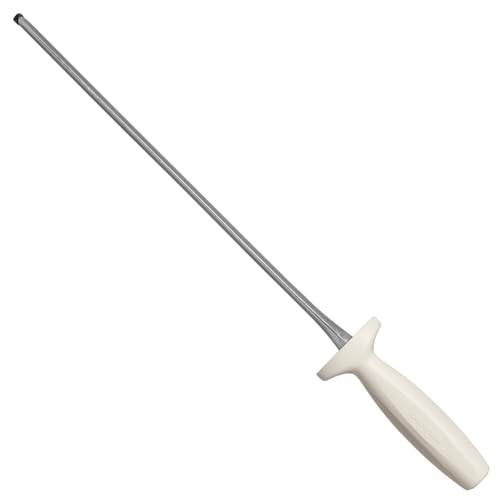
When a standard steel won’t cut it because your blade has been abused against bone or dulled from heavy trimming, the Dexter-Russell DDS-12PCP provides a diamond-coated surface that actually removes steel to reform the edge. The medium-grit oval rod works wet or dry, giving you flexibility depending on your sharpening environment. At 12 inches, it covers most butcher knife lengths comfortably.
The Sani-Safe handle is ergonomic and made from a slip-resistant white polymer that holds up to commercial sanitation cycles. Users who have used Smith sharpeners note that this diamond rod outlasts them by years, maintaining its abrasiveness even after weekly use in a professional kitchen. The oval shape provides a broad contact patch, which helps prevent the uneven edge wear that can happen with narrow round rods.
Some users note that diamond rods cut faster than plain steel, so it’s easy to oversharpen if you’re not deliberate with your stroke count. Pair it with a regular honing steel for daily touch-ups and reserve the diamond rod for when the edge truly needs to be reset. For butchers dealing with high-carbon knives that frequently hit bone, this rod is the fastest path back to a razor edge.
Why it’s great
- Diamond coating quickly restores heavily dulled or damaged edges
- Works wet or dry, offering flexibility in different prep environments
- Oval shape provides even contact for consistent edge formation
Good to know
- Aggressive cut requires careful stroke control to avoid over-sharpening
- Best used as a restoration tool, not for daily honing maintenance
4. Victorinox Round Finecut Butcher Sharpening Steel

The Victorinox Finecut Steel uses long grooves instead of a diamond pattern, creating a surface that re-aligns the edge without the harsh scraping sensation some users dislike. At 12 inches, it covers the working edge of most boning and breaking knives without requiring multiple passes per section. The round profile is straightforward for those already comfortable with a traditional honing technique.
Users transitioning from cheaper steels often report that this rod produces a noticeably more uniform edge with fewer strokes. The fine cut is particularly well-suited to softer stainless steels—like those found on Victorinox Fibrox knives—where a more aggressive diamond surface would remove too much metal. The plastic handle is lightweight and provides adequate grip when your hands are dry or slightly damp.
Some users wish the rod were 14 inches for better coverage on longer blades, and the round shape offers less stability than an oval rod for beginners. Still, for the price, it’s one of the most reliable entry-level steels for maintaining a consistent edge between butchering sessions. If you’re looking for a dependable tool that won’t overcorrect, this is a solid starting point.
Why it’s great
- Fine-cut grooves provide smooth, controlled edge alignment
- Excellent match for Victorinox and other soft stainless blades
- Lightweight and easy to handle during frequent use
Good to know
- 12-inch length is shorter than ideal for very long butcher blades
- Round profile offers less edge stabilisation than oval designs
5. WÜSTHOF 9″ Honing Steel

WÜSTHOF’s 9-inch honing steel is a compact, precision-forged rod tempered to 58 HRC, designed for home cooks who want to maintain their German steel knives between sharpening sessions. The grooved surface attracts loose metal fibers during the stroke, reducing the mess on your counter. At only 0.4 pounds, it’s light enough to handle comfortably during quick touch-ups.
The magnetic rod does an effective job of capturing particles, and the slip-resistant textured handle with a protective bolster gives you confidence during the stroke. Users new to quality knives have noted that this steel is intuitive to use and produces consistent results without requiring advanced technique. The 9-inch length works well for chef’s knives up to about 8 inches, but feels undersized for longer butcher blades like a 10-inch breaking knife.
The plastic handle has drawn some criticism for being soft and easily scratched if stored against other tools. Made in Germany and backed by a lifetime warranty, this steel is a reliable choice for the home cook who processes smaller cuts and wants a durable, branded steel. For serious butchery, consider stepping up to a longer rod for better coverage.
Why it’s great
- Magnetic rod captures loose metal fibers during sharpening
- 58 HRC hardened steel provides a durable honing surface
- Lifetime warranty ensures long-term value for home kitchens
Good to know
- 9-inch length is too short for efficient honing of long butcher knives
- Plastic handle can be scratched or damaged by rough storage
6. Warthog V-Sharp A4 Knife Sharpener

The Warthog V-Sharp A4 is a precision guided system that lets you select between four sharpening angles (15°, 20°, 25°, and 30°), making it suitable for everything from delicate fillet knives to thick machetes. The spring-loaded V-Sharp mechanism hones both sides of the blade simultaneously, eliminating the need to maintain a steady freehand angle. It comes with a 325-grit natural diamond hone and a hardened steel hone for finishing.
Users consistently report that this sharpener produces an insanely sharp, long-lasting edge with minimal effort. The metal frame and rubber base keep it stable during use, even when applying pressure on wider blades. For hunters and fishermen who sharpen multiple knives in one session, the A4’s repeatability is a major time saver. The 325-grit diamond hone quickly restores abused edges, while the steel hone refines the burr.
Some users note that the included stones are relatively coarse, so adding finer 600/1000-grit hones improves the edge finish on chef’s knives. The price reflects the build quality and the engineering of the V-Sharp mechanism. For anyone who wants professional-grade results without relying on freehand skill, this is the most consistent solution for maintaining butcher knives.
Why it’s great
- Four adjustable angles match different blade types and uses
- Simultaneous dual-side sharpening ensures consistent edge geometry
- 325-grit diamond hone quickly restores heavily dulled blades
Good to know
- Additional finer-grit hones are recommended for a polished edge finish
- Price includes the base system; extra stones add to the total cost
7. VN3 Professional Knife Sharpener (Grihot Sailboat)
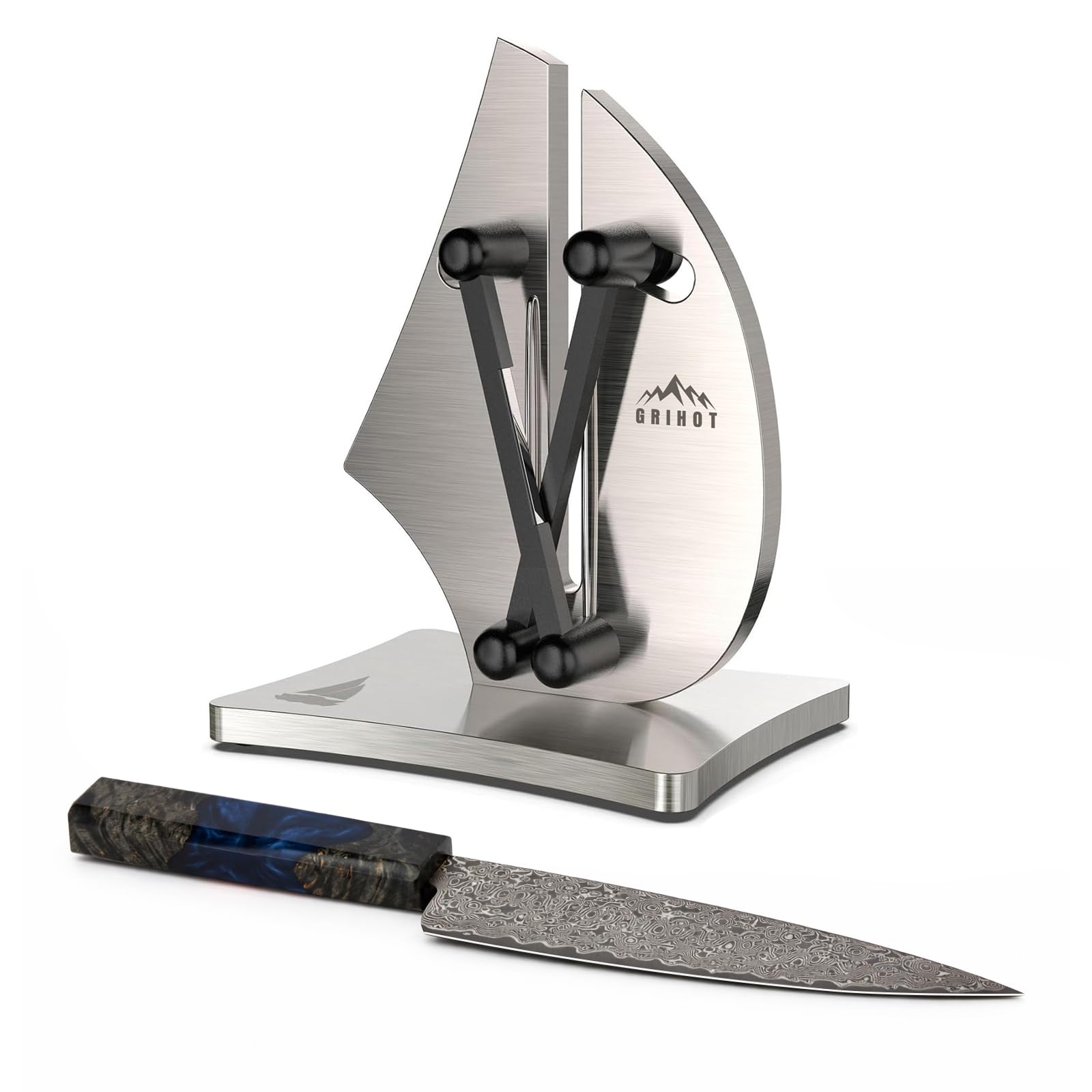
The VN3 Grihot Sailboat sharpener is a 3-action pull-through system housed in a polished stainless steel body. Its two independent spring arms use tungsten carbide inserts that automatically adjust to the existing edge angle, making it extremely easy for anyone to sharpen a dull knife in seconds without learning a technique. The base includes specific slots for repair, restoration, and fine sharpening, covering serrated blades as well.
Weighing just under 2 pounds, the solid 304 stainless steel construction gives it a premium feel that stays put on the counter during use. Users who have been using this sharpener for two years consistently report that it delivers razor-sharp results on German and Japanese steel alike. The 3-action system works quickly—about 12 strokes per knife can transform a dull blade into a functional edge suitable for breaking down meat.
Some users note that the tungsten carbide inserts remove metal faster than ceramic or diamond rods, so you should avoid overusing it on high-value knives to preserve their edge life. The 5-year warranty provides peace of mind on the build quality. For home butchers who want a no-fuss sharpener that works on multiple knife types without requiring skill, this is the fastest route from dull to sharp.
Why it’s great
- Spring-loaded tungsten carbide arms auto-adjust to existing edge angle
- 3-action system handles repair, restoration, and serrated blades
- Solid stainless steel construction provides stability during use
Good to know
- Carbide inserts remove metal quickly—use sparingly on premium knives
- Pull-through motion requires practice to avoid uneven edge wear
FAQ
Can I use a steel rod to sharpen a knife that has become completely dull?
What angle should I use when sharpening a butcher knife?
How often should I hone my butcher knife during a working day?
Final Thoughts: The Verdict
For most users, the butcher knife sharpener winner is the Dexter-Russell 14” Butcher Steel (1227-14) because it delivers professional-grade length and medium-coarse bite at a mid-range price, making it the most versatile daily honing tool for both high-carbon and stainless butcher knives. If you want a guided system that removes the guesswork from edge angles, grab the Warthog V-Sharp A4. And for restoring heavily dulled blades without a stone, nothing beats the metal-removing speed of the Dexter-Russell DDS-12PCP Diamond Sharpener.

Mo Maruf
I created WellFizz to bridge the gap between vague wellness advice and actionable solutions. My mission is simple: to decode the research and give you practical tools you can actually use.
Beyond the data, I am a passionate traveler. I believe that stepping away from the screen to explore new environments is essential for mental clarity and physical vitality.