Our readers keep the lights on and my smoothie glass nicely filled. As an Amazon Associate, I earn from qualifying purchases.
The difference between a good day in the woods and a survival scenario often comes down to the edge in your hand. A bushcraft tool isn’t just a blade—it’s an extension of your intent, converting standing timber into shelter, fuel, and safety. Choosing the wrong steel or handle geometry means fighting your gear instead of the elements.
I’m Mohammad Maruf — the founder and writer behind WellFizz. I’ve spent years analyzing the metallurgy, handle ergonomics, and real-world field performance of outdoor tools to separate marketing hype from genuinely capable gear.
Whether you need a hatchet, knife, or saw, the right kit makes backwoods living a craft rather than a chore. This guide walks through the five top contenders for the title of best bushcraft tools, focusing on the specs that matter most in the field.
How To Choose The Best Bushcraft Tools
Bushcraft tools aren’t general-purpose camp gear—they are purpose-built for processing wood, carving, and surviving extended periods off-trail. Getting the right one requires understanding three critical variables: steel composition, handle integration, and tool type.
Full-Tang Construction and Blade Steel
The blade should run the entire length of the handle—this is full-tang. Any partial tang or rat-tail construction introduces a failure point under lateral stress when batoning or prying. Look for 440C or 8Cr13MoV stainless for corrosion resistance with decent edge retention, or carbon steel if you prioritize easy sharpening and don’t mind a patina. The blade thickness matters too: a hatchet edge around 5.0mm handles splitting, while a knife with a 3.5mm blade is better for fine carving.
Handle Ergonomics and Grip Material
When your hands are wet, cold, or tired, a slippery handle becomes a hazard. G10 (woven fiberglass) offers excellent grip and is impervious to moisture, temperature shifts, and chemicals. Wood handles like beechwood are classic and warm to the touch but require maintenance and can be slick when wet. Rubber overmold handles provide secure grip in all conditions but add weight. Also consider the handle contour—a pronounced palm swell reduces fatigue during prolonged carving sessions.
Choosing the Right Tool Type: Axe, Knife, or Saw
A hatchet with a 4-inch blade is ideal for splitting kindling, limbing small trees, and rough shaping. A fixed-blade bushcraft knife in the 3.5–4.5 inch range handles carving, food prep, and light batoning. A folding saw excels at cutting larger diameter wood cleanly and efficiently with less effort than an axe. Many bushcrafters carry all three, but for a minimal kit, prioritize the knife as your primary survival tool, then add a saw, then a hatchet.
Quick Comparison
On smaller screens, swipe sideways to see the full table.
| Model | Category | Best For | Key Spec | Amazon |
|---|---|---|---|---|
| Spyderco Bow River | Fixed Blade Knife | All-around bushcraft | 4.36″ 8Cr13MoV steel | Amazon |
| Gerber Freescape Camp Saw | Folding Saw | Cutting large diameter wood | 12″ Aluminum Oxide blade | Amazon |
| NedFoss Warthog Hatchet | Hatchet | Splitting kindling and limbing | 5.0mm blade thickness | Amazon |
| NedFoss Hyenas Knife | Fixed Blade Knife | Camp chores and food prep | 3.5″ 440C steel | Amazon |
| Opinel Folding Saw | Folding Saw | Light pruning and small branches | 3.15″ cut capacity | Amazon |
In‑Depth Reviews
1. Spyderco Bow River Fixed Blade

The Spyderco Bow River hits a sweet spot few knives in this class reach. Its 4.36-inch full-flat-ground blade from 8Cr13MoV stainless steel delivers outstanding edge retention and sharpness straight from the factory. The full-tang design and contoured G10 handle provide a secure grip for extended carving sessions without hot spots.
Designed in collaboration with master knifemaker Phil Wilson, this blade geometry leans toward versatility—it’s equally at home field dressing a whitetail, slicing through food prep, or batoning through smaller logs. The leather sheath included is premium quality, though some users note it could be more accommodating for faster draws.
While the smooth G10 handle can feel slightly slippery when wet, the ergonomic contour compensates well. A few early units had minor edge sharpness inconsistencies, but this is an exception rather than the rule. For the build quality, steel choice, and brand pedigree, this knife earns its reputation as a top-tier bushcraft companion.
Why it’s great
- Full-flat grind offers excellent slicing and carving performance
- Premium 8Cr13MoV steel holds a sharp edge well
- Contoured G10 handle provides comfortable grip for long use
Good to know
- Smooth G10 can be slippery when hands are wet
- Leather sheath can be tight for quick access
- A few units may arrive with a slightly dull edge out of box
2. Gerber Freescape Camp Saw
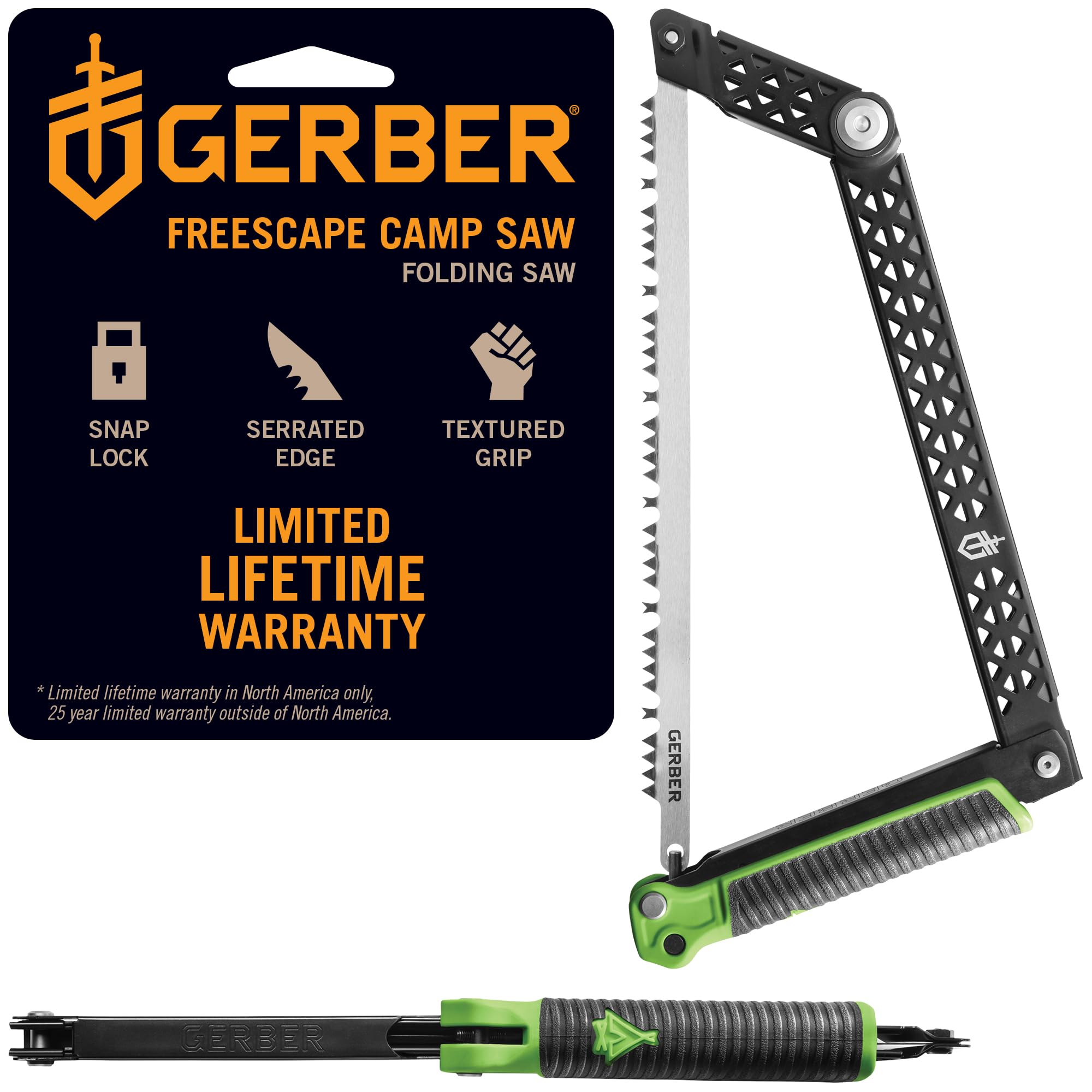
The Gerber Freescape redefines what a portable camp saw can do. Its innovative folding design uses four pivot points to maximize the 12-inch blade’s length, allowing it to cut through wood up to 8 inches in diameter in about seven minutes. The blade is aluminum oxide coated for durability and cuts efficiently on the pull stroke.
When folded, the saw packs completely flat at just 1.2 inches wide and 17 inches long, making it easy to stash in a backpack or gear bag without protruding. The textured rubber handle provides a secure, comfortable grip even when your hands are sweaty or cold—a critical feature for prolonged sawing tasks. Bright green accents help you spot it quickly among your gear.
Some users note that the included blade has a lower tooth count than ideal, requiring more effort per stroke. Replacing the blade with a finer-tooth option improves cutting speed dramatically. The folding mechanism is robust but adds some weight compared to simpler saw designs. For serious campers and backpackers needing a reliable saw for larger wood, the Freescape is a solid choice.
Why it’s great
- Folds completely flat for easy packing and transport
- 4 pivot points maximize blade length and cutting capacity
- Textured rubber handle ensures firm grip in all conditions
Good to know
- Included blade has low tooth count, requiring more effort
- Folding mechanism adds some weight
- Not ideal for very fine or precision cuts
3. NedFoss Warthog Camping Axe

The NedFoss Warthog is a compact hatchet designed for lightweight bushcraft kits. Its 4.2-inch curved stainless steel blade is heat-treated for sharpness and paired with a 5.0mm thickness that offers a good balance between chopping power and control. The full-tang construction ensures the tool won’t fail under stress when splitting kindling or limbing small trees.
The ergonomic wood handle features an etched warthog pattern that adds both grip and aesthetic appeal. At just 15.2 ounces, it’s light enough to carry on a belt without weighing you down. The included leather sheath is well-crafted, though some users note it can be difficult to draw the blade due to its snug fit. The hatchet is versatile enough for camp chores, from chopping firewood to clearing trail debris.
While the wood handle provides a classic feel, it can become slippery when wet—a common trade-off. The small size means it’s not intended for heavy splitting tasks; it’s optimized for detail work and portability. The sheath’s quality is adequate but not premium. For the build, sharpness, and price point, this hatchet represents strong value for pack-in bushcrafters who need a reliable entry-level axe.
Why it’s great
- Full-tang construction with 5.0mm blade thickness for durability
- Lightweight at 15.2 ounces for easy carrying
- Sharp heat-treated stainless steel blade for efficient cutting
Good to know
- Wood handle can be slippery when wet
- Sheath is snug, making blade removal difficult
- Not suited for heavy splitting—designed for smaller tasks
4. NedFoss Hyenas Bushcraft Knife

The NedFoss Hyenas is a sleek fixed-blade knife built for versatility. Its 3.5-inch 440C stainless steel blade is full-flat ground for superior slicing ability, and the satin finish resists corrosion. The drop point shape makes it suitable for a wide range of bushcraft tasks: cutting small branches, preparing food, carving notches, and even light chopping.
The ripple-textured G10 handle offers excellent grip and durability, resisting moisture and temperature changes. The knife comes with a lightweight Kydex sheath that can be adjusted for horizontal or vertical carry, making it easy to integrate into any pack or belt setup. It also includes a fire starter, adding utility for emergency situations.
Some users note that the blade steel stamp reads 8CR14MoV instead of the advertised 440C, though performance remains satisfactory. The sheath is functional but not as refined as premium options. The knife is very light, which is a plus for backpacking but may feel less substantial for heavy-duty tasks. For the price, it offers a sharp out-of-box edge and a durable build that suits day-to-day camp chores.
Why it’s great
- Full-flat grind 440C blade for excellent slicing ability
- Textured G10 handle for secure grip in all weather
- Includes fire starter for emergency backup
Good to know
- Steel stamp may not match advertised 440C
- Kydex sheath is adequate but not premium
- Very lightweight may lack heft for heavy chopping
5. Opinel Folding Saw

Its 8cm (3.15 inch) carbon steel blade features an anti-corrosion coating and cuts on the pull stroke, making it efficient for pruning small branches and cutting wood up to 8cm in diameter. The Virobloc safety ring locks the blade securely in both open and closed positions, preventing accidental closure during use.
The beechwood handle is comfortable and warm in the hand, with a natural aesthetic that bushcrafters appreciate. At just 102 grams, this saw disappears into a pack or large pocket. It cuts quickly and cleanly, ideal for gathering tinder, cutting notches, or processing small campfire wood. The carbon steel blade is easy to sharpen with a stone or file, maintaining its edge with minimal maintenance.
Carbon steel is more prone to rust than stainless—keep the blade dry and oiled. The handle may require some reshaping for optimal comfort, as some users note it can be tight to open. The lanyard hole can be crooked in some units. For the price and heritage, this saw delivers solid performance for light bushcraft tasks but isn’t designed for heavy or prolonged cutting.
Why it’s great
- Ultra-lightweight at 102 grams for easy carry
- Virobloc safety ring locks blade open and closed
- Carbon steel blade is easy to sharpen and holds an edge
Good to know
- Carbon steel requires rust protection and maintenance
- Handle may need reshaping for comfortable grip
- Not suitable for cutting wood over 3 inches in diameter
FAQ
What is the best blade shape for bushcraft?
Can a hatchet replace a bushcraft knife?
How often should I sharpen my bushcraft blade?
Final Thoughts: The Verdict
For most users, the best bushcraft tools winner is the Spyderco Bow River because it combines premium 8Cr13MoV steel with a full-flat grind and full-tang G10 construction at a price that undercuts many competitors. If you prioritize cutting larger wood quickly, grab the Gerber Freescape Camp Saw for its efficient folding design. And for a budget-friendly hatchet that performs well for smaller camp chores, nothing beats the NedFoss Warthog.

Mo Maruf
I created WellFizz to bridge the gap between vague wellness advice and actionable solutions. My mission is simple: to decode the research and give you practical tools you can actually use.
Beyond the data, I am a passionate traveler. I believe that stepping away from the screen to explore new environments is essential for mental clarity and physical vitality.