Our readers keep the lights on and my smoothie glass nicely filled. As an Amazon Associate, I earn from qualifying purchases.
Forcing a bag of all-purpose lawn food on your flowering shrubs is a fast track to lush leaves and zero blooms. Bush fertilizers demand a specific NPK ratio that prioritizes root strength and flower development over pure vegetative growth. The wrong numbers leave you with a green bush that refuses to show off.
I’m Mohammad Maruf — the founder and writer behind WellFizz. I’ve spent hours analyzing NPK breakdowns, slow-release mechanisms, and organic certifications to separate the formulas that actually feed the root zone from those that just wash away.
This guide drills into the five fertilizers that earned their place based on measurable nutrient delivery, mycorrhizal content, and real-world application ease. Read on to find the best bush fertilizer for your specific soil and shrub type.
How To Choose The Best Bush Fertilizer
Bushes have different nutritional demands than your vegetable patch or lawn. The goal is to encourage a strong root system, sturdy branching, and — for flowering varieties — abundant blooms. Selecting the right formula starts with understanding three key factors unique to woody ornamentals.
NPK Ratio: Nitrogen vs. Blooms
The three numbers on the bag represent nitrogen (N), phosphorus (P), and potassium (K). For bushes, you want a balanced or slightly phosphorus-heavy ratio (like 19-8-10 or 4-4-4). High nitrogen (first number) triggers excessive leaf growth at the expense of flowers and can make bushes vulnerable to pests.
Release Mechanism: Granules vs. Spikes
Granules spread across the soil surface and break down with watering, offering even coverage for larger shrub beds. Spikes are driven directly into the root zone, delivering nutrients slowly over months without runoff. Spikes work well for individual specimen bushes where you want precise placement.
Organic vs. Synthetic Formulation
Organic fertilizers feed the soil microbes that, in turn, make nutrients available to plant roots. They release slower but improve soil structure over time. Synthetic options provide an immediate nutrient spike but can burn roots if over-applied. For long-term shrub health, an OMRI-listed organic bag is usually the safer bet.
Quick Comparison
On smaller screens, swipe sideways to see the full table.
| Model | Category | Best For | Key Spec | Amazon |
|---|---|---|---|---|
| Jobe’s Tree Fertilizer Spikes | Spike | Deep root feeding | 16-4-4 NPK, 15 spikes | Amazon |
| Jobe’s Organics Granular All Purpose | Granular | Large shrub beds | 4-4-4 NPK, 16 lbs | Amazon |
| FoxFarm Happy Frog All Purpose | Granular | Organic soil building | 6-4-5 NPK, 4 lbs | Amazon |
| Espoma Organic Bio-Tone Starter Plus | Granular | New transplants | 4-3-3 NPK, 4 lb pack of 2 | Amazon |
| Fertilome Tree and Shrub Food | Granular | Targeted tree & shrub feeding | 19-8-10 NPK, 4 lbs | Amazon |
In‑Depth Reviews
1. Jobe’s Tree Fertilizer Spikes, 16-4-4

Jobe’s spikes deliver a 16-4-4 NPK ratio directly to the active root zone without any mixing, measuring, or runoff. Each spike is pre-measured, so over-fertilization is virtually impossible — a real advantage for gardeners who worry about burning tender shrub roots. The 30-count package covers a substantial number of bushes, and the slow-release design feeds consistently across the entire growing season.
Customer feedback highlights how well these spikes work on drought-stressed bushes and woody ornamentals like hydrangeas, lilacs, and rose of Sharon. Users report noticeable recovery within weeks after spring application, with blooms arriving on schedule. The spikes require pounding into damp soil, but that minor physical effort is a fair trade for zero mess.
For the gardener who wants a set-it-and-forget-it solution, Jobe’s spikes eliminate the guesswork that granular formulas demand. The 16-4-4 ratio provides enough nitrogen for healthy leaf canopy without suppressing flower development — a balance that makes this the most versatile bush fertilizer in the lineup.
Why it’s great
- Pre-measured spikes eliminate risk of over-fertilization
- Feeds for an entire season with one application
- No runoff, odor, or dust during application
Good to know
- Requires effort to drive spikes into hard or dry soil
- Not ideal for small potted bushes or container plants
2. Jobe’s Organics Granular All Purpose Fertilizer, 4-4-4

The 16-pound bag of Jobe’s Organics delivers a balanced 4-4-4 NPK ratio that supports both leaf growth and flower production in bushes without pushing excessive foliage. This granular formula is OMRI-listed for organic gardening, meaning it contains no synthetic chemicals. For gardeners managing a large shrub bed or mixed border, the bag size alone makes it a cost-effective choice compared to smaller boutique options.
Users consistently note that this fertilizer improves bloom color and overall vigor in outdoor shrubs when applied every two to three weeks during the growing season. The granules are friable and dark green, spreading easily with a hand-crank spreader or by hand. The smell is pungent — typical of organic fertilizers — but milder than raw manure, and the absence of dust clouds makes application much cleaner than powder-based formulas.
One practical advantage is the resealable bag design, which keeps the granules dry between uses. For the home gardener who wants an organic, reliable, and high-volume feed for a diverse shrub collection, this is the sensible pickup that won’t break the budget.
Why it’s great
- Large 16-pound bag covers extensive shrub beds
- OMRI-listed for certified organic gardening
- No synthetic chemicals and minimal dust during spreading
Good to know
- Requires reapplication every 2-3 weeks during active growth
- Strong organic odor that some find unpleasant
3. FoxFarm Happy Frog All Purpose Fertilizer, 6-4-5

FoxFarm Happy Frog stands apart because it packs beneficial soil microbes and mycorrhizal fungi into every granule. The 6-4-5 NPK ratio is slightly higher in nitrogen than a typical bush feed, but the microbial activity helps regulate nutrient availability so the bush takes what it needs without forcing excessive green growth. It’s OMRI-listed and designed for a wide range of plants, including woody ornamentals and fruiting shrubs.
Gardeners report that this fertilizer revived yellowing tomato and zucchini plants within a week, and the same principle applies to nutrient-starved bushes. The granules are easy to scatter around the drip line, and the slow-release action provides a gentle feeding rather than a chemical spike. The odor, however, is distinctly pungent — some users describe it as manure-like — so indoor mixing or storage is not recommended.
For the organic gardener who prioritizes long-term soil health over immediate green-up, FoxFarm Happy Frog is an excellent choice. The mycorrhizal fungi enhance water absorption and nutrient uptake, which is especially valuable for bushes planted in marginal or compacted soil.
Why it’s great
- Contains active soil microbes and mycorrhizal fungi
- OMRI-listed for organic gardening
- Gentle slow-release action reduces burn risk
Good to know
- Strong organic smell during and after application
- Smaller bag size requires more frequent purchase for large areas
4. Espoma Organic Bio-Tone Starter Plus, 4-3-3
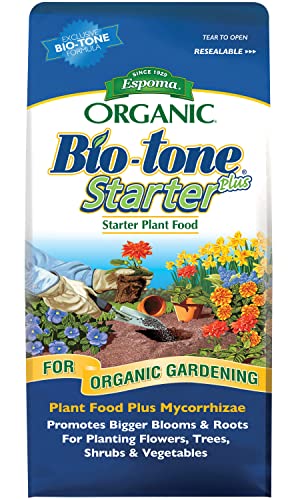
Espoma Bio-Tone Starter Plus is formulated specifically for the moment a bush goes into the ground. The 4-3-3 NPK ratio is deliberately low to avoid burning tender new roots, and the addition of both endo and ecto mycorrhizae accelerates root establishment. The 5% calcium content supports cell wall development, which helps young bushes withstand transplant shock and environmental stress.
Gardeners who follow Laura from Garden Answer swear by this product, and the reviews confirm it: new plants establish noticeably faster, with stronger root systems and earlier growth flushes. The pack comes as two 4-pound bags, giving you enough volume for a moderate planting project. The scent is strong — typical of quality organic fertilizers — but the results justify the brief olfactory offense.
For the intentional gardener who is installing new shrub borders or replacing tired bushes, Bio-Tone Starter Plus is the right first meal. It’s approved for organic production and carries the Espoma legacy of natural gardening since 1929, making it a trusted choice for transplant success.
Why it’s great
- Contains both endo and ecto mycorrhizae for root development
- 5% calcium strengthens cell walls against transplant shock
- Approved for organic gardening
Good to know
- Strong odor similar to organic compost
- Best used only at planting or transplanting time
5. Fertilome Tree and Shrub Food, 19-8-10

Fertilome’s 19-8-10 formulation is a high-nitrogen tree and shrub food designed with a penetrating action that moves nutrients directly to feeder roots without requiring holes to be dug. The high first number makes it better suited for established bushes that need a foliar boost rather than flowering stimulation, but for evergreen shrubs or hedges where green density is the goal, this ratio delivers fast visible results.
Long-term users report feeding their bushes twice a year — early spring and early fall — for three consecutive years, with bushes that were on the verge of dying making a full recovery. The granules are small enough to scatter easily by hand or with a handheld spreader, and the bag size fits well in smaller garden sheds. Some reviewers note the packaging feels lighter than previous iterations, but the effectiveness remains consistent.
For the budget-conscious gardener who primarily cares about keeping established shrubs alive and green, Fertilome offers reliable performance at a low entry cost. It’s not the best choice for flowering bushes, but for general maintenance of woody landscape plants, it gets the job done without frills.
Why it’s great
- Penetrating action feeds roots without digging holes
- High nitrogen content for rapid green-up of evergreens
- Budget-friendly price point
Good to know
- High nitrogen may suppress flowering on blooming shrubs
- Smaller bag size means more frequent purchases for large landscapes
FAQ
Can I use the same bush fertilizer on all types of flowering shrubs?
How often should I apply granular bush fertilizer during the growing season?
Are fertilizer spikes better than granules for established bushes?
Final Thoughts: The Verdict
For most users, the best bush fertilizer winner is the Jobe’s Tree Fertilizer Spikes because the spike delivery eliminates guesswork, feeds for a full season, and provides a balanced 16-4-4 ratio that supports both foliage and flowers. If you want an organic granular option for large shrub beds, grab the Jobe’s Organics Granular All Purpose for its 16-pound value and OMRI certification. And for transplanting new bushes, nothing beats the Espoma Organic Bio-Tone Starter Plus with its dual mycorrhizae and calcium content for shock resistance.

Mo Maruf
I created WellFizz to bridge the gap between vague wellness advice and actionable solutions. My mission is simple: to decode the research and give you practical tools you can actually use.
Beyond the data, I am a passionate traveler. I believe that stepping away from the screen to explore new environments is essential for mental clarity and physical vitality.