Our readers keep the lights on and my smoothie glass nicely filled. As an Amazon Associate, I earn from qualifying purchases.
Indoor plants don’t fail because you lack a green thumb—they fail because the light they receive is too weak or the wrong spectrum. A standard household bulb lacks the specific red and blue wavelengths plants crave for photosynthesis, leading to leggy stems, pale leaves, and stunted growth.
I’m Mohammad Maruf — the founder and writer behind WellFizz. My research process for this guide involved cross-referencing photon flux density (PPFD) readings, thermal output, and bulb longevity data across dozens of models to separate genuine grow lights from glorified desk lamps.
After filtering for true full-spectrum output, energy efficiency, and real buyer feedback, these picks represent the most reliable options currently available. This guide will walk you through everything you need to confidently select the best bulb for indoor growing that matches your setup and plant type.
How To Choose The Best Bulb For Indoor Growing
Not every “grow light” label delivers the same results. You need to look past the marketing to understand what your specific plants require—succulents need intense direct light, leafy greens thrive under broad spectrum, and flowering plants demand higher red output. Here are the specs that separate effective bulbs from dim disappointments.
Full Spectrum vs. Blurple Lights
Full spectrum bulbs emit a white light closely matching sunlight, covering the 380nm–800nm range. These are better for home aesthetics because they don’t cast the harsh pinkish-purple glow associated with older “blurple” LEDs. Blurple lights can be more efficient for flowering, but full spectrum is more versatile and comfortable for shared living spaces.
PPFD and Beam Angle
PPFD (Photosynthetic Photon Flux Density) measures how many usable photons hit a given area per second—higher numbers mean stronger light intensity for your plants. A narrow beam angle (like 60°) concentrates light into a tight spot, ideal for a single plant, while a wider angle (230°) spreads the light across a shelf or tray. Match the angle to your plant arrangement.
Heat Output and Bulb Shape
LED grow bulbs generate far less heat than HID or fluorescent alternatives, but some models still run warm enough to scorch leaves if placed too close. Bulb shapes like PAR20 feature a reflective lens that directs light downward—great for focused coverage—while A19 bulbs are standard household shapes that spread light broadly. Always check the bulb base compatibility: E26 is the standard medium base in most U.S. lamps.
Quick Comparison
On smaller screens, swipe sideways to see the full table.
| Model | Category | Best For | Key Spec | Amazon |
|---|---|---|---|---|
| SANSI Dimmable 10W PAR20 | Mid-Range | Remote-controlled automated setups | PPFD 97.91 μmol/s/㎡ @ 1FT | Amazon |
| SANSI 10W Gooseneck Clip | Mid-Range | Targeted light for single pots | Lifetime free bulb replacement | Amazon |
| LBW 3-Pack Height-Adjustable | Premium | Small plants with adjustable stands | 5 brightness levels, 16H timer | Amazon |
| Miracle LED 9W R20 | Budget | Supplemental daylight for shelves | CRI 100, runs /yr | Amazon |
| ALIDE A19 10W 6-Pack | Budget | Multi-bulb setups for trays | 230° beam angle spread | Amazon |
In‑Depth Reviews
1. SANSI Dimmable Grow Light Bulb 10W PAR20
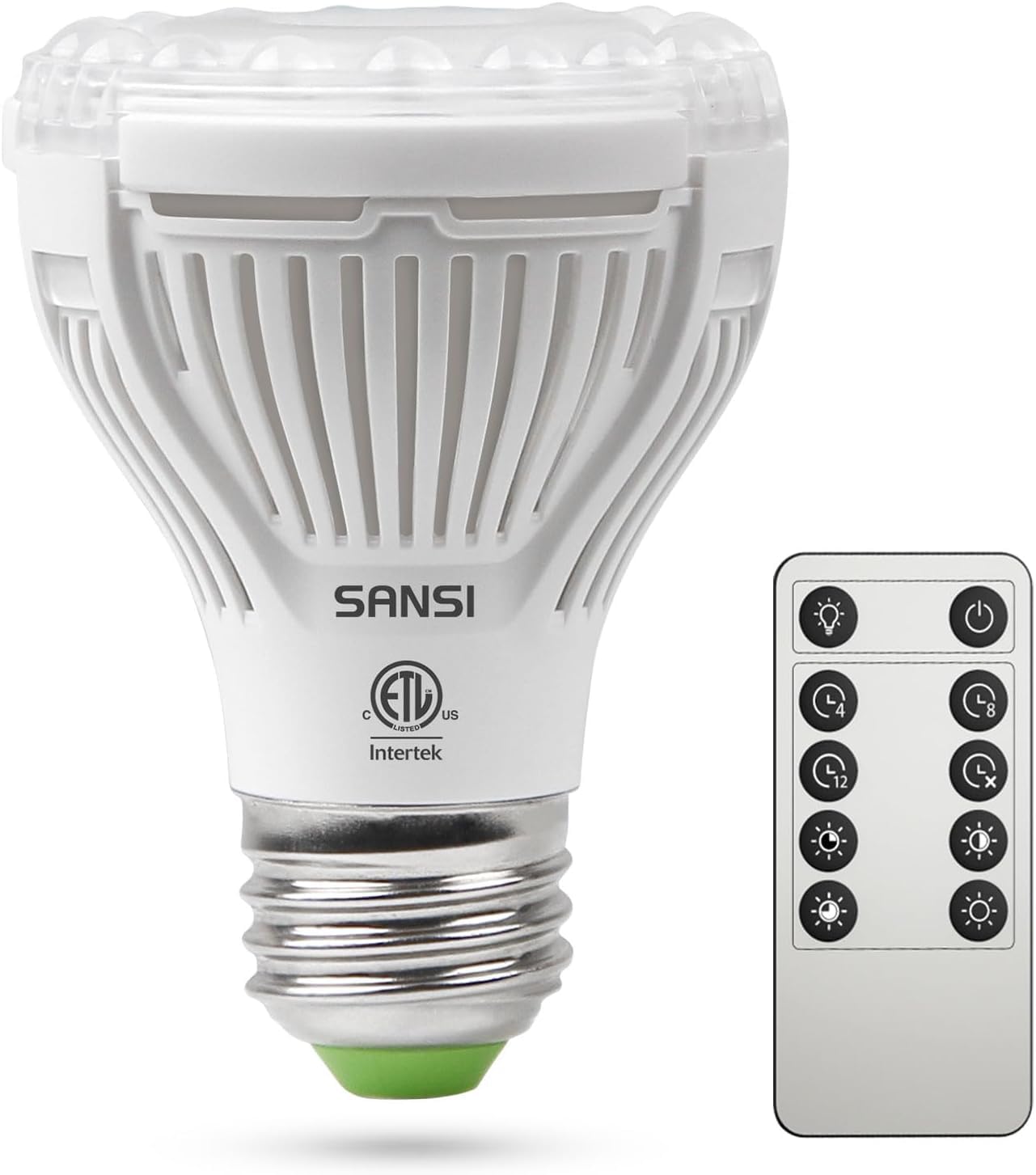
This SANSI PAR20 bulb stands out because it gives you complete control over your light cycle without ever touching the lamp. The included remote allows you to dim from 25% to 100% in four steps and set an auto on/off timer for 4, 8, or 12 hours—critical for mimicking natural day lengths. With a measured PPFD of 97.91 μmol/s/㎡ at one foot, it delivers enough intensity for medium-light plants like monstera, philodendron, and basil.
The 60-degree beam angle focuses light tightly, making this ideal for a single large pot or a small cluster of plants on a desk. Users consistently mention that the natural white light (4000K, CRI 80) looks great in a living room—no garish purple glow. The secondary optical lens design improves light utilization while extending bulb lifespan to 25,000 hours.
ETL listed with a five-year protection plan, this bulb checks every box for a fuss-free, automated indoor growing experience. The only catch is that the focused beam means you’ll need to keep it close—about one foot above the canopy—for best results.
Why it’s great
- Remote-controlled brightness and timer eliminates guesswork
- High PPFD in a compact PAR20 body
- True white light blends with home decor
- Low heat output won’t burn leaves at proper distance
Good to know
- Narrow 60° beam requires close placement
- CRI of 80 is adequate but not as high as some alternatives
2. SANSI 10W Gooseneck Clip Grow Light

If you need directional light that wraps around a shelf or desk edge, the SANSI gooseneck clip provides a flexible arm and a sturdy clamp that holds a PAR20 bulb head. The 380nm–800nm full spectrum output, combined with 1000 lumens from a 10W chip, makes this powerful enough for herbs, succulents, and even cherry tomatoes.
The auto on/off timer (4, 8, or 12 hours) operates on a 24-hour cycle, so you set it once and the light turns itself on and off daily. The bulb is replaceable—a standout feature because SANSI offers a lifetime free replacement for the bulb itself. This reduces long-term waste and cost significantly compared to sealed-unit grow lights.
Users report that the clip is strong enough to hold the fixture steady, though the gooseneck can sag slightly if extended fully. The white light is described as pleasant and not harsh on the eyes. Keep the bulb at least six inches above plants—some users noted that the bulb head can get hot enough to singe leaves if placed too close.
Why it’s great
- Flexible gooseneck targets light exactly where needed
- Lifetime free bulb replacement saves money long-term
- Auto timer simplifies daily light cycles
- ETL listed for safety
Good to know
- Clip may swing slightly with heavy bulb attached
- Timer resets after power outage
3. LBW Grow Light 3-Pack Height-Adjustable

This LBW set includes three individual halo-style lights that each feature a telescoping pole adjustable from 7.8 to 26 inches. The height adjustment is key because it lets you raise the light as your plant grows without losing intensity. Each light offers three color modes—white, warm, and full spectrum—plus five dimmable brightness levels from 20% to 100%.
The timer can be set to 6, 8, 12, or 16 hours, giving you more granularity than most competitors. The base is designed to be pressed down by a flower pot, which keeps the unit stable but means the light won’t stay upright without a plant on it. An included soil stake alternative works for pots too small for the base.
For small succulents, herbs, and orchids, this is an attractive solution that doubles as decor. The 78-inch cord offers plenty of placement flexibility. Some users found the color settings a bit cool for their taste, but the full spectrum mode produces good growth results. The three-pack format makes this a strong value for multiple plants in one area.
Why it’s great
- Telescoping pole adjusts height as plants grow
- Three color modes suit different growth stages
- Flexible timer options (6/8/12/16 hours)
- Stylish design blends into home decor
Good to know
- Base requires a pot on top for stability
- Light output is modest for larger plants
4. Miracle LED 9W R20 Full Spectrum

The Miracle LED Almost Free Energy bulb is the entry-level workhorse that proves you don’t need to spend much to get results. With a Color Rendering Index of 100, it produces daylight-white light that looks identical to natural sunlight—excellent for both plant health and visual comfort. The 9W chip replaces a 100W incandescent floodlight, consuming about of electricity per year.
Users consistently report that succulents, cacti, spider plants, and ivy thrive under this bulb when used as a supplemental light source. The R20 shape fits standard medium-base (E26) recessed cans and pendant fixtures. The 1900 micromoles of growing power is sufficient for maintaining plants in a north-facing room or dark corner.
The biggest trade-off is heat output—multiple reviews note that the bulb gets hot if left on for extended periods. It’s best used with a fixture that provides adequate ventilation. It also lacks any dimming or timer features, so you’ll need to plug it into a separate timer outlet for automated schedules.
Why it’s great
- CRI 100 delivers true daylight color
- Extremely low annual electricity cost
- Proven growth results for many common houseplants
- Very affordable entry price
Good to know
- Runs hotter than other LED options
- No timer, dimming, or remote control
- Best used as supplemental light, not sole source
5. ALIDE A19 10W 6-Pack Full Spectrum
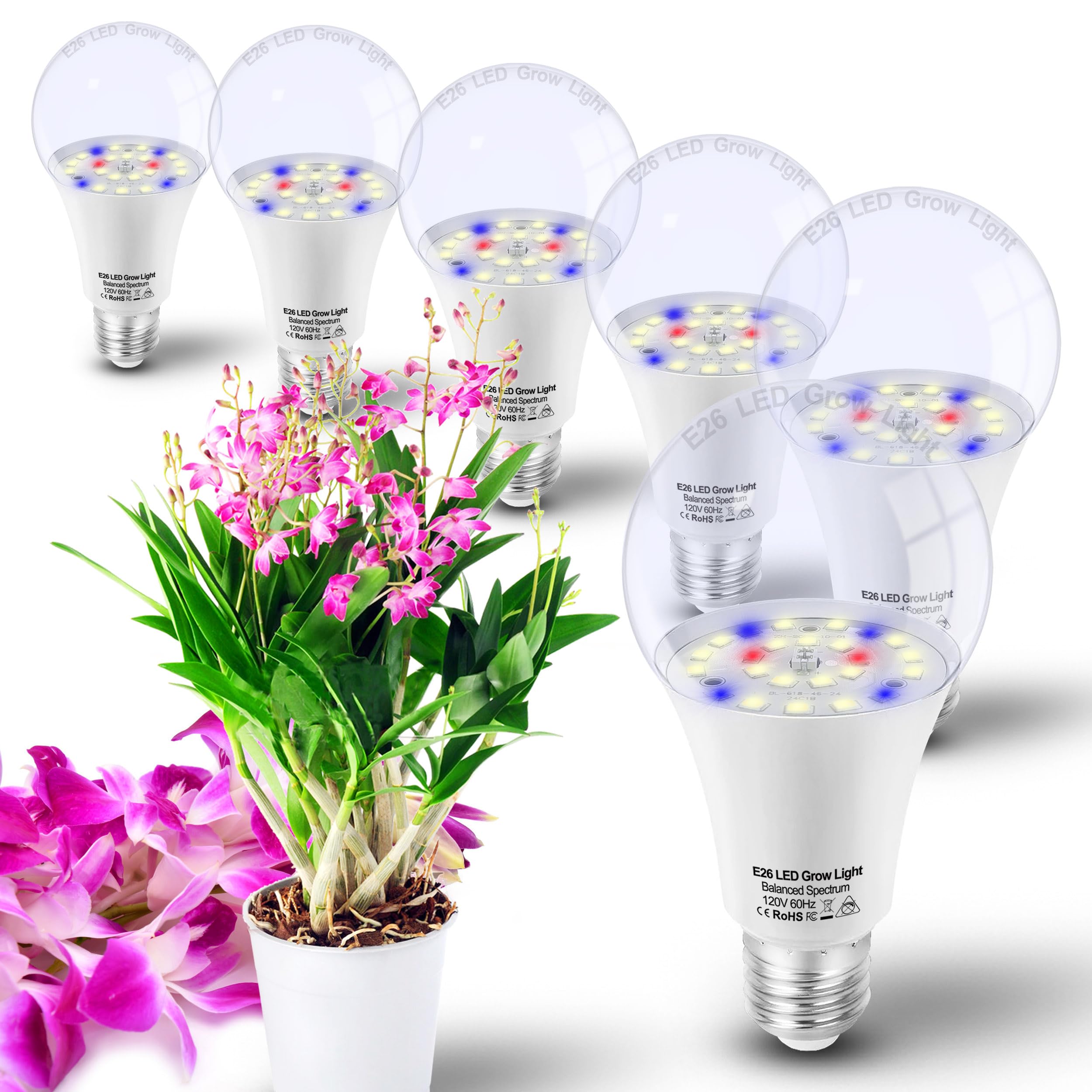
This ALIDE six-pack of A19 bulbs is designed for the grower who needs to cover a larger area—think seed-starting shelves, greenhouse tables, or hydroponic trays. Each bulb uses three distinct LED chip colors—red for flowering, blue for seedling growth, and 5000K white for balanced photosynthesis—rather than a simple phosphor coating. The result is a PPF of 23 μmol/s per bulb, which is competitive for the price.
The 230-degree beam angle is very wide, spreading light across a broad area. This makes the ALIDE bulbs excellent for uniform coverage over a flat shelf, but less effective as a spotlight for a single plant. At 10W each, they produce 1000 lumens and generate very little heat—users report no noticeable warmth even after hours of operation.
The standard E26 base screws into any household lamp or fixture, and the bulbs are lightweight. The main drawback is the lack of any dimming or timer built in, so you’ll need an external outlet timer for automation. However, for the price of a single premium bulb, you get six bulbs that can illuminate an entire grow shelf setup.
Why it’s great
- Six bulbs for covering large shelf or tray setups
- Wide 230° beam angle provides even light distribution
- Mixed red/blue/white chips target all growth stages
- Very low heat output
Good to know
- No integrated timer or dimming
- Best for broad-area lighting, not focused spot
- Some users reported occasional DOA units (warranty handled)
FAQ
Can I use a regular LED bulb as a grow light instead of a dedicated bulb?
How far should I place the grow bulb from my plants?
What does the R20, PAR20, and A19 label mean for my fixture?
Final Thoughts: The Verdict
For most users, the bulb for indoor growing winner is the SANSI Dimmable 10W PAR20 because it combines remote-controlled timer and dimming with a high PPFD output in a compact, eye-friendly white light. If you need a flexible gooseneck setup with lifetime bulb protection, grab the SANSI Gooseneck Clip. And for covering multiple shelves on a budget, nothing beats the ALIDE A19 6-Pack.

Mo Maruf
I created WellFizz to bridge the gap between vague wellness advice and actionable solutions. My mission is simple: to decode the research and give you practical tools you can actually use.
Beyond the data, I am a passionate traveler. I believe that stepping away from the screen to explore new environments is essential for mental clarity and physical vitality.