Our readers keep the lights on and my smoothie glass nicely filled. As an Amazon Associate, I earn from qualifying purchases.
A one-year-old’s world is all about grip, gum, and gravity — they want to grab it, taste it, and then watch it fall. Standard hard plastic blocks can hurt when thrown and are often too heavy for unsteady hands, while wooden sets risk splinters if chewed. The right set needs to be soft enough to protect tiny teeth, textured enough to engage curious fingers, and sized just right for a palm that is still learning to grasp.
I’m Mohammad Maruf — the founder and writer behind WellFizz. I’ve spent years analyzing early childhood development products, focusing on material safety, ergonomic design, and how specific textures and weights influence fine motor skill progression in infants and toddlers.
After sorting through dozens of options on material safety, sensory features, and durability for the roughest play, this guide highlights the building blocks for 1 year old that truly support developmental milestones without compromising on safety.
How To Choose The Best Building Blocks For 1 Year Old
A one-year-old interacts with blocks differently than an older child — they will bite, throw, and sit on them as much as they stack. Choosing a set requires evaluating material safety first, then sensory variety, and finally how the blocks encourage the specific gross and fine motor milestones typical at this age.
Material Matters: Silicone vs Foam vs Cardboard
For a one-year-old who is still teething, silicone is the gold standard — it is non-toxic, easy to sanitize, and offers a satisfying chew-resistant surface. Soft plastic or EVA foam blocks are lightweight and quiet when knocked over, but they can trap moisture in crevices. Cardboard nesting blocks are great for stacking sequences, but they will not survive being drooled on. Always look for BPA-free, phthalate-free, and lead-free certifications.
Sensory Engagement: Texture, Sound, and Weight
Blocks designed for this age group should do more than stack. Textured surfaces — raised dots, ridges, or soft bumps — stimulate tactile nerves and help a baby differentiate objects by feel alone. Some blocks include internal rattles or squeakers that reward shaking, which builds cause-and-effect understanding. Weight matters too: blocks that are too light frustrate stacking attempts, while blocks that are too heavy can hurt when dropped on little toes.
Size and Quantity for Small Hands
Blocks between 1.5 and 2.5 inches across are ideal for a one-year-old’s palm span. Sets with fewer than eight pieces are easier for a beginner to manage, while sets with twelve or more pieces encourage sorting and categorizing as the child approaches 18 months. Look for blocks with rounded corners and enough surface area for a baby to wrap their whole hand around without squeezing too hard.
Quick Comparison
On smaller screens, swipe sideways to see the full table.
| Model | Category | Best For | Key Spec | Amazon |
|---|---|---|---|---|
| Plunack 4-in-1 Set | Multi-Activity | All-in-one learning | 6 blocks + rings + pull string | Amazon |
| hahaland Silicone Sorting | Silicone Stacking | BPA-free sensory play | 15 pieces with storage bag | Amazon |
| Infantino Super Soft Blocks | Soft Foam | Budget-friendly durability | 12-piece BPA-free set | Amazon |
| ShyLizard Farm Nesting | Cardboard Nesting | Animal recognition play | 6 nesting boxes + finger puppets | Amazon |
| Itzy Ritzy Sensory Blocks | Textured PVC | Tactile exploration | 10 character blocks | Amazon |
In‑Depth Reviews
1. Plunack 4-in-1 Baby Toys Set

This 4-in-1 set packs more developmental value per box than any other option on the list. It includes six soft building blocks with embossed animals, numerals, and shapes, plus five stacking rings, a shape sorter toy, and a pull-string activity board with six silicone cords. The combination means your one-year-old gets stacking practice, fine-motor threading, and sensory chewing all from one purchase.
Made from food-grade silicone and ABS plastic, every piece passes CPSIA and ASTM F963 certification in the US. The blocks are large enough to discourage swallowing — each one measures roughly two inches across — and the pull-string cords offer a safe teething surface that also trains hand strength. Parents report it wipes clean in seconds after meals or outdoor use.
The stacking rings provide an easier vertical challenge than blocks alone, which helps a child who is still mastering the concept of “on top of.” The inclusion of a sensory cube with elastic bands adds a bonus activity where blocks can be pushed through slots, reinforcing spatial reasoning. This is the set that grows with your child from 9 months past their second birthday.
Why it’s great
- Four distinct play modes in one box — blocks, rings, sorter, pull-string
- Food-grade silicone safely doubles as a teether
- CPSIA certified for rigorous safety compliance
Good to know
- Blocks have a slight squeak when squeezed, which may startle some babies initially
2. hahaland Silicone Sorting & Stacking Toys
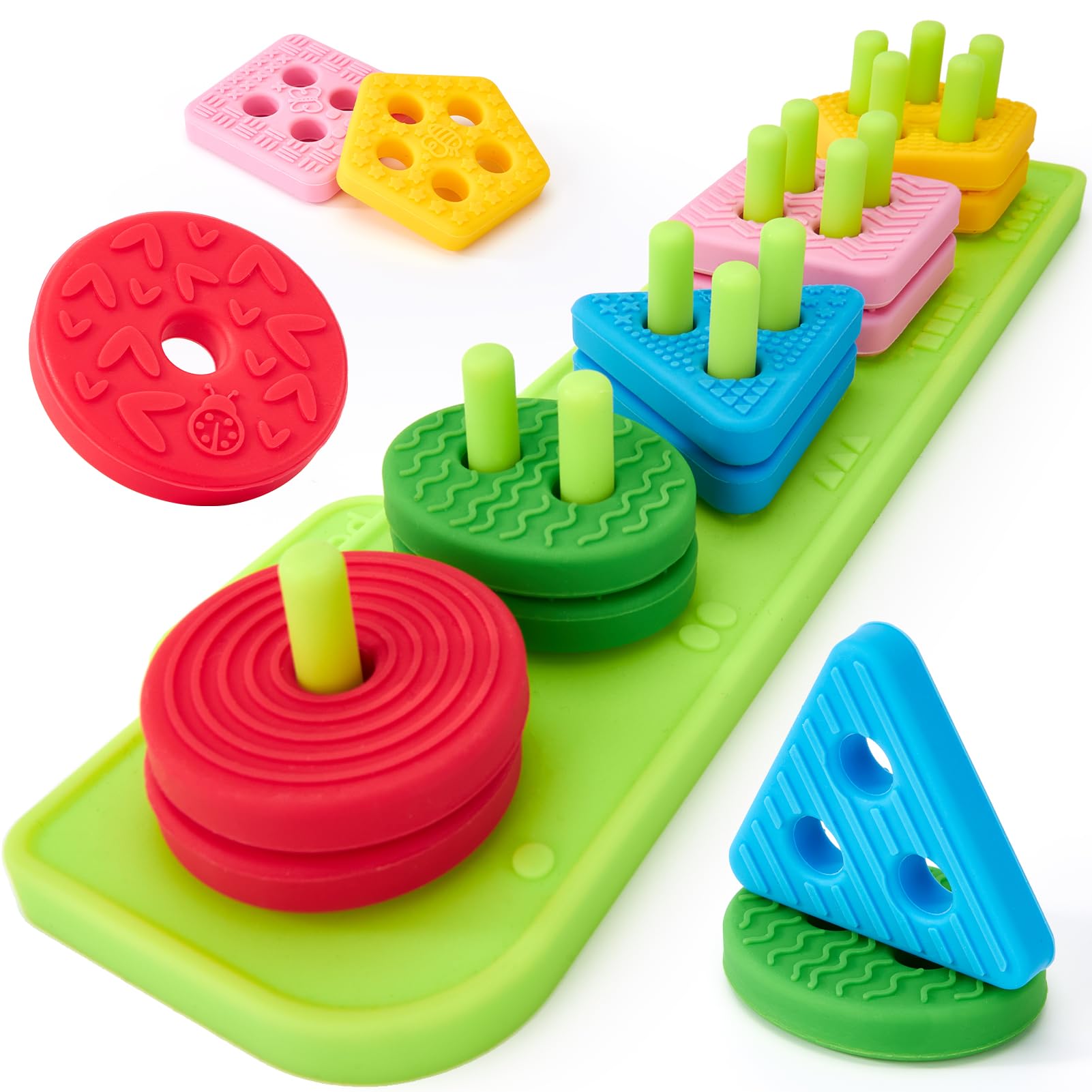
hahaland takes a Montessori-inspired approach with fifteen chunky silicone blocks in five colors and three shapes — square, triangle, and cylinder. Each block features double-sided textures, including raised dots and ridges, that invite a one-year-old to explore with their fingers before they even attempt stacking. The silicone base has an anti-slip texture that keeps the stacking post stable on hard floors.
Parents consistently praise the easy-clean nature of silicone — a simple rinse or wipe sanitizes the blocks after teething sessions. The included storage bag is a practical addition that prevents lost pieces during travel or trips to daycare. Set dimensions measure 10.63 by 3.15 inches, making the total footprint compact enough for small play areas.
The color-guided outlines on the base help older toddlers begin matching blocks to slots, extending the toy’s usability well past the first birthday. The blocks themselves are hollow but thick-walled, giving them a satisfying weight that stacks reliably without toppling at the slightest bump. For a focused sensory and sorting experience, this set is hard to beat.
Why it’s great
- Food-grade silicone is non-toxic and completely safe for mouthing
- Anti-slip base stays put during frantic stacking attempts
- Storage bag encourages clean-up habits from an early age
Good to know
- Only three distinct shapes — some parents wish for more variety in block geometry
3. Infantino Super Soft Building Blocks
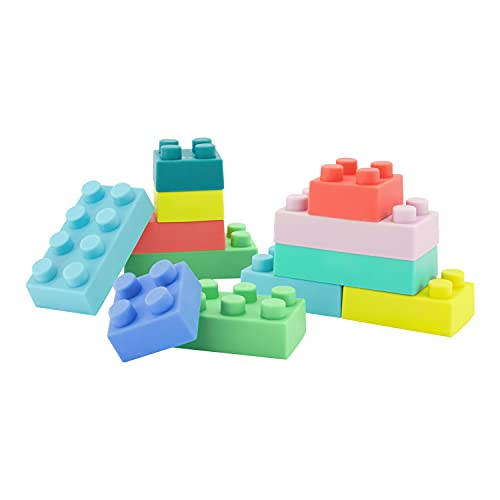
Infantino delivers twelve super-soft blocks made from BPA-free foam that compress under pressure — meaning no ouchies when thrown or stepped on. The set includes three size varieties (small, medium, large), which introduces your one-year-old to the concept of relative scale during stacking. The largest blocks measure roughly three inches across, while the smallest fit snugly in a palm.
The foam surface has a slight grip that helps blocks stay stacked longer than slippery plastic alternatives. Parents report that these blocks are light enough for a 12-month-old to lift with one hand, yet sturdy enough to survive daily stacking and knocking-down sessions. The multi-colored design helps with early color recognition, and the soft texture makes them quiet during play — a relief for parents in apartments.
Because the blocks are foam, they are not suitable for aggressive chewing; a teething baby may dent the surface. However, for a child who is past the intense mouthing phase, these are among the most forgiving blocks on the market. They are also dishwasher-safe on the top rack, making sanitation effortless after sticky hands have been at work.
Why it’s great
- Compressible foam eliminates injury risk during throws
- Three distinct sizes teach scale and spatial relationships
- Dishwasher-safe for easy cleaning
Good to know
- Foam can become dented from aggressive biting or chewing
4. ShyLizard Toddler Farm Animal Stacking

ShyLizard takes a completely different approach with six nesting cardboard boxes that double as stacking blocks and storage homes for matching finger puppets. Each box is numbered one through six and printed with a farm animal pattern, so a one-year-old can practice sequencing by size while learning to recognize a cow, pig, chicken, sheep, horse, and duck. The boxes feature a sealed finish that resists light spills.
The finger puppets are small enough for an adult to animate but large enough for a toddler to hold — each puppet measures roughly two inches tall. Stacking the boxes from largest to smallest encourages a child to stand and squat repeatedly, building gross motor strength. The boxes nest inside each other for compact storage when playtime ends, which helps teach organizational skills early.
Because the material is cardboard with a coated finish, this set is best for supervised play where the child is not actively chewing the edges. At 1.5 pounds total weight, the largest box is light enough for a wobbly toddler to lift without tipping over. This set excels as a storytelling and animal-recognition tool that complements traditional block stacking.
Why it’s great
- Nesting design teaches size sequencing and spatial awareness
- Finger puppets add a dramatic-play dimension
- Compact storage — all boxes nest into one unit
Good to know
- Cardboard is not water-resistant and will warp if soaked
5. Itzy Ritzy Sensory Blocks Set

Itzy Ritzy focuses purely on tactile exploration with ten PVC blocks shaped into whimsical characters — each one featuring a unique texture surface ranging from smooth to bumpy to ribbed. The blocks are squishy-soft and weigh almost nothing, making them ideal for a baby who is just beginning to bat at objects during tummy time. The multi-color palette uses calming pastels that are visually engaging without being overstimulating.
Parents report that these blocks are a favorite for sensory play during car rides or high-chair downtime. The squishable nature means they make no noise when dropped, and the soft PVC is gentle on emerging teeth. Each block is large enough that a one-year-old cannot fully close their fist around it, which encourages an open-palm grasping motion that strengthens hand muscles.
The blocks lack any internal rattle or crinkle, so auditory stimulation comes only from the child’s own movement of the blocks — a quieter play experience that some parents prefer for wind-down time. The set is limited to ten pieces, which keeps the play space tidy but offers fewer stacking combinations than larger sets. For a baby who responds strongly to textured touch, this is a top-tier sensory tool.
Why it’s great
- Six distinct textures on one set — excellent for tactile development
- Ultra-lightweight and safe for unsupervised floor play
- Pastel colors are soothing and visually calming
Good to know
- No sound elements — quieter play but less cause-and-effect feedback
FAQ
How do I sanitize silicone blocks after my baby chews them?
Are cardboard nesting blocks safe for a one-year-old who still mouths toys?
Why do some blocks cause my baby to get frustrated and cry?
How many blocks should I give my one-year-old at one time?
Final Thoughts: The Verdict
For most users, the building blocks for 1 year old winner is the Plunack 4-in-1 Set because it combines soft blocks, stacking rings, a shape sorter, and a pull-string activity into a single, safe, and CPSIA-certified package. If you want a pure silicone sensory experience with easy portability and sorting challenges, grab the hahaland Silicone Sorting Set. And for the budget-friendly family looking for soft, throw-safe blocks that introduce three different sizes, nothing beats the Infantino Super Soft Blocks.

Mo Maruf
I created WellFizz to bridge the gap between vague wellness advice and actionable solutions. My mission is simple: to decode the research and give you practical tools you can actually use.
Beyond the data, I am a passionate traveler. I believe that stepping away from the screen to explore new environments is essential for mental clarity and physical vitality.