Our readers keep the lights on and my smoothie glass nicely filled. As an Amazon Associate, I earn from qualifying purchases.
The real war against mosquitoes, gnats, and moths isn’t won with sprays—it’s won with light frequency. A standard white porch bulb acts like a dinner bell for flying insects because their compound eyes are hypersensitive to the cool blue spectrum. The right bug light shifts that emission into the amber, yellow, or ultraviolet range that either repels or traps the swarm.
I’m Mohammad Maruf — the founder and writer behind WellFizz. I’ve spent years dissecting spectral power distribution curves and insect phototaxis studies to understand which wavelengths actually reduce landing counts on patios and decks.
Every product in this review was selected because its specific wavelength output, lumen delivery, and build quality make it a legitimate contender for the title of best bug light in its category.
How To Choose The Best Bug Light
Choosing a bug light requires more than grabbing the first yellow bulb on the shelf. You need to match the light source to your fixture type, insect pressure, and desired coverage area. A passive repellent bulb is ideal for covered patios where you want ambient light without swarms. If you have standing water nearby or heavy mosquito populations, a UV-attractant zapper bulb that actively kills pests becomes the better investment.
Spectral Output — Kelvin Rating
The color temperature measured in Kelvin determines which insects see the light. Standard cool-white bulbs (4000K-6500K) emit high levels of blue light that strongly attract mosquitoes and moths. Bug lights operate below 2500K, usually at 1900K amber or 2200K yellow. At these warm temperatures, the light appears dim to insects but remains perfectly usable for human vision. For active zappers, ultraviolet light in the 365nm range is used because it triggers a strong phototactic response in flying insects.
Fixture Compatibility and Base Type
The vast majority of bug lights use the standard E26 medium screw base, making them drop-in replacements for porch lights, garage fixtures, and sconces. If you have a recessed or enclosed fixture, check the bulb dimensions — particularly the length of T8-style fluorescent replacements and the width of spiral CFLs. Bulbs with integrated photocell sensors require direct exposure to natural light to function correctly. A fully covered or shaded fixture may prevent the sensor from detecting dusk, leaving the bulb off all night.
Passive Repellent vs. Active Zapper
Passive repellent bulbs (yellow, amber, or LED insect-repellent) simply make your area less attractive to bugs. They do not kill insects — they just discourage landing. Active zapper bulbs combine an attractant light source with a high-voltage killing grid that electrocutes insects on contact. Zapper bulbs require periodic cleaning of the grid to maintain performance and are best used away from human seating areas because the zapping sound and smell can be unpleasant. For dining tables and seating zones, passive bulbs are the quieter, cleaner choice.
Quick Comparison
On smaller screens, swipe sideways to see the full table.
| Model | Category | Best For | Key Spec | Amazon |
|---|---|---|---|---|
| BANPESTT Bug Zapper 2-Pack | Active Zapper | Indoor & covered outdoor areas | 500 sq. ft coverage, 260 lumens | Amazon |
| Qualilux Dusk to Dawn | Smart Passive | Recessed & frosted fixtures | 1900K amber, photocell auto | Amazon |
| TORCHSTAR LED A19 Yellow | Passive LED | Covered patios & entryways | 2500K yellow, 40W equivalent | Amazon |
| Xtricity CFL Yellow Spiral | Passive CFL | High-brightness outdoor areas | 800 lumens, 13W CFL | Amazon |
| Dichroma BK-40D Replacement Bulb | Zapper Replacement | Flowtron BK-40D units | T8 U-shape, 32W | Amazon |
In‑Depth Reviews
1. BANPESTT Bug Zapper Light Bulb 2-Pack

The BANPESTT is the rare product that works as both a functional 260-lumen LED bulb and a high-voltage insect zapper in a single E26 package. The 30° slope design on the housing causes dead bugs to slide off the grid automatically, which drastically reduces the stickiness and maintenance frequency compared to flat-grid zappers. Users consistently report that the zapper operates silently — no loud popping sounds — making it far more pleasant for dinner areas than traditional bug zappers.
With an EPA-registered physical control method and a coverage area of 500 square feet, this unit is effective against mosquitoes, gnats, and moths. The fire-resistant ABS housing adds a layer of safety for enclosed porch fixtures. The two-pack configuration gives you separate coverage for front and back entries without requiring fixture modification. The light output is warm enough for general illumination but the zapper grid does need occasional brushing with compressed air to maintain peak performance.
For anyone who wants active pest elimination without toxic sprays or sticky traps, this is the most versatile plug-and-play option on the market. The dual-function design means you never have to choose between a bug light and a functional porch light again. Just note that outdoor use requires protection from direct rain exposure — this unit is best in covered sconces or under eaves.
Why it’s great
- Combines illumination with active zapping in one bulb
- Silent operation with automatic bug-slide design
- EPA-registered for chemical-free pest control
Good to know
- Zapper grid requires periodic cleaning with compressed air
- Not suitable for direct rain exposure without fixture cover
2. Qualilux Dusk to Dawn A19 LED Bug Light
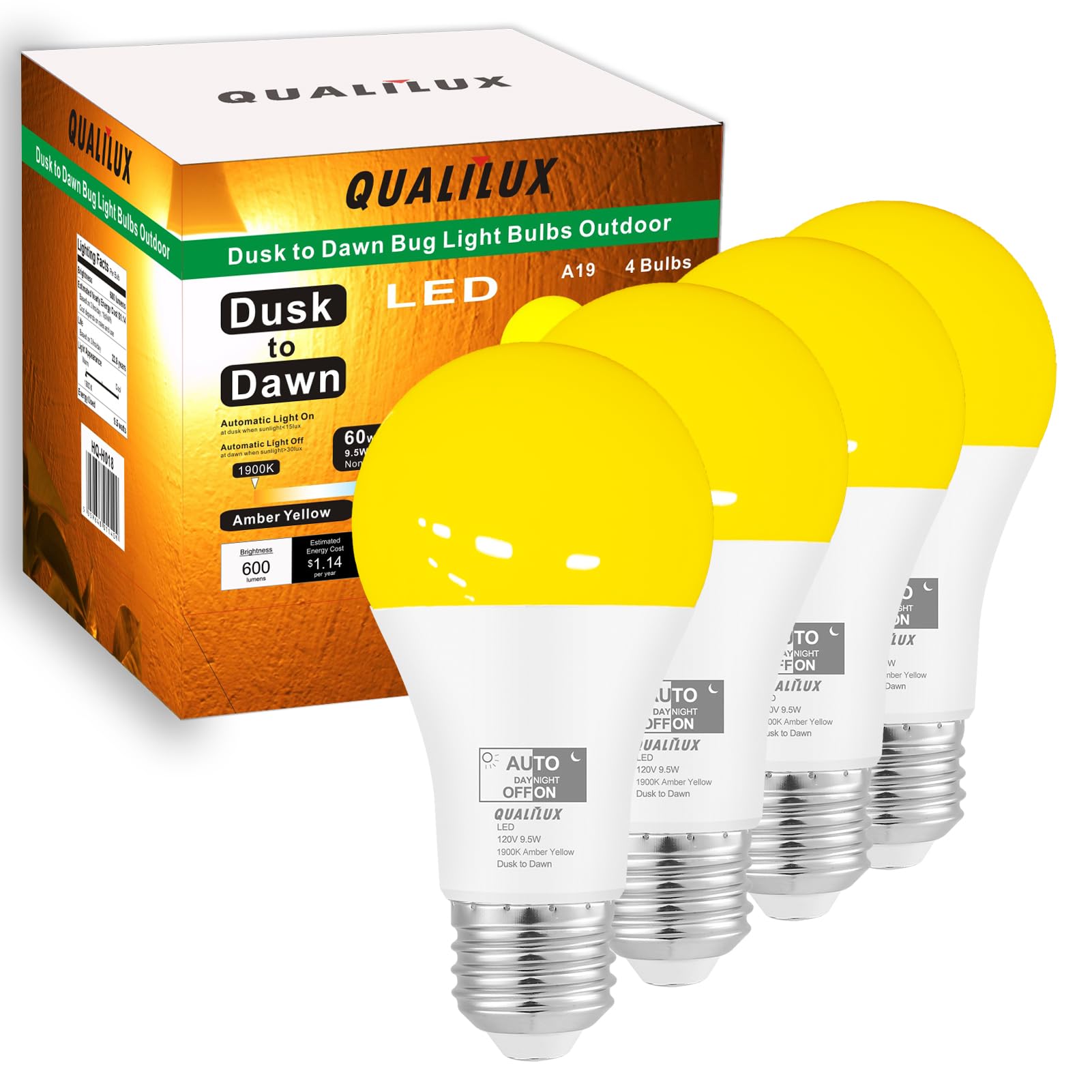
What sets the Qualilux apart is its 1900K amber output — the warmest color temperature in this review — combined with a built-in photocell sensor that automatically turns the bulb on at dusk and off at dawn. This eliminates the need for timers or manual switching, which is especially valuable for hard-to-reach fixtures. The 360-degree light sensing angle ensures the photocell detects ambient daylight regardless of how the bulb is oriented in the socket.
An intelligent smart driver chip reduces energy consumption by 50 percent after six hours of operation, dropping to 70 percent brightness for the remainder of the night. Since most people are asleep during those hours, the dimmed output is rarely noticeable. The beam angle of 270 degrees provides broad coverage for entryways, garages, and covered porches. Users consistently report a dramatic reduction in bugs congregating around doors after switching from standard bulbs.
With a 25,000-hour lifespan and a 3-year warranty, this is a long-term investment in hassle-free outdoor lighting. The non-dimmable design is a minor limitation, but the automatic dimming feature more than compensates. For homeowners who want maximum insect deterrence with zero daily effort, the Qualilux is the most thoughtful bulb on the list.
Why it’s great
- 1900K amber wavelength minimizes insect attraction
- Photocell sensor with 360-degree sensing angle
- Intelligent auto-dimming saves power after six hours
Good to know
- Non-dimmable with standard wall dimmers
- Photocell requires natural daylight exposure to function
3. TORCHSTAR LED A19 Yellow Bug Light Bulbs

The TORCHSTAR LED A19 yellow bulbs deliver the most familiar warm yellow glow in the lineup — a 2500K color temperature that is bright enough for security and ambiance but completely invisible to most flying insects. The plastic-clad aluminum construction provides excellent heat dissipation, and the integrated yellow LED chips combined with a uniform full-yellow casing ensure no white light bleeds through to attract bugs. Each bulb consumes only 8 watts while outputting the equivalent of a 40-watt incandescent.
The six-pack configuration makes this an excellent choice for households with multiple exterior fixtures. The E26 base fits standard porch lights, garage fixtures, and decorative sconces without any adapter. Users consistently note that these bulbs produce a rich, even yellow color without the greenish tint that cheap bug lights often emit. The 10,000-hour rated lifespan means you are unlikely to replace these more than once every few years with normal nightly use.
For homeowners who simply want to swap out their existing white bulbs for something that stops attracting bugs, the TORCHSTAR six-pack delivers the best per-unit value in the passive repellent category. The lack of any active zapping means zero maintenance — just screw in and forget. These bulbs are best used in covered fixtures as the manufacturer recommends avoiding direct contact with rainwater.
Why it’s great
- True yellow spectrum with no white light leakage
- Plastic-clad aluminum for excellent heat management
- Six-pack covers multiple fixtures in one purchase
Good to know
- Should not be used in fixtures exposed to direct rain
- Lower lumen output than CFL alternatives
4. Xtricity Yellow CFL Spiral Bug Light Bulbs

The Xtricity CFL spiral delivers 800 lumens from only 13 watts — the highest light output in this review — making it the best choice for homeowners who want bug-free illumination and security-level brightness. The T2 spiral design emits a bright yellow light that is invisible to insects but provides excellent visibility for walkways, driveways, and entryways. Users consistently report that these bulbs illuminate a 12-foot radius with soft yellow light while eliminating insect swarming around the fixture.
The CFL technology provides instant-on, flicker-free operation with a 10,000-hour lifespan. Unlike older CFLs that emitted a harsh greenish-yellow hue, the Xtricity bulbs produce a warm yellow light that is gentle on the eyes. The four-pack configuration covers multiple outdoor fixtures, and the E26 base fits standard sockets. These bulbs are UL listed and contain a small amount of mercury, requiring proper disposal at the end of life.
For buyers who prioritize raw brightness — perhaps for security cameras or large gathering spaces — the Xtricity CFLs offer nearly double the lumen output of the LED alternatives while consuming minimal energy. The trade-off is a slightly longer warm-up time compared to instant-on LEDs and the need for careful disposal. If your priority is maximum light with minimum bug attraction, this is the brightest option available.
Why it’s great
- 800 lumens provides excellent security illumination
- Consumes 80% less energy than incandescent equivalents
- Instant-on with flicker-free performance
Good to know
- Contains mercury — requires proper disposal
- Slightly slower warm-up than LED alternatives
5. Dichroma BK-40D Replacement Bulb for Flowtron

If you already own a Flowtron BK-40D electronic insect killer, the Dichroma replacement bulb is the exact T8 U-shaped 32W fluorescent tube that keeps your unit running. The 10-inch bulb length and 2.36-inch U-bend width are specifically designed to match the BK-40D housing — it will not fit the smaller BK-15D or the larger BK-80D models. The two-pack ensures you have a spare ready for the next replacement cycle.
The ultraviolet blue light produced by this bulb is in the 365nm range, which is the optimal wavelength for attracting mosquitoes, gnats, and moths. Users consistently report a bright blue hue rather than purple, and the bulbs perform flawlessly for several months of nightly use. The rated lifespan of 3,000 hours is typical for fluorescent zapper bulbs, and the direct-fit design means no adapter or modification is needed.
For Flowtron owners, this is the most reliable and cost-effective replacement option available. The bulbs arrive well-packaged — essential since these glass tubes are fragile during shipping. The manufacturer offers a no-hassle replacement if shipping damage occurs. If you rely on a Flowtron unit for outdoor pest control, keeping this two-pack on hand ensures you never have a gap in coverage during peak mosquito season.
Why it’s great
- Exact fit for Flowtron BK-40D — no adapter needed
- UV-A spectrum effectively attracts flying insects
- Two-pack provides a backup for replacement
Good to know
- Compatible only with BK-40D, not BK-15D or BK-80D
- Glass tube is fragile during shipping
FAQ
Do amber bug lights actually repel insects or just fail to attract them?
Can I use an amber bug light in a recessed or enclosed outdoor fixture?
How often do I need to clean the grid on a bug zapper light bulb?
Final Thoughts: The Verdict
For most users, the best bug light winner is the BANPESTT Bug Zapper 2-Pack because it combines a functional 260-lumen LED with an active high-voltage zapper in a single E26 base, giving you both illumination and pest elimination without toxic chemicals. If you want a completely maintenance-free, set-and-forget solution with automatic dusk-to-dawn operation, grab the Qualilux Dusk to Dawn Amber. And for the brightest possible bug-free security lighting that illuminates large areas, the Xtricity CFL Yellow Spiral delivers 800 lumens with minimal insect attraction.

Mo Maruf
I created WellFizz to bridge the gap between vague wellness advice and actionable solutions. My mission is simple: to decode the research and give you practical tools you can actually use.
Beyond the data, I am a passionate traveler. I believe that stepping away from the screen to explore new environments is essential for mental clarity and physical vitality.