Our readers keep the lights on and my smoothie glass nicely filled. As an Amazon Associate, I earn from qualifying purchases.
A power outage doesn’t announce itself. One blink and your PC hard-shuts, a draft of an hour vanishes, and your router goes dark mid-call. A battery backup is the insurance you plug in once and forget about—until the lights flicker. But with a limited budget, the risk is real: grab a unit with too little VA or a junk surge rating, and you’ve bought a heavy paperweight. The trick is knowing exactly which corners you can cut and which ones will cost you a motherboard.
I’m Mohammad Maruf — the founder and writer behind WellFizz. I spend my days combing through user-verified reviews and bench-level specs to separate hardware that actually holds line voltage from units that just beep politely before failing.
After filtering dozens of units under the premium price ceiling, I landed on seven models that deliver real transfer time, usable runtime, and surge clamping you can trust. This guide breaks down the best budget uninterruptible power supply picks so you don’t waste a cent on inadequate VA or phantom features.
How To Choose The Best Budget Uninterruptible Power Supply
When your wallet is tight, every spec decision matters. You don’t need a data-center-grade rack unit, but you do need a unit that switches to battery faster than your PSU can drop out. Here are the three decisions that separate a smart buy from a regretful purchase.
Match VA to Your Critical Load
VA (Volt-Amps) is the real gatekeeper. A 350VA unit like the Tripp Lite BC350 will run a modem, router, and a desk lamp for an hour, but it won’t hold a gaming PC with a 750W PSU. List the wattage of everything you need to keep alive—usually your modem, router, and one PC—then pick a UPS with a VA rating at least 1.6x that total wattage. For a typical home office, 600VA to 900VA is the sweet spot: enough for a graceful shutdown without paying for idle capacity.
AVR or Die Slow
Automatic Voltage Regulation (AVR) boosts or trims incoming voltage without tapping the battery. If your area suffers from brownouts or voltage sags—common in older buildings or during summer AC surges—a non-AVR UPS will switch to battery dozens of times a day, eating lifespan. AVR units cost a bit more up front but save you from replacing sealed lead-acid batteries every 18 months. For a budget build, an AVR unit like the SKE SK425 or the CyberPower AVRG900LCD pays for itself in battery longevity.
Don’t Skimp on Outlet Separation
“6 outlets” sounds good until you try plugging three wall-wart transformers side by side. Many budget UPS units pack outlets too close for bulky AC adapters. If your gear includes chunky power bricks for routers or monitors, look at the physical spacing—APC’s BE600M1 and the Amazon Basics 1000VA offer better layout with staggered or widely-spaced receptacles. A unit with three usable outlets is worse than a unit with five that actually fit your plugs.
Quick Comparison
On smaller screens, swipe sideways to see the full table.
| Model | Category | Best For | Key Spec | Amazon |
|---|---|---|---|---|
| CyberPower CP1500AVRLCD | Premium | High-wattage PC + peripherals | 1500VA / 900W | Amazon |
| APC BX1350M | Premium | Gaming PC + network stack | 1350VA / 810W | Amazon |
| Amazon Basics 1000VA | Mid-Range | Home office with AVR | 1000VA / 550W | Amazon |
| CyberPower AVRG900LCD | Mid-Range | Desktop + network with AVR | 900VA / 480W | Amazon |
| SKE SK425 | Mid-Range | Rural areas with voltage fluctuation | 850VA / 480W | Amazon |
| APC BE600M1 | Budget | Modem/router + low-watt PC | 600VA / 330W | Amazon |
| Tripp Lite BC350 | Budget | Minimal network gear only | 350VA / 316 Joules | Amazon |
In‑Depth Reviews
1. CyberPower CP1500AVRLCD

The CyberPower CP1500AVRLCD is the most capacity you can reasonably plug into a standard 15-amp household circuit without tripping a breaker. With 1500VA and 900W on tap, this unit runs a desktop PC, a 32-inch monitor, external drives, and a modem stack with enough headroom for a 30+ minute runtime at typical loads. The simulated sine wave output is fine for modern active PFC power supplies, and the AVR corrects brownouts down to about 88V without draining the battery. The multifunction LCD panel shows load percentage, estimated runtime, input voltage, and battery capacity—so you’re never guessing how much time you have left.
The 12-outlet layout includes six battery-backed receptacles and six surge-only, giving you room for both critical and non-critical gear. Users report surviving a direct lightning strike (with connected equipment still alive) and getting solid 37-minute runtimes at a 165W load. The user-replaceable battery extends the unit’s life beyond the 3-year warranty period, and the silent mode kills the beeping during overnight outages. A few owners mention the power button is easy to bump accidentally and the outlets are a tight squeeze for large wall warts, so plan your plug layout before mounting.
If you need to keep a high-wattage gaming rig or a small server alive long enough for a proper shutdown, this is the most cost-effective way to do it without stepping into true commercial gear. The connected equipment guarantee adds real peace of mind for anyone running expensive components. It’s overkill for a modem-only setup, but for a full home office or entertainment center, the CP1500AVRLCD delivers premium protection at a value-tier price point.
Why it’s great
- Deep AVR range (88V-145V) keeps equipment stable
- Clear LCD shows runtime and load in real time
- User-replaceable battery and quiet mode available
Good to know
- Simulated sine wave, not pure sine wave
- Outlets are tightly spaced for large adapters
- Power button is easy to accidentally press
2. APC Back-UPS Pro BX1350M

The APC BX1350M sits in a rare spot: it delivers 1350VA and 810W in a tower form factor that fits under most desks without dominating the space. At a 300W load—a typical mid-range PC with a 24-inch monitor and router—you get over 15 minutes of runtime, more than enough to save work and shut down cleanly. The AVR trims high voltage and boosts low voltage within a ±13% window without switching to battery, which matters if your home line voltage drifts throughout the day. APC’s equipment protection covers up to , and the 3-year warranty includes the battery.
The ten outlets split five battery-backed and five surge-only, plus coaxial and Ethernet surge protection—a rare inclusion at this level. Users report surviving lightning strikes that fried a modem but left the PC untouched, and several note the unit’s red wiring fault indicator saved them from plugging into a miswired outlet. The replaceable battery (APCRBC123) is easy to swap without tools, and the ENERGY STAR certification means the unit runs at 92%+ efficiency, saving a few dollars a year on idle power draw.
The downsides are few but real: some users wish the unit had a pure sine wave output for sensitive audio gear, and the large form factor means you need about 10 inches of depth clearance. A few owners had to use extension cords because the battery-backed outlets can’t accommodate oversized power bricks side by side. If you run a high-end gaming PC with an RTX-class card and want reliable runtime without stepping up to a 1500VA brick, the BX1350M is the most balanced mid-premium option on this list.
Why it’s great
- Coaxial and Ethernet surge protection built in
- AVR handles brownouts down to 88V
- ENERGY STAR certified with replaceable battery
Good to know
- Simulated sine wave output
- Tower depth requires desk clearance
- Some outlets blocked by large adapters
3. Amazon Basics 1000VA UPS

The Amazon Basics 1000VA UPS is a line-interactive unit that brings AVR and simulated sinewave technology to a price point where most competitors offer only standby topology. The nine-outlet layout gives you five battery-backed and four surge-only receptacles, which is generous for a compact tower this size. At half load (roughly 275W), you get about 7 minutes of runtime—enough for a fast save and shutdown on a standard desktop. The 6-foot power cord provides flexible placement under a desk or behind an entertainment center.
Build quality is solid thanks to the metal enclosure, and the unit feels heavier than its rivals at 15 pounds, which translates to better internal shielding and heat dissipation. Users report that the unit performs well in simulated power outages and handles brief flickers without dropping the load. The mini-tower design saves desk space compared to the wider, flatter form factors of APC and CyberPower. Setup is genuinely plug-and-play: no software required for basic protection, though a browser-based utility is available for more advanced monitoring.
The Achilles’ heel here is the battery. Multiple users report the internal battery failing within the first month, though Amazon’s return policy covers replacement quickly. The USB-only communication is limiting compared to units with serial or network management, and the browser-based software can be flagged by Windows 11 security settings. If you need a no-frills AVR unit for a home office and you’re comfortable swapping a battery if it craps out early, this is the lowest-cost entry into line-interactive protection with decent outlet count.
Why it’s great
- AVR maintains stable voltage without battery drain
- Metal tower enclosure dissipates heat well
- Generous 9-outlet layout in a compact footprint
Good to know
- Battery failure rate higher than average early on
- USB-only communication; no network card option
- Browser software may trigger security warnings
4. CyberPower AVRG900LCD
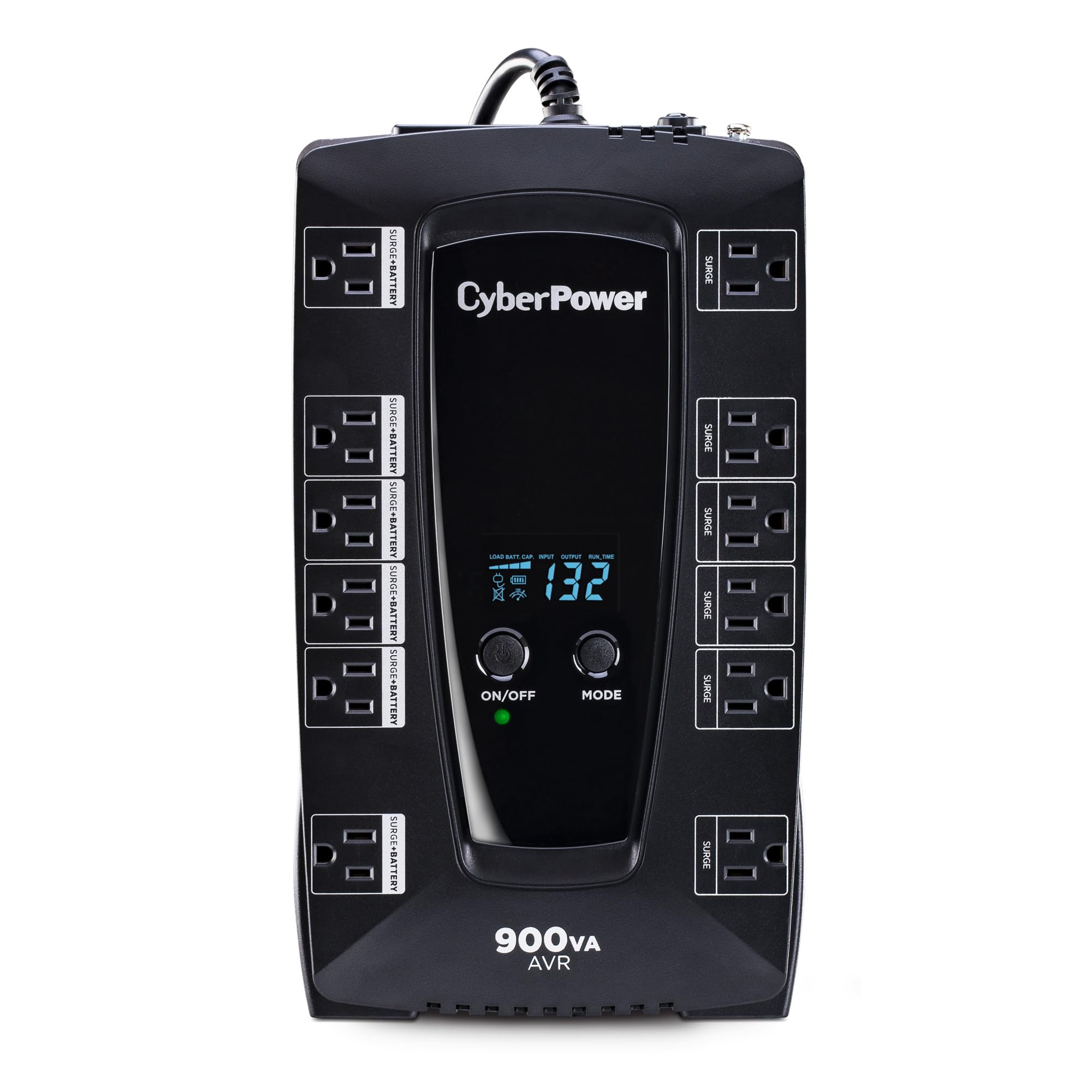
The CyberPower AVRG900LCD is the most feature-dense unit in the mid-range tier, packing 12 outlets into a compact chassis that’s only 3.5 inches wide. The intelligent LCD panel cycles through voltage, load percentage, and estimated runtime—helpful for fine-tuning which devices drain the battery fastest. At 900VA and 480W, this unit is a perfect match for a desktop PC with a single monitor and a modest network stack. The AVR corrects fluctuations from 89V to 147V, which covers the most common brownout and overvoltage scenarios in residential wiring.
The outlet split is six battery-backed and six surge-only, giving you the flexibility to protect peripherals like a printer or desk lamp without wasting battery capacity. The right-angle NEMA 5-15P input plug saves space against the wall, and the 5-foot cord reaches most under-desk outlets without an extension. Users describe getting 62 minutes of runtime at a 72W load—plenty for a modem, router, and a small PC—and around 18-20 minutes at a 175-200W load. The free PowerPanel software allows automatic shutdown and monitoring from Windows, Mac, and Linux systems.
The biggest quality concern is the DOA rate: a few users received units with dead batteries or non-functional displays. CyberPower’s support team is responsive and provides prepaid return labels, but it’s an inconvenience to deal with out of the box. The simulated sine wave may cause minor compatibility issues with some UPS-equipped medical devices or sensitive audio equipment. For the price, you get the most outlets per VA of any unit in this roundup, making it ideal if you have many small devices to protect on a single circuit.
Why it’s great
- 12 total outlets—most in this price band
- LCD shows runtime, voltage, and load
- AVR covers brownouts and surges
Good to know
- Some units arrive DOA with dead battery
- Simulated sine wave output only
- Outlets are very tightly spaced
5. SKE SK425
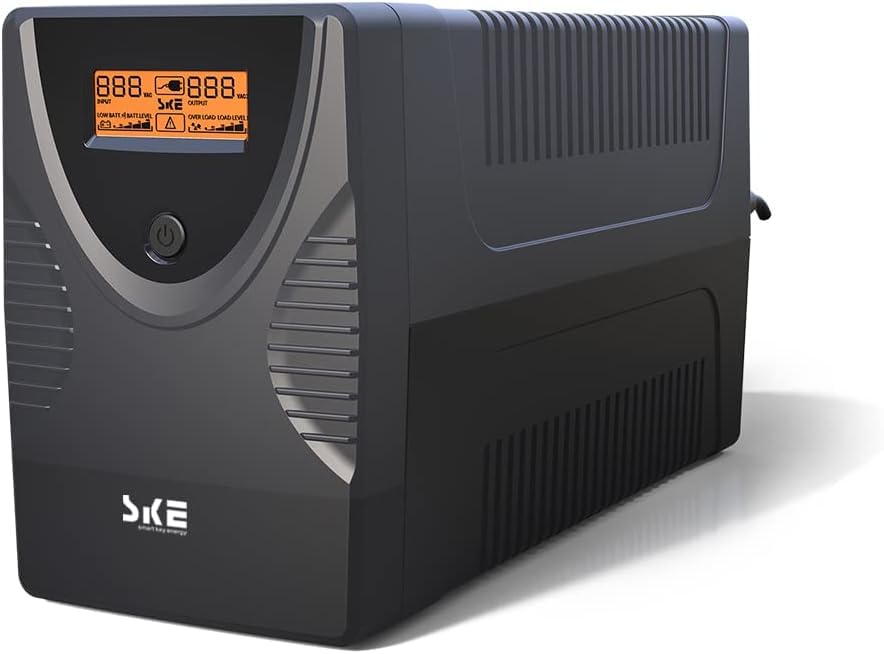
The SKE SK425 is an 850VA/480W line-interactive UPS that punches above its price grade with an LCD display and genuine AVR functionality—features normally reserved for units costing significantly more. The tower form factor uses a metal enclosure that feels robust and helps with heat dissipation during extended battery operation. The six outlets are all battery-backed and surge-protected, which simplifies setup: plug everything in and all ports get backup power. The AVR keeps voltage between 89V and 147V without tapping the battery, critical for rural homes where the line voltage sags when the well pump kicks on.
Users with rural power report that the SK425 handles the brief 1-2 second outages that plague generator-based or long-run electrical service, keeping their fiber modem, switch, and router alive without interruption. The 850VA capacity gives you enough headroom to add a small NAS or a 24-inch monitor alongside your network gear. The LCD display cycles through input voltage, battery level, and load percentage—simple but effective for a quick status check. The software compatibility spans Windows 98 through Windows 11, making it one of the most backward-compatible units on the market.
The main trade-off is outlet spacing: the six receptacles are packed tight, and you’ll struggle to fit more than two wall-wart transformers without using a small power strip or outlet extender. The user-replaceable battery is a plus for extending the unit’s life, but the battery compartment isn’t tool-less, requiring a small screwdriver. If you live in an area where voltage sags happen multiple times a day and you need a budget-friendly AVR unit that actually works, the SKE SK425 delivers exactly what it promises without the premium markup.
Why it’s great
- AVR handles rural voltage fluctuations
- Metal tower chassis for durability
- Broad OS compatibility with shutdown software
Good to know
- Outlets too tight for multiple large power bricks
- No surge-only outlets for less critical gear
- Battery replacement requires a screwdriver
6. APC BE600M1

The APC BE600M1 is the trusty compact unit that has quietly become the default recommendation for anyone protecting a modest home office. At 600VA and 330W, it won’t run a gaming PC through a movie, but it will keep your fiber modem, router, and a small desktop alive for 23 minutes at a 100W load—more than enough to ride out brief flickers or shut down gracefully. The seven-outlet layout includes five battery-backed and two surge-only receptacles, and the 1.5A USB charging port works during outages, letting you top off a phone without draining the backup outlets.
The recessed power button is a subtle but brilliant design choice: users report their cats can’t accidentally shut it off, a surprisingly common problem with exposed switches. The user-replaceable battery (APCRBC154) is easy to swap without tools, which is rare in the entry-level segment. The compact form factor (10.8 x 4.1 x 5.5 inches) slides easily under a desk or behind a monitor stand. The PowerChute software provides automatic shutdown for Windows and macOS, and the unit supports a 3-year warranty plus equipment protection policy.
The limitation is clear: you won’t get AVR here, so if your home voltage sags frequently, the BE600M1 will switch to battery often, shortening its lifespan. The runtime drops fast as you add load—expect about 5 minutes at the full 330W rating. Some users find the beeping alarm annoying during outages, though it serves as a useful reminder to start shutting down. If your needs are limited to networking gear plus one low-power PC and you don’t suffer from daily brownouts, this is the most reliable entry-level unit you can buy.
Why it’s great
- Compact size fits in tight spaces
- USB charging port works during blackouts
- User-replaceable battery extends product life
Good to know
- No AVR leads to frequent battery cycles
- Low 330W max load limits connected gear
- No LCD display for status monitoring
7. Tripp Lite BC350

The Tripp Lite BC350 is the entry-level UPS that fills a very specific niche: keeping your modem and router alive during an outage so your internet stays up. At 350VA with a 316-joule surge rating, this is not a unit for a desktop PC or a home server—it’s a network-only device. The six outlets split three battery-backed and three surge-only, and the 5-foot power cord with bottom mounting tabs lets you wall-mount it near your network panel. The internal battery is replaceable, which is a rare find at this price point, and the unit is virtually silent in both line and battery mode—the alarm only sounds for low battery or fault conditions.
Users report this unit running a fiber-to-Ethernet converter for over 12 hours on a single charge, which is exceptional longevity at this VA rating. The compact dimensions (5 x 7.99 x 2.99 inches) mean it fits nearly anywhere, and the lightweight 1-pound design makes mounting painless. The PWM sine wave output in battery mode is adequate for switch-mode power supplies used by most networking hardware but may cause hum in analog audio gear. The 3-year warranty and connected equipment insurance are generous for a unit in this class and reflect Tripp Lite’s confidence in their power conditioning.
The downsides are clear: 350VA is too small for any PC with a discrete GPU, and the 316-joule surge rating is on the low end—you should pair this with a higher-joule surge protector for anything expensive. The alarm isn’t adjustable; it beeps continuously on low battery, which can be annoying in a bedroom. If you already have a separate UPS for your PC and just need something dedicated to keeping your internet alive through extended outages, the BC350 does that one job reliably and cheaply.
Why it’s great
- 12+ hour runtime for low-power network gear
- Wall-mountable design saves desk space
- Replaceable battery in a budget unit
Good to know
- Only 350VA—not suitable for desktop PCs
- Low 316-joule surge clamping rating
- No AVR means battery cycles on voltage dips
FAQ
Can a budget UPS power a gaming PC during a blackout?
Is simulated sine wave bad for electronics?
How often do I need to replace the battery in a budget UPS?
Should I plug a power strip into a UPS?
Final Thoughts: The Verdict
For most users, the best budget uninterruptible power supply winner is the CyberPower CP1500AVRLCD because it delivers the highest VA-per-dollar ratio along with AVR, a useful LCD display, and enough runtime to shut down a high-wattage desktop safely. If you want a compact unit that keeps your modem and router alive for hours during extended blackouts, grab the Tripp Lite BC350. And for the best balance of outlet count, AVR, and price in the mid-range, nothing beats the CyberPower AVRG900LCD with its 12-outlet layout and intelligent display.

Mo Maruf
I created WellFizz to bridge the gap between vague wellness advice and actionable solutions. My mission is simple: to decode the research and give you practical tools you can actually use.
Beyond the data, I am a passionate traveler. I believe that stepping away from the screen to explore new environments is essential for mental clarity and physical vitality.