Our readers keep the lights on and my smoothie glass nicely filled. As an Amazon Associate, I earn from qualifying purchases.
Built-in television speakers have not meaningfully improved in two decades — they remain small, rear-firing, and starved of bass, leaving action scenes muddy and dialogue buried under background noise. A dedicated soundbar solves this instantly, but the market is flooded with options that promise surround sound and deliver distortion, or that look sleek but add nothing audible. The difference between a good budget soundbar and a bad one comes down to driver size, amplifier wattage, and the quality of the digital signal processing that separates voices from explosions.
I’m Mohammad Maruf — the founder and writer behind WellFizz. I’ve spent hundreds of hours analyzing specification sheets, decoding frequency response claims, and cross-referencing real owner experiences to separate the hardware that actually performs from the ones that just look good on a shelf.
Whether you are upgrading a bedroom television or finally fixing the hollow sound in your living room, this guide cuts through the noise to find the best budget tv speakers built on real drivers, real wattage, and real-room performance.
How To Choose The Best Budget TV Speakers
A soundbar is a simple product, but marketing claims around wattage, channel count, and virtual surround make it easy to overpay for features that your room and ears may never use. Focus on these three factors to get real improvement for your money.
Driver Configuration and Cabinet Volume
A 2.0 channel soundbar has a left and right driver. A 2.1 channel adds a dedicated subwoofer, either wired or wireless. For budget models, a single subwoofer enclosure often does more for movie impact than a second pair of tiny full-range drivers. Pay attention to the physical size of the drivers — larger diaphragms (oval or circular) move more air and produce fuller sound without needing excessive amplification. A compact soundbar with two 2-inch drivers cannot produce authoritative bass no matter what the spec sheet says. Look for oval drivers or separate woofer-and-tweeter arrangements in the same cabinet.
Connection Protocol — ARC Is the Gold Standard
Optical (TOSLINK) carries compressed 2.0 PCM or Dolby Digital 5.1, but it cannot carry higher-resolution object-based audio. HDMI ARC or eARC carries Dolby Atmos metadata, DTS signals, and allows the TV remote to control the soundbar volume without a second remote. Most budget soundbars include optical, and many include ARC. If your television has an HDMI ARC port, use it — the audio sync and convenience are measurably better. Bluetooth is fine for music streaming but introduces latency that makes lip-sync noticeable during movies.
Digital Signal Processing and EQ Modes
DSP chips clean up distortion and separate dialogue from background effects. A soundbar with dedicated Movie, Music, and News or Voice modes will handle different content better than a single flat setting. Voice or News mode narrows the frequency range and boosts the mid-range where human speech lives. This is the single most important feature for anyone who struggles to hear dialogue. Budget soundbars without DSP modes often sound boxy and hollow at low volumes. Do not skip this feature.
Quick Comparison
On smaller screens, swipe sideways to see the full table.
| Model | Category | Best For | Key Spec | Amazon |
|---|---|---|---|---|
| TCL S45H | 2.0 Soundbar | Cinematic spatial audio | 100W, Dolby Atmos + DTS Virtual:X | Amazon |
| Philips B5109 | 2.0 Soundbar | Roku integration & app control | 120W, DTS Virtual:X, Dolby Digital Plus | Amazon |
| Amazon Fire TV Soundbar | 2.0 Soundbar | Fire TV ecosystem users | DTS Virtual:X, Dolby Audio, 24-inch length | Amazon |
| Miroir SL3301 | 2.0 Soundbar | Adding an external subwoofer later | 100W, HDMI-ARC, subwoofer pre-out | Amazon |
| MZEIBO Soundbar | 2.0 Detachable | Detachable tower speakers | 80W, 4 full-range drivers, detachable design | Amazon |
| Wohome S100 Pro | 2.1 Soundbar | Deep bass with a wired subwoofer | 80W total, 5-inch wired subwoofer, DSP modes | Amazon |
| Saiyin Soundbar | Detachable 2.0 | Flexible placement & compact rooms | 98dB max, oval full-range drivers, detachable towers | Amazon |
In‑Depth Reviews
1. TCL S45H 2.0 Soundbar

TCL put Dolby Atmos and DTS Virtual:X into a 2.0 soundbar that costs less than most entry-level soundbars without those codecs. The 100-watt output powers two full-range drivers that produce noticeable spatial height cues — something normally reserved for units with up-firing drivers. The AI Sonic auto room calibration, accessed through the TCL app, measures your room’s reflections and adjusts the frequency curve accordingly. This is rare at any price and essentially unheard of in this tier. The bar measures just 2.36 inches tall, which slides under most television screens without blocking the IR receiver.
Setup is genuinely plug-and-play: the included HDMI cable connects to the eARC or ARC port, and the television remote immediately controls volume. Owners report that the calibration step eliminated initial static pop issues, and the soundbar turns on automatically with the TV via CEC. For apartments, bedrooms, or medium living rooms, this bar fills the space without needing a separate subwoofer. The low-profile design and matte finish keep it visually unobtrusive.
The trade-off is that there is no dedicated subwoofer, so deep bass below 60 Hz is absent. Action movie explosions have punch but lack the chest-thump of a 2.1 system. The single light bar on the front shows volume and input changes, but detailed settings like EQ adjustments exist only inside the app. Users who want to tweak without a phone interface will find the remote limited. For anyone upgrading from TV speakers, the clarity, spatial width, and easy setup make this the best all-rounder in the category.
Why it’s great
- Dolby Atmos and DTS Virtual:X in a 2.0 bar produce real height effects
- AI Sonic auto-calibration tailors sound to your room dimensions
- Incredibly slim profile fits under almost any TV without blocking ports
- Includes wall-mount kit, HDMI cable, batteries, and remote with no hidden purchases
Good to know
- No included subwoofer — deep bass extension stops around 60 Hz
- EQ and advanced settings require the smartphone app for full control
- Some users need spacer pads to prevent the bar from blocking the TV’s IR receiver
2. Philips B5109 2.0 Channel Bluetooth Soundbar

Philips brings 120 watts of total power to a 2.0 bar that is Roku TV Ready certified, meaning the Roku TV remote controls the soundbar volume, power, and mute without any programming. The bar supports Dolby Digital Plus and DTS Virtual:X, the latter of which creates a convincing 3D bubble around the listener without side or rear speakers. Four EQ modes — Movie, Music, Voice, and Stadium — let you shift the frequency curve for content type, and a dedicated Night Mode compresses dynamic range so you can watch action films without rattling the neighbors.
The Philips Home Entertainment app adds a layer of control that the physical remote cannot match: you can enable virtual surround, adjust treble and bass independently, and save custom presets. Bluetooth 5.4 provides a stable 100-meter range for streaming music from a phone, and the optical input works as a fallback for older televisions without ARC. The dark grey finish and rounded edges integrate better with modern furniture than glossy black alternatives. Setup documentation is minimal, but plugging in the optical cable works in under five minutes for most users.
The primary compromise is the mounting system — the B5109 ships without a desktop stand, relying entirely on wall brackets. Owners without wall-mounting ability have had to improvise with aftermarket soundbar brackets or place the bar directly on a console, which may block the television’s IR port. Bass presence is present but not deep; the 2.0 configuration cannot match the low-end extension of a 2.1 system. For Roku users who want tight integration and a wealth of sound customization through an app, this bar delivers surprising flexibility.
Why it’s great
- Roku TV Ready certification allows full control with your existing TV remote
- Four EQ modes plus app-based treble and bass tuning
- DTS Virtual:X provides convincing spatial audio from a single bar
- Night Mode compresses dynamics for late-night viewing without disturbing others
Good to know
- No desktop stand included — wall bracket is the only mounting method provided
- Deep bass extension is limited compared to bars with a separate subwoofer
- Setup guide is sparse; most users rely on optical connection instructions found online
3. Amazon Fire TV Soundbar

Amazon’s own soundbar was designed around a tight brief: integrate perfectly with Fire TV devices and deliver clearer dialogue without the complexity of a receiver. The 24-inch length makes it the shortest bar in this roundup, ideal for smaller televisions in bedrooms, dorms, or apartments where console space is limited. DTS Virtual:X and Dolby Audio processing work behind the scenes to widen the soundstage, and owners report that the dialogue clarity improvement over internal TV speakers is immediate — even at low volume, voices no longer blend into background music.
Setup takes five minutes: plug the included HDMI cable into the television’s HDMI eARC or ARC port, and the Fire TV remote takes over volume and power control automatically. For Fire TV Stick users, this means one remote for everything. The bar also supports Bluetooth for phone or tablet streaming, though the primary use case remains television audio. Amazon claims 18 percent recycled materials in the device construction, and the compact footprint means it fits on stands that would block a full-size soundbar. Owners consistently report that the sound quality far exceeds expectations for the size and price.
The trade-offs are the same as any 2.0 bar without a subwoofer: bass is present but polite, and the mid-range can sound slightly congested during complex action sequences with heavy score. The virtual surround effect is subtle — it widens the soundstage but does not create the height cues of a true Atmos bar. Some users note a slight volume lag when changing levels with the Fire TV remote. For Fire TV owners who want seamless integration and a massive audio upgrade from flat-panel speakers, this is the most frictionless option.
Why it’s great
- Seamless one-remote control with Fire TV devices via HDMI ARC
- Very compact 24-inch length fits small consoles and under-mounted TVs
- DTS Virtual:X and Dolby Audio widen the soundstage significantly
- Included HDMI cable and simple plug-and-play setup
Good to know
- No separate subwoofer — bass is modest and lacks low-end authority
- Virtual surround is subtle and does not produce overhead height effects
- Small volume lag reported when using the Fire TV remote for control
4. Miroir SL3301 2.0ch 100W Soundbar
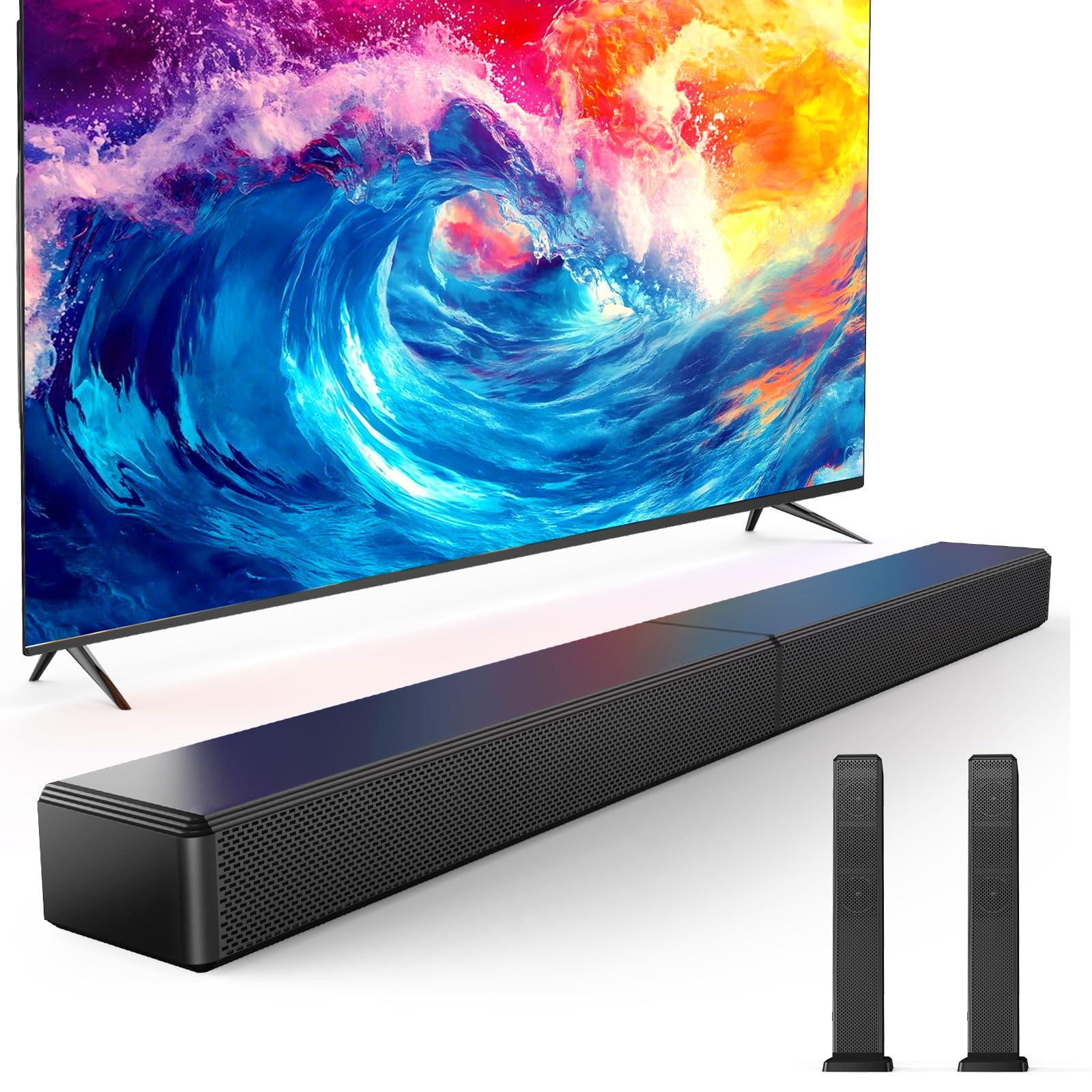
Miroir’s SL3301 is a 2.0 soundbar that builds in a subwoofer pre-out — a dedicated port that lets you connect an external powered subwoofer later without replacing the entire soundbar. This is the most budget-conscious path to a future 2.1 system: start with the bar, add a subwoofer when funds allow. The bar itself delivers 100 watts through dual tweeter and dual woofer drivers, with HDMI-ARC for one-remote control and Bluetooth 5.3 for wireless streaming. Three EQ modes (Music, Movie, Gaming) are selectable via the included remote, and DSP noise cancellation keeps dialogue crisp even at elevated volume levels.
Build quality is respectable: the chassis uses ABS plastic with a matte finish that resists fingerprints. The 31.2-inch width is standard for a 50- to 55-inch television pairing, and the 2.54-inch height slides under most sets. Owners consistently note that the HDMI-ARC connection synced instantly with their television and that the subwoofer pre-out worked without any configuration — plug in a powered subwoofer and the bar auto-detects it. The remote includes a button to dim or fully turn off the bright front LED, a small detail that eliminates a common annoyance with budget soundbars.
The two main drawbacks are the remote’s lack of a volume level indicator — you adjust by feel since there are no numerical markers — and the fact that the bar sometimes needs to be re-paired with the TV after a power outage. The sound profile leans slightly bright, which helps with dialogue clarity but can make sibilant sounds pop during high-frequency content. For buyers who want a strong 2.0 foundation today with a clear upgrade path to a subwoofer tomorrow, the SL3301 offers the most value per dollar.
Why it’s great
- Subwoofer pre-out enables easy future upgrade to a 2.1 system
- HDMI-ARC provides one-remote control with automatic CEC detection
- DSP noise cancellation keeps dialogue clear during action scenes
- Bright front LED can be dimmed or turned off via the remote
Good to know
- Remote lacks numerical volume or level indicators
- May require re-pairing with the TV after a power loss event
- Sound profile leans bright; sibilant high frequencies can be pronounced
5. MZEIBO 80W Detachable Soundbar

The MZEIBO 80W soundbar takes a modular approach: the single bar splits into two separate speaker towers that can be placed on either side of the television, widening the stereo separation beyond what a single cabinet can achieve. Four full-range drivers — two per channel — produce 80 watts of combined output with a large sound cavity that avoids the thinness typical of budget 2.0 bars. Three EQ modes (Movie, Music, News) are accessible via the remote, and the News mode specifically boosts vocal frequencies for clearer dialogue during broadcasts and talk shows.
Connection options cover the major bases: Bluetooth, AUX, Optical, and ARC. The detachable design uses a simple latch mechanism, and each tower includes a non-slip base that keeps it stable on a shelf. Owners consistently praise the ease of setup — the bar arrives with all required cables, and the Bluetooth pairing process takes under ten seconds. The compact 2.36-inch height and 33-inch width fit under most TVs, and the matte black finish matches standard television bezels without standing out.
The detachable design has one practical limitation: when separated, each tower lacks its own power source, so the two units must remain connected by a cable to the main power adapter. This creates a visual wire run between the two speakers. Bass output is adequate for a 2.0 bar but does not match the depth of a 2.1 system. Some owners note that the included optical cable requires the TV’s audio output to be set to PCM — a common step that is easy to miss. For users who want the flexibility to spread speakers wide for a bigger soundstage, this is the only detachable option in this price range.
Why it’s great
- Detachable towers create wider stereo separation than a single bar
- Four full-range drivers produce fuller sound than twin-driver competitors
- News mode specifically boosts vocal frequencies for dialogue clarity
- Comes with all cables and a straightforward plug-and-play setup
Good to know
- Separated towers require a visible connecting cable to the main power adapter
- Bass depth is good for 2.0 but cannot match a 2.1 system with subwoofer
- Optical connection requires the TV output to be set to PCM for proper audio
6. Wohome S100 Pro 2.1 Soundbar

The Wohome S100 Pro is a 2.1 channel system that includes a 5-inch wired subwoofer — the only entry in this roundup with a dedicated bass driver from the factory. The soundbar portion measures 16 inches wide, making it the shortest bar here by a significant margin, while the subwoofer is a separate box that sits on the floor. Total system power is 80 watts: two 20-watt full-range drivers in the bar plus a 40-watt subwoofer. DSP provides three EQ modes — Movie, Music, and News — and the Movie mode specifically boosts low-frequency effects for cinematic impact.
The subwoofer is the headline feature here. Owners consistently describe the bass as feelable — the 5-inch driver in a ported cabinet produces enough low-end energy to vibrate a wooden floor in a bedroom or small living room. Dialogue clarity benefits indirectly: because the subwoofer handles the low frequencies, the main bar drivers can focus on mid-range and treble, resulting in cleaner vocal reproduction. Connection options include Bluetooth 5.3, ARC, Optical, AUX, and USB, covering every modern and legacy television. Setup takes about 15 minutes, and the remote includes dedicated EQ mode buttons for quick switching.
The subwoofer is wired rather than wireless, which means you must run a cable from the soundbar to the subwoofer enclosure. This limits placement flexibility unless you are willing to hide the wire along a baseboard. The 2.9-inch tall soundbar is slim enough for most consoles, and the touch controls on the top of the bar serve as a backup if the remote is misplaced. Some owners report that the optical connection did not produce sound initially — switching to HDMI ARC resolved the issue. For buyers who want real bass extension without a separate receiver, this system delivers the most physical impact per dollar.
Why it’s great
- Includes a dedicated 5-inch wired subwoofer for genuine low-end extension
- Three DSP EQ modes with Movie mode tuned for cinematic bass impact
- 16-inch ultra-compact soundbar fits easily under smaller televisions
- Touch controls on the bar provide backup when the remote is missing
Good to know
- The subwoofer is wired, limiting placement options unless you hide the cable
- Some optical connections do not produce sound; HDMI ARC is more reliable
- Bass can cause port noise at certain frequencies in untreated rooms
7. Saiyin Detachable Soundbar
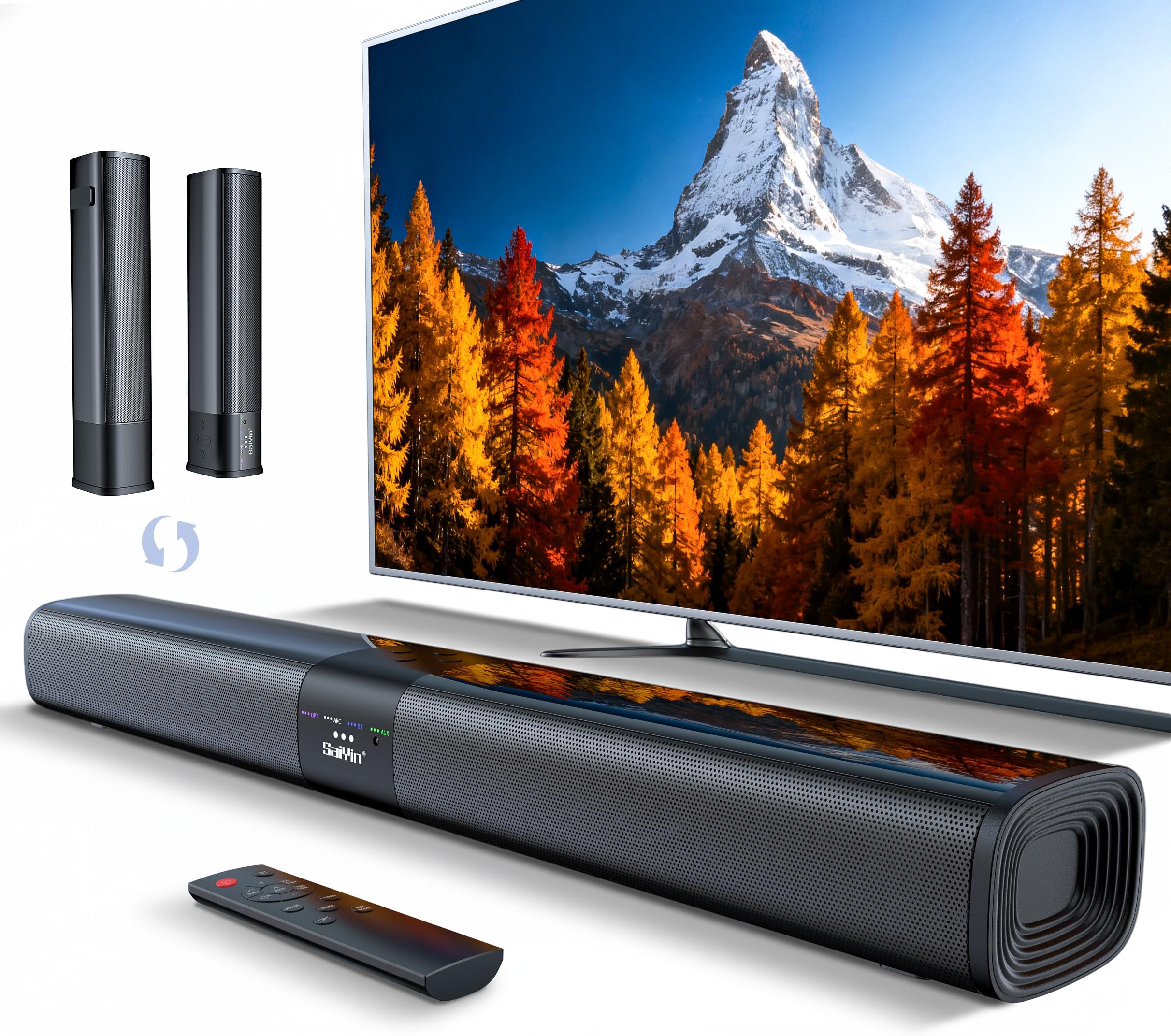
The Saiyin soundbar occupies the entry-level sweet spot by using two 3.9-by-2.1-inch oval full-range drivers — a larger diaphragm area than the round drivers found in many bars at this level. The oval shape allows more air displacement without increasing the cabinet height, which explains how this 2.0 bar reaches 98dB of output. The bar is detachable: a screw-on base turns the single unit into two tower speakers that can be placed apart for a wider stereo image. Bluetooth 5.3, optical, AUX, and ARC connections cover all common inputs.
Owners consistently praise the clarity and volume. Multiple reviews note that the bass vibrates the floor in smaller rooms, which is unexpected for a 2.0 bar without a subwoofer. The oval drivers are the reason — they move more air than circular drivers of the same height. The ARC connection allows the TV remote to control power and volume, and the included wall-mount kit provides an alternative to desktop placement. The rounded corner design and matte black finish look clean under most televisions.
The downside is the optical connection setup requirement: the television’s audio output must be set to PCM, and Dolby or DTS processing must be disabled, or the bar produces crackling noise or no sound at all. This is a common instruction across budget soundbars, but it is not prominently indicated in the packaging. Some owners note that the bass port on the separate towers can produce chuffing noise between 70 and 110 Hz, which can be mitigated by stuffing foam into the port. For the price, this bar delivers surprising output and flexibility, but it rewards users who are comfortable with a minor setup adjustment.
Why it’s great
- Oval full-range drivers displace more air for richer sound than round drivers
- Detachable towers create a wider stereo field than a single bar
- 98dB max output fills medium rooms with authority
- ARC support enables single-remote control with most modern televisions
Good to know
- Optical connection requires manual PCM setting and disabling of Dolby/DTS
- Bass port chuffing noise can occur between 70-110 Hz in untreated setups
- Setup instructions for optical mode are not prominently displayed in the box
FAQ
Will a 2.0 soundbar sound better than my TV speakers?
What does the PCM setting do for optical connections?
Can I control the soundbar with my existing TV remote?
Final Thoughts: The Verdict
For most users, the best budget tv speakers winner is the TCL S45H because it brings Dolby Atmos spatial processing, AI room calibration, and 100 watts of clean power into a low-profile bar that works with any television. If you want deep bass and physical impact from a dedicated subwoofer, grab the Wohome S100 Pro. And for Fire TV users who demand seamless one-remote control in a compact footprint, nothing beats the Amazon Fire TV Soundbar.

Mo Maruf
I created WellFizz to bridge the gap between vague wellness advice and actionable solutions. My mission is simple: to decode the research and give you practical tools you can actually use.
Beyond the data, I am a passionate traveler. I believe that stepping away from the screen to explore new environments is essential for mental clarity and physical vitality.