Our readers keep the lights on and my smoothie glass nicely filled. As an Amazon Associate, I earn from qualifying purchases.
A real surround sound system uses multiple speakers placed around the room to create a three-dimensional audio bubble. Most “budget” systems skip the rear speakers entirely, relying on virtual processing that rarely delivers the spatial separation promised on the box. The challenge is finding a configuration with actual rear channels, a dedicated subwoofer, and dialogue clarity—without the price tag of a full AVR setup.
I’m Mohammad Maruf — the founder and writer behind WellFizz. I’ve spent years analyzing the intersection of home theater specifications and real-world value, focusing on how channel count, driver size, and audio codec support translate into tangible listening experiences at accessible price points.
Below, we cut through the marketing noise to identify the systems that deliver genuine immersion. Whether you prioritize Dolby Atmos height effects or a thumping subwoofer for movie nights, this guide to the best budget surround sound system focuses on setups that build a true sound field around your seating position.
How To Choose The Best Budget Surround Sound System
Building a surround setup on a budget means weighing channel configuration against audio quality and connectivity. The most common pitfall is buying a “surround sound” soundbar that relies solely on psychoacoustic tricks rather than physical rear speakers. Focus on these three factors to make the right call.
Channel Count vs. Actual Speaker Placement
A 5.1 system with five discrete satellite speakers and one subwoofer provides genuine separation—sounds move from front to back, not just left to right. A 2.1 or 3.1 bar, even with virtual processing, cannot recreate that spatial depth. If physical rear speakers are impossible due to room layout, look for a system with wireless surrounds that you can place on side tables or stands without running cables across the floor.
Subwoofer Driver Size and Frequency Response
The subwoofer handles all low-frequency effects, from explosions to bass lines. A 6.5-inch driver is the minimum for satisfying rumble in a medium room; a 10-inch driver will pressurize a larger space. Pay attention to the frequency response spec: a subwoofer that reaches down to 40 Hz is noticeably more immersive than one that bottoms out at 60 Hz. You want that low-end extension to feel the impact of action scenes.
HDMI eARC and Codec Support
HDMI eARC (Enhanced Audio Return Channel) is critical for passing lossless audio like Dolby TrueHD from streaming apps or Blu-ray players. Without it, you are limited to compressed Dolby Digital Plus. For budget buyers, at least one HDMI input with ARC is essential, and eARC is a serious bonus. Dolby Atmos support with up-firing or dedicated height drivers adds vertical dimension that standard 5.1 cannot match, making overhead effects like rain or helicopter flyovers feel authentic.
Quick Comparison
On smaller screens, swipe sideways to see the full table.
| Model | Category | Best For | Key Spec | Amazon |
|---|---|---|---|---|
| ULTIMEA Skywave F40 | Premium | Dolby Atmos immersion | 5.1.2ch up-firing Atmos | Amazon |
| Hisense AX5140Q | Premium | Feature-packed 5.1.4 setup | 5.1.4ch with up-firing rears | Amazon |
| Amazon Fire TV Soundbar Plus | Mid-Range | Seamless Fire TV integration | 5.1ch with wireless surrounds | Amazon |
| Samsung HW-Q600F | Mid-Range | Q-Symphony with Samsung TVs | 3.1.2ch with up-firing Atmos | Amazon |
| TCL Q85H | Premium | Full 7.1.4 channel count | 7.1.4ch with AI sonic tuning | Amazon |
| LG S40TR | Mid-Range | WOW Orchestra with LG TVs | 4.1ch wireless rear speakers | Amazon |
| Samsung HW-B550F | Value | Compact virtual surround | 2.1ch DTS Virtual:X | Amazon |
| ULTIMEA Poseidon D70 | Value | Seven physical channels | 7.1ch with wired surrounds | Amazon |
| Bobtot 5.1 System | Budget | Traditional AVR-style setup | 10-inch sub, karaoke mics | Amazon |
In‑Depth Reviews
1. ULTIMEA 5.1.2ch Sound Bar with Dolby Atmos (Skywave F40)
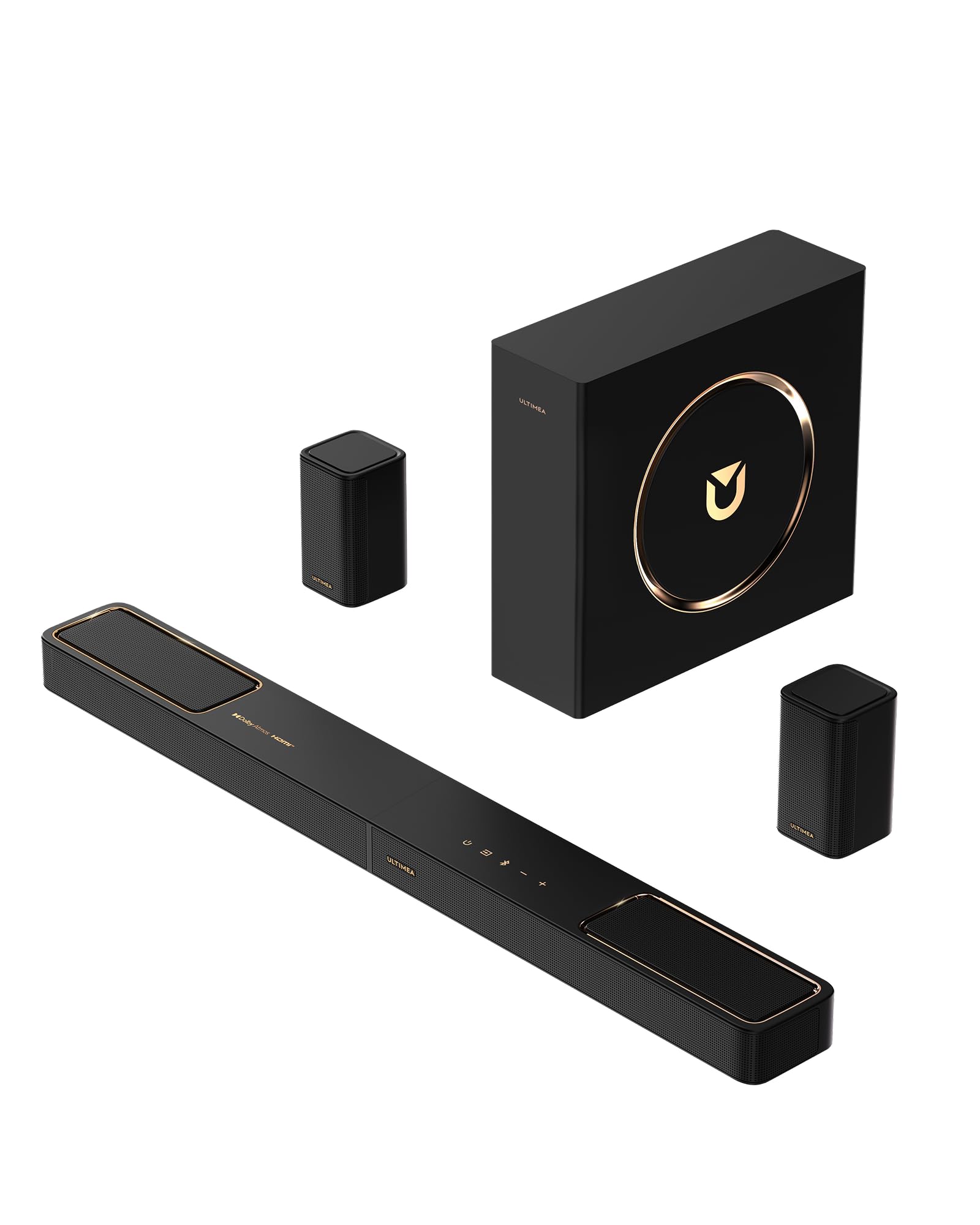
The Skywave F40 delivers Dolby Atmos via dedicated up-firing drivers with neodymium cores, which produce cleaner high-frequencies and a more focused vertical soundstage than typical budget implementations. The 5.1.2-channel configuration includes two wired rear surround speakers and a 5.25-inch subwoofer, giving you discrete side-to-side motion plus overhead effects. It also supports HDMI eARC for lossless 5.1.2-channel audio up to 37 Mbps, avoiding the compression that plagues optical connections.
SurroundX technology uses spatial algorithms to position audio precisely around and above the listener, while the Ultimea app provides 13-step surround level adjustment and a 10-band graphic EQ. The 121 preset equalizer matrices let you dial in bass-heavy movie presets or a flatter music curve without manual tweaking. OTA firmware updates ensure the DSP improves over time, which is rare at this tier.
On the downside, the subwoofer is wired (not wireless), and the system does not support DTS codecs. The rear speakers connect via cables to the subwoofer, so you must plan placement accordingly. Owners consistently praise the installation ease and the dramatic upgrade over TV speakers, with one noting the sound “made the salon a theater” on a sailboat. For buyers who want true object-based audio without crossing into the mid-hundreds, this is the strongest value.
Why it’s great
- Genuine up-firing drivers for Atmos height effects
- HDMI eARC for lossless audio transmission
- Extensive EQ control via app with 121 presets
Good to know
- Subwoofer requires a wired connection to soundbar
- No DTS:X or DTS compatibility
2. Hisense AX5140Q 5.1.4ch Soundbar System
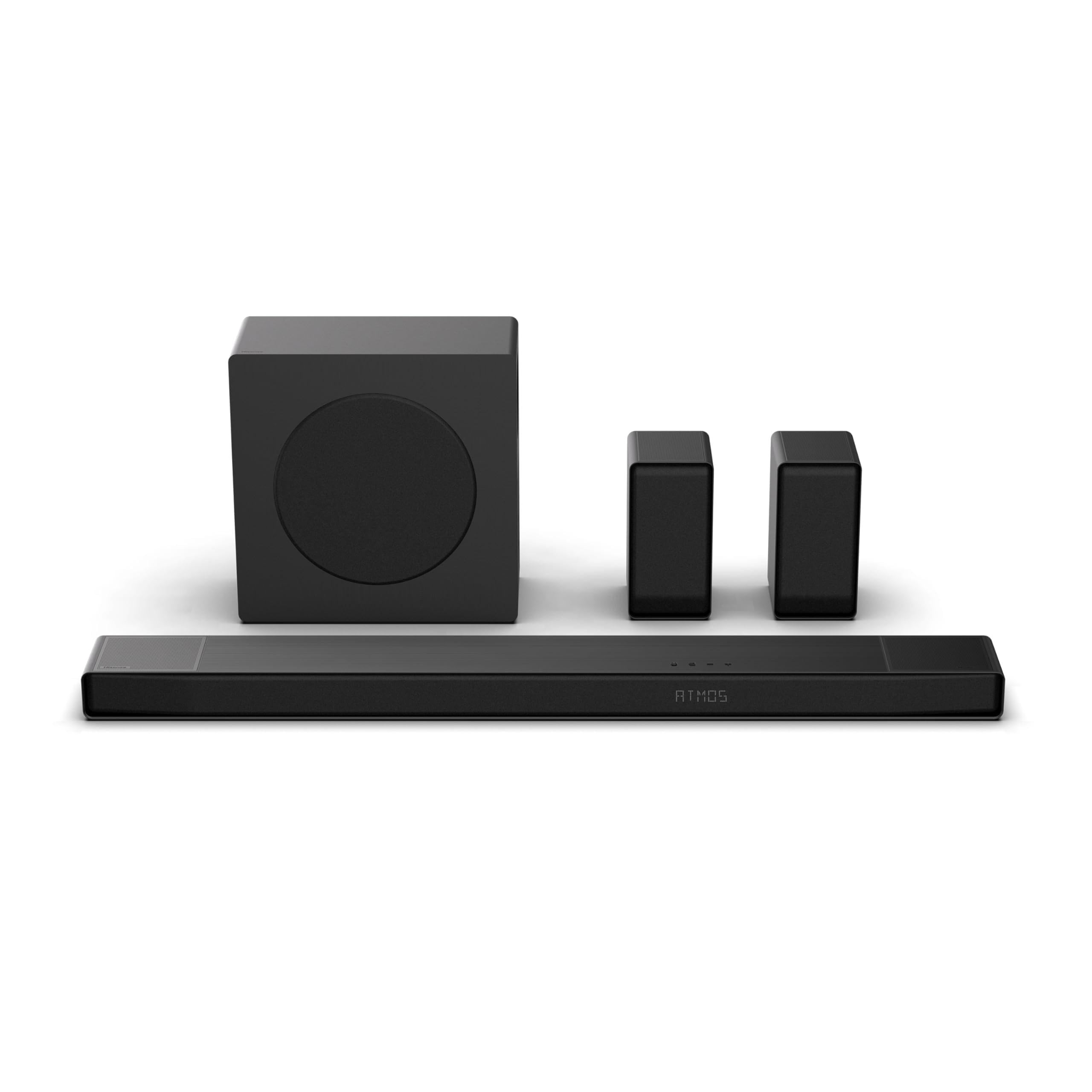
The Hisense AX5140Q packs a 5.1.4-channel layout with two up-firing drivers in the soundbar and two more in the rear satellite speakers, creating four height channels for overhead Dolby Atmos content. The 6.5-inch wireless subwoofer hits a frequency response down to 40 Hz, delivering deep bass that feels substantial in medium to large living rooms. HDMI eARC support allows single-cable connection with 4K HDR passthrough, so you do not lose video quality when routing through the bar.
Seven EQ presets (Music, Movie, Voice, Sports, Night, AI, and Game) give quick access to optimized audio curves without navigating an app. The built-in room calibration feature analyzes your space and adjusts the soundstage automatically, which is a premium capability found on systems costing considerably more. Bluetooth 5.3 provides stable wireless streaming from a phone or tablet with minimal latency.
While the surround effect is convincing, the rear speakers can feel slightly underpowered in open-concept spaces larger than 400 square feet. Some users report occasional audio garbling when streaming via Bluetooth from an iPhone, though the HDMI connection remains flawless. For a complete Atmos setup that includes rear up-firing drivers and a wireless subwoofer, the AX5140Q offers a rare combination of features at a competitive price.
Why it’s great
- Four up-firing drivers for extensive height coverage
- Automatic room calibration
- 4K HDR passthrough with HDMI eARC
Good to know
- Rear speakers may lack power in large rooms
- Occasional Bluetooth audio glitch reported
3. Amazon Fire TV Soundbar Plus with Subwoofer & Surrounds

The Amazon Fire TV Soundbar Plus is a true 5.1 system with a dedicated center channel for dialogue, two wireless rear speakers, and a wireless subwoofer. The center channel is particularly effective—owners consistently report that voices are crisp and intelligible even during complex action sequences, with a five-level dialogue boost adjustable via the remote. Dolby Atmos and DTS:X support add a layer of object-based immersion, though there are no physical up-firing drivers; the system relies on psychoacoustic processing to create height effects.
Setup is remarkably simple: the subwoofer and rear speakers pair automatically with the soundbar after plugging into power. The system uses HDMI-ARC for control, so your existing TV remote handles power and volume. Dedicated sound modes (Movie, Music, Sports, Night) optimize the output for different content types, and Bluetooth streaming from a phone or tablet works without a hitch.
The main limitation is the lack of physical Atmos drivers—the height virtualization is decent but not as convincing as systems with up-firing hardware. The bass, while tight and punchy, does not reach the deepest frequencies of larger subwoofers. That said, for a completely wireless, no-hassle 5.1 setup with excellent dialogue clarity and Dolby Atmos/DTS:X support, this is a standout option that integrates seamlessly into any smart TV environment.
Why it’s great
- True wireless rear speakers with auto-pairing
- Five-level dialogue boost for clear voices
- Supports Dolby Atmos and DTS:X
Good to know
- No physical up-firing drivers for Atmos
- Subwoofer placement limited to 12 inches from wall
4. Samsung HW-Q600F 3.1.2ch Soundbar
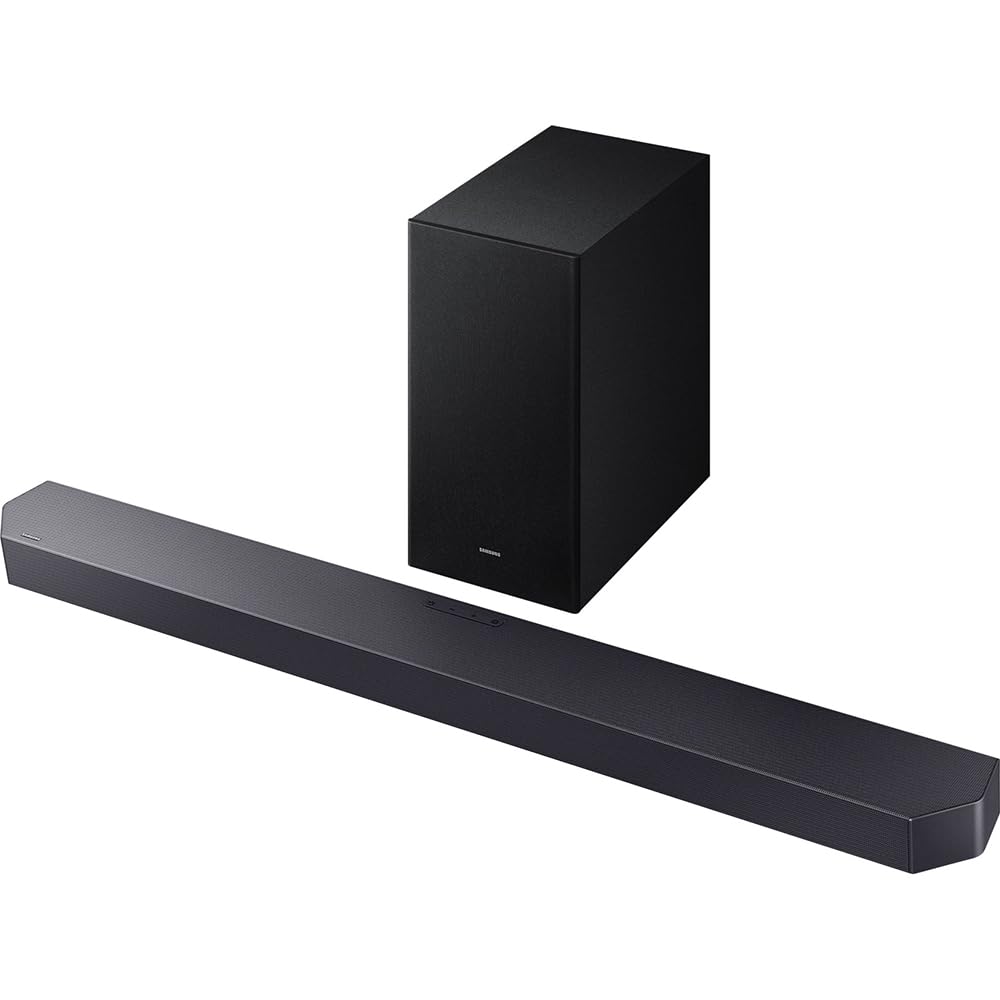
The Samsung HW-Q600F uses a 3.1.2-channel array with two up-firing drivers and a dedicated wireless subwoofer to deliver true Dolby Atmos and DTS Virtual:X immersion. What sets it apart is Q-Symphony—a feature that synchronizes the soundbar’s speakers with compatible Samsung TV speakers to create a wider, more cohesive soundstage. Adaptive Sound analyzes each scene in real time and adjusts equalization to keep dialogue clear while maintaining surround effects. Game Pro Mode automatically optimizes the audio when a console is detected, enhancing directional cues for competitive play.
SpaceFit Sound calibration measures your room’s acoustics and compensates for furniture placement, wall reflections, and room shape. The system is also expandable with an optional wireless rear speaker kit, turning the 3.1.2 setup into a full 5.1.4 configuration down the line. HDMI eARC simplifies connectivity, and the soundbar can be controlled via a Samsung TV remote for a unified experience.
The 3.1.2 channel count means you are starting with fewer physical speakers than a 5.1 system—the surround field relies heavily on virtual processing from the front bar. Owners note that the bass from the 6.5-inch subwoofer is powerful enough for a normal-sized room, but those wanting distinct rear effects will need the additional speaker kit. For Samsung TV owners who want seamless integration and future expansion, the HW-Q600F is a smart starting point.
Why it’s great
- Q-Symphony harmonizes with Samsung TVs
- SpaceFit Sound room calibration
- Expandable with wireless rear speakers
Good to know
- 3.1.2 — rear speakers sold separately for true surround
- Best value for Samsung TV owners specifically
5. TCL Q85H 7.1.4 Surround Sound Bar

The TCL Q85H is a full 7.1.4-channel system with a 42-inch soundbar, two rear speakers that each contain both forward-firing and up-firing drivers, and a 6.5-inch wireless subwoofer. The 7.1.4 configuration provides seven horizontal channels (left, center, right, side left, side right, rear left, rear right), one subwoofer channel, and four height channels for Dolby Atmos and DTS:X. The rear speakers with built-in up-firing drivers are the defining feature here—they create overhead effects behind the listening position that most budget systems cannot replicate.
AI Sonic optimization tunes the output to your room and seating position via the TCL app, adjusting channel levels and equalization automatically. The 860W peak power rating ensures the system can fill a large living room without distortion, and owners consistently describe the sound as “theater-like” with deep, room-shaking bass. Setup is plug-and-play with HDMI eARC, and the system works with any smart TV.
The system does not support 4K/120Hz passthrough, which may disappoint gamers with next-gen consoles. Some users note that non-Atmos content can sound comparatively quiet, requiring individual channel adjustment. The price is higher than most budget options, but for a complete, real 7.1.4 setup with discrete rear height channels, the Q85H delivers a level of immersion that justifies the stretch for serious home theater enthusiasts.
Why it’s great
- True 7.1.4 with rear up-firing speakers
- AI Sonic tuning for room-specific calibration
- Powerful, distortion-free 860W output
Good to know
- No 4K/120Hz passthrough for gaming
- Non-Atmos content may need EQ adjustment
6. LG S40TR 4.1ch Soundbar with Wireless Rear Speakers

The LG S40TR is a 4.1-channel system that combines an LG soundbar with a wireless subwoofer and wireless rear speakers, delivering genuine surround sound without the need for a separate receiver. WOW Orchestra allows the soundbar to pair with compatible LG TV speakers for a fuller soundstage, while WOW Interface enables on-screen control of soundbar settings directly from the LG TV menu. Dolby Audio and DTS Digital Surround provide enhanced sound quality for all content, and Clear Voice Plus analyzes audio to improve dialogue clarity through the center speakers.
The rear speakers connect wirelessly to the soundbar, requiring only power outlets—no long cable runs. The Smart Up-Mixer converts 2-channel stereo into multi-channel audio, widening the soundstage for music and older content. The LG Soundbar App provides a 3-band equalizer for customizing bass, treble, and midrange frequencies. The crest design with a metal grill adds a premium aesthetic while protecting the drivers from dust.
The 4.1 channel count means there is no dedicated center channel, so dialogue clarity relies on the soundbar’s virtual processing rather than a physically separate driver. Some users note that the bass, while solid, does not pressurize larger rooms as effectively as bigger subwoofers. For LG TV owners seeking seamless integration and a clean, wireless surround layout, the S40TR is an excellent fit at a modest price.
Why it’s great
- True wireless rear speakers with simple setup
- WOW Orchestra syncs with LG TV speakers
- On-screen WOW Interface control
Good to know
- No dedicated center channel driver
- Subwoofer size limited for large rooms
7. Samsung B-Series HW-B550F 2.1ch Soundbar

The Samsung HW-B550F is a 2.1-channel soundbar with a wireless subwoofer that uses DTS Virtual:X to create a multi-directional spatial soundfield from a front-only speaker array. While it lacks physical rear speakers, the virtual processing does widen the soundstage significantly—especially for movies and games encoded with spatial audio. Adaptive Sound automatically detects the type of content playing and adjusts equalization to prioritize dialogue for news or bass for action scenes. Bass Boost adds an extra punch for beat-heavy music and explosive film moments.
Voice Enhance Mode amplifies dialogue frequencies to make conversations stand out, which is a useful feature for those who struggle with TV speaker clarity. The subwoofer adds a tangible low-end rumble that TV speakers simply cannot match, and the system works with any TV via HDMI ARC or optical connection. The optional rear speaker kit (sold separately) allows expansion to a full surround setup in the future.
Without physical rear speakers, the surround effect is limited compared to 5.1 or 4.1 systems. The virtual processing can feel diffuse rather than precise during complex audio scenes. However, for small apartments, bedrooms, or secondary TVs where running speaker wire is impractical, the HW-B550F provides a noticeable upgrade in immersion and bass extension without requiring additional speakers. It is a solid entry-level solution for those who want better-than-TV audio with minimal footprint.
Why it’s great
- DTS Virtual:X creates a wider soundstage
- Adaptive Sound auto-tunes to content
- Voice Enhance Mode for clear dialogue
Good to know
- 2.1 channel — no physical rear speakers
- Surround effect relies on virtual processing
8. ULTIMEA 7.1ch Poseidon D70

The ULTIMEA Poseidon D70 is a 7.1-channel system that includes four wired surround speakers (two front, two rear) plus a soundbar and a 6.5-inch wireless subwoofer. Unlike virtual surround bars, this configuration places discrete speakers at the front and rear of the room, creating genuine spatial separation. The 13 adjustable surround levels allow fine-tuning of the rear speaker volume to match room size and seating distance. The 410W peak power ensures enough headroom for dynamic movie soundtracks without noticeable distortion at moderate volumes.
The Ultimea Smart App provides 121 preset equalizer matrices across four styles (Bass, Pop, Classical, Rock) plus a 10-band graphic EQ for full manual control. The app also supports OTA firmware updates, which can improve sound processing algorithms over time. Setup is straightforward with color-coded speaker wires, and the 20-foot rear speaker cables give flexibility for speaker placement in typical living rooms. The system works via HDMI, Optical, or Bluetooth 5.4.
While the channel count is impressive on paper, the D70 does not support Dolby Audio or Atmos codecs—it relies on PCM 2.0 input, so the 7.1 processing is done by the soundbar rather than being decoded from a native multichannel stream. Some users note that movie bass can feel underwhelming at lower volumes unless the subwoofer level is boosted. For the price, however, the physical speaker density and adjustable surround field are hard to beat for buyers who prioritize direct rear-channel audio over codec compatibility.
Why it’s great
- Four physical surround speakers for true separation
- 13-level surround adjustment for custom balance
- Extensive EQ options via app
Good to know
- Does not support Dolby Atmos or Dolby Audio
- Bass may need boosting at lower volumes
9. Bobtot Home Theater System 5.1/2.1
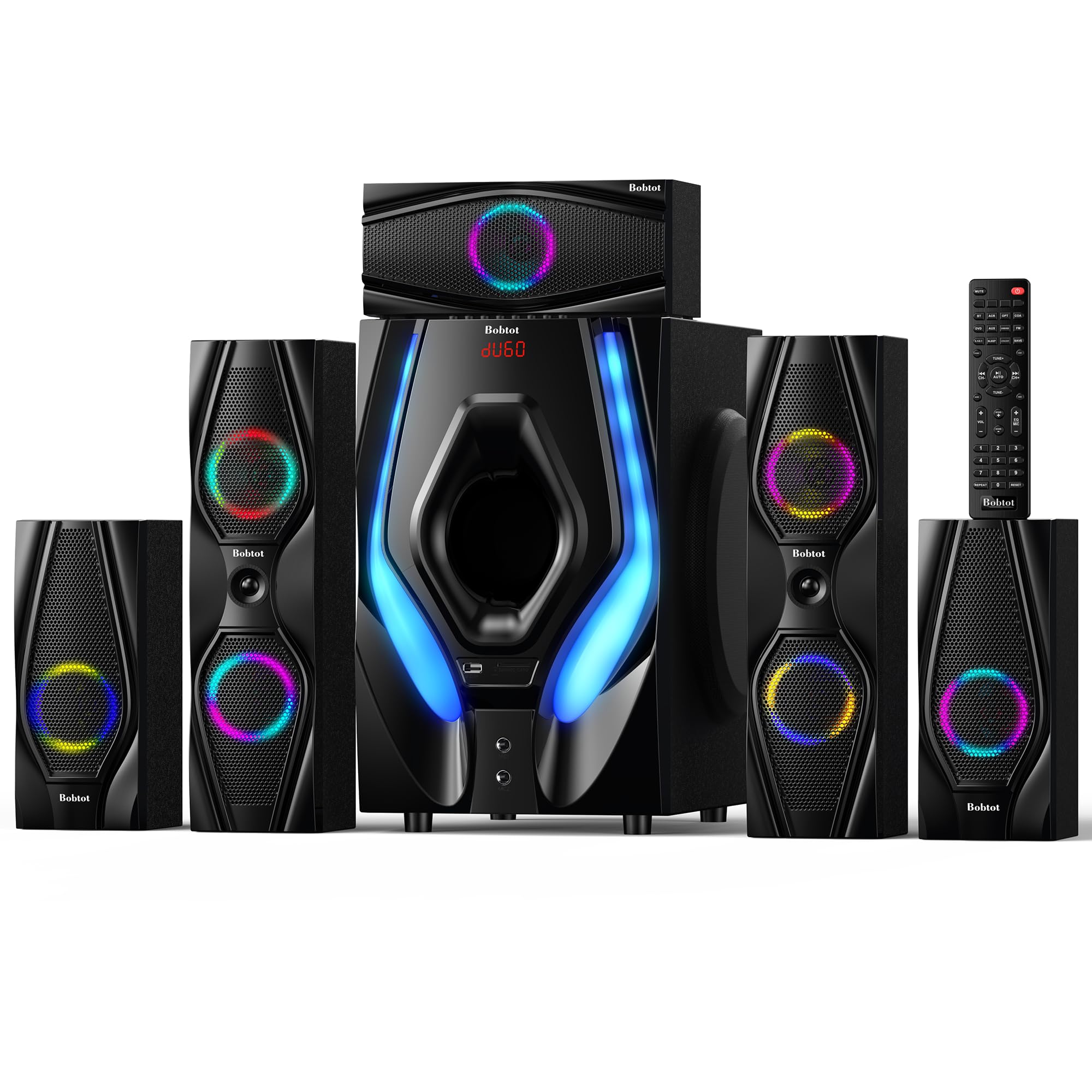
The Bobtot system takes a traditional approach: a 10-inch subwoofer with a built-in receiver connects to five passive satellite speakers and a center channel, forming a classic 5.1 surround layout. The 10-inch driver produces deep, room-shaking bass that systems with 6.5-inch subwoofers simply cannot match—this is the most physically impactful subwoofer on this list. The 1200W peak power rating provides substantial headroom for filling larger rooms with clear, loud audio, and the system includes two 1/4-inch microphone inputs with echo control for karaoke sessions.
Four LED lighting modes on the subwoofer (blink to beat, solid on, spectrum EQ analyzer, off) add visual ambiance for parties or movie nights. Bluetooth 5.3 supports direct streaming from phones and tablets, while ARC, optical, coaxial, AUX, USB, and FM radio inputs provide near-universal compatibility. The included cables are generous: rear speaker wires reach 31 feet, allowing flexible placement without extensions. The remote control independently adjusts the volume of each speaker channel and the subwoofer.
Build quality and reliability are concerns—several owners report subwoofer failures within the first year, though the manufacturer provided replacements via email. The center channel speaker is tall and may block the TV remote sensor if placed directly in front of a TV. Distortion becomes noticeable at very high volume levels, though this is common at this price point. For buyers who want a true 5.1 system with a massive subwoofer and karaoke capability as the primary draw, the Bobtot delivers a unique feature set that no soundbar can replicate.
Why it’s great
- 10-inch subwoofer provides powerful, deep bass
- Two microphone inputs with echo for karaoke
- Individual channel volume control
Good to know
- Reliability concerns reported with subwoofer
- Center speaker may block TV sensor
FAQ
Is a soundbar with virtual surround as good as a system with rear speakers?
Do I need HDMI eARC for a budget surround system?
How important is Dolby Atmos for a budget system?
Final Thoughts: The Verdict
For most users, the best budget surround sound system winner is the ULTIMEA Skywave F40 because it packs genuine Dolby Atmos with up-firing drivers, HDMI eARC for lossless audio, and extensive EQ control—all at a price that undercuts competing Atmos systems by a wide margin. If you want a fully wireless 5.1 setup with outstanding dialogue clarity and Fire TV integration, grab the Amazon Fire TV Soundbar Plus. And for a traditional 5.1 system with a massive 10-inch subwoofer and karaoke capability that no soundbar can match, nothing beats the Bobtot Home Theater System.

Mo Maruf
I created WellFizz to bridge the gap between vague wellness advice and actionable solutions. My mission is simple: to decode the research and give you practical tools you can actually use.
Beyond the data, I am a passionate traveler. I believe that stepping away from the screen to explore new environments is essential for mental clarity and physical vitality.