Our readers keep the lights on and my smoothie glass nicely filled. As an Amazon Associate, I earn from qualifying purchases.
Stepping into solar power no longer requires a second mortgage on your home. Affordable photovoltaic panels now deliver reliable off-grid electricity for RVs, camping, emergency backup, and small cabin setups, with conversion rates that rival their expensive counterparts just a few years ago. The trick is knowing which specs actually matter—and which build features separate a lasting investment from a quick disappointment.
I’m Mohammad Maruf — the founder and writer behind WellFizz. I’ve spent hundreds of hours digging into technical specifications, customer longevity reports, and real-world wattage output data to separate marketing claims from true performance in the affordable solar market.
This guide examines seven of the most compelling picks to help you find the best budget solar panels that match your specific power needs and gear compatibility.
How To Choose The Best Budget Solar Panels
Picking the right affordable solar panel means focusing on three key factors: cell efficiency, connector compatibility with your existing gear, and build durability for the environment you plan to use it in. A high wattage rating means nothing if the voltage doesn’t match your power station’s input range, and a low weight isn’t helpful if the panel can’t handle a sudden rain shower.
Cell Type and Conversion Efficiency
Almost every budget-friendly option in this space uses monocrystalline silicon cells because they offer the best space-to-power ratio and perform better in low-angle light than polycrystalline panels. Look for efficiency ratings between 23% and 25%—anything below 20% indicates older cell technology that will require more surface area for the same wattage.
Voltage, Connectors, and Power Station Pairing
A 12V nominal panel typically produces around 18V to 23V open-circuit, which is ideal for charging most portable power stations. Check your generator’s input voltage range carefully—some smaller stations top out at 60W input, so a 100W panel won’t charge them any faster than a 60W panel. The connector type matters too: XT60, Anderson, DC7909 (8mm), and DC5521 are the most common standards, and the best budget panels include multiple adapters or a 5-in-1 cable.
Build Quality and Weather Resistance
For portable foldable panels, ETFE coating is superior to PET because it offers better light transmission, higher heat resistance, and longer outdoor lifespan. Rigid panels should have a corrosion-resistant aluminum frame and tempered glass. IP65 or IP67 waterproof ratings are essential if you plan to leave the panel in an exposed location—the junction box is typically the weak point on budget models.
Quick Comparison
On smaller screens, swipe sideways to see the full table.
| Model | Category | Best For | Key Spec | Amazon |
|---|---|---|---|---|
| HQST 200W Ultra-Light | Premium Foldable | High-capacity portable power | 25% N-Type Cell Efficiency | Amazon |
| ZOUPW 100W Foldable | Mid-Range Foldable | Universal power station pairing | 5-in-1 Adapter Cable | Amazon |
| Topsolar 100W Kit | Premium Rigid Kit | Permanent 12V battery charging | 30A Charge Controller Included | Amazon |
| JJN 200W Rigid Panels | Mid-Range Rigid Pair | Fixed roof or ground installation | 10BB Monocrystalline Cells | Amazon |
| DOKIO 100W Solar Suitcase | Entry-Level Suitcase | Alligator clip battery charging | Built-in PWM Controller | Amazon |
| FlexSolar 60W Foldable | Budget Foldable | Small device and 300Wh station charging | USB-C PD 60W Output | Amazon |
| Keshoyal 60W Foldable | Entry-Level Foldable | Ultra-light backpacking charging | 4 lbs Weight | Amazon |
In‑Depth Reviews
1. HQST 200W Ultra-Light Portable Solar Panel
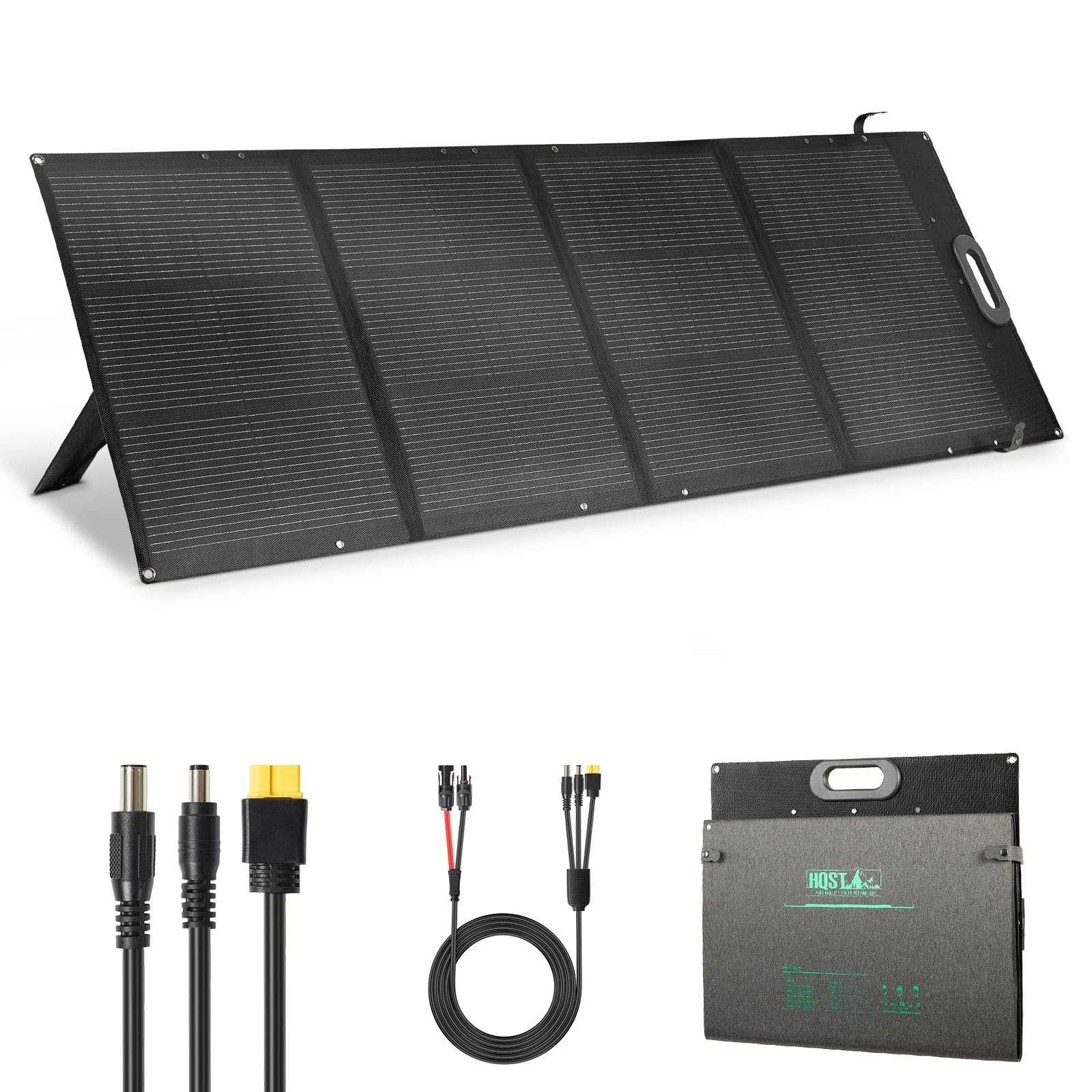
The HQST 200W panel sits at the top of the budget-friendly spectrum because it packs next-gen 16BB N-Type cells that achieve 25% efficiency—a full two percentage points above standard monocrystalline panels. This means it harvests more energy from the same sunlight, especially during overcast conditions, and it’s 37% lighter than most 200W competitors at just 11 pounds. The foldable design collapses to under two inches thick with built-in buckles, making it genuinely portable for RV trips and overlanding.
Two adjustable kickstands support 40° to 60° angles, and the rigid foldable design stays stable on uneven ground without collapsing like softer fabric panels. The included 4.9-foot 3-in-1 adapter cable covers XT60, DC7909 (8mm), and DC5521 connectors, ensuring broad compatibility with Jackery, EcoFlow, BLUETTI, and Anker power stations. The fully laminated construction with PVDF coating eliminates stitched seams where water typically seeps in, backed by a 12-month warranty and lifetime technical support.
Real-world owners report that the panel consistently delivers near its rated 200W output, with one user measuring 21V open-circuit in direct late-afternoon sun. Some units have arrived with minor cosmetic dents from shipping, but the panels themselves perform exactly as specified. The combination of high efficiency, lightweight portability, and robust waterproofing makes this the best all-around choice for anyone wanting serious portable power without a premium price tag.
Why it’s great
- 25% N-Type cell efficiency outperforms standard panels in low light
- 37% lighter than typical 200W portable panels at 11 lbs
- IP67 waterproof with fully laminated, seam-free construction
Good to know
- Adapter cable is only 4.9 feet, which may be short for some setups
- Shipping packaging could be more protective to prevent minor frame dents
2. ZOUPW 100W Portable Solar Panel

The ZOUPW 100W panel is a mid-range standout because its 5-in-1 adapter cable is genuinely universal—it includes DC8020 for newer Jackery models, XT60 for EcoFlow and Anker, Anderson for older Jackery units, DC7909 (8mm) for BLUETTI, and DC5521 for generic power stations. This eliminates the adapter hunt that frustrates many budget panel buyers. The A+ monocrystalline cells achieve 23.5% efficiency, and the ETFE coating provides superior heat resistance and light transmittance compared to cheaper PET laminates.
The panel weighs 9.48 pounds and folds to 24.13 x 21.06 x 1.77 inches with a magnetic carry handle. Two adjustable kickstands allow a 45° tilt to capture up to 25% more sunlight than flat positioning. The built-in controller includes three direct charging ports—one USB-C PD at 15V/3A and two USB-A including QC3.0—so you can charge phones, tablets, and cameras directly without a power station. The IP67 rating means it can handle rain and splashes, though the zippered pocket protects the internal components.
Owners consistently report strong performance, with one user noting it charged their Jackery Explorer 300 from 84% to 100% in about 20 minutes on a cloudy day. Another reviewer compared it head-to-head with name-brand panels and found it delivered near-top performance among all 100W foldable options. The magnetic clasp and spacious storage pouch are appreciated for daily use. The only minor complaint is that the USB-C PD port maxes out around 45W rather than the full 60W, but this rarely affects real-world device charging.
Why it’s great
- 5-in-1 connector cable covers almost every power station brand
- IP67 waterproof ETFE coating for reliable outdoor use
- Built-in USB-C PD and QC3.0 ports for direct device charging
Good to know
- Heavier than some competitors at 9.48 lbs for a 100W panel
- USB-C PD output is limited to ~45W in practice
3. Topsolar 100W 12V Solar Panel Kit

The Topsolar 100W kit is built for buyers who want a turnkey solution for 12V battery charging without piecing together components. The package includes a monocrystalline panel with a heavy-duty anodized aluminum frame and tempered glass, a 30A PWM charge controller, V-shape tilt mount brackets, two 16-foot MC4 cables, and two 5-foot O-ring battery cables. This is an all-in-one kit designed for RVs, boats, cabins, gate openers, and off-grid battery maintenance.
The panel measures 46.5 x 21.8 x 1.37 inches and weighs 15.84 pounds, making it heavier than foldable options but far more durable for permanent or semi-permanent installation. The aluminum frame is corrosion-resistant, and the tempered glass coating protects the cells from hail and debris. The intelligent charge controller provides overcharge, over-discharge, over-voltage, and short-circuit protection, and the tilt bracket allows you to adjust the angle for optimal seasonal sun exposure.
Customer reviews consistently highlight the straightforward installation and reliable performance. One owner has been using the kit on their RV roof for three years without issues. A common workaround is that the pre-drilled mounting holes don’t always align with roof rails, but users easily drill through the aluminum frame to match their setup. The only functional limitation reported is that once the controller is set to 24V mode, it cannot be switched back to 12V without expert intervention.
Why it’s great
- Complete kit includes everything needed for 12V battery charging
- 30A charge controller with comprehensive protection features
- Durable anodized aluminum frame and tempered glass construction
Good to know
- Mounting holes may not align with all RV roof rails
- Charge controller voltage setting cannot be easily changed after initial setup
4. JJN 200 Watt Solar Panels (2 x 100W)
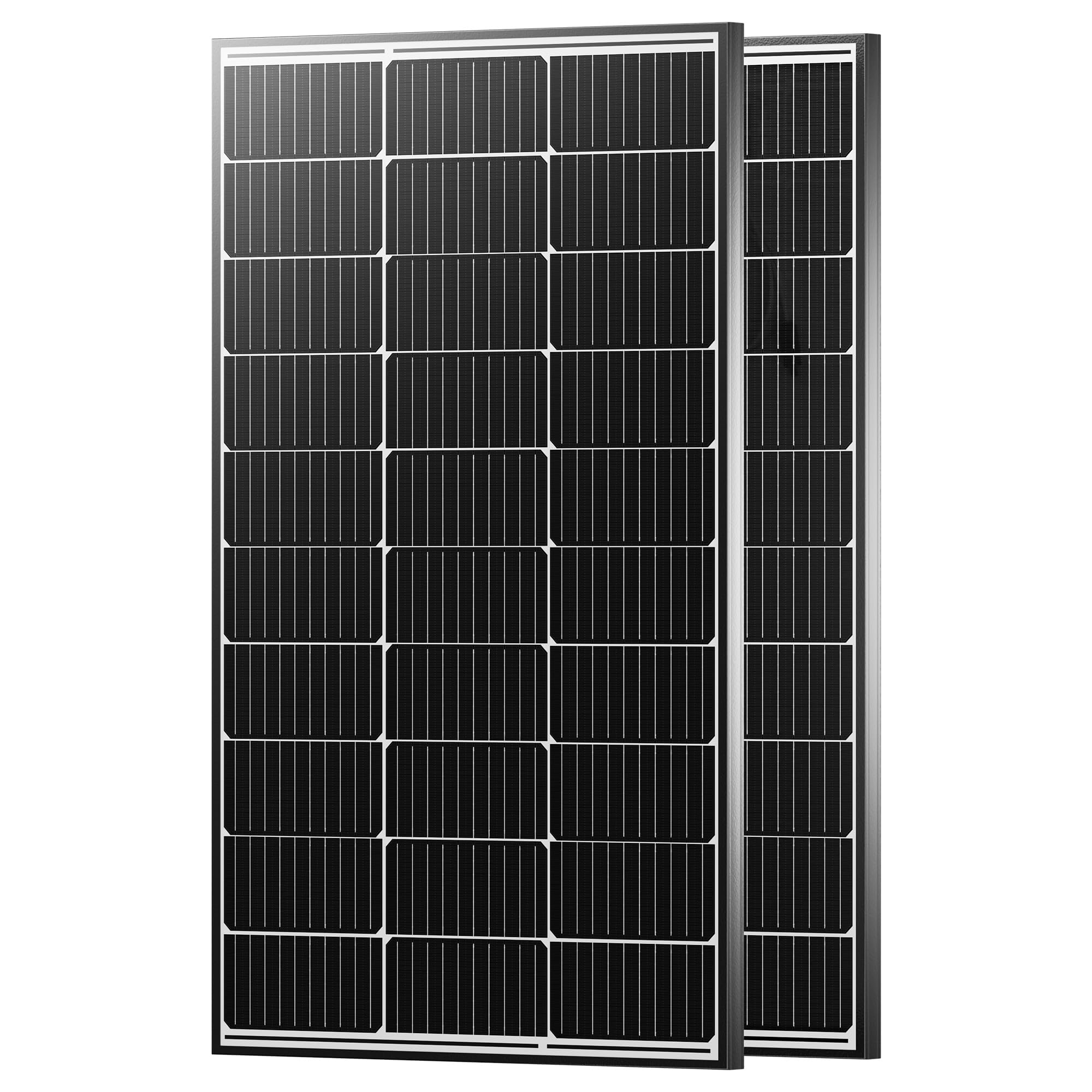
The JJN package delivers two 100-watt rigid monocrystalline panels using Grade A+ cells with a 10BB busbar design that achieves 23% conversion efficiency. Each panel measures 38.2 x 22.7 x 1.2 inches and is built with a corrosion-resistant aluminum frame and tempered glass, making them suitable for rooftop, ground, or pole-mounted installations. The panels come pre-drilled for straightforward mounting and include no controller or cables—this is a panel-only purchase for those who already have a charge controller and wiring.
The true advantage here is the 10BB busbar layout, which reduces the current path length across each cell, minimizing resistive losses and improving performance under partial shading. Rigorous EL testing ensures zero microcracks, and the panels are backed by a 30-year transferable power output warranty from the manufacturer. With an open-circuit voltage of 20.8V and a rated current of 6.42 amps, two panels wired in series provide an ideal 41.6V input for 24V MPPT charge controllers.
Real-world performance data from owners is impressive—one user reported 190-194W output from the pair in March sun, close to the rated 200W. Another user runs four panels on a 24V system that delivers 15A during summer, powering an entire small workshop. A common caveat is that the panels average around 90W each in clear conditions rather than the full 100W, though this is typical for most budget rigid panels. One customer received a shattered panel due to poor packaging, but the replacement process was handled quickly.
Why it’s great
- 10BB busbar cells reduce resistive losses for better shading performance
- 30-year transferable power output warranty
- Two panels in series ideal for 24V MPPT systems
Good to know
- Panel-only package requires separate charge controller and wiring
- Some units arrive with minor shipping damage to the frame
5. DOKIO Solar Suitcase 100W
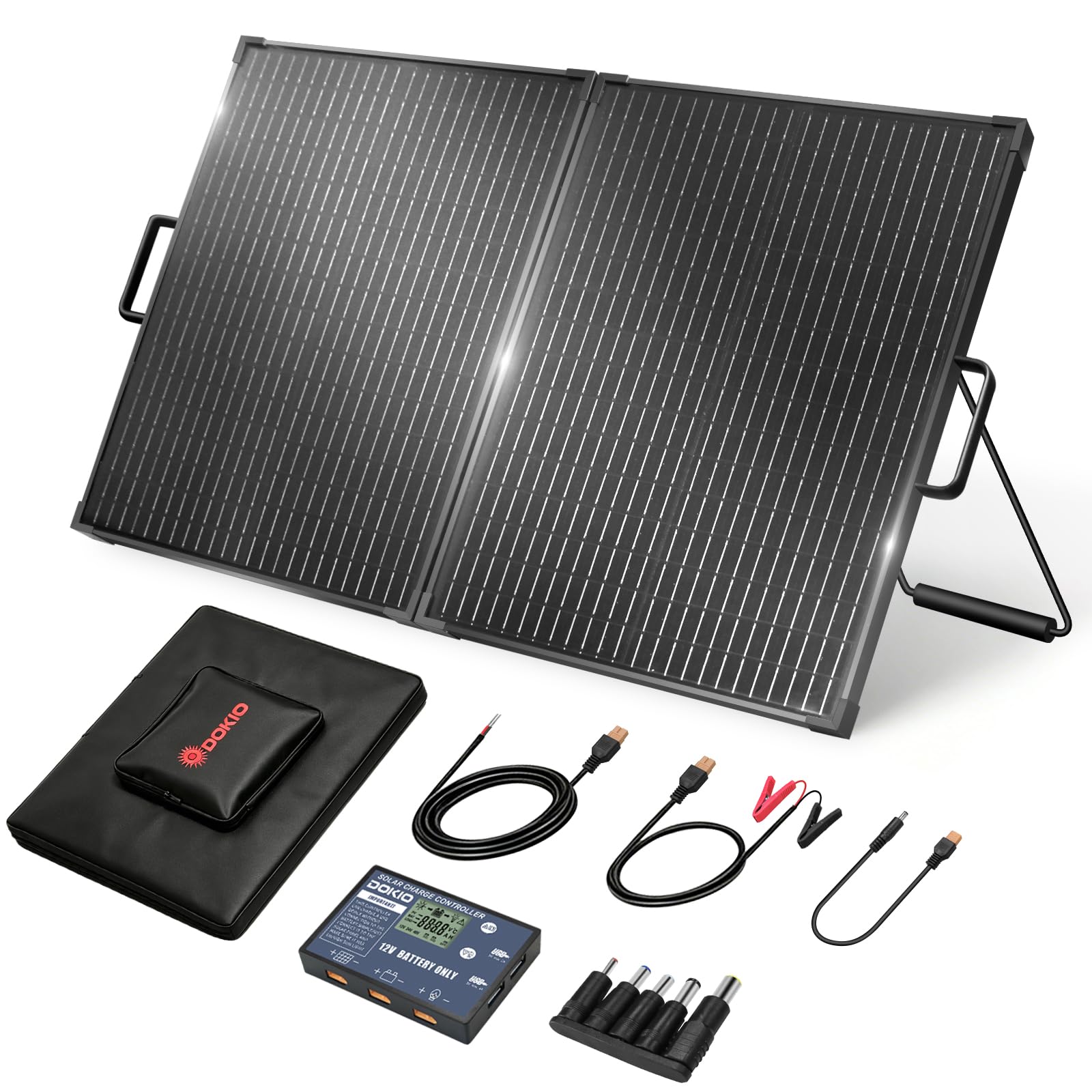
The DOKIO 100W Solar Suitcase offers the simplest out-of-the-box experience for charging 12V lead-acid batteries. The panel unfolds, and the included alligator clips connect directly to your battery terminals with no additional wiring or controllers to configure—just mind the polarity and it starts charging immediately. The monocrystalline panel is housed in a corrosion-resistant aluminum frame and includes an integrated PWM charge controller with smart protection against reverse polarity, overcharging, short-circuits, and reverse current.
The 9.8-foot cable length provides flexibility to position the panel in the sun while keeping the battery in shade or inside your RV. An adjustable bracket lets you tilt the panel to maintain a 90-degree angle to the sun for peak charging efficiency. Two integrated 5V 2A USB ports allow direct charging of phones and small USB devices without needing a separate power station. The compact folded size of 23.8 x 19.3 x 1.3 inches makes it easy to store between trips.
This unit is specifically designed for all types of 12V lead-acid batteries including vented, AGM, and gel types, making it ideal for marine, camping, and RV battery maintenance. The 25-year transferable power output warranty gives long-term confidence. The stand design is straightforward but effective—the panel is best used in direct sun and requires manual adjustment as the sun moves. There’s no MPPT controller here, so charging efficiency in low-light conditions is lower than premium suitcase options.
Why it’s great
- Genuinely plug-and-play with alligator clips and built-in controller
- 9.8-foot cable allows flexible placement away from battery
- Includes dual USB ports for direct device charging
Good to know
- PWM controller is less efficient in low light than MPPT
- Only compatible with 12V lead-acid battery types
6. FlexSolar 60W Portable Solar Panel

The FlexSolar 60W panel is an excellent entry-level foldable for those who primarily charge smaller devices and sub-300Wh power stations. Its standout feature is the USB-C PD port that can deliver up to 60W, making it one of the few budget panels capable of fast-charging modern laptops and tablets directly. It also includes QC2.0 and QC3.0 USB-A ports, plus a DC5521 port that outputs 20-28V at up to 60W for power station charging.
The six-panel fold design collapses to a laptop-sized 13.8 x 9.1 x 2.2 inches and weighs 6.4 pounds, making it genuinely portable for hiking and backpacking. The ETFE-coated A+ monocrystalline cells claim 24% efficiency, and the IP65 waterproof rating provides protection against rain and splashes—though as with most foldable panels, the junction box should be kept dry. The built-in smart chip automatically identifies connected devices and adjusts output current for optimal charging speed, with an LED indicator showing charging status.
Customer feedback confirms reliable performance within its power range. One user charges their Golabs 300Wh station at about 35W in full sun, gaining roughly 10% charge every 40 minutes. Another reviewer uses it to keep an Anker 300Wh station topped off during camping trips, noting peak output of 48W on sunny days and 10-20W in overcast conditions. The main limitation is that the DC output maxes out around 35-38W even in direct sun, below the panel’s theoretical 60W rating for power station charging.
Why it’s great
- USB-C PD 60W output enables direct laptop charging
- Compact folded size fits easily in a backpack
- Smart chip automatically optimizes charging speed
Good to know
- DC output to power stations typically maxes at 35-38W in practice
- Not sufficient for power stations over 300Wh capacity
7. Keshoyal 60W Foldable Solar Panel

The Keshoyal 60W panel is the lightest and most packable option in this lineup at just 4 pounds with a 0.2-inch unfolded thickness. It folds to 10.62 x 14.56 x 1.57 inches—roughly the size of a laptop bag—making it the best choice for backpackers, hikers, and emergency go-bags where every ounce matters. The monocrystalline cells achieve a solid 23.5% conversion efficiency, and the ETFE laminated construction is waterproof, corrosion-resistant, and high-temperature resistant.
The panel includes dual USB-A ports and a DC output with eight different adapters, covering compatibility with most portable power stations on the market. Four reinforced hanging holes and included fixing clips allow easy mounting on RVs, tents, or trees. The 1.5-meter DC cable plus a 3-meter extension provides a total 4.5-meter reach, giving flexibility to position the panel in the sun while keeping electronics in the shade. The manufacturer backs the unit with a one-year warranty and responsive customer service.
Real-world testing shows the panel performs well within its power class. One owner measured 22V and 1.5A (33W) in December sun charging an 88Wh power station, and another reported it fully charges a 146Wh power station on a sunny day. The panel charges 10,000mAh power banks in 1-2 hours. Customers consistently note the build quality and compact design exceed expectations for the price point. The main trade-off is the lower total wattage—60W means slower charging for larger power stations, and the DC output is limited to 18V, which won’t support high-input generators.
Why it’s great
- Extremely light at 4 lbs for easy backpacking carry
- Eight DC adapters ensure broad power station compatibility
- Compact folded size fits inside a laptop bag or satchel
Good to know
- 60W rating is best suited for small power stations and direct device charging
- DC output voltage limited to 18V max
FAQ
Can I use a 100W budget panel with my Jackery or EcoFlow power station?
How much real power can I expect from a budget 100W solar panel?
Is a PWM charge controller okay for budget solar setups or do I need MPPT?
How long do budget portable solar panels typically last?
Final Thoughts: The Verdict
For most users, the best budget solar panels winner is the HQST 200W Ultra-Light because its 25% N-Type cell efficiency, IP67 waterproofing, and portable kickstand design deliver premium-level performance at a mid-range price point. If you want universal power station compatibility with a shorter cable and built-in USB ports, grab the ZOUPW 100W Foldable. And for a complete plug-and-play kit to maintain 12V batteries on an RV or boat, nothing beats the Topsolar 100W Kit with its included charge controller and mounting brackets.

Mo Maruf
I created WellFizz to bridge the gap between vague wellness advice and actionable solutions. My mission is simple: to decode the research and give you practical tools you can actually use.
Beyond the data, I am a passionate traveler. I believe that stepping away from the screen to explore new environments is essential for mental clarity and physical vitality.