Our readers keep the lights on and my smoothie glass nicely filled. As an Amazon Associate, I earn from qualifying purchases.
Shopping for a solar generator on a budget often means navigating a minefield of inflated wattage claims and undersized battery cells. Many entry-level units pair a small inverter with a lithium battery that can’t keep a CPAP running through the night, leaving you tethered to the grid when you need freedom most. The real trick is identifying a power station that delivers honest capacity, clean inverter output, and reliable charge cycling without demanding a second mortgage.
I’m Mohammad Maruf — the founder and writer behind WellFizz. My research into portable power stations focuses on isolating the actual usable watt-hours from marketing hype, comparing battery chemistries, inverter efficiencies, and real-world charge times across the budget tier.
After analyzing capacity claims versus real customer load tests, BMS protection logic, and cycle life ratings across nine models, I’ve identified the true contenders that earn the best budget solar generator label without sacrificing the safety and cycle longevity that turn a one-time purchase into a ten-year investment.
How To Choose The Best Budget Solar Generator
A buyer stepping into the budget solar generator market for the first time often focuses on peak wattage or total capacity while overlooking the three specifications that determine whether the unit will still perform reliably in year five: battery chemistry, inverter type, and charge controller efficiency. Each of these factors directly impacts how much usable power you get per dollar spent.
LiFePO4 Chemistry — The Cycle Life Anchor
Lithium Iron Phosphate (LiFePO4) cells dominate the budget tier for good reason. They deliver 3,000 to 4,000+ charge cycles before degrading to 80% capacity, compared to the 500 cycles typical of NMC (Nickel Manganese Cobalt) cells. A budget LiFePO4 generator may cost slightly more upfront but effectively halves your cost-per-cycle over a decade of weekend camping or emergency standby use.
Pure Sine Wave Inverter vs. Modified Sine Wave
A pure sine wave inverter outputs clean AC power identical to grid electricity, making it safe for sensitive electronics like CPAP machines, laptops, and medical devices. Modified sine wave inverters can cause buzzing, overheating, or outright failure in these loads. Every unit on this list uses a pure sine wave inverter, which is a non-negotiable baseline for a genuinely useful budget solar generator.
BMS Logic and UPS Switching Speed
The Battery Management System prevents overcharge, deep discharge, and short circuits, but not all BMS implementations are equal. A budget generator with a UPS mode rated under 20ms switching time can keep a router or computer running through a brownout without a glitch. Units with slower switching (over 30ms) may allow connected devices to reboot, defeating the purpose of emergency backup.
Solar Input Voltage and MPPT Efficiency
A generator with Maximum Power Point Tracking (MPPT) extracts 20-30% more energy from solar panels than a PWM controller under partial sun conditions. Budget units often list a maximum solar input wattage, but the real-world charging speed depends on the MPPT algorithm’s ability to track the panel’s voltage peak. Look for generators with at least 100W of solar input capacity to make a 100W panel feasible for daily off-grid use.
Quick Comparison
On smaller screens, swipe sideways to see the full table.
| Model | Category | Best For | Key Spec | Amazon |
|---|---|---|---|---|
| BLUETTI Elite 100 V2 | Premium Compact | High-capacity home backup & fast solar recharge | 1024Wh, 1800W inverter, 0-80% in 45 min | Amazon |
| GRECELL EB1000 | Mid-Range Workhorse | Balanced 999Wh capacity at a moderate price | 999Wh, 1000W inverter, wireless charging pad | Amazon |
| BLUETTI AC70 | Fast-Charge Mid-Range | Ultra-rapid AC recharge for frequent power users | 768Wh, 1000W inverter, 0-80% in 45 min | Amazon |
| Anker SOLIX C1000 | High-End Bundle | Integrated 200W panel with fast solar charging | 1056Wh, 1800W inverter, 80% in 43 min (AC) | Amazon |
| Jackery Explorer 2000 v2 | Large Capacity Premium | Heavy-duty home backup and extended off-grid trips | 2042Wh, 2200W inverter, 30dB silent mode | Amazon |
| DARAN Cubus1000 | Compact Premium | Lightweight 1000W power with four AC outlets | 576Wh, 1000W inverter, under 35dB fanless | Amazon |
| Jackery Explorer 300 (w/ 40W Panel) | Entry-Level Complete Kit | Lightweight camping & CPAP backup with included panel | 292Wh, 300W inverter, LiFePO4, 7.5 lbs | Amazon |
| VTOMAN Jump 600X | Value Multi-Tool | Car jump starting combined with portable power | 299Wh, 600W inverter, expandable to 939Wh | Amazon |
| LIBRIDS C600 | Budget Champion | Best entry-level value for home backup and camping | 640Wh, 600W inverter, 4000+ cycles | Amazon |
In‑Depth Reviews
1. BLUETTI Elite 100 V2 Portable Power Station
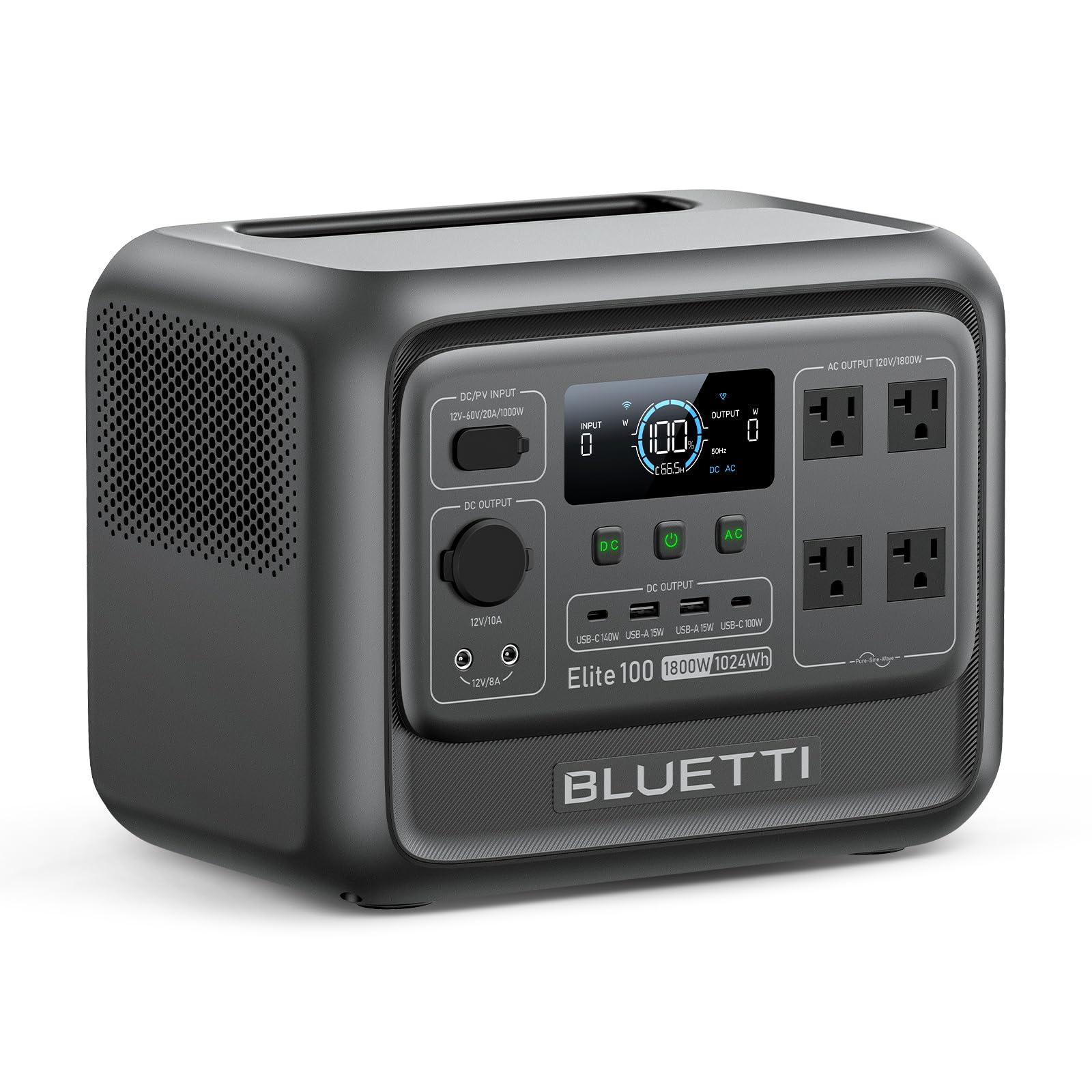
The ELITE 100 V2 from BLUETTI represents a significant leap in the premium mid-range category, packing 1024Wh of LiFePO4 capacity into a chassis that is 35% more compact than its predecessor. The 1800W pure sine wave inverter handles 99% of household appliances, while the 3600W surge power lifts motor startup loads like refrigerators and sump pumps without tripping the BMS. The unit’s 1000W solar input capability means a full charge from panels in roughly 70 minutes under ideal sun, making it a viable off-grid hub for extended camping or outage scenarios.
The 11-port output panel includes four AC outlets, a 100W USB-C PD port, and regulated DC outputs, all controlled by independent switches for per-port power management. The ≤10ms UPS switching time guarantees connected electronics never reboot during a grid flicker, a feature usually reserved for much more expensive units. The fan noise stays under 30dB at typical loads, which is effectively silent in a bedroom or RV environment.
Customer feedback highlights the unit’s reliability as a mobile office power source and its ability to run a mini fridge and guitar amp simultaneously without inverter noise. The hidden carry handle makes one-handed transport manageable despite the 25-pound weight. While the app interface is functional rather than polished, the core hardware delivers performance that justifies its place at the top of the budget-constrained premium tier.
Why it’s great
- 35% smaller footprint than previous generation without sacrificing capacity.
- True 1800W continuous output powers most home appliances.
- Fast 70-minute full charge via AC or 1000W solar input.
Good to know
- No built-in light or wireless charging pad.
- App connectivity requires Bluetooth proximity for full control.
2. GRECELL EB1000 Portable Power Station
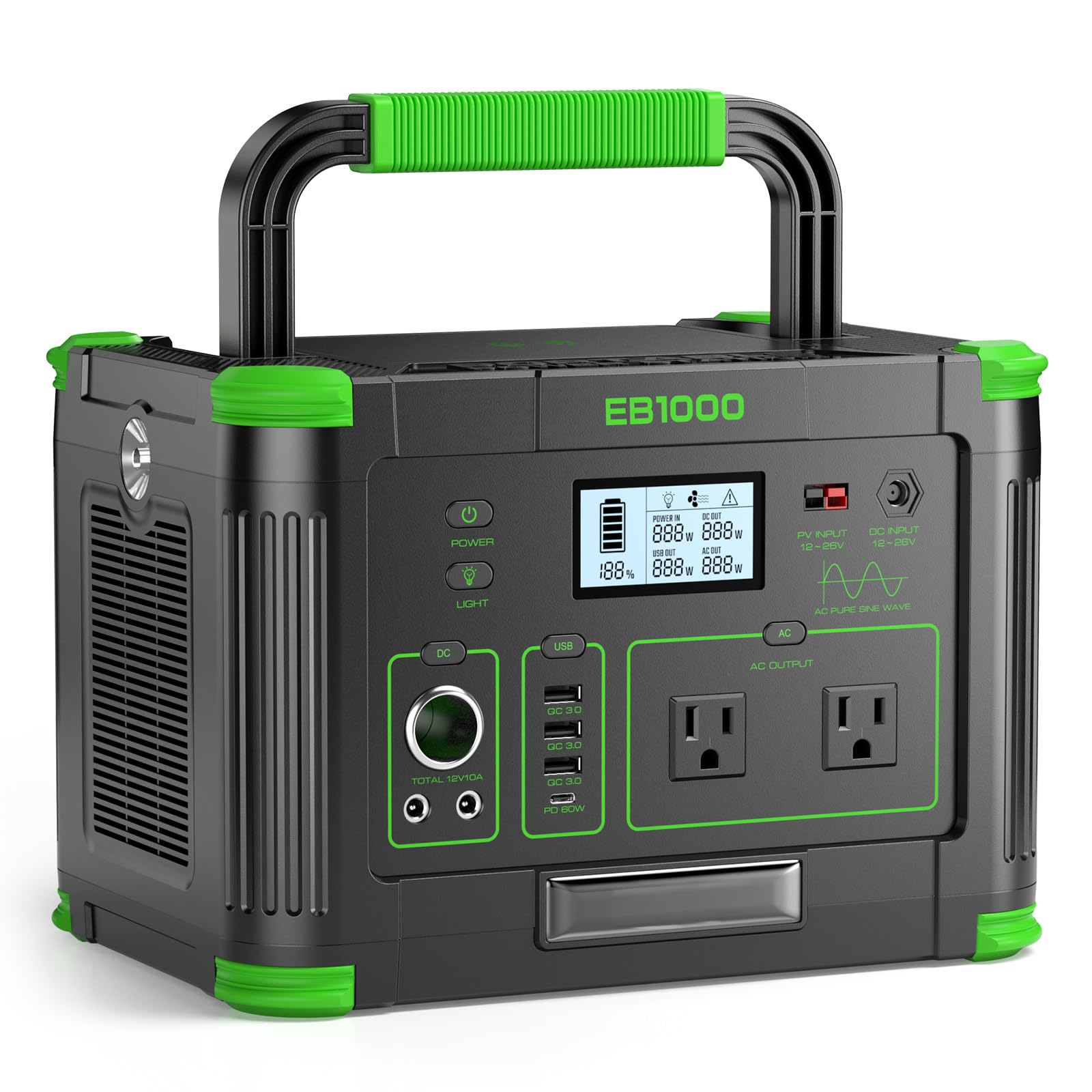
The GRECELL EB1000 positions itself as a 999Wh powerhouse in a surprisingly lightweight 17.8-pound frame, offering a strong capacity-to-weight ratio that few competitors in its price tier match. The 1000W pure sine wave inverter (2000W surge) is sufficient for laptops, mini fridges, CPAP machines, and even some rice cookers, making it a flexible companion for car camping or home outage prep. The built-in MPPT charge controller optimizes solar input from compatible panels, and the included 7909 solar cable simplifies connection to standard portable panel kits.
The port selection is generous for the price: two AC outlets, a 60W USB-C PD port, three USB-A QC 3.0 ports, a wireless charging pad on top, a 12V car port, and two DC outputs. The independent power switches for AC, DC, and USB modules let you manage parasitic drain when certain outputs are not in use. The smart LCD display provides real-time wattage draw and remaining runtime, which is rare in the budget-mid segment and helps users avoid overloading the inverter.
Real-world testing by users confirms the unit holds around 350Wh of usable capacity beyond its stated rating due to conservative BMS headroom. The AC port deactivation during charging is a quirk to note, but it does not affect routine use. For buyers who want a 1000-watt-class generator with wireless charging and a clear display without crossing into premium pricing, the EB1000 delivers exceptional bang for the buck.
Why it’s great
- Nearly 1000Wh capacity with a compact, light design.
- Wireless charging pad reduces cable clutter for phones.
- MPPT charge controller for efficient solar recharging.
Good to know
- AC outlets are disabled while the unit is charging via AC.
- Wireless charging requires USB power button to be toggled on.
3. BLUETTI AC70 Portable Power Station

The BLUETTI AC70 brings a 768Wh LiFePO4 battery and a 1000W pure sine wave inverter (2000W Power Lifting surge) to the table, but its defining feature is the recharge speed. A single AC cable delivers up to 950W input, pushing the unit from 0-80% in just 45 minutes and full in 1.5 hours. This makes the AC70 ideal for users who cycle through their battery daily — van lifers, mobile workers, or anyone relying on a generator as a primary power source rather than a standby reserve.
The port configuration is streamlined but capable: two AC outlets, a 100W USB-C PD port, and a 12V car port. The XT-60 solar input is a significant upgrade over the fragile 7909 connectors found on older budget units, providing a more robust physical connection for outdoor use. Up to 500W of solar input is supported, meaning a full solar recharge in under 2.5 hours with adequate panel wattage. The BLUETTI app adds remote monitoring and charge/discharge scheduling, which is a smart-home feature typically found on units costing significantly more.
Users running a 100W guitar amplifier and pedalboard for eight hours reported the battery dropped to only 59%, confirming real-world efficiency. The UPS transfer time under 20ms keeps connected PCs from resetting during brief outages. The build quality is dense at 22.5 pounds, but the compact dimensions make it easy to stow under a car seat. For the budget buyer who prioritizes rapid recharge and app control over raw capacity, the AC70 is a compelling choice.
Why it’s great
- 0-80% AC recharge in 45 minutes — fastest in its capacity class.
- Robust XT-60 solar input connector for durable outdoor use.
- BLUETTI app provides remote power management.
Good to know
- Only two AC outlets may limit multi-appliance setups.
- Heavier than some 1000Wh competitors at 22.5 pounds.
4. Anker SOLIX C1000 with 200W Solar Panel

The Anker SOLIX C1000 pairs a 1056Wh LFP (LiFePO4) power station with a 200W monocrystalline solar panel, creating a turnkey solar generator bundle that skips the panel-selection guesswork. The power station itself delivers 1800W continuous AC output (2400W SurgePad) across six AC outlets, making it one of the most outlet-dense units in its class. The UltraFast recharge mode fills the battery to 80% in 43 minutes via AC input — a benchmark that only the AC70 beats in this lineup.
The included 200W solar panel features IP67 waterproofing and adjustable kickstand angles (30°, 40°, 50°, 80°), allowing precise alignment with the sun’s position to maximize absorption. The monocrystalline cells achieve up to 23% conversion efficiency, and the panel’s rugged build means it can handle rain and dust without issue. The power station itself is not weatherproof, so keep the C1000 dry during use. The 10-foot solar cable provides ample reach for panel placement in sunny spots while keeping the generator shaded.
CPAP users with full humidity settings drained the battery to 48% overnight, indicating solid efficiency for medical devices. The 3,000-cycle LFP battery with a 10-year lifespan minimizes total cost of ownership. The only drawback is the strong mildew odor reported from some initial solar panel batches, though Anker has since revised manufacturing to eliminate the issue.
Why it’s great
- Complete bundle with a high-efficiency 200W solar panel included.
- Six AC outlets and 2400W SurgePad for demanding appliances.
- IP67 weatherproof solar panel for all-conditions charging.
Good to know
- Power station is not weatherproof, must be kept dry.
- Some early solar panel units had odor issues; newer revisions resolved this.
5. Jackery Explorer 2000 v2 Portable Power Station

The Jackery Explorer 2000 v2 brings a massive 2042Wh LiFePO4 battery and a 2200W pure sine wave inverter, yet achieves a 41% lighter and 34% smaller footprint than typical 2kWh power stations thanks to Jackery’s Cell-to-Body (CTB) technology borrowed from electric vehicle design. The 3-port AC setup handles full-size refrigerators, power tools, and medical equipment with ease, while the 100W USB-C PD port charges high-end laptops at full speed without needing a separate adapter.
Fast AC charging pushes the battery from 0-80% in 66 minutes, and the Emergency Super Charging mode (activated via the app) reaches full in 102 minutes. Silent Charging mode keeps fan noise below 30dB while still delivering a full charge in five hours — ideal for overnight use in a bedroom or camper van. The 20ms UPS switching speed is UL1778 certified, ensuring seamless power backup for critical electronics during grid transitions.
Users report running a full-size refrigerator for over 21 hours on a single charge and keeping Starlink internet and security systems operational for 2.5 weeks straight with alternator recharging in an off-grid setup. The Bluetooth and Wi-Fi app control allows remote battery monitoring and charge scheduling. For buyers after the generous capacity footprint and familiar Jackery ecosystem, the Explorer 2000 v2 is a rock-solid long-term investment.
Why it’s great
- 2042Wh capacity for whole-home backup or extended off-grid trips.
- CTB technology reduces weight and size vs. other 2kWh units.
- UL1778 certified UPS ensures seamless power switching.
Good to know
- At 39.5 pounds, it is heavy despite the lighter design.
- Slow solar charging with a single 200W panel in overcast conditions.
6. DARAN Cubus1000 Portable Power Station
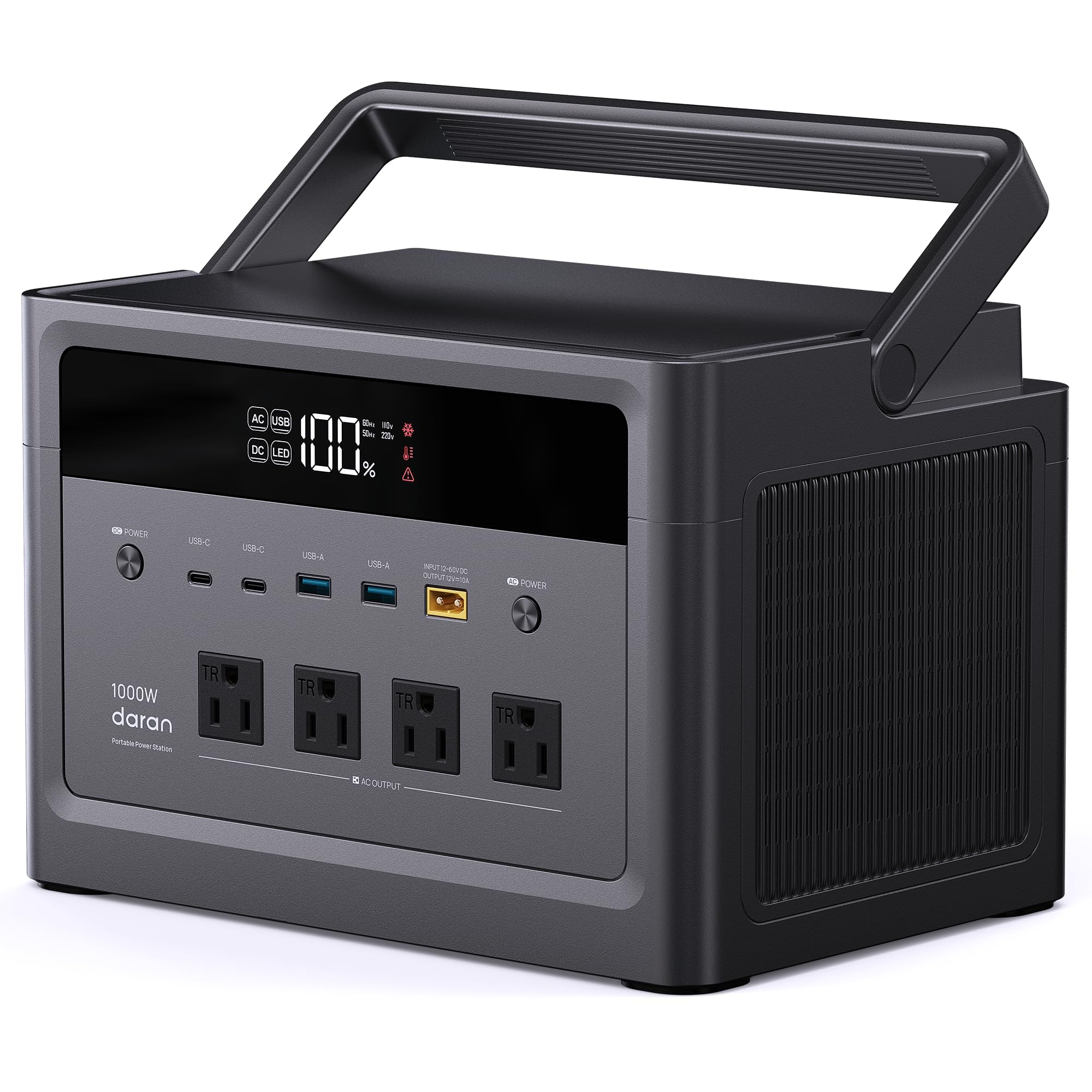
The DARAN Cubus1000 compresses a 576Wh LiFePO4 battery and a 1000W inverter (2000W surge) into a 14.8-pound chassis with an integrated ergonomic handle, making it one of the most portable units in the 1000-watt class. What sets it apart is the inclusion of four AC outlets — double what most similarly sized units offer — allowing you to power multiple kitchen appliances, entertainment devices, or power tools simultaneously without relying solely on USB ports.
The fanless operation design keeps noise under 35dB, which is virtually silent in normal use and a rare find in a 1000W inverter. Recharging is versatile: AC wall input reaches 70% in 1.8 hours, while solar or car input at 200W hits 70% in 1.4 hours via the built-in MPPT controller. The 100W USB-C PD port provides fast laptop charging, and the three-mode LED light with SOS adds utility for nighttime camping or emergency scenarios.
Users report the unit powers security cameras indefinitely via the DC output and keeps phones, laptops, and a mini fridge running for hours during outages. The 3,500+ cycle LiFePO4 battery with a 10-year design life makes the cost-per-cycle very low. The limited included accessories (just an AC cable and manual) mean you will need to budget for a solar panel separately. For the buyer who prioritizes multiple AC outlets and silent operation in a lightweight frame, the Cubus1000 is a smart pick.
Why it’s great
- Four AC outlets in a 14.8-pound package.
- Fanless design keeps noise under 35dB.
- Fast solar recharge to 70% in 1.4 hours via MPPT.
Good to know
- Solar panel not included; must be purchased separately.
- Accessories are minimal — AC cable and manual only.
7. Jackery Explorer 300 with 40W Solar Panel
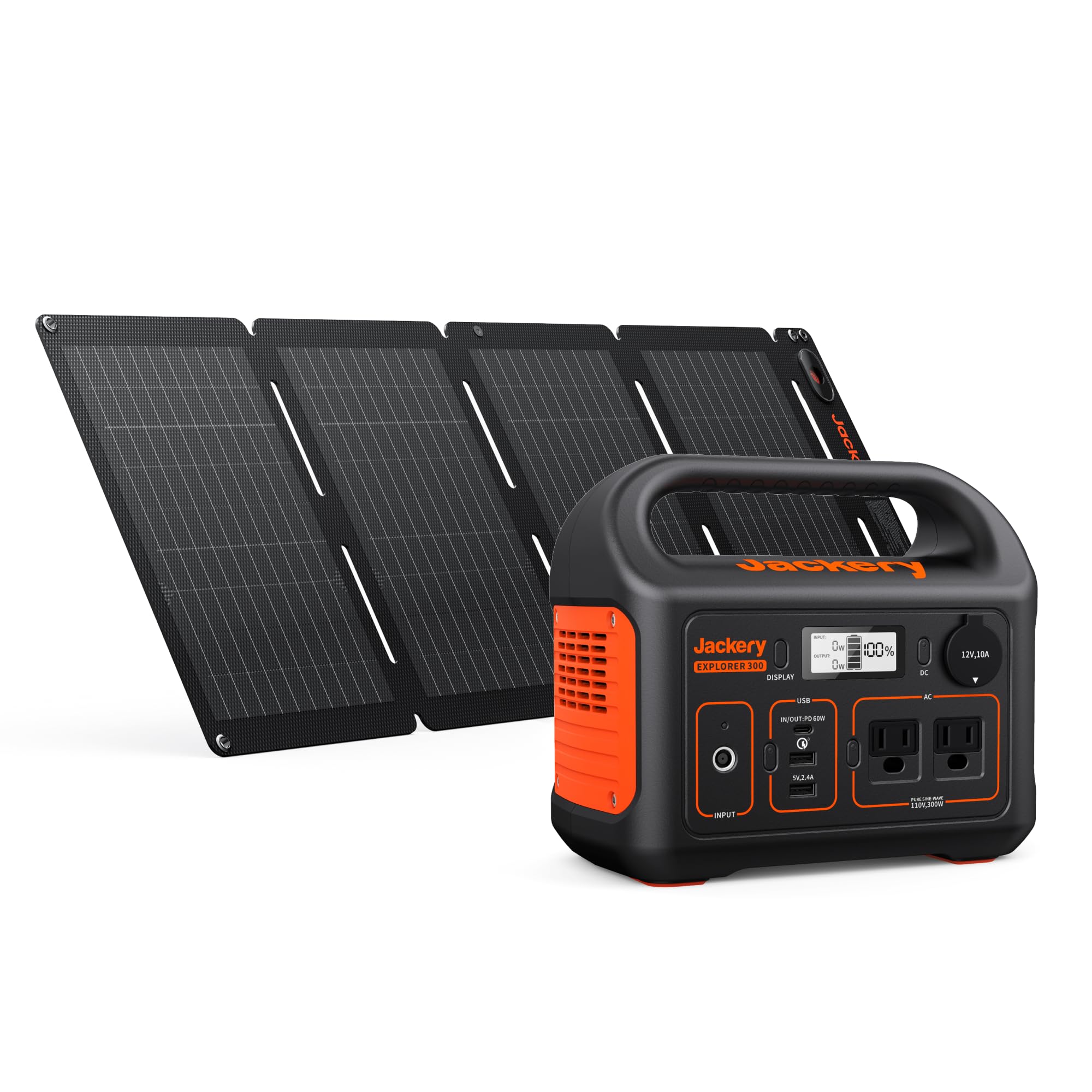
The Jackery Explorer 300 paired with the 40W SolarSage panel is the quintessential entry-level solar generator bundle for lightweight camping, CPAP backup, or short off-grid stays. Weighing just 7.5 pounds for the power station and 5.4 pounds for the panel, the total kit is easily carried in one hand or strapped to a backpack. The 292Wh LiFePO4 battery provides over 4,000 charge cycles before dropping to 70% capacity, translating to roughly 11 years of weekly use.
The 300W pure sine wave inverter (600W surge) handles laptops, drones, cameras, phone chargers, and low-power CPAP machines. The port array includes two AC outlets, a 100W USB-C PD port (rare for a 300W-class unit), two USB-A ports, and a 120W car port. The 40W panel folds into a compact 15.43 x 9.92-inch footprint and charges the battery to 80% in about 7.5 hours under direct sun — enough for daily topping off at a base camp. Faster solar charging is possible with a larger Jackery panel if you upgrade later.
User reports confirm the unit ran a 70-quart fridge for nine hours, dropping from 100% to 50% battery, and kept a CPAP with heated humidifier running for a full night with moderate drain. The improved 80W DC input rate in this version means quicker car charging compared to earlier models. The main limitation is the 300W inverter ceiling: you cannot run a mini fridge and a high-draw appliance simultaneously. For the budget shopper seeking a reliable, portable all-in-one kit, this Jackery bundle is a proven choice.
Why it’s great
- Complete ready-to-use kit with 40W solar panel included.
- Very lightweight at 7.5 lbs for the power station.
- LiFePO4 battery with 4,000+ cycle lifespan.
Good to know
- 300W inverter limits simultaneous high-draw appliances.
- 40W solar panel charges slowly; larger panel recommended for daily off-grid use.
8. VTOMAN Jump 600X Portable Power Station

The VTOMAN Jump 600X is a dual-purpose device that combines a 299Wh LiFePO4 power station with a dedicated car jump-start port, eliminating the need to carry a separate jump starter for roadside emergencies. The 600W pure sine wave inverter (1200W surge) handles small appliances, CPAP machines, and electronics, while the jump-start function can revive a dead 12V battery from a Dodge Ram or full-size SUV using power from as low as 9% station charge.
The 299Wh internal capacity is modest, but VTOMAN offers an expansion battery (sold separately) that boosts total capacity to 939Wh, effectively tripling the runtime without forcing you to replace the entire unit. The port selection is comprehensive for its size: two AC outlets, a 60W USB-C PD port, three USB-A ports (one QC 3.0), regulated 12V/10A DC outputs, and a car cigarette lighter port. Pass-through charging allows the station to power devices while it recharges simultaneously, saving time during pit stops.
Users report the unit runs a mini fridge for over five hours on half charge and jumpstarts large trucks instantly. The expandable design is a key differentiator: you can start with the base unit and add the extra battery when your budget allows, avoiding upfront cost while retaining future upgradeability. The 3,000-cycle LiFePO4 chemistry ensures the core battery outlasts the expansion packs. For the buyer who needs both portable power and a reliable car starter in one box, the Jump 600X is a uniquely practical solution.
Why it’s great
- Integrated car jump start eliminates the need for a separate device.
- Expandable from 299Wh to 939Wh with add-on battery.
- Pass-through charging runs devices while the station recharges.
Good to know
- Jumper cables are sold separately, not included.
- 300Wh base capacity may be tight for all-night CPAP use without expansion pack.
9. LIBRIDS C600 Portable Power Station
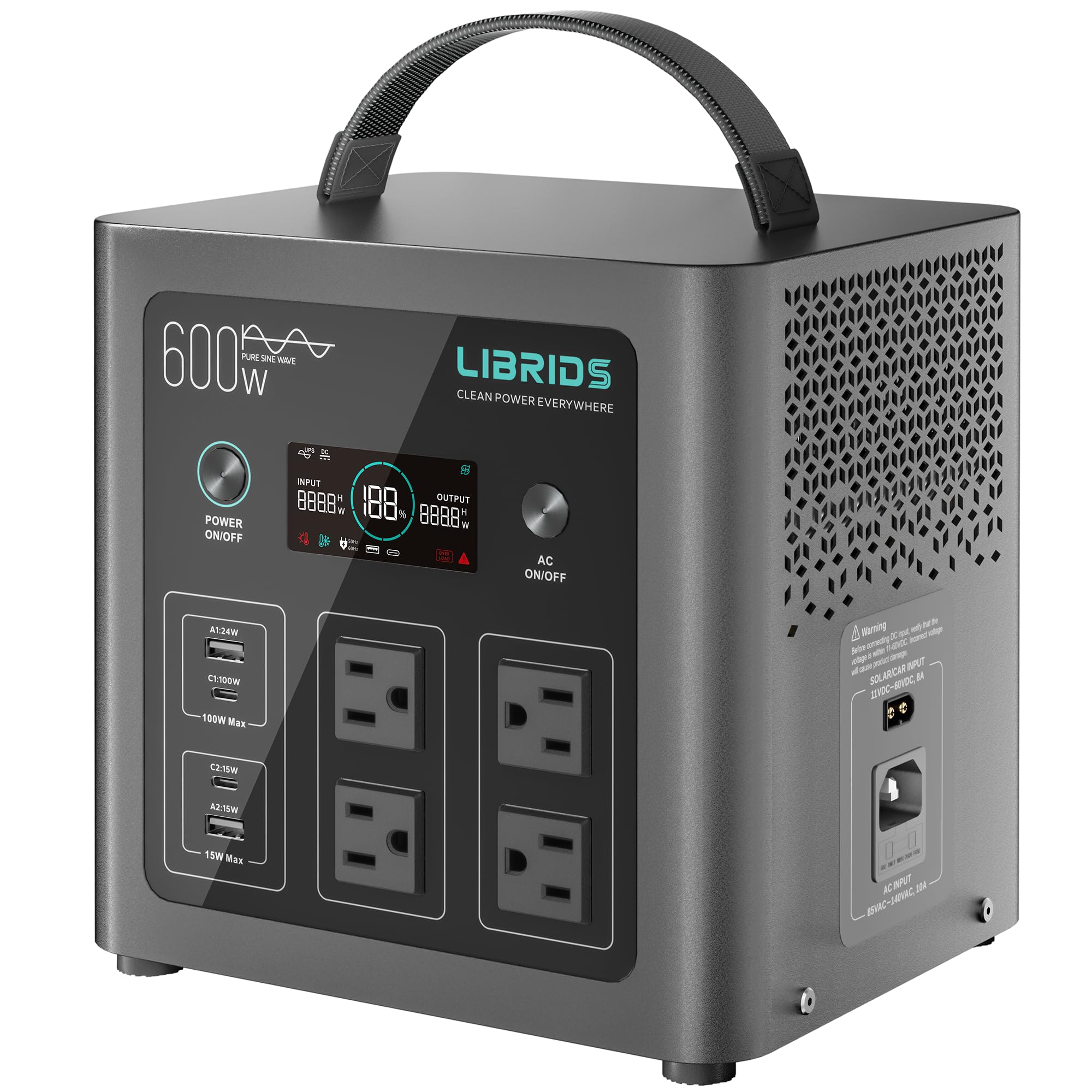
The LIBRIDS C600 delivers a compelling 640Wh LiFePO4 battery and a 600W pure sine wave inverter (1200W peak) inside a durable metal enclosure, making it one of the most physically robust options at the entry level. The 8-port output panel includes four AC outlets — unusual for a budget 600W unit — plus USB-A and USB-C ports, allowing simultaneous charging of up to eight devices. The 1.5-hour full AC recharge via the included adapter is impressively fast for the capacity class.
The built-in 10ms UPS switching automatically takes over during a power glitch, keeping WiFi routers, CPAP machines, and other sensitive electronics running without interruption. The smart LCD screen provides real-time battery percentage, input wattage, and output wattage — a level of visibility normally reserved for mid-range units. The metal chassis improves heat dissipation and durability compared to the plastic shells common at this price point, and the LiFePO4 battery is rated for 4,000+ cycles, far exceeding the 500-cycle NMC cells found in cheaper alternatives.
User feedback confirms the C600 runs a CPAP with heated humidifier for a full night using only 24% battery drain and powers aquarium pumps, gaming consoles, and small kitchen appliances. The included 5-year warranty reduces long-term ownership risk. The “Indoor Use Only” label attached to the bottom is a UL-required warning directing against wet outdoor use, but the unit can still be operated in dry, well-ventilated outdoor spaces like a covered campsite. For the buyer seeking maximum capacity and build quality at the lowest entry point, the C600 is the definitive budget champion.
Why it’s great
- 640Wh capacity at an entry-level price point.
- Metal enclosure improves durability and heat dissipation.
- Four AC outlets and fast 1.5-hour full recharge.
Good to know
- 600W inverter limited to low-draw appliances only.
- Not weather-sealed — keep dry during outdoor use.
FAQ
Can a budget solar generator run a full-size refrigerator?
How long does a 600Wh solar generator take to recharge from a 100W solar panel?
What is the difference between a budget solar generator and a traditional gas generator?
Can I leave my budget solar generator plugged in all the time?
Final Thoughts: The Verdict
For most users, the clear winner in the best budget solar generator category is the LIBRIDS C600 because it offers 640Wh of genuine LiFePO4 capacity, a metal enclosure for durability, four AC outlets, and a fast 1.5-hour recharge at the lowest entry price. If you need more AC outlets and silent fanless operation, grab the DARAN Cubus1000. And for those wanting the ultimate capacity-to-weight ratio with app control, nothing beats the BLUETTI AC70 for sheer recharge speed and smart-home integration.

Mo Maruf
I created WellFizz to bridge the gap between vague wellness advice and actionable solutions. My mission is simple: to decode the research and give you practical tools you can actually use.
Beyond the data, I am a passionate traveler. I believe that stepping away from the screen to explore new environments is essential for mental clarity and physical vitality.