Our readers keep the lights on and my smoothie glass nicely filled. As an Amazon Associate, I earn from qualifying purchases.
Choosing a sleeping pad for backpacking on a tight budget means you’re wrestling with three conflicting demands: you need it light enough to carry all day, thick enough to protect your hips from granite-hard tent floors, and durable enough not to spring a leak on night three. That’s a tall order when every dollar counts. Many campers end up tossing and turning on paper-thin foam or waking up flat on the ground thanks to a faulty valve—neither outcome makes for a good trip.
I’m Mohammad Maruf — the founder and writer behind WellFizz. I spend my time cross-referencing ASTM insulation ratings, measuring packed volumes against claimed weights, and stress-testing pump mechanisms so you don’t have to guess which bargain pad will actually hold up on the trail. This guide focuses on the specific metrics that separate a smart value buy from a frustrating waste of gear space.
Whether you prioritize closed-cell foam reliability or inflatable comfort, the right best budget sleeping pad for backpacking balances R-value, packed size, and thickness to match your sleep style and the terrain you’ll be covering.
How To Choose The Best Budget Sleeping Pad For Backpacking
Backpacking pads live at the intersection of weight, warmth, and packed size. When your pack is already stuffed with a tent, bag, food, and water, every extra ounce and cubic inch feels heavy. The guide below breaks down the core specs you need to check before buying, with a focus on what actually matters for budget shoppers who still want a reliable night’s sleep.
R-Value and Seasonal Suitability
The R-value measures how well a pad resists heat loss to the cold ground. For three-season backpacking (spring through fall), an R-value between 2.0 and 3.0 is usually sufficient. A pad rated at 1.0 is summer-only and will leach warmth on chilly autumn nights, while anything above 4.0 adds unnecessary weight for mild conditions. Always confirm the R-value is ASTM F3340 tested; some budget pads inflate their claims without standardized testing.
Foam vs. Inflatable: Weight and Durability Trade-offs
Closed-cell foam pads (like the accordion-fold styles) are virtually indestructible, weigh very little, and never deflate. Their downside is bulk—they strap to the outside of your pack—and they provide less cushioning, usually around half an inch to one inch thick. Inflatable pads offer far more comfort with thicknesses reaching three to six inches, but they carry the risk of punctures and require inflation time. For budget buyers, foam pads are the safest long-term investment, while a well-sealed inflatable can dramatically improve sleep quality on rocky terrain.
Packed Size and Inflation Method
An inflatable pad that packs down to the size of a one-liter water bottle is far easier to stash inside your pack than a foam pad that must be strapped externally. However, many budget inflatables include built-in foot pumps, which add convenience but also add bulk and weight. Consider whether you prefer quick setup (foam) or compact storage (inflatable). If you choose an inflatable, check for dual-valve systems that allow fine-tuning firmness and rapid deflation—these features save time and frustration at camp.
Quick Comparison
On smaller screens, swipe sideways to see the full table.
| Model | Category | Best For | Key Spec | Amazon |
|---|---|---|---|---|
| Klymit Static V | Inflatable | Ultralight solo trips | 13.5 oz, packs to 3×8 in | Amazon |
| NEMO Switchback | Closed Cell Foam | Durability & warmth | 16 oz, R-Value 2.0 | Amazon |
| Featherstone El Cordion | Closed Cell Foam | Insulated value | 16 oz, R-Value 2.1 | Amazon |
| VALEHOWL Ultralight | Inflatable | Quick inflation | 1.8 lbs, R-Value 3.0 | Amazon |
| OGERY Double | Inflatable | Two-person comfort | 2.4 lbs, 6 in thick | Amazon |
| AceCamp Accordion | Closed Cell Foam | Lightest weight | 11 oz, R-Value 2.0 | Amazon |
| FOCHIER Peanut Foam | Closed Cell Foam | Compact folding | 13.4 oz, aluminum film | Amazon |
In‑Depth Reviews
1. Klymit Static V Sleeping Pad

The Klymit Static V has earned a reputation among ounce-counting backpackers for its balance of weight, comfort, and packability. At just 13.5 ounces, it compresses down to 3 by 8 inches — roughly the size of a water bottle — making it one of the most packable inflatable pads at this price point. The V-shaped chamber design limits air movement and minimizes heat loss, which helps maintain warmth even on cooler nights. Its 2.5-inch thickness provides reliable cushioning for side sleepers, though taller users may find the 50-inch length restricts legroom.
The 75-denier polyester fabric feels durable for its weight class, and the separate inflation and deflation valves simplify setup and tear-down. However, the pad lacks an R-value specification and its insulation is thinner than some competitors. Several users report micro-leaks developing over extended use — a risk inherent to low-cost inflatables. The included stuff sack and patch kit are standard, but the patch material works best for small punctures.
For backpackers seeking an ultralight inflatable that won’t break the bank, the Static V is a legitimate contender. Its compact packed size is a major advantage for multi-day trips where every cubic inch counts, and the tapered shape fits well inside mummy sleeping bags. That said, it’s best suited for shorter individuals or those willing to sacrifice a few inches of length for a lighter load.
Why it’s great
- Exceptional weight-to-packed-size ratio (13.5 oz, 3×8 in)
- V-chamber design reduces heat loss and air movement
- Durable 75-denier polyester for its category
Good to know
- No official ASTM R-value rating
- 50-inch length may be too short for taller campers
- Reports of micro-leaks after extended use
2. NEMO Equipment Switchback Foam Sleeping Pad
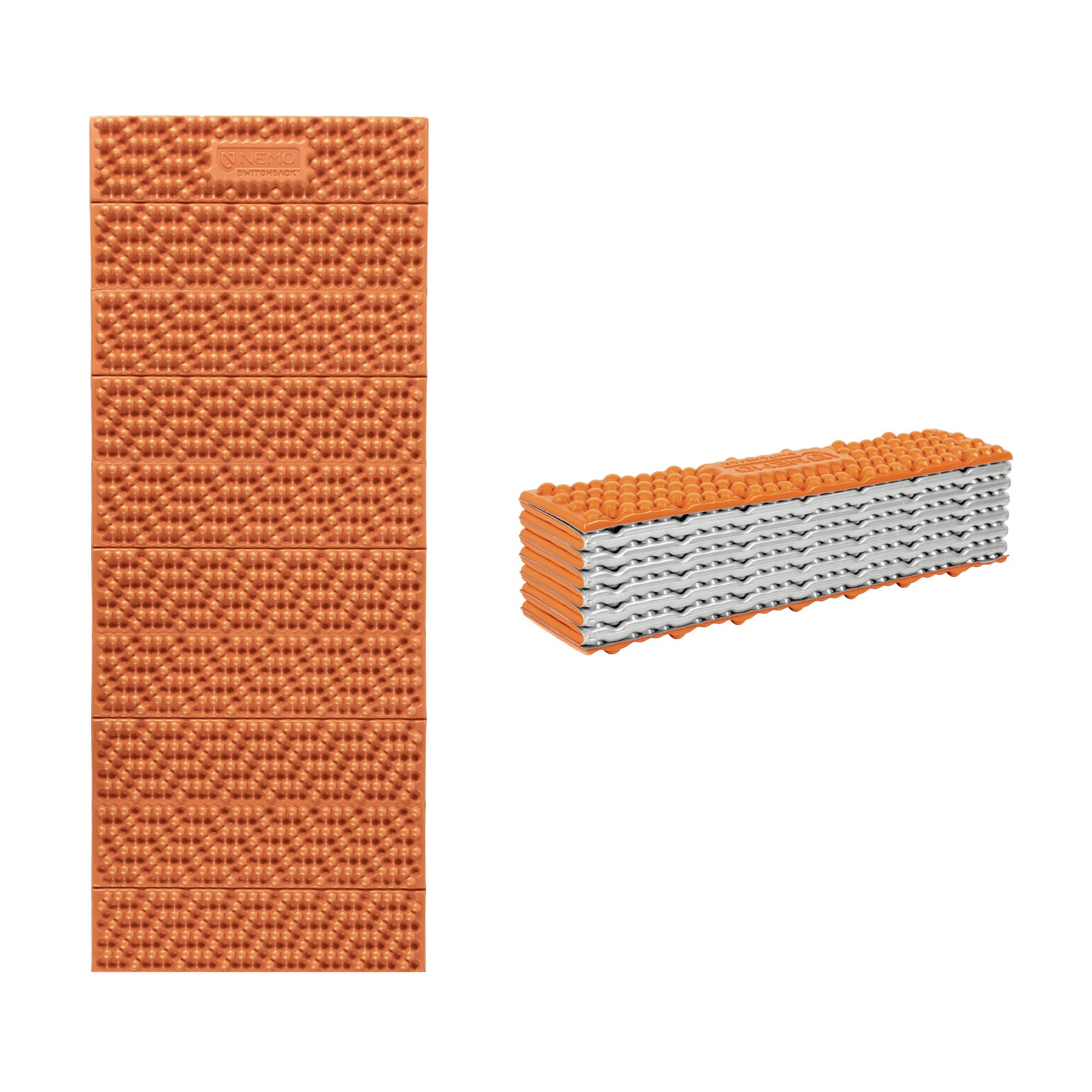
The NEMO Switchback is a premium closed-cell foam pad that borrows the hexagonal nesting pattern from its more expensive Z-Line sibling. The taller, wider nodes create more space for sleeping bag loft to trap warmth, giving it an R-value of 2.0 that’s suitable for three-season use. The dual-density Axiotomic foam combines a softer top layer for comfort with a denser bottom layer for support, all while keeping the total weight at 16 ounces. It folds down via an accordion pattern, but its packed size is larger than an inflatable, so it typically straps to the outside of a backpack.
One of the standout features here is the metallized thermal reflective film laminated to the bottom side, which bounces body heat back upward. That film is protected by a durable layer, so it resists peeling over time. The pad measures 51 by 20 inches — narrow enough to save weight but still wide enough for most torso lengths. Some side sleepers find it less forgiving than an inflatable, though the hexagonal nodes do a decent job of distributing pressure.
The Switchback is practically indestructible: no punctures, no valves to leak, and no inflation time. It’s a favorite among thru-hikers who prioritize dependability over plush comfort. It also doubles as a sit pad or a gear-protecting layer under an inflatable in winter. If you’re willing to give up a bit of cushion for a pad that will never fail, the Switchback is one of the best investments in durability you can make.
Why it’s great
- Hexagonal nesting improves warmth and comfort
- Dual-density Axiotomic foam with heat-reflective film
- Lifetime warranty against defects
Good to know
- Bulkier packed size than an inflatable
- Less cushioned than thick air pads
- Narrow width (20 in) may feel tight for broad shoulders
3. Featherstone Outdoor El Cordion Insulated Sleeping Pad

The Featherstone El Cordion delivers a genuine ASTM-tested R-value of 2.1 in a closed-cell foam pad that weighs only 16 ounces. That tested insulation rating is the key differentiator here — many budget foam pads simply state a generic number without standardized testing. The combination of irradiation cross-linked polyethylene foam and a dual-density heat reflective film creates a barrier that actually holds warmth, making it viable for early spring and late autumn trips. The hexagonal node pattern provides 40% more coverage than traditional egg-shell foam, which translates to better pressure distribution across the hips and shoulders.
At 22 inches wide and roughly 72 inches long, it covers the full torso without needing to extend beyond the shoulders. The accordion fold design means it packs flat against the side of a pack or straps easily to the top. It does not compress as small as an inflatable, but the trade-off is zero risk of deflation. The included elastic bands hold the folded pad securely during transit. Users note that the foam feels stiffer than the NEMO Switchback, so it may require a slight break-in period.
Featherstone backs the El Cordion with a limited lifetime warranty from a US-based company, which adds an extra layer of confidence for budget shoppers. It’s a strong pick for backpackers who want a proven R-value without paying premium prices. Just be aware that the foam’s firmness is less forgiving than an inflatable — pairing it with a thin foam sit pad can help add cushion under the hips.
Why it’s great
- ASTM F3340 tested R-value of 2.1 for reliable warmth
- Lifetime warranty from a US company
- More surface coverage than egg-shell foam pads
Good to know
- Firmer foam may not suit all sleepers
- Bulkier packed size than inflatables
- Requires strapping to pack exterior
4. VALEHOWL Ultralight Camping Sleeping Pad
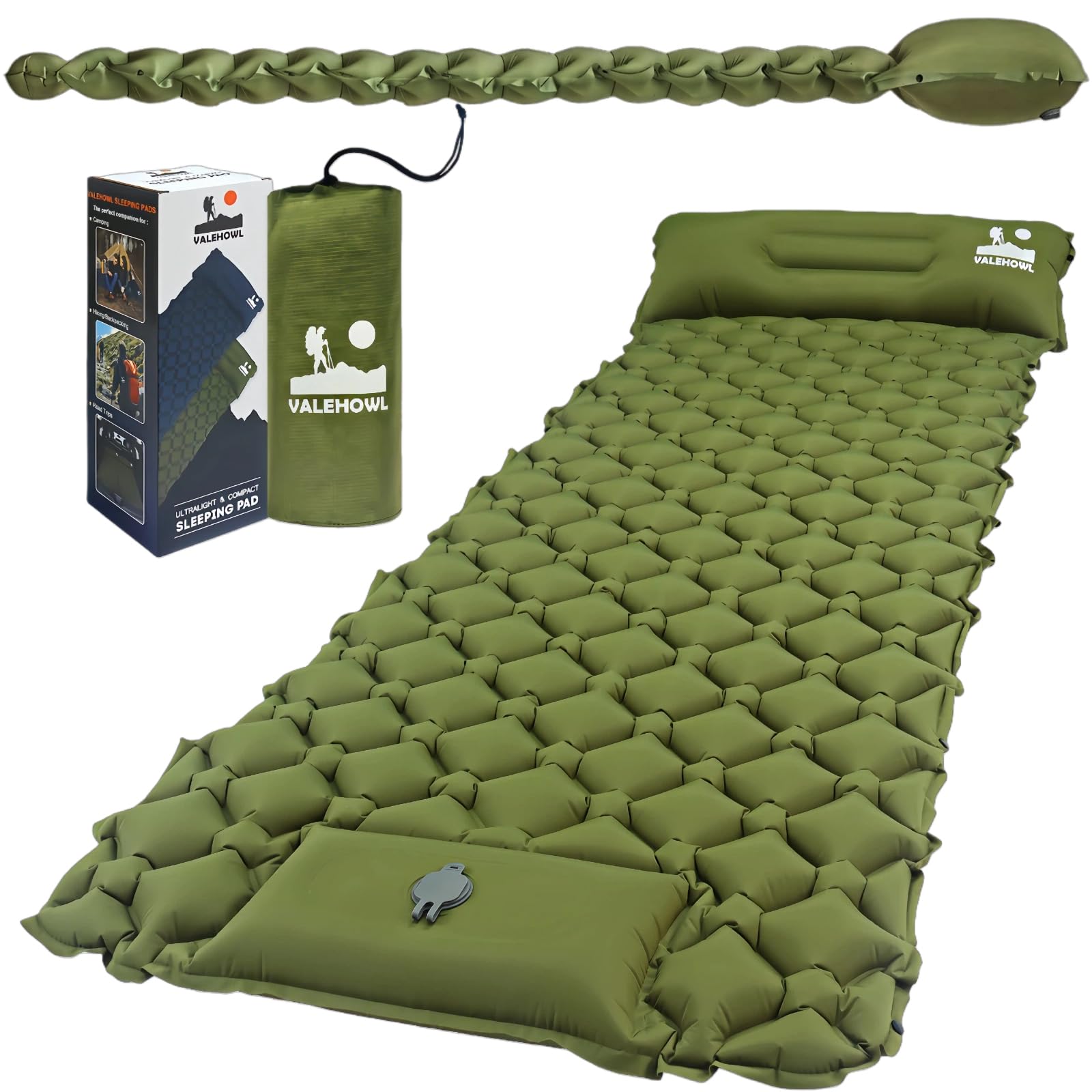
The VALEHOWL pad bridges the gap between budget-friendly inflatables and mid-range performance, offering a built-in foot pump that reaches full inflation in roughly 40 seconds. The honeycomb air chamber design creates a 2.7-inch thick cushion with an R-value of 3.0, making it one of the warmest options in this list for three-season use. It’s made from 40-denier nylon with a TPU coating — a combination that resists punctures better than the thin polyester found on many budget pads. The integrated ergonomic pillow sits at a fixed position, which some users find comfortable but others feel is awkwardly placed.
Weighing 1.8 pounds and packing down to 10 by 5 inches, it’s not the lightest inflatable here, but it still fits inside a main pack compartment or side pocket. The two-stage deflation system allows rapid air release when packing up camp. Side snap buttons let you connect two pads for a double-wide sleep surface, a feature couples or friends hiking together will appreciate. The 40D nylon outer layer is noticeably tougher than standard 20D fabrics, so it handles rocky tent pads with fewer worries.
The main downsides are the weight penalty compared to ultralight foam pads and the need to properly seat the dual plugs before sleeping — missed valves can cause slow air loss. The foot pump, while convenient, adds bulk that reduces the packability advantage over simpler valve-only designs. For backpackers who prioritize a warm, thick sleeping surface and don’t mind the extra ounces, the VALEHOWL is a solid inflatable that punches above its price tier.
Why it’s great
- Built-in foot pump inflates in under a minute
- R-value of 3.0 for three-season warmth
- 40D nylon resists punctures and scratching
Good to know
- Heavier than closed-cell foam alternatives
- Fixed pillow position may not suit all sleepers
- Double valves must be fully sealed to prevent leaks
5. OGERY Sleeping Pad with Foot Pump

The OGERY sleeping pad stands out immediately for its 6-inch thickness — a dramatic cushion that rivals much more expensive car-camping air beds. It’s a double-wide pad measuring 79 by 27.5 inches, which accommodates two sleepers comfortably or provides generous solo space to starfish out. The built-in foot pump inflates the pad by stepping repeatedly, though it requires roughly 200 pumps to reach full firmness. The 50-denier polyester shell with TPU waterproof coating feels reasonably robust, and the integrated pillows at the head section eliminate the need for a separate camping pillow.
At 2.4 pounds and packing down to 5.9 by 5.9 by 11 inches, this is not an ultralight backpacking pad — it’s better suited for short overnight hikes, car-camping base camps, or canoe trips where weight is less critical. The dual-layer air valves prevent backflow and hold air well once sealed. Some users report a crinkly noise from the fabric when shifting positions, a trade-off for the thick, soft feel. The built-in pillow works best for back sleepers; side sleepers may still need to bring a supplementary pillow.
For its intended audience — backpackers who don’t mind carrying a few extra pounds for guaranteed comfort — the OGERY is a strong contender. It inflates and deflates easily, and the included carry bag keeps it contained. Just bear in mind that its packed volume is more than triple that of a typical ultralight inflatable, so it’s best reserved for trips where pack space isn’t at a premium.
Why it’s great
- 6-inch thickness rivals premium luxury pads
- Double-wide size fits two sleepers
- Built-in pillows add convenience
Good to know
- Heavy and bulky compared to most backpacking pads
- Crinkly fabric can be noisy during sleep
- Foot pump requires many cycles to inflate fully
6. AceCamp Portable Foam Sleeping Pad

The AceCamp accordion foam pad is one of the lightest options available for backpackers who want to shave every possible ounce. At just 11 ounces, it adds almost negligible weight to your pack, and the polyethylene (PE) closed-cell foam construction means it will never pop or deflate. Its R-value of 2.0 is adequate for three-season use, though the 0.5-inch thickness provides minimal cushioning — you’re essentially sleeping on a firm, foam mat that softens pressure points rather than fully isolating you from the ground. Many users place it under an inflatable pad to add a protective layer and boost insulation.
The pad measures 69.2 by 21.6 inches, offering full-length coverage for most adults. It folds accordion-style and includes two compression straps to keep it compact, though its folded size is noticeably bulkier than an inflatable in a stuff sack. The PE foam is not as supple as the IXPE or Axiotomic foams used by pricier competitors, so it may feel stiff on uneven ground. Durability is good for its weight class, though repeated folding can cause edge wear over time.
If you need an ultralight, dead-simple pad that never requires inflation or air removal, the AceCamp is a solid entry-level choice. It’s also easy to cut down to a torso-length pad if you’re looking to drop even more weight. The thin profile is best paired with a sleeping bag that has its own bottom insulation, or used as a supplementary layer under a thicker inflatable for extra warmth and puncture protection.
Why it’s great
- Ultralight at only 11 ounces
- Zero deflation risk with closed-cell foam
- R-value 2.0 good for three-season use
Good to know
- Thin 0.5-inch cushioning is minimal
- Bulkier packed size than inflatables
- PE foam may feel stiff on uneven ground
7. FOCHIER Foam Sleeping Pad
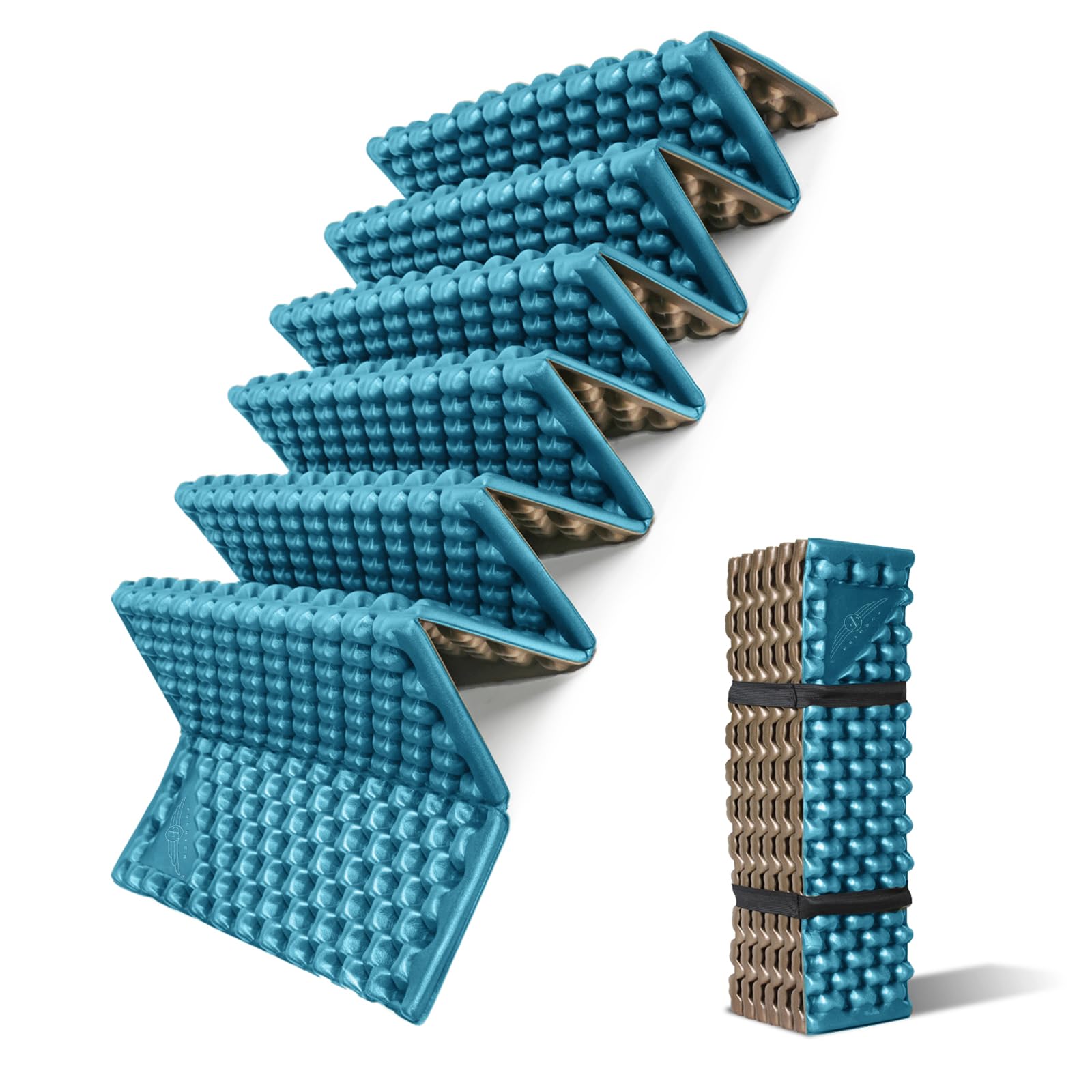
The FOCHIER pad brings a peanut-shaped closed-cell foam design to the budget backpacking market, with an aluminum film layer on one side that acts as a heat reflector. That reflective surface helps amplify warmth without adding bulk, making it more efficient than plain foam pads of similar thickness. The IXPE foam is softer than standard PE foam, providing a slightly more comfortable sleep surface. It folds accordion-style with peaks and valleys that nest together tightly when packed, resulting in a compact folded bundle that fits easily into a backpack side pocket.
Weighing just 13.4 ounces, it sits in the middle of the foam-pad weight range. The peanut-shape creates separate segments that can be folded in different ways, which adds versatility — you can double it under your hips for extra cushion or use a single panel as a sitting pad. Durability is strong, with users reporting it survived multiple field training events and rough ground without tearing. The waterproof coating prevents moisture absorption from damp tent floors or picnic areas.
The main trade-off is that its thin profile (approximately 0.6 inches) still leaves you feeling the ground, especially for side sleepers. Pairing it with a thin inflatable or using it as a base layer under an air pad solves this issue. For backpackers who want a lightweight, packable foam pad with better insulation than standard models, the FOCHIER is a smart budget buy that punches above its weight in terms of warmth-to-weight ratio.
Why it’s great
- Aluminum film layer improves heat reflection
- IXPE foam is softer than standard PE pads
- Peanut design nests tightly for compact folding
Good to know
- Thin cushioning may require supplemental pad
- Slightly narrower than full-width alternatives
- Reflective film can be damaged by rough surfaces
FAQ
Can I use a closed-cell foam pad alone for backpacking in temperatures near freezing?
How do I prevent an inflatable sleeping pad from leaking on the trail?
Final Thoughts: The Verdict
For most users, the best budget sleeping pad for backpacking winner is the Klymit Static V because it offers an unbeatable combination of ultralight weight, compact packed size, and reliable comfort for solo overnighters. If you want guaranteed durability and a tested R-value for three-season use, grab the Featherstone El Cordion. And for maximum budget savings with zero leak risk, nothing beats the AceCamp Accordion Foam Pad at just 11 ounces.

Mo Maruf
I created WellFizz to bridge the gap between vague wellness advice and actionable solutions. My mission is simple: to decode the research and give you practical tools you can actually use.
Beyond the data, I am a passionate traveler. I believe that stepping away from the screen to explore new environments is essential for mental clarity and physical vitality.