Our readers keep the lights on and my smoothie glass nicely filled. As an Amazon Associate, I earn from qualifying purchases.
A shotgun microphone is the one piece of gear that instantly separates amateur audio from professional-sounding dialog. Whether you’re filming a vlog, recording an interview, or trying to capture clean voice-over at your desk, the narrow pickup pattern of a shotgun mic rejects the surrounding noise of air conditioners, traffic, and chatter so your listener hears only the speaker. The challenge is finding a model that delivers that focused isolation without demanding a studio-sized budget.
I’m Mohammad Maruf — the founder and writer behind WellFizz. I’ve spent years dissecting audio hardware specifications, analyzing customer feedback patterns, and cross-referencing technical datasheets to identify the on-camera microphones that provide the best real-world performance for their cost.
This guide cuts through the noise to highlight five models that prove you do not need to spend a fortune for clean, directional sound. After thorough research, I have selected the standout options in the budget shotgun microphone category that offer genuine value for content creators and remote workers alike.
How To Choose The Best Budget Shotgun Microphone
Picking the right budget shotgun microphone comes down to understanding how its pickup pattern, power source, and connectivity fit your specific recording setup. These three factors determine whether your audio sounds clean or still picks up the rumble of the room.
Polar Pattern: Supercardioid vs. Hypercardioid
A shotgun microphone’s defining feature is its highly directional polar pattern. Supercardioid offers a narrow pickup with good rear rejection, making it ideal for on-camera use where you want to capture the subject directly in front of the lens. Hypercardioid is even tighter, providing slightly more side rejection but allowing a small lobe of rear sensitivity. For most vloggers, interviewers, and desk recorders, a supercardioid pattern strikes the best balance between focus and forgiveness.
Power Source: Passive vs. Active
Passive shotgun microphones draw power directly from the camera’s or recorder’s plug-in power (typically 3–5V). This eliminates the need for batteries, keeping the unit lightweight and always ready. Active microphones include an internal battery or USB power source, which can drive higher output levels and add features like adjustable gain, headphone monitoring, or AI noise cancellation. If you own a camera with reliable plug-in power, a passive mic is simpler and lighter. If you record on a smartphone or want on-board controls, an active mic is worth the extra weight.
Connectivity and Compatibility
A 3.5mm TRS cable connects to most DSLRs and mirrorless cameras. A 3.5mm TRRS cable is needed for smartphones and some tablets. USB-C output offers direct digital connection to computers and modern Android devices. Many budget shotgun mics now include both 3.5mm and USB-C cables in the box, giving you flexibility across multiple platforms. Verify that your camera provides plug-in power over the 3.5mm jack — some older models do not, which forces you to use an active mic.
Quick Comparison
On smaller screens, swipe sideways to see the full table.
| Model | Category | Best For | Key Spec | Amazon |
|---|---|---|---|---|
| BOYA BY-MM1 AI | Active | AI noise cancellation & app control | 30-hour battery, -40 dB DNN reduction | Amazon |
| Rode VideoMicro | Passive | Ultra-light on-camera use | 42g, no battery, Rycote Lyre mount | Amazon |
| Movo X1-Mini | Hybrid | Analog & digital dual output | 24-bit digital, aluminum body | Amazon |
| Deity V-Mic D4 Mini | Passive | Secondary mic input & low weight | 20mph wind rating, dual-track input | Amazon |
| COMICA VM10 PRO | Hybrid | Stepless gain in digital mode | USB-C & 3.5mm, battery-free | Amazon |
In‑Depth Reviews
1. BOYA BY-MM1 AI
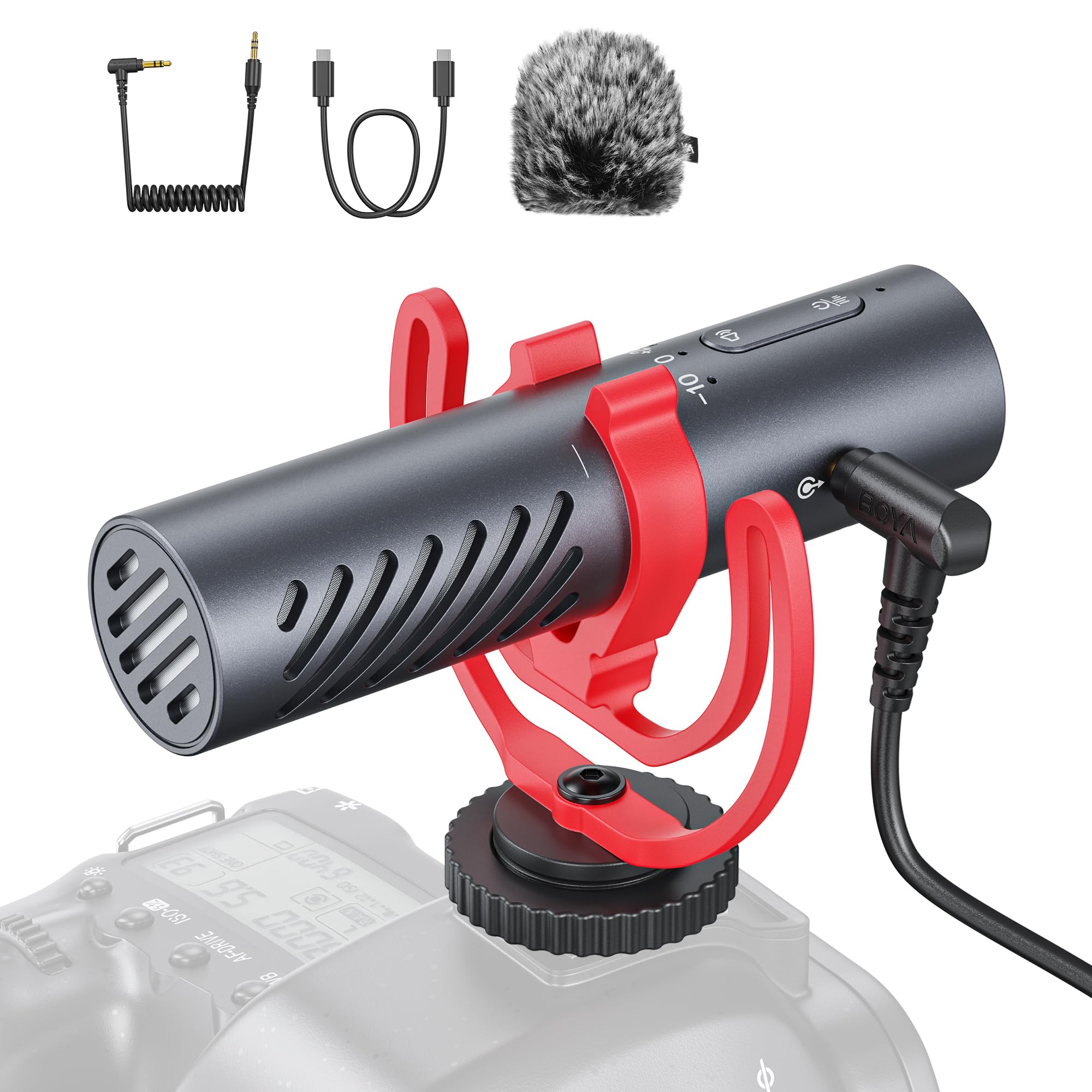
The BOYA BY-MM1 AI stands apart from every other mic in this roundup because of its dedicated neural processing chip. Instead of relying on a simple high-pass filter to reduce rumble, the onboard AI analyzes the audio with Deep Neural Networks and achieves up to -40 dB of noise cancellation. In real terms, that means a fridge compressor, street traffic, or an air conditioner are virtually removed from the recording without making the speaker sound like they are in a muffled tunnel.
The supercardioid pickup pattern is tight and focused, and the companion app gives you control over EQ presets, gain, and a safety track that records a second channel at a lower level to prevent clipping. With a 30-hour internal battery and passthrough charging via USB-C, you can record all day without hunting for an outlet. The included Rycote-style lyre shock mount and dual 3.5mm and USB-C outputs make it compatible with cameras, computers, and smartphones right out of the box.
At under , the BY-MM1 AI delivers active noise processing that usually belongs on mics costing three times as much. The trade-off is a slightly heavier build at 330 grams due to the battery and processing hardware, and the app is essential for switching between standard and noise-cancelling modes. For creators who record in uncontrolled environments — busy streets, coffee shops, or open-plan offices — this is the most powerful tool in the budget tier.
Why it’s great
- Dedicated AI chip reduces background noise by -40 dB
- 30-hour battery with USB-C passthrough charging
- Full app control for EQ, gain, and safety track
Good to know
- Heavier than passive shotgun mics (330 g)
- App needed to engage AI noise cancellation mode
2. Rode VideoMicro

The Rode VideoMicro is the benchmark that every other budget shotgun mic is measured against, and for good reason. Weighing only 42 grams and measuring just 80mm in length, it is so light you will forget it is mounted on your camera. It is a completely passive design, meaning it requires no battery — it draws plug-in power directly from the camera’s 3.5mm jack. This simplicity makes it the most reliable option for long shooting days where you do not want to worry about charging another device.
The VideoMicro uses a cardioid polar pattern that offers excellent rear rejection, which reviewers confirm is strong enough to isolate a stage performance from crowd noise. Its all-metal body feels denser than its weight suggests, and the included Rycote Lyre shock mount effectively decouples the mic from handling vibrations and camera motor noise. The frequency response is slightly rolled off on the low end at 100 Hz, which helps reduce rumble but means you may want to add a bit of warmth in post-production.
This mic is optimal for shooters who want a set-it-and-forget-it solution. You attach it, plug in the SC2 TRS cable, and record. The lack of USB connectivity or on-board gain control means it is not suited for smartphone recording unless you buy a separate TRRS adapter, and its output level is lower than active mics — you will likely need to raise your camera’s gain by a few dB. But for pure, zero-fuss directional audio on a DSLR, nothing in this price range beats its build quality.
Why it’s great
- Ultra-light 42g design with no batteries required
- All-metal body and Rycote Lyre shock mount
- Proven rear rejection for clean dialog capture
Good to know
- Only 3.5mm TRS output; no USB-C or TRRS cables included
- Lower output level may require camera gain adjustment
3. Movo X1-Mini

The Movo X1-Mini is a hybrid shotgun mic that bridges the gap between analog camera mics and modern USB-C devices. It includes three cables in the box — a 3.5mm TRS for DSLRs, a 3.5mm TRRS for smartphones, and a USB-C cable for computers and tablets — making it the most versatile out-of-box option in this list. The supercardioid pickup pattern provides focused front-facing audio while rejecting side and rear noise, and the 24-bit digital mode offers higher fidelity than the standard 16-bit analog path.
Users consistently praise the clarity of the X1-Mini for both gaming voice chat and dialog recording up to five feet away. The aluminum enclosure and integrated Rycote-style dual shock mount reduce handling noise effectively, and the furry windshield tames wind interference during outdoor shoots. A headphone monitoring port lets you hear what the mic is capturing in real time, a feature that is rarer in this price bracket than it should be.
The main compromise is the absence of any on-board gain adjustment or battery power — it is passive, so performance depends entirely on your device’s plug-in power quality. The included carrying case is a welcome addition but is too small to fit the mic with the shock mount attached. For content creators who switch between a camera for A-roll and a smartphone or laptop for B-roll, the X1-Mini’s all-in-one cable kit is a genuine time saver.
Why it’s great
- Includes TRS, TRRS, and USB-C cables for any device
- 24-bit digital audio clarity via USB-C
- Durable aluminum build with headphone monitoring
Good to know
- Passive design; no battery for on-board gain
- Carrying case too small for assembled mic and mount
4. Deity V-Mic D4 Mini

The Deity V-Mic D4 Mini distinguishes itself with a 3.5mm auxiliary input that can accommodate a secondary microphone source, such as a wireless lavalier. When a second source is plugged in, the D4 automatically assigns it to a separate track in compatible cameras, giving you the flexibility to record an interview subject with both a shotgun and a lav without needing an external recorder. The supercardioid capsule itself produces warm, crisp audio with very low self-noise at 74 dBA, and reviews confirm it handles sibilance well without harshness.
At only 150 grams, the D4 is light enough for use on a small boom pole, and the included TRS camera cable and TRRS phone cable make it immediately usable with both tools. The furry windshield is rated for winds up to 20 mph, so outdoor dialog recording stays clean in moderate breezes. The metal chassis feels solid, though the shock mount design is a bit flexible and some users found the assembly finicky.
The trade-off for the auxiliary input is that the secondary lavalier channel records on a single track with inconsistent volume levels according to several buyers — the feature is useful for backup audio, but not reliable as a primary second source. If you do not need the extra input, the D4 is still a well-tuned passive shotgun with one of the warmest sounds in its class. For vloggers and indie filmmakers who want the option to blend a lav with room tone, the D4 offers flexibility unmatched at this price.
Why it’s great
- 3.5mm auxiliary input for a second mic source
- Warm, sibilance-free audio with low self-noise
- Includes both TRS and TRRS cables for cameras and phones
Good to know
- Auxiliary input records on a single track with inconsistent volume
- Shock mount is flexible and can be fiddly to attach
5. COMICA VM10 PRO
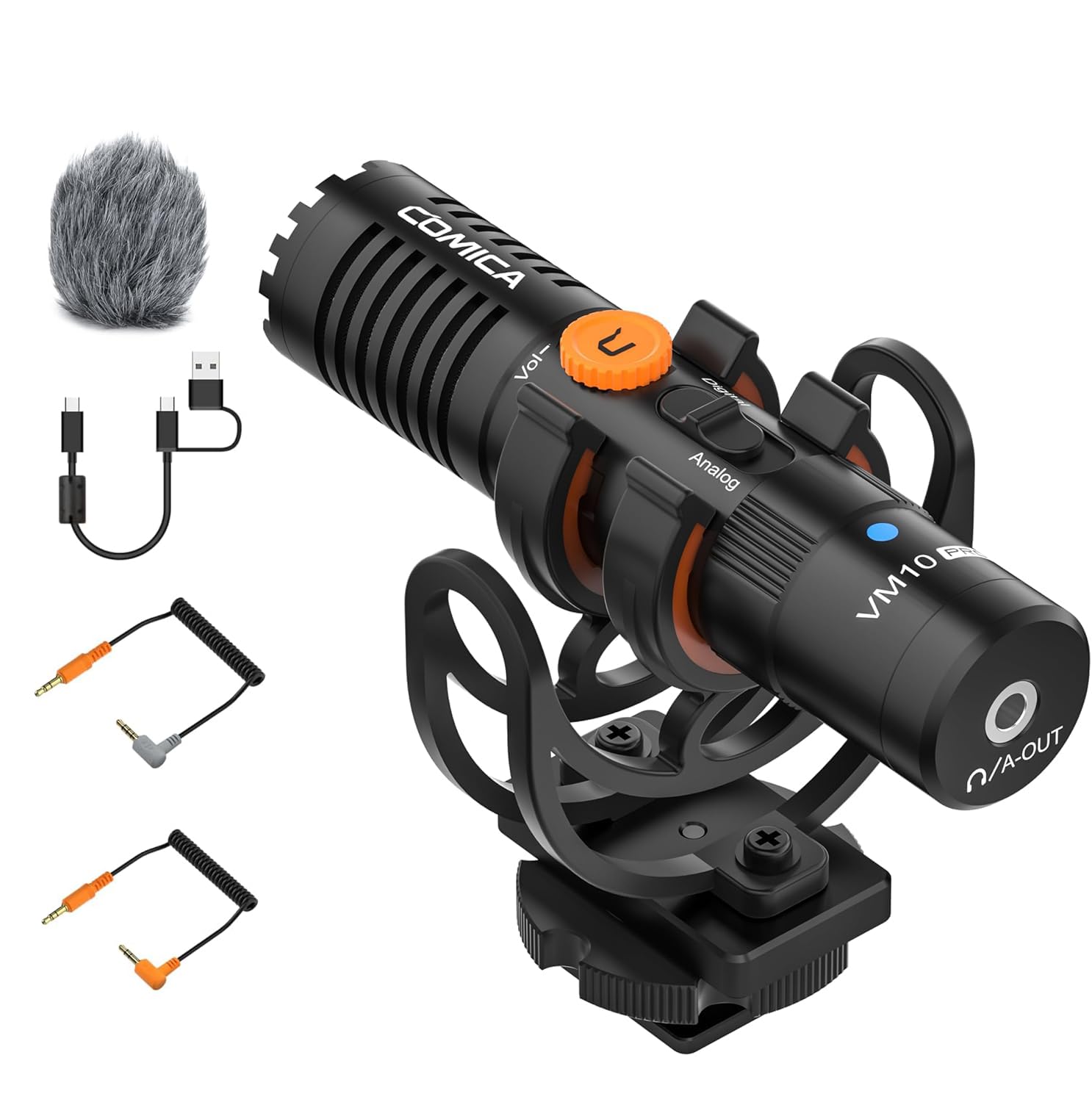
The COMICA VM10 PRO is the most budget-friendly entry in this guide, but its aluminum housing and dual USB-C plus 3.5mm output prevent it from feeling cheap. The battery-free design draws power from the host device, and the supercardioid pickup pattern effectively narrows the audio field to reject side conversations and room noise. It includes a shock mount, foam windscreen, and both USB-C and 3.5mm cables, covering compatibility with cameras, computers, and smartphones out of the box.
The standout feature at this price point is the stepless gain control that works in both analog and digital modes, allowing you to adjust the recording level without diving into your camera’s menu. A headphone monitoring jack lets you check levels on the fly. Real-world user reports confirm the VM10 PRO delivers clear dialog up to 20 feet away when set at 50% gain, and it has been used effectively to isolate a singer’s voice in a karaoke bar, rejecting the crowd noise around them.
The VM10 PRO is not without quirks. The analog output to a PC is noticeably quieter than the smartphone analog path, and the gain knob only functions in USB mode — a distinction that requires attention during setup. For casual vloggers, remote meeting participants, or students recording lectures, the VM10 PRO delivers directional audio isolation at the lowest entry cost. It is the most accessible on-ramp to understanding why a dedicated shotgun mic is dramatically better than a built-in laptop or phone microphone.
Why it’s great
- Stepless gain control with digital and analog output
- Aluminum body with USB-C and 3.5mm compatibility
- Battery-free, plug-and-play operation
Good to know
- Analog output to PC is quieter than to smartphone
- Gain knob functions only in USB mode
FAQ
Can I use a passive shotgun mic with my Android smartphone?
What is the difference between AI noise cancellation and a low-cut filter?
Why does my shotgun mic sound quiet on my camera?
Final Thoughts: The Verdict
For most users, the budget shotgun microphone winner is the BOYA BY-MM1 AI because it packs active AI noise cancellation and a 30-hour battery into a sub- package, making it the clear choice for recording in noisy real-world environments. If you want an ultra-light, zero-battery solution that you can mount on a DSLR and forget about, grab the Rode VideoMicro. And for versatile cross-platform connectivity with both analog and digital outputs, nothing beats the Movo X1-Mini.

Mo Maruf
I created WellFizz to bridge the gap between vague wellness advice and actionable solutions. My mission is simple: to decode the research and give you practical tools you can actually use.
Beyond the data, I am a passionate traveler. I believe that stepping away from the screen to explore new environments is essential for mental clarity and physical vitality.