Our readers keep the lights on and my smoothie glass nicely filled. As an Amazon Associate, I earn from qualifying purchases.
A budget sewing machine that can’t handle a simple denim hem or jams on two layers of cotton isn’t a bargain — it’s a frustrating paperweight. The real challenge isn’t finding a cheap machine; it’s finding one with the right balance of stitch versatility, motor torque, and build quality at a price that doesn’t make you wince. Many entry-level machines look alike on the surface, but small differences in frame construction, bobbin system, and presser foot compatibility separate the reliable daily workers from the ones that end up in a closet after three projects.
I’m Mohammad Maruf — the founder and writer behind WellFizz. I’ve spent the last 15 years analyzing consumer hardware, from appliance motors to filtration media, and I’ve combed through hundreds of hours of sewing machine data, customer feedback, and technical spec sheets to identify the models that actually deliver consistent stitch quality without breaking down.
Whether you’re mending your own clothes, teaching a child to sew, or starting a small home craft business, the right best budget sewing machine can save you dozens of hours and hundreds of dollars in repairs. This guide covers nine machines across three price tiers, with detailed breakdowns of what each one truly handles.
How To Choose The Best Budget Sewing Machine
Picking the right entry-level machine means looking past the marketing promises and focusing on the three things that determine whether you’ll enjoy sewing or give up in frustration: the motor’s ability to push through thick seams, the frame’s resistance to vibration at speed, and the ease of daily maintenance like threading and bobbin changes. Here’s what matters most.
Frame Construction: Metal vs. Plastic
A full or partial metal internal frame absorbs the vibration generated by the needle piercing fabric at high speed. Plastic-framed machines tend to walk across a table during use and develop inconsistent stitch tension over time as the frame flexes. For any machine you plan to use regularly, look for at least a metal internal skeleton, even if the outer shell is plastic. The SINGER Heavy Duty 4411 and the FEIYUE FYe350 both use reinforced metal frames that stay stable through long sewing sessions.
Motor Type: Servo vs. Induction
Traditional sewing machines use single-phase induction motors, which are heavy, inefficient, and often lack low-speed torque — meaning the needle can stall when you’re trying to sew slowly around a curve. Modern servo motors solve this: they deliver consistent torque across the entire speed range, use less electricity, and include automatic shutoff when a thread jam is detected. Servo-powered machines like the FEIYUE FYe330 and FYe350 also run quieter and generate less heat during extended use, which extends the machine’s mechanical lifespan.
Stitch Count vs. Useful Stitches
A machine with 200 stitch patterns sounds impressive, but most home sewers use only three to five stitch types regularly: straight stitch, zigzag, blind hem, and a buttonhole. The quality of those core stitches matters far more than decorative pattern variety. Machines like the Brother XM3700 with 37 built-in stitches cover every essential application without overwhelming a beginner with menus. If you do want decorative and alphanumeric stitches for personalization, a computerized model like the Poolin EOC02 gives you access to those extras without sacrificing the basic stitch quality.
Bobbin System: Drop-In vs. Front-Loading
Front-loading bobbins (common on older Singer models) require you to remove the extension table, insert the bobbin case, and thread it through a tension spring — a process that takes practice to master. Drop-in bobbins, found on most modern budget machines, let you simply drop the bobbin into a compartment on top and pull the thread through a slot. For beginners, a jam-resistant drop-in system like the one on the Brother XM3700 or SM3701 reduces the learning curve significantly and makes mid-project bobbin changes much less disruptive.
Quick Comparison
On smaller screens, swipe sideways to see the full table.
| Model | Category | Best For | Key Spec | Amazon |
|---|---|---|---|---|
| Brother XM3700 | Mid-Range | Beginners wanting 37 stitches & ease | 37 stitches, drop-in bobbin | Amazon |
| SINGER 4411 | Mid-Range | Sewing denim, canvas & leather | 1100 stitches/min, metal frame | Amazon |
| FEIYUE FYe350 | Mid-Range | Energy-saving servo & thick fabrics | Servo motor, 23 stitches | Amazon |
| FEIYUE FYe330 | Mid-Range | Ultra-low speed control & precision | Servo motor, 105 stitch apps | Amazon |
| Brother SM3701 | Premium | Reliable daily sewing & teaching | 37 stitches, free arm | Amazon |
| Poolin EOC02 | Premium | Quilting & computerized stitch variety | 200 stitches, LCD screen | Amazon |
| SINGER 6800C | Premium | Serious home sewers & heavy fabrics | 586 stitches, 10 presser feet | Amazon |
| American Home AH600 | Budget | Teaching kids & basic mending | 12 stitches, 12.8 lbs | Amazon |
| Stoigeld SM-725 | Budget | Kids & ultra-light fabric projects | 12 stitches, 4.2 lbs | Amazon |
In-Depth Reviews
1. Brother XM3700 Sewing Machine, 37 Built-in Stitches

The Brother XM3700 hits the sweet spot for a beginner-friendly machine that won’t leave you wanting more after a month. Its 37 built-in stitches cover everything you’ll realistically need: straight, zigzag, blind hem, decorative, and a one-step auto-size buttonhole. The automatic needle threader saves time, though it does have a slight learning curve — once you get the feel, it threads consistently. The drop-in top bobbin is jam-resistant and transparent, so you can see how much thread remains without removing it. At 12.5 pounds, it’s light enough to store in a closet and bring out for a weekend project.
What makes this machine stand out at its price point is the free arm capability for sewing cuffs, sleeves, and cylindrical shapes — a feature often missing from cheaper alternatives. Sewing through felt, cotton, and even silk is smooth, and the stitch length and width adjustments are easy to access. Users report good results on heavier materials like denim when using the correct needle. The reverse stitch lever takes a bit of practice to reach smoothly, but it becomes natural quickly.
Brother’s “At Your Side” support is genuinely useful, with free online chat and phone help available for the machine’s lifetime. The included accessory pouch holds five presser feet and a needle set, giving you enough to start most common projects without buying extra gear. For someone who wants a reliable machine that sews well from day one without a steep learning curve, the XM3700 is the most balanced choice in the range.
Why it’s great
- 37 stitches cover every essential application
- Jam-resistant drop-in bobbin is beginner-friendly
- Free arm for cuffs and sleeves works well
- Lightweight and easy to store
- Lifetime customer support from Brother
Good to know
- Auto needle threader requires practice to master
- Reverse stitch lever location is awkward initially
2. SINGER Heavy Duty 4411 High Speed Sewing Machine

The SINGER 4411 is the machine you reach for when your project involves denim, canvas, or even light leather. Its heavy-duty motor delivers 60% more power than a standard home machine, and the all-metal internal frame keeps the needle stable even at 1,100 stitches per minute. This isn’t a machine that shakes or walks off the table when you’re sewing through four layers of jean material at the hem. It’s built for speed and torque, which is exactly what you need if you plan to do alterations, upholstery, or bag-making.
With only 11 built-in stitches producing 69 stitch applications, the 4411 isn’t trying to dazzle you with decorative patterns. Instead, it focuses on doing the straight stitch and zigzag extremely well, plus a four-step buttonhole, blind hem, and a few stretch stitches. The top drop-in bobbin has a transparent cover, so you can monitor thread supply during long seams. Users consistently report that this machine glides through denim effortlessly and handles layered seams without hesitation — a real test for any budget machine.
One minor annoyance: the threading path includes a tricky bracket above the needle that requires careful attention at step seven to avoid thread tangling. Also, the included needle should be swapped for a heavier-duty one when working with thick materials. The 25-year limited warranty is reassuring for a machine this price. If your sewing involves regular work with tough fabrics, the 4411 is the most capable option in the mid-range tier.
Why it’s great
- Strong motor handles denim, canvas, leather with ease
- Metal frame eliminates vibration at high speed
- Fast 1100 stitches per minute for efficient work
- Drop-in bobbin with transparent cover
- 25-year warranty adds peace of mind
Good to know
- Threading step 7 is tricky and needs care
- Only 11 stitch patterns — basic focus
- Original needle should be upgraded for heavy work
3. FEIYUE FYe350 Sewing Machine, Servo Motor
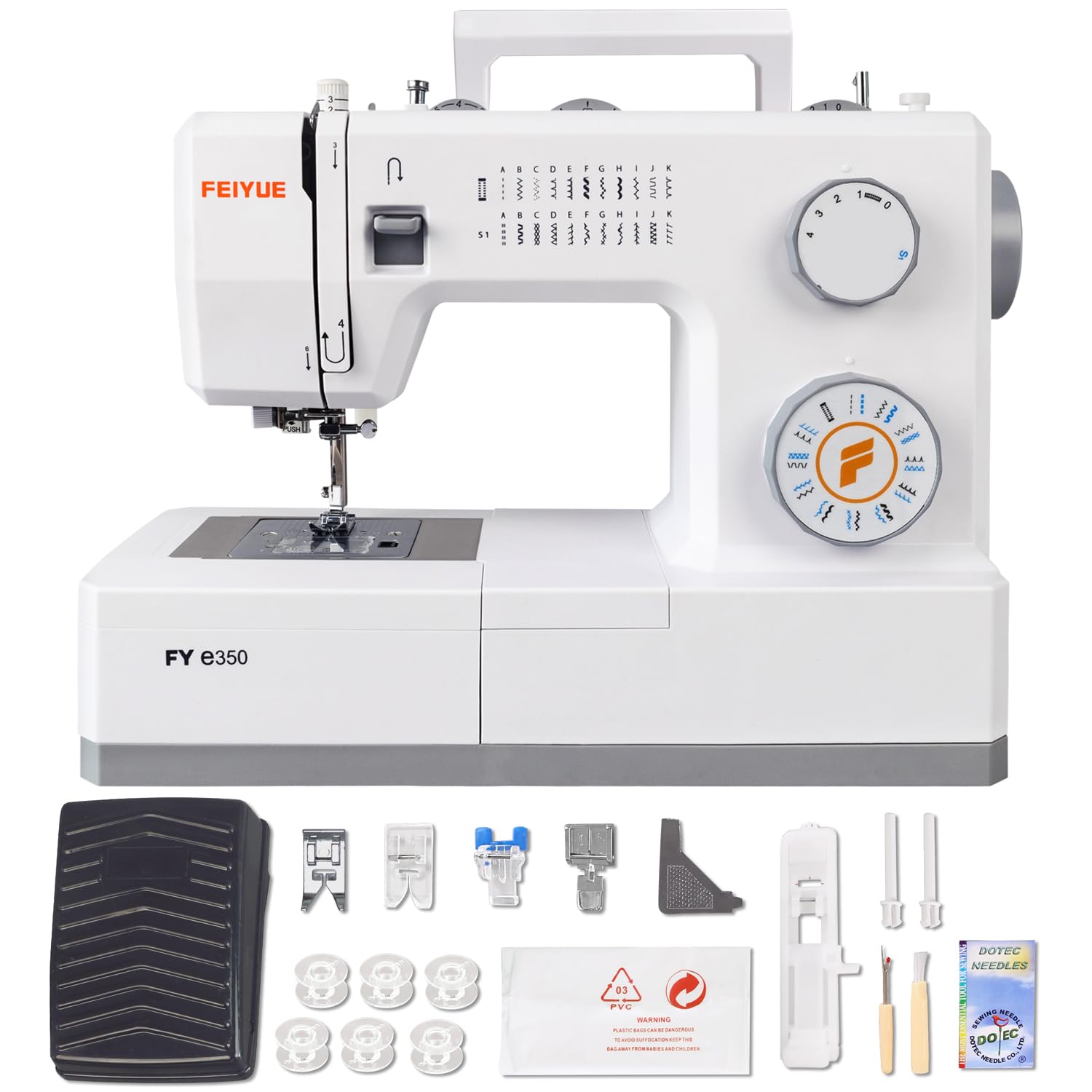
The FEIYUE FYe350 brings genuine servo motor technology to the budget bracket — a feature usually reserved for machines costing twice as much. The servo motor is 10% more efficient than a traditional induction motor and uses up to 35% less energy. But the real benefit for the sewer is the ability to sew at ultra-slow speeds with complete control. Curves, corners, and delicate fabrics like silk become manageable because the needle doesn’t jerk or stall at low RPM. If the machine detects a thread jam, it stops automatically and flashes a warning light — no blown fuses or damaged needles.
With 23 built-in stitches covering basic, stretch, and decorative patterns plus a one-step buttonhole, the FYe350 offers more stitch variety than the SINGER 4411 while keeping the same heavy-duty metal frame construction. Users report sewing through two layers of 2-4 oz leather easily, and the machine runs comparatively quiet for its class. The automatic needle threader works well, though some users prefer a hand threading tool as a backup. The kit includes six bobbins, three needles, and five presser feet, which is generous at this price point.
The foot pedal has a slightly hard initial press to get the machine started, which takes getting used to. Also, one user reported the feed dog adjustment broke early, while others had no issues — quality control may vary between units. If you want a machine that sews thick materials with servo precision and energy efficiency, the FYe350 delivers features you’d normally find a tier higher.
Why it’s great
- Servo motor enables precise low-speed control
- Handles leather and denim with metal frame stability
- Thread jam protection stops machine automatically
- Quieter operation than induction motor machines
- Generous accessory kit included
Good to know
- Foot pedal requires firm press to start
- Quality control may be inconsistent
- Needle threader can be finicky at times
4. FEIYUE FYe330 Sewing Machine, 105 Stitch Applications

The FEIYUE FYe330 shares the same servo motor platform as the FYe350 but with an expanded stitch library. Twenty-five built-in stitches give you 105 stitch applications, including decorative patterns, stretch stitches, and buttonhole options that the FYe350 doesn’t offer. This makes the FYe330 a better choice if you plan to do some decorative stitching alongside your basic repairs. The reinforced metal frame and high-torque drive system ensure the needle doesn’t wander at low speeds — a genuine advantage when sewing curves or doing detailed appliqué work.
Automatic thread jam protection works the same way as on the FYe350: the machine stops and flashes a warning light, letting you clear the jam without damaging the motor or needle. This is a standout safety feature for beginners who are still learning proper tension and fabric handling. The automatic needle threader is a one-touch mechanism that works smoothly once you hold the thread at the right angle. The kit includes six bobbins, three needles, and five presser feet — enough to start sewing immediately.
The main drawback reported by users is that the automatic threader occasionally fails to catch the needle eye or breaks the thread, especially with lower-quality thread. A few buyers also noted that the machine’s plastic components feel less durable than the metal parts, though the metal frame itself is solid. At this price, you’re getting servo motor precision and expanded stitch variety that many budget machines don’t offer, making it a strong pick for the detail-oriented home sewer.
Why it’s great
- 105 stitch applications for creative projects
- Servo motor with ultra-low speed control
- Thread jam protection prevents damage
- Sturdy metal frame reduces vibration
- Good accessory kit for getting started
Good to know
- Auto threader can be unreliable with some threads
- Some plastic parts feel less robust
5. Brother SM3701 37-Stitch Free Arm Sewing Machine

The Brother SM3701 is remarkably similar to the XM3700 in stitch count and features, but it edges ahead for home sewers who value a compact footprint and a proven track record. Its 37 built-in stitches include all the essentials: straight, zigzag, blind hem, decorative stitches, and a one-step auto-size buttonhole that creates consistent buttonholes every time. The free arm is easily accessible for sewing cuffs, sleeves, and pant legs, and the overall machine footprint is small enough to leave set up on a desk without dominating the space. At 12.9 pounds, it’s not the lightest, but it’s manageable.
Users consistently praise this machine’s ability to handle thick fabrics like denim and even multiple layers of cotton without struggling, thanks to a sturdy metal frame and a motor that delivers consistent power. The threading path is clearly marked with arrows on the machine body, which makes the setup process straightforward even for first-time users. The included instructional DVD and detailed manual are genuinely helpful, covering everything from bobbin winding to stitch selection. The jam-resistant drop-in bobbin system is the same reliable design found on the XM3700.
The main long-term consideration is maintenance: after about two years of use, the internal oil can dry out, causing the machine to seize. A simple self-oiling procedure, guided by YouTube tutorials, restores function — but it’s something to be aware of if you plan to keep the machine for years. Some users also find the bobbin cover requires a tool to remove, which is less convenient than the snap-off covers on newer models. For a dependable machine with proven durability and a user-friendly design, the SM3701 is a solid choice.
Why it’s great
- Compact size fits easily on any desk
- 37 stitches with one-step buttonhole function
- Marked threading path makes setup intuitive
- Handles thick fabrics well for its size
- Includes instructional DVD for beginners
Good to know
- Internal oil may dry out after 2+ years
- Bobbin cover needs tool to remove
- Needle threader has a learning curve
6. Poolin EOC02 Computerized Sewing Machine, 200 Stitches
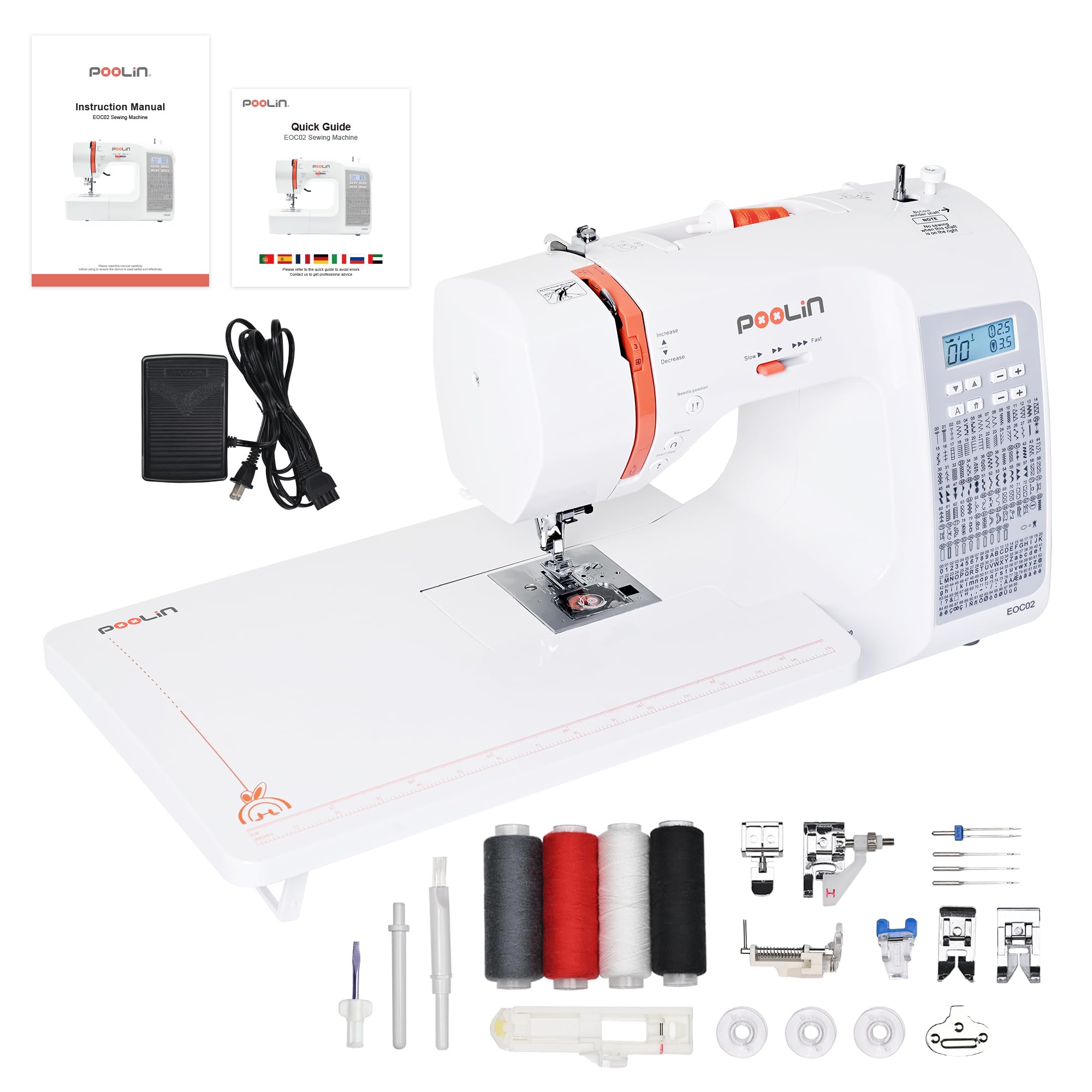
The Poolin EOC02 is a computerized machine that brings 200 built-in stitches, including alphanumeric patterns, to a price point where most competitors offer only mechanical stitch selection. The LCD screen displays your stitch choice and settings clearly, and the intuitive control panel lets you adjust stitch length and width with buttons rather than physical dials. The automatic needle threader on this machine is notably reliable — users report it works consistently without the learning curve seen on some Brother and SINGER models. The machine also features a start/stop button, so you can sew without using the foot pedal, which is a nice convenience for long seams.
The extra-wide extension table is a significant advantage if you plan to do any quilting or work with bulky materials. It provides a generous workspace that supports the fabric’s weight, preventing drag that can distort stitches. The free arm is accessible by removing the accessory compartment. Seven presser feet come in the box, including a zipper foot, buttonhole foot, and button sewing foot, covering most common applications. Users consistently note that this machine runs very quietly and smoothly, with no vibration even at higher speeds — a testament to its build quality.
The main consideration is that the walking foot is not included, which is a disappointment for quilters who need it for even feed on multiple layers. Also, the machine is heavier at 7.5 kg (16.5 lbs) than many alternatives, making it less portable. Some users reported that 100% cotton thread can cause tension issues; switching to a poly-cotton blend solved the problem. Poolin offers customer support and a social media community for troubleshooting. If you want computerized features and a large work area without stepping up to a premium tier, the EOC02 delivers impressive value.
Why it’s great
- 200 stitches including alphanumeric patterns
- Very quiet and vibration-free operation
- Wide extension table for quilting projects
- Reliable automatic needle threader
- Start/stop button allows foot-free sewing
Good to know
- Walking foot not included — needs separate purchase
- Heavier than mechanical machines at 16.5 lbs
- Cotton thread may cause tension issues
7. SINGER Heavy Duty 6800C Computerized Sewing Machine

The SINGER 6800C is the most feature-rich machine on this list, combining the heavy-duty motor of the 4411 with a fully computerized stitch selection system. With 586 stitch applications, including basic, stretch, decorative stitches, and two built-in lettering fonts, plus nine one-step buttonhole styles, this machine can handle almost any sewing task a home sewer would encounter. The LCD screen displays stitch images and presser foot recommendations, so you always know which foot to use. The motor is 60% stronger than a standard machine, delivering speeds up to 1,100 stitches per minute — equal to the non-computerized 4411 but with computerized precision.
The accessory package is the most generous of any machine here: ten presser feet including an even feed/walking foot for quilting, an open toe foot for decorative stitching, and a cording foot. The built-in needle threader works well, and the top drop-in bobbin with transparent cover is easy to monitor. Automatic features include a thread cutter, a tie-off button for securing seams, and drop feed for free-motion sewing. Stitch length adjusts up to 6mm and width up to 5mm, giving you flexibility for everything from fine silk to heavy canvas.
The 6800C is heavier at 16.6 pounds but still portable enough for most home setups. The included FREE Creativate app provides digital access to the manual, tutorials, and troubleshooting guides directly linked to your machine model. Some users noted that the included needles broke quickly and recommended swapping them for higher-quality ones. This machine represents the top end of the budget-conscious buyer’s range — if you can stretch your budget, the 6800C offers professional-level features without crossing into industrial-machine territory.
Why it’s great
- 586 stitches with lettering fonts for personalization
- 10 presser feet included, even walking foot
- Computerized LCD with presser foot recommendations
- 60% stronger motor with 1100 stitches/min speed
- Automatic thread cutter and tie-off functions
Good to know
- Heavier than most at 16.6 pounds
- Included needles are low quality — replace immediately
- Higher price point for the budget category
8. American Home Believe AH600 Beginner Sewing Machine

The American Home Believe AH600 is designed specifically for beginners who don’t need dozens of stitch patterns or complex controls. With 12 pre-set stitches — including straight, zigzag, blind hem, and a four-step buttonhole — it covers the basics without overwhelming a first-time user. The automatic bobbin winder stops when the bobbin is full, and automatic stitch control manages width and length, so there’s no manual guesswork. This makes it a strong candidate for teaching a child, as the learning curve is minimal. Users report that a 9-year-old was able to learn threading and bobbin winding quickly and was soon using the machine independently for quilting and simple repairs.
The free arm has a generous amount of space, which users say is better than what competitors offer at this price. This makes hemming pants and sleeves more comfortable than on many compact machines. At 12.8 pounds with a built-in carry handle, it’s easy to move from room to room or store in a closet. The metal bobbin case helps maintain consistent tension. The kit includes two presser feet, two bobbins, and a seam ripper — enough to start simple projects.
The built-in work light is not very bright, which can make threading the needle in low-light conditions difficult. Some users also found the manual’s instruction order confusing (bobbin winding instructions should come earlier in the sequence), though YouTube videos quickly fill the gap. For a dedicated entry-level machine for a young learner or someone who only needs occasional mending, the AH600 is simple, sturdy, and effective.
Why it’s great
- Very simple controls ideal for teaching kids
- Generous free arm space for hemming
- Automatic bobbin winder and stitch control
- Lightweight with carry handle for portability
- Metal bobbin case for good tension consistency
Good to know
- Built-in light is dim for threading in low light
- Manual’s instruction order could be better
- Only 12 stitches — very basic selection
9. Stoigeld SM-725 Sewing Machine for Beginners
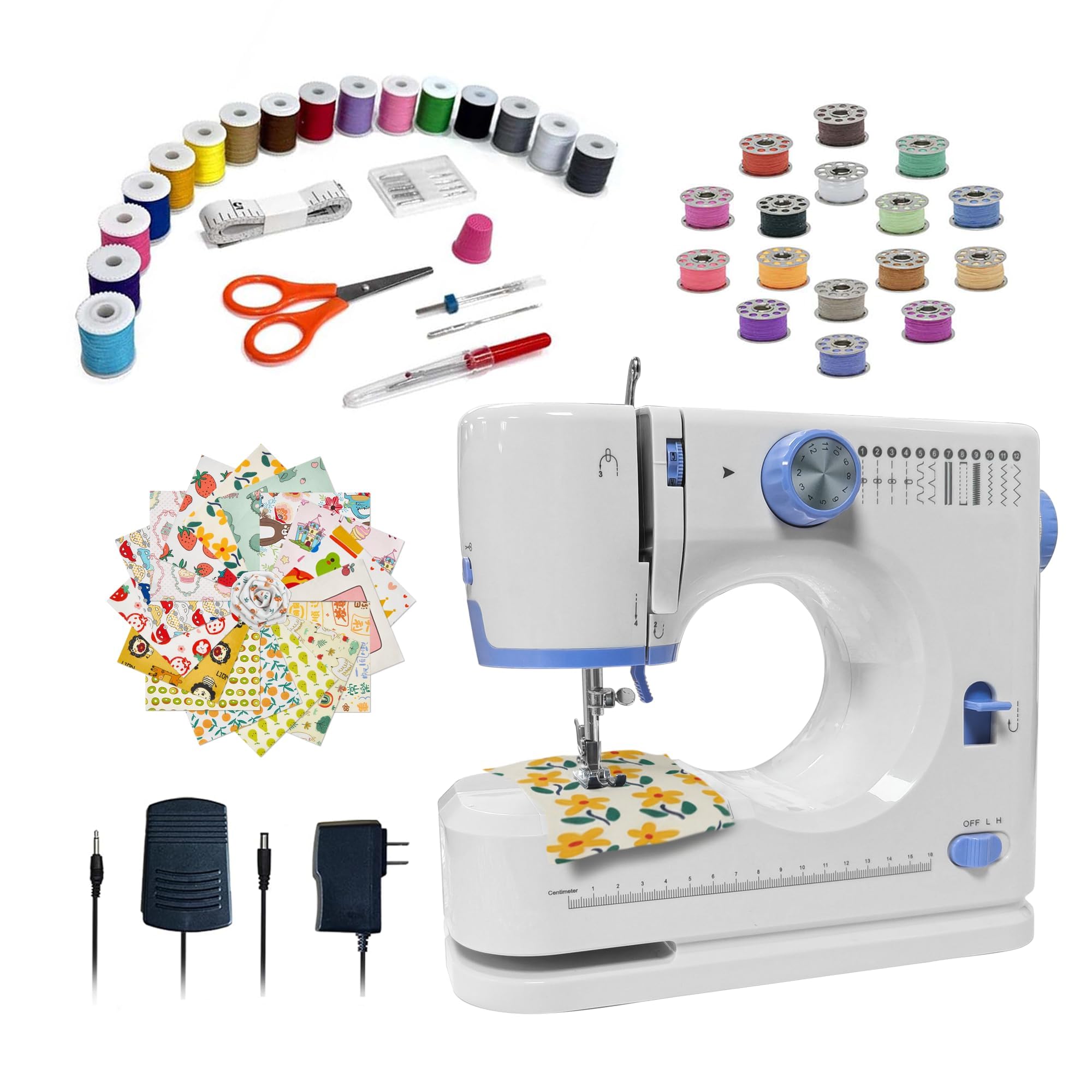
The Stoigeld SM-725 is the lightest and most compact machine in this lineup at just 4.2 pounds, making it a genuinely portable option for small apartments, classrooms, or for keeping in a drawer between uses. Its 12 built-in stitches and two-speed control (high and low) give even a complete beginner enough options for basic repairs and simple DIY projects. The complete starter bundle — 32 spools of thread and 20 fabric pieces — means you can start sewing immediately without a trip to the craft store. The low-speed setting is particularly helpful for children learning to control fabric feed.
This machine is specifically designed for light fabrics: thin cotton, linen, and woven materials up to 4-6 layers. It is not intended for denim or heavy canvas, and attempting to sew thick materials will likely cause jamming. The plastic frame and small motor are adequate for occasional mending, hemming, and small craft projects but won’t hold up to heavy daily use. The reverse function and four-step buttonhole are welcome features at this size. The included drawer for needles is a thoughtful touch for keeping small parts organized.
The primary risk here is durability: a few users reported that the machine stopped working after only a few uses, with threads breaking or jamming at the same spot above the needle. The instructions are clear about fabric limitations, and following them carefully is essential for avoiding problems. For a child’s first sewing machine or for ultra-basic emergency repairs, the SM-725 is affordable and compact. For any regular sewing, one of the heavier machines above will last significantly longer.
Why it’s great
- Extremely lightweight and portable at 4.2 lbs
- Includes 32 thread spools and 20 fabric pieces
- Two-speed control helpful for beginners and kids
- Compact size fits in a drawer when not in use
- Four-step buttonhole on such a small machine
Good to know
- Only handles light thin fabrics — no denim
- Plastic frame limits long-term durability
- Several reports of thread jamming after few uses
- Not suitable for frequent or heavy sewing
FAQ
Can a budget sewing machine handle denim or multiple fabric layers?
How many stitches do I actually need in a beginner machine?
What does a servo motor do that a regular motor doesn’t?
Is a heavier sewing machine always better?
How long should a budget sewing machine last with regular use?
Final Thoughts: The Verdict
For most users, the best budget sewing machine winner is the Brother XM3700 because it balances a large stitch library, reliable drop-in bobbin, and lightweight portability at a price that doesn’t compromise on build quality. If you plan to sew denim, canvas, or leather regularly, grab the SINGER Heavy Duty 4411 for its metal frame and powerful motor. And for the home sewer who wants servo motor precision with expanded stitch variety, nothing beats the FEIYUE FYe350.

Mo Maruf
I created WellFizz to bridge the gap between vague wellness advice and actionable solutions. My mission is simple: to decode the research and give you practical tools you can actually use.
Beyond the data, I am a passionate traveler. I believe that stepping away from the screen to explore new environments is essential for mental clarity and physical vitality.