Our readers keep the lights on and my smoothie glass nicely filled. As an Amazon Associate, I earn from qualifying purchases.
Finding a receiver that balances real-world performance with real-world cost is a challenge that often leads to disappointment. You don’t want to waste money on features you’ll never use, but you also don’t want a bare-bones unit that compromises on the core listening experience.
I’m Mohammad Maruf — the founder and writer behind WellFizz. For over a decade, my work has focused on dissecting consumer electronics specifications and market data to identify where true value lies, separating marketing hype from tangible performance.
This guide is the result of deep analysis, comparing critical specs and real-world user feedback across the major brands to pinpoint the models that deliver serious performance without a serious investment. The right choice depends entirely on whether you’re building a simple stereo setup or a full home theater, but a great best budget receiver exists for both.
How To Choose The Best Budget Receiver
Stepping into the world of audio receivers can feel overwhelming with all the technical jargon. The key is to focus on a few core decisions that directly impact your daily use. Let’s break down what you should prioritize before you start comparing specific models.
Stereo vs. AV Receiver: Your First Big Choice
This is the most fundamental decision. A stereo receiver is built for two-channel audio—perfect for music listening with a pair of speakers, a turntable, and a CD player. An AV (Audio/Video) receiver is designed for home theater, handling video switching and decoding surround sound formats like Dolby Atmos for movies and gaming. If your primary goal is immersive music, go stereo. If you want a central hub for your TV, game console, and streaming box, an AV receiver is necessary.
Connectivity: Plan for Today and Tomorrow
Think about your current and future sources. Essential audio connections include a dedicated phono input if you have a turntable, and enough RCA or digital optical inputs for other gear. For modern setups, HDMI is non-negotiable, with ARC (Audio Return Channel) or eARC being crucial for sending TV audio back to the receiver. Built-in Bluetooth is a massive convenience for wireless streaming, while Wi-Fi opens the door to higher-quality streaming services and multi-room audio.
Power and Speaker Compatibility
Wattage per channel is often overemphasized. For a typical living room, 50-100 watts per channel is more than sufficient. Pay closer attention to speaker compatibility (usually 6 or 8 ohms) and ensure the receiver can comfortably drive the speakers you own or plan to buy. A quality budget receiver will have robust power supplies and clean amplification that sounds good at both low and high volumes.
Quick Comparison
On smaller screens, swipe sideways to see the full table.
| Model | Type | Best For | Key Feature | Amazon |
|---|---|---|---|---|
| Yamaha R-S202BL | Stereo | Simple 2-channel music | Bluetooth, A/B speaker switching | Amazon |
| Sony STRDH190 | Stereo | Vinyl listeners on a budget | Built-in phono preamp | Amazon |
| Denon AVR-S570BT | AV Receiver | First 5.1 home theater | 5.1 channels, 8K HDMI | Amazon |
| Yamaha RX-V385 | AV Receiver | 4K HDR movie nights | YPAO room calibration | Amazon |
| Sony STRDH590 | AV Receiver | 5.2 channel flexibility | Virtual surround, 4K pass-through | Amazon |
| Denon AVR-X1700H (Renewed) | AV Receiver | Feature-packed 7.2 setup | Dolby Atmos, 8K/120Hz, HEOS | Amazon |
| Yamaha R-N600A | Network Stereo | High-res music streaming | ESS Sabre DAC, Wi-Fi/Bluetooth | Amazon |
| Yamaha TSR-700 | AV Receiver | Future-proof 7.1 system | 8K HDMI, MusicCast, 7 channels | Amazon |
| Marantz NR1510 | Slim AV Receiver | Space-constrained home theater | Slim 4″ design, HEOS multi-room | Amazon |
| Yamaha RX-V6A | AV Receiver | High-performance 7.2 audio | 8K60, Dolby Atmos, MusicCast | Amazon |
| Denon AVR-X3800H | Premium AV Receiver | Advanced home theater | 9.4 channels, Auro-3D, IMAX Enhanced | Amazon |
In‑Depth Reviews
1. Yamaha R-S202BL Stereo Receiver

The Yamaha R-S202BL consistently stands out as the most reliable and versatile entry-point into quality stereo sound. It strips away unnecessary complexity, focusing on delivering clean power and essential modern features. The brushed aluminum finish and straightforward layout make it feel more substantial than many entry-level options, setting a high bar for build quality in its class.
Performance is where this receiver truly shines. Users report its ability to drive demanding tower speakers with ease, producing a “stunning and uncompressed” sound that belies its accessible positioning. The Bluetooth connectivity (version 4.1) is notably stable and pairs quickly, making wireless streaming from your phone a seamless experience. The inclusion of A/B speaker switching is a thoughtful touch, allowing you to power two sets of speakers in different rooms or switch between them.
It’s a quintessential workhorse. The FM/AM tuner with 40 presets is robust, and the auto power standby function adds a layer of convenience. While it lacks a phono input or subwoofer output, its core competency—amplifying music with clarity and authority—is executed flawlessly. For anyone seeking an uncomplicated, powerful foundation for a two-channel music system, the R-S202BL is exceedingly difficult to beat.
Why it’s great
- Exceptionally clean and powerful sound for stereo music.
- Reliable Bluetooth connectivity for easy wireless streaming.
- A/B speaker switching adds useful flexibility for multi-room audio.
- Solid, no-nonsense build quality with a clean design.
Good to know
- Lacks a dedicated phono input for turntables.
- No subwoofer output for adding a powered sub.
- Bluetooth version is 4.1, not the latest 5.0.
2. Sony STRDH190 Stereo Receiver

The Sony STRDH190 carves out a perfect niche for the vinyl enthusiast on a tight budget by including a built-in phono preamp—a feature often omitted at this price point. This thoughtful inclusion means you can plug a turntable directly into it without needing an external box, simplifying your setup and reducing clutter. Its low-profile design also makes it easier to fit into entertainment centers than bulkier models.
Beyond the phono stage, this receiver is a well-rounded performer. The 100 watts per channel provide ample headroom for most bookshelf or floor-standing speakers. The Bluetooth implementation is praised for its strong range and stable connection, making it simple to switch between spinning records and streaming playlists. The ability to connect and power two sets of speakers (A/B switching) is another practical feature for spreading sound to another room.
Feedback highlights its “fabulous sound and power” and easy setup. The full-sized headphone jack on the front is a nice bonus for private listening. While some users note a desire for more pronounced bass control or an optical input, the STRDH190 delivers exactly what most people need from a basic stereo receiver: clear sound, essential inputs, and straightforward operation, all at a very compelling point.
Why it’s great
- Includes a dedicated phono input for turntables, saving you money.
- Clean, powerful amplification suitable for a variety of speakers.
- Compact height fits easily into tight AV cabinet spaces.
- Reliable Bluetooth with good operational range.
Good to know
- Bass response may feel restrained without tone controls or a subwoofer output.
- Speaker terminals are spring-clip type, not binding posts.
- FM antenna uses a proprietary plug, limiting upgrade options.
3. Denon AVR-S570BT AV Receiver

The Denon AVR-S570BT is the gateway drug to real home theater. It delivers the core surround sound experience—5.1 channels of discrete audio—with surprising polish and future-ready video support. For those moving from a soundbar or TV speakers, the difference in movie immersion is dramatic. Denon’s renowned audio processing ensures dialogue is clear and action scenes are engaging without becoming muddy.
A key advantage here is its modern HDMI suite. With four 8K/60Hz inputs and support for HDR10+, Dolby Vision, and HLG, it handles all current video formats without breaking a sweat. This means your gaming console and 4K Blu-ray player will look their best. The built-in Bluetooth is straightforward for music streaming, and the on-screen setup assistant is genuinely helpful, walking you through connections and basic calibration with clear instructions.
Users appreciate its intuitive operation and how it “powers all 5… speakers very well, and with great clarity.” It runs cooler than many previous-generation receivers, a sign of efficient design. While it lacks advanced room correction like Audyssey or Wi-Fi streaming, it includes every essential feature needed to build a satisfying first home theater system, making it an outstanding value in the entry-level AV receiver category.
Why it’s great
- Delivers authentic 5.1 surround sound for a cinematic experience.
- Future-proof 8K/HDR HDMI inputs ensure compatibility with new gear.
- Denon’s reliable sound quality and easy on-screen setup.
- Runs relatively cool and quiet during operation.
Good to know
- Lacks Wi-Fi for built-in music streaming services.
- No advanced auto-calibration system (e.g., Audyssey).
- 70 watts per channel is adequate but not overly powerful for large rooms.
4. YAMAHA RX-V385 5.1-Channel AV Receiver

The Yamaha RX-V385 represents a significant step up in user experience for the budget home theater category, primarily due to the inclusion of YPAO (Yamaha Parametric Room Acoustic Optimizer). This auto-calibration system uses the included microphone to measure your room’s acoustics and automatically sets speaker levels, distances, and equalization. The result is a balanced, optimized soundstage right out of the gate, a feature rarely found at this tier.
Its video capabilities are fully modern, with 4K Ultra HD pass-through, HDR10, Dolby Vision, and Hybrid Log-Gamma support. The four HDMI inputs provide enough connectivity for most core components. Users transitioning from other brands often note the superior sound clarity, with one stating it’s “MUCH better” than a comparable competitor, with a “crisp and clear” output and a notably cleaner subwoofer signal.
This receiver strikes a perfect balance between advanced features and accessible operation. The Bluetooth connectivity is stable, and the overall design is robust. It’s an ideal choice for someone who wants the benefits of professional-style room correction without venturing into more complex and expensive AV receiver territory. It just makes your system sound its best with minimal effort.
Why it’s great
- YPAO auto-calibration optimizes sound for your specific room.
- Excellent sound quality with clear dialogue and impactful surround effects.
- Full support for 4K HDR and Dolby Vision video formats.
- Robust build quality and reliable performance.
Good to know
- Only four HDMI inputs may be limiting for some setups.
- Lacks support for newer audio formats like Dolby Atmos.
- Subwoofer output requires an external amp if using a passive sub.
5. Sony STRDH590 5.2 Channel AV Receiver
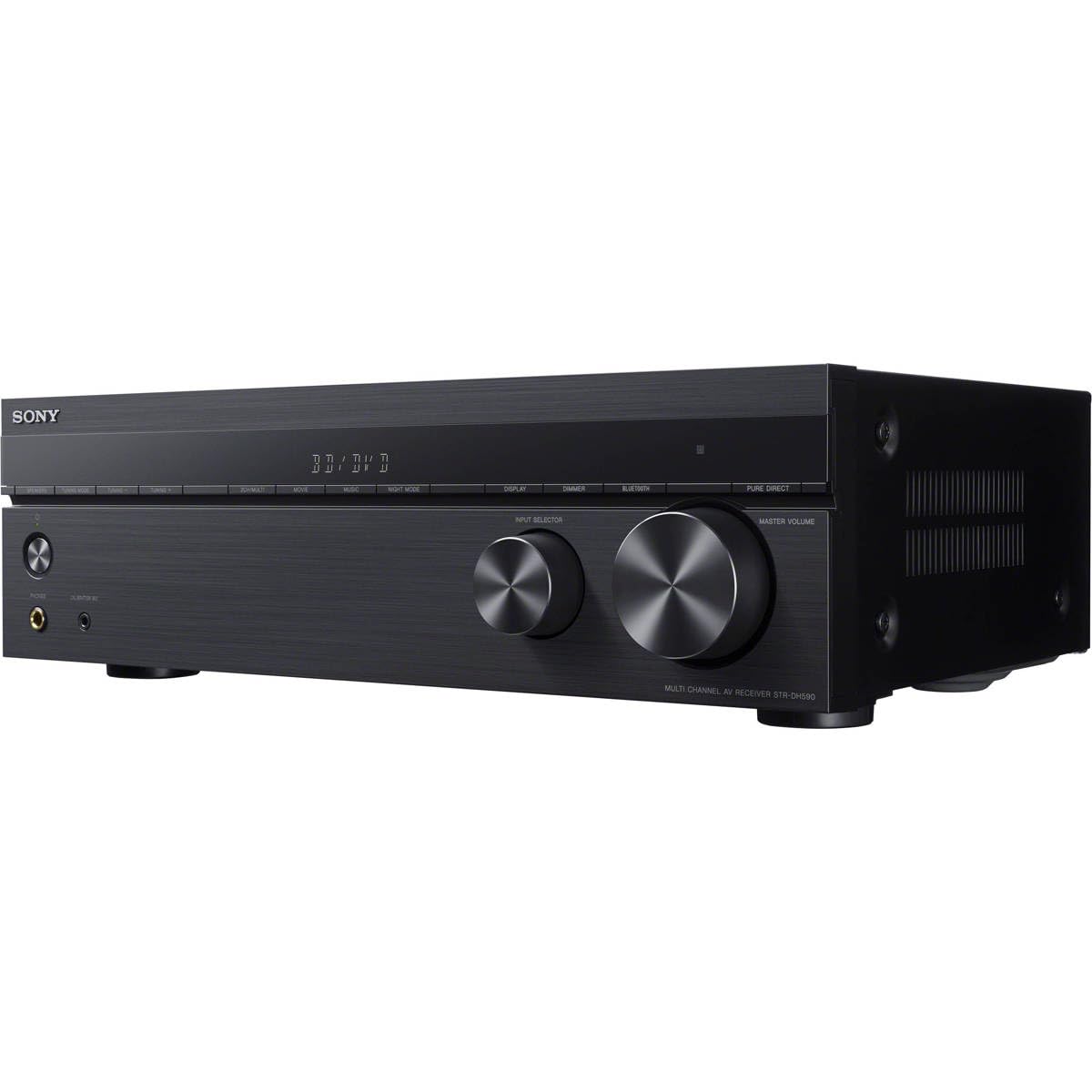
The Sony STRDH590 offers a distinct advantage for home theater enthusiasts who love deep bass: dual subwoofer outputs. This allows you to connect two powered subwoofers to smooth out bass response across a larger seating area, a feature that’s uncommon in budget receivers. It’s a 5.2-channel design, giving you that flexibility from the start.
It’s built to be a straightforward, powerful hub for your entertainment. With 4K HDR pass-through and HDCP 2.2 support, it handles modern video sources without issue. Sony’s S-Force PRO front surround technology can create a wider virtual soundstage even with just a two-speaker setup, which is handy for casual music listening. User reviews that span years commend its longevity and ability to deliver crisp sound at high volumes.
Setup is noted as “extremely easy,” with an automatic calibration microphone that gets you up and running quickly. While it foregoes some of the granular audio settings found on more expensive models, it provides a satisfying, no-fuss home theater experience. If your priority is movie impact with the option for dual subwoofers, the STRDH590 is a compelling and durable choice.
Why it’s great
- Dual subwoofer outputs for enhanced bass management.
- Proven long-term reliability noted in user reviews.
- Easy setup with included calibration microphone.
- Solid power output for dynamic movie soundtracks.
Good to know
- Menu system and sound adjustments can be less intuitive than competitors.
- No built-in Wi-Fi for streaming; Bluetooth only.
- Lacks advanced surround formats like Dolby Atmos or DTS:X.
6. Denon AVR-X1700H 7.2ch Receiver (Renewed)

The Denon AVR-X1700H, when found in certified renewed condition, represents a massive leap in features for the budget-conscious home theater builder. It brings high-end capabilities like Dolby Atmos and DTS:X object-based surround sound down to an accessible level. This means you can experience sound that moves all around you, including overhead, with the proper speaker setup.
This is a fully-featured modern receiver. It includes six HDMI 2.1 inputs (three dedicated to 8K/60Hz), full HDR support, and built-in Wi-Fi and HEOS multi-room streaming. The HEOS platform allows you to stream music from Spotify, Amazon Music, and more directly to the receiver, or group it with other HEOS speakers around your home. The Audyssey MultEQ room correction is a significant upgrade over basic calibration systems, fine-tuning the sound with great precision.
Users describe it as a “perfect pick up for a beginner home theater” that’s “very easy to program.” It offers a clear path for expansion, supporting up to a 7.2 or 5.2.2 Atmos configuration. Opting for a certified renewed model from a reputable seller is an excellent way to acquire this level of technology, though it’s wise to ensure it has a good return policy and warranty.
Why it’s great
- Adds immersive Dolby Atmos and DTS:X audio to a budget setup.
- Comprehensive connectivity with 8K/60Hz & 4K/120Hz HDMI.
- HEOS multi-room audio and built-in Wi-Fi streaming.
- Superior Audyssey MultEQ room correction technology.
Good to know
- Being a renewed product, condition and warranty are variable.
- Requires high-speed HDMI cables for full 4K/120Hz performance.
- More complex setup due to advanced feature set.
7. Yamaha R-N600A Network Receiver

The Yamaha R-N600A is a music lover’s dream within the mid-range category. It forgoes video switching entirely to focus on being the ultimate high-fidelity stereo hub. At its heart is a high-quality ESS Sabre DAC (Digital-to-Analog Converter), which ensures that digital music from streaming services, USB drives, or computers is reproduced with exceptional clarity and detail.
Its connectivity is purpose-built for modern audio sources. Along with Wi-Fi and Bluetooth, it supports AirPlay 2 and Spotify Connect, giving you multiple seamless ways to stream. It can also connect to music servers on your home network. Despite its modern internals, it sports a classic, vintage-inspired silver faceplate with satisfying physical knobs and buttons, offering a tactile experience that app-based controls can’t match.
Users rave about its “crystal clear” sound and “phenomenal” build quality, noting it feels built to last for decades. The inclusion of a phono input, optical input for TV sound, and a front-panel USB port makes it incredibly versatile. If your primary goal is to build a stunning two-channel music system that excels with both vinyl and high-resolution streaming, the R-N600A is a standout investment.
Why it’s great
- High-performance ESS Sabre DAC for superb digital audio quality.
- Comprehensive streaming via Wi-Fi, AirPlay 2, Bluetooth, and Spotify Connect.
- Beautiful, solid retro design with premium build quality.
- Includes phono input and is packed with useful connections.
Good to know
- No HDMI ports, so it’s not suitable for home theater video switching.
- MusicCast app is required for full control, which some may find limiting.
- Positioned at a higher price point than basic stereo receivers.
8. Yamaha TSR-700 7.1 Channel AV Receiver

The Yamaha TSR-700 is essentially a value-packed version of Yamaha’s popular RX-V6A series, offering an incredible amount of technology for the money. Its headline feature is support for 8K/60Hz and 4K/120Hz video pass-through, making it ready for next-generation gaming consoles and sources. With 7 channels of amplification, it can power a traditional 7.1 system or a 5.1.2 Dolby Atmos setup with two overhead speakers.
Integration with Yamaha’s MusicCast ecosystem is a major bonus, enabling multi-room audio and voice control via Alexa, Google Assistant, or Siri. Users praise its clean sound quality and powerful output, with one noting it “blows my old RX-V677 out of the water.” The YPAO room calibration with 3D sound optimization is included, which helps tailor the audio to your specific room layout, especially for Atmos configurations.
This receiver is for the buyer who wants to “set it and forget it” for many years. It provides a clear upgrade path from a basic 5.1 system to a more immersive 7.1 or Atmos system without needing a new receiver. While some early units had HDMI 2.1 firmware issues, these have largely been resolved, making it a very solid and future-oriented choice in the mid-range market.
Why it’s
- Early models required firmware updates for full HDMI 2.1 functionality.
- The on-screen display is basic compared to full GUI interfaces.
- Some users report complexities with eARC functionality.
9. Marantz NR1510 Slim 5.2 Channel AV Receiver

The Marantz NR1510 solves a common spatial problem: fitting a full-featured AV receiver into a narrow media cabinet. At just 4 inches tall, it slips into spaces where standard 6-7 inch receivers won’t, without sacrificing core functionality. This slim design is achieved through innovative engineering and a horizontal motherboard layout, a signature of Marantz’s slimline series.
Don’t let the size fool you—it’s packed with premium Marantz hallmarks. It features a high-quality phono input, six HDMI inputs with 4K/HDR/Dolby Vision support, and built-in HEOS for multi-room Wi-Fi streaming. The audio performance carries the warm, detailed character Marantz is known for, making it excellent for both movies and music. Users note the dramatic improvement in sound, saying it’s “like I got new speakers too.”
The graphical setup interface is user-friendly, and the included calibration microphone does a solid job balancing speaker levels. It’s the ideal centerpiece for a stylish, space-conscious home theater or a high-quality stereo setup in a confined entertainment center. If you’ve been told you need a soundbar due to space constraints, the NR1510 offers a far superior, component-based alternative.
Why it’s great
- Unique slimline design fits in tight spaces standard receivers can’t.
- Marantz’s refined, musical sound signature for both movies and music.
- Full HEOS multi-room audio and streaming capabilities built-in.
- Comprehensive connectivity including phono and six HDMI inputs.
Good to know
- Lower power output (50W/channel) than bulkier models.
- Lacks support for advanced 3D audio formats like Dolby Atmos.
- The compact design can lead to warmer operating temperatures.
10. YAMAHA RX-V6A 7.2-Channel AV Receiver

The Yamaha RX-V6A is a feature-dense powerhouse that sits at the sweet spot for serious home theater and gaming enthusiasts. It supports the latest video standards including 8K/60Hz and 4K/120Hz pass-through, which is essential for getting the most from new gaming consoles and PCs. With seven channels of amplification, it’s ready for a 5.1.2 Dolby Atmos or DTS:X setup, delivering truly three-dimensional sound.
It’s deeply integrated into the Yamaha ecosystem, featuring MusicCast for whole-home audio, voice control, and streaming from every major service. The YPAO room calibration with Reflected Sound Control is advanced, optimizing sound for both your room’s layout and its acoustical properties. Users upgrading from older units report “spectacular” sound improvements and praise its reliability and cool operation compared to some competitors.
This model represents a significant step up in processing power and future-proofing. The inclusion of seven HDMI inputs ensures plenty of connectivity for all your gear. For the home theater builder who wants top-tier specs—high frame-rate gaming support, object-based audio, and robust streaming—without venturing into the premium price class, the RX-V6A is arguably the most balanced and capable choice available.
Why it’s great
- Full 8K/60 and 4K/120Hz support for next-gen gaming and video.
- Comprehensive audio format support including Dolby Atmos and DTS:X.
- Advanced YPAO room calibration with reflection control.
- Extensive streaming and multi-room features via MusicCast.
Good to know
- The menu system can feel technical and less graphical than some.
- Initial setup and learning all features can be time-consuming.
- Some users note the remote control could be more intuitive.
11. Denon AVR-X3800H 9.4-Channel AV Receiver

The Denon AVR-X3800H is a tour de force that transcends the “budget” category, landing instead as the ultimate value proposition for the serious home theater enthusiast. It’s a no-compromise platform with 9 channels of amplification (expandable to 11 with an external amp), support for every major 3D audio format including Dolby Atmos, DTS:X Pro, IMAX Enhanced, and Auro-3D. This is the receiver you buy to build a system that lasts a decade.
Its processing power is immense. It features the highest tier of Audyssey room correction (MultEQ XT32) with optional Dirac Live upgradeability, allowing for incredibly precise acoustic tailoring. Four independent subwoofer outputs let you perfectly integrate multiple subs to eliminate nulls and smooth bass response across every seat. The HDMI section is fully featured with 8K/60Hz and 4K/120Hz support across six inputs.
This is for the viewer who demands reference-quality performance and maximum configuration flexibility. It handles the most complex speaker layouts (like 7.2.4 or 5.2.6) and provides the tools to optimize them professionally. While it commands a higher investment, its extensive capabilities and build quality offer long-term value that cheaper receivers simply cannot match.
Why it’s great
- Unmatched flexibility with 9 channels and support for all 3D audio formats.
- Professional-grade Audyssey MultEQ XT32 room correction (Dirac ready).
- Four subwoofer outputs for advanced bass management.
- Extensive connectivity and full next-gen HDMI 2.1 support.
Good to know
- Positioned at a premium price point beyond typical budget ranges.
- Extremely complex setup that may intimidate casual users.
- Physical size is large and requires substantial ventilation space.
Understanding the Specs
Channels (5.1, 7.2, etc.)
This number describes the speaker configuration the receiver can support. The first digit (5, 7, 9) is the number of main speakers. The digit after the decimal (.1, .2, .4) indicates the number of subwoofer outputs. A “5.1.2” system means 5 main speakers, 1 subwoofer, and 2 overhead height speakers for Dolby Atmos. More channels allow for more immersive sound, but require more speakers and amplification power.
HDMI ARC & eARC
Audio Return Channel (ARC) lets your TV send audio back to the receiver over a single HDMI cable, eliminating a separate audio connection. Enhanced ARC (eARC) is a major upgrade that supports higher-quality audio formats like Dolby TrueHD and DTS-HD Master Audio, which are essential for Blu-ray soundtracks. If you watch content from your TV’s apps, eARC ensures you get the best possible sound.
FAQ
Do I need an AV receiver for a soundbar?
Can I use any speakers with a budget receiver?
What’s the difference between Bluetooth and Wi-Fi on a receiver?
Is a phono input necessary for a turntable?
Final Thoughts: The Verdict
For most people, the best budget receiver winner is the Yamaha R-S202BL because it delivers exceptional stereo sound quality, reliable Bluetooth, and essential flexibility with A/B switching at a truly accessible point. If you want a dedicated home theater starting point with modern HDMI, grab the Denon AVR-S570BT. And for the music lover who streams everything, nothing beats the feature-packed, DAC-focused Yamaha R-N600A.

Mo Maruf
I created WellFizz to bridge the gap between vague wellness advice and actionable solutions. My mission is simple: to decode the research and give you practical tools you can actually use.
Beyond the data, I am a passionate traveler. I believe that stepping away from the screen to explore new environments is essential for mental clarity and physical vitality.