Our readers keep the lights on and my smoothie glass nicely filled. As an Amazon Associate, I earn from qualifying purchases.
Finding a keyboard that inspires practice without draining your wallet is the central tension every new player faces. The difference between a sticky, spring-loaded toy and a responsive instrument with proper weighted keys can determine whether you stick with lessons for a month or a decade.
I’m Mohammad Maruf — the founder and writer behind WellFizz. I’ve spent years analyzing digital piano specifications, cross-referencing customer feedback, and identifying the real-world trade-offs between polyphony counts, key action mechanisms, and build quality at every price tier.
This guide cuts through the noise to help you find the truly best budget piano keyboard that delivers proper touch response, decent sound engines, and enough features to grow with you—without costing more than your monthly rent.
How To Choose The Best Budget Piano Keyboard
The budget piano keyboard market is crowded with options that look similar but feel dramatically different under your fingers. Before you click “buy,” understand these three non-negotiable factors that separate a practice tool from a frustration machine.
Key Action and Touch Sensitivity
Weighted or semi-weighted keys simulate the resistance of an acoustic piano. Unweighted spring-loaded keys require zero finger strength and will cripple your ability to play dynamics. For any serious beginner, look for the words “touch sensitive” or “velocity sensitive” in the specs—this means the volume changes with how hard you press, which is the foundation of expressive playing.
Polyphony — The Hidden Cap
Polyphony is the number of notes a keyboard can produce simultaneously. A 32-note limit will cut off sustained notes as you play chords with pedal, creating audible gaps. For a budget keyboard, 64-note polyphony is the realistic minimum. Models advertising 128-note polyphony give you headroom for layering sounds and using the sustain pedal freely.
Connectivity and Expandability
A USB-MIDI port lets you connect to learning apps like Simply Piano and GarageBand. A standard 6.35mm headphone jack enables silent practice without disturbing roommates. A sustain pedal input is essential for proper piano technique. If you find a model with Bluetooth MIDI, you’ve found a future-proof gem.
Quick Comparison
On smaller screens, swipe sideways to see the full table.
| Model | Category | Best For | Key Spec | Amazon |
|---|---|---|---|---|
| Yamaha PSR-E383 | Portable | Beginners needing touch sensitivity | 61 touch-sensitive keys | Amazon |
| STRICH SDP-120 | Home Console | Authentic weighted feel on a budget | 88 fully-weighted keys | Amazon |
| Donner DEP-08 | Home Console | Space-saving with real pedal set | 88 velocity-sensitive keys | Amazon |
| Yamaha PSRE283 | Portable | Uncompromised Yamaha sound at entry price | 61 full-sized keys | Amazon |
| RockJam RJ761 | Complete Kit | All-in-one beginner bundle | 61 keys, touch display | Amazon |
| RockJam 61-Key Kit | Complete Kit | Value-focused starter bundle | 61 keys, 50 tones | Amazon |
| KUMENG KU-3506 | Home Console | 88 semi-weighted keys with furniture design | 88 semi-weighted keys | Amazon |
| Amazon Basics 61-Key | Portable | Budget travel practice keyboard | 61 full-size keys | Amazon |
| Liquid Stands Kit | Accessory Set | Sturdy stand & bench for any keyboard | 250 lbs load capacity | Amazon |
In‑Depth Reviews
1. Yamaha 61 Touch Sensitive Keys Portable Keyboard PSR-E383

The Yamaha PSR-E383 is the goldilocks option for serious beginners: it offers genuine touch-sensitive keys that respond to your playing dynamics, a feature that most keyboards at this tier skip entirely. The 61-key layout is compact enough for a dorm room desk while still providing enough range for two-handed playing.
Yamaha’s sound engine is the star here—the built-in piano voice is rich and nuanced, and the hundreds of built-in songs let you play along immediately. The “Keys to Success” guided learning mode breaks songs into manageable steps, and the “Touch Tutor” mode visually teaches you how varying your finger pressure changes volume. At just 9.7 pounds, it’s genuinely portable.
The 6.35mm headphone jack is full-sized and reliable, and the power adapter is included in the packaging. What you don’t get is a sustain pedal (sold separately) or a full stand, but the core instrument—the keys and the sound—are miles ahead of any generic-brand competitor at this price.
Why it’s great
- Touch-sensitive keys develop proper dynamic control from day one
- Authentic Yamaha piano tone with genuine acoustic resonance
- Lightweight 9.7-pound build is easy to move between rooms
- Hundreds of built-in songs and guided learning features
Good to know
- Only 61 keys—limited range for advanced classical pieces
- Sustain pedal not included in the box
- No Bluetooth or wireless MIDI connectivity
2. STRICH SDP-120 88 Keys Weighted Keyboard

The STRICH SDP-120 delivers what many budget buyers thought impossible: fully-weighted hammer-action keys that genuinely mimic the resistance of an acoustic grand piano. The key weight is slightly lighter than a premium Roland or Yamaha console, which actually reduces finger fatigue during longer practice sessions—a smart design choice for developing hands.
Sound comes through twin 15-watt speakers that are loud enough to fill a living room, with 128-voice polyphony that ensures zero note dropouts when using the sustain pedal. The built-in wireless MIDI is a standout feature at this price—you can connect wirelessly to GarageBand or any DAW without a USB cable dangling from the front panel.
The sustain pedal is included, and the classic black lacquered finish looks far more expensive than it is. The only trade-off is the lack of a music stand that can hold a tablet securely, and the power switch placement behind the music rest is awkward to reach. For the weighted-key action alone, this is an extraordinary value.
Why it’s great
- Fully-weighted keys provide authentic acoustic piano resistance
- 128-voice polyphony handles complex pedal work without cutouts
- Wireless MIDI eliminates cable clutter with music apps
- Dual 15W speakers deliver room-filling volume
Good to know
- Power switch behind the music rest is inconveniently placed
- Manual lacks clear tone layering instructions
- Requires a dedicated stand—heavy X-style stands recommended
3. Donner Digital Piano DEP-08 Velocity-Sensitive 88 Keys

The Donner DEP-08 stands out for including a proper triple pedal unit—sustain, sostenuto, and soft—which is almost unheard of in the budget tier. This gives students the full pedal technique vocabulary required for classical repertoire, not just a single on/off sustain switch. The velocity-sensitive 88 keys respond well to varying attack pressure, though the action feels slightly lighter than a fully-weighted hammer mechanism.
The removable piano stand is a clever space-saving design, making the unit compact enough for small apartments while still looking like a proper piece of furniture. The LED digital tube display is retro but functional, showing tone and rhythm selections clearly. With 380 tones, 128 rhythms, and 88 demo songs, the variety is generous.
The USB-MIDI connectivity works flawlessly with learning apps, and the headphone mode ensures silent practice. A few users note the keys feel slightly narrower than standard, which may take adjustment for players with larger hands. For the combination of triple pedal, slim footprint, and responsive keys, this is a compelling package.
Why it’s great
- Triple pedal unit enables full classical pedal technique
- Removable stand saves space in small rooms
- 380 tones and 128 polyphony for versatile sound exploration
- Split mode and recording function for creative layering
Good to know
- Keys are slightly narrower than standard acoustic piano width
- Action is lighter than fully-weighted hammer mechanisms
- Speaker sound can be hollow; external speakers recommended for performance
4. Yamaha 61-Key Portable Keyboard PSRE283

The Yamaha PSRE283 is the entry point into Yamaha’s legendary build quality, offering that unmistakable Yamaha piano tone in a lightweight 8.8-pound package. The “Portable Grand” button instantly recalls the flagship acoustic grand piano sample, and the sound quality genuinely surprises everyone who plays it for the first time.
The “Quiz Mode” is a hidden gem for ear training—it plays a note and asks you to identify it, building your musical memory naturally. “Smart Chord” lets you play complex jazz chords with a single finger, which is fantastic for beginners who want to sound musical before their technique catches up. The 61 full-sized keys are not touch-sensitive, so you won’t develop dynamic control here, but the learning tools are among the best in class.
Hundreds of built-in songs span pop hits, children’s classics, and traditional pieces. The included power adapter and music rest make it ready out of the box. If your priority is the best learning software and tone at the lowest weight, this is your keyboard.
Why it’s great
- Yamaha acoustic grand piano sample is rich and expressive
- Quiz Mode ear training develops aural skills
- Smart Chord lets beginners play advanced harmonies instantly
- Ultra-light 8.8 pounds for easy transport
Good to know
- Keys are not touch-sensitive—no dynamic volume response
- 61 keys limit two-handed classical repertoire
- No sustain pedal input included
5. RockJam RJ761 61 Key Keyboard with Touch Display
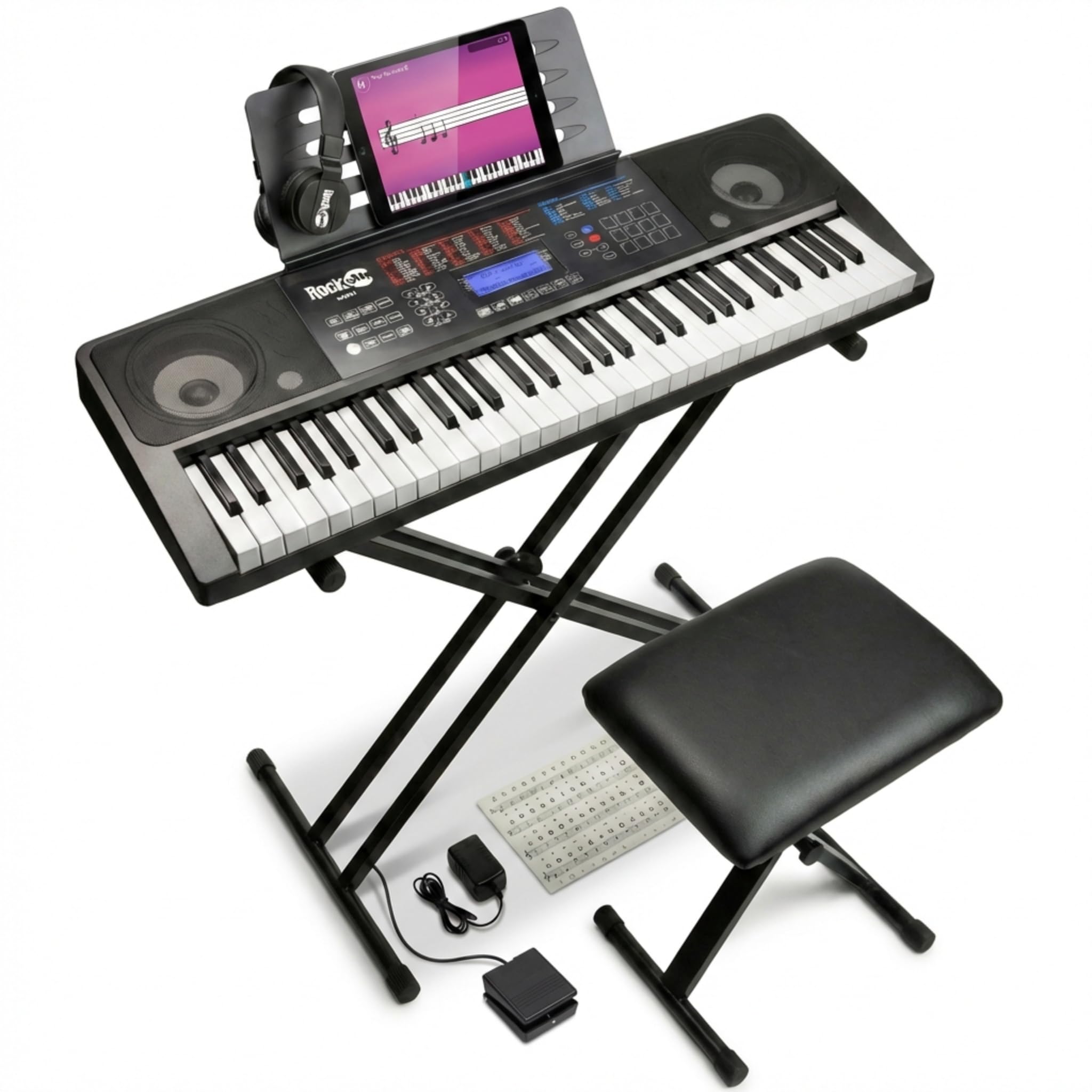
The RockJam RJ761 is the bundle king—it arrives with a sturdy X-style stand, a padded adjustable bench, over-ear headphones, a sustain pedal, and a sheet music stand. For a family buying their first keyboard, this eliminates the hassle of sourcing accessories separately. The touch screen interface is genuinely responsive and makes navigating 200 rhythms and 200 sounds intuitive.
The recording and playback function lets beginners hear themselves and self-correct, which is a powerful teaching tool. MIDI output via 5-pin DIN connects directly to DAWs like Ableton and Logic, so this keyboard won’t become obsolete when the player outgrows the built-in sounds. The keys are unweighted but responsive enough for early practice.
The padded bench seat is comfortable for hour-long practice sessions, and the headphones allow quiet practice without disturbing the household. The main drawbacks are that the keys are not velocity-sensitive—so no dynamic expression—and the music stand is flimsier than ideal. As a complete starter package, the value density is hard to beat.
Why it’s great
- Complete bundle with stand, bench, headphones, and sustain pedal
- Touch screen interface for easy navigation
- MIDI output connects to professional DAWs
- Record and playback for self-correcting practice
Good to know
- Keys are not velocity-sensitive—no dynamic control
- Music stand is flimsy and may wobble
- Included headphones are basic quality
6. RockJam 61-Key Keyboard Piano Kit with Stand, Stool, Headphones

The original RockJam 61-Key kit has been a staple in the beginner market for years, and for good reason. The 61 full-sized keys offer decent resistance for an entry-level keyboard, and the 100 rhythms and 50 tones give beginners plenty of sonic variety to keep practice interesting. The LCD display is basic but functional, clearly showing which sound or rhythm is active.
The included stand and padded bench are genuinely comfortable and adjustable for children and adults alike. The record and playback function is simple—press record, play, and listen back. This immediate feedback loop is surprisingly effective for spotting timing issues. The keynote stickers and Simply Piano access code add educational value.
The biggest caveat is that these keys are not velocity-sensitive, meaning you cannot control volume by touch—a limitation every serious player will hit within a few months. The music stand is also flimsy. For a casual player who wants a complete setup without complications, this remains a solid entry point.
Why it’s great
- Complete set with adjustable stand, padded bench, and headphones
- Record and playback for immediate performance review
- Includes keynote stickers and access to Simply Piano lessons
- LCD display simplifies tone and rhythm selection
Good to know
- Keys lack velocity sensitivity—no dynamic touch response
- Music stand is flimsy and may not hold heavier books
- 61 keys will feel limiting for intermediate players
7. KUMENG KU-3506 88 Key Semi Weighted Digital Piano
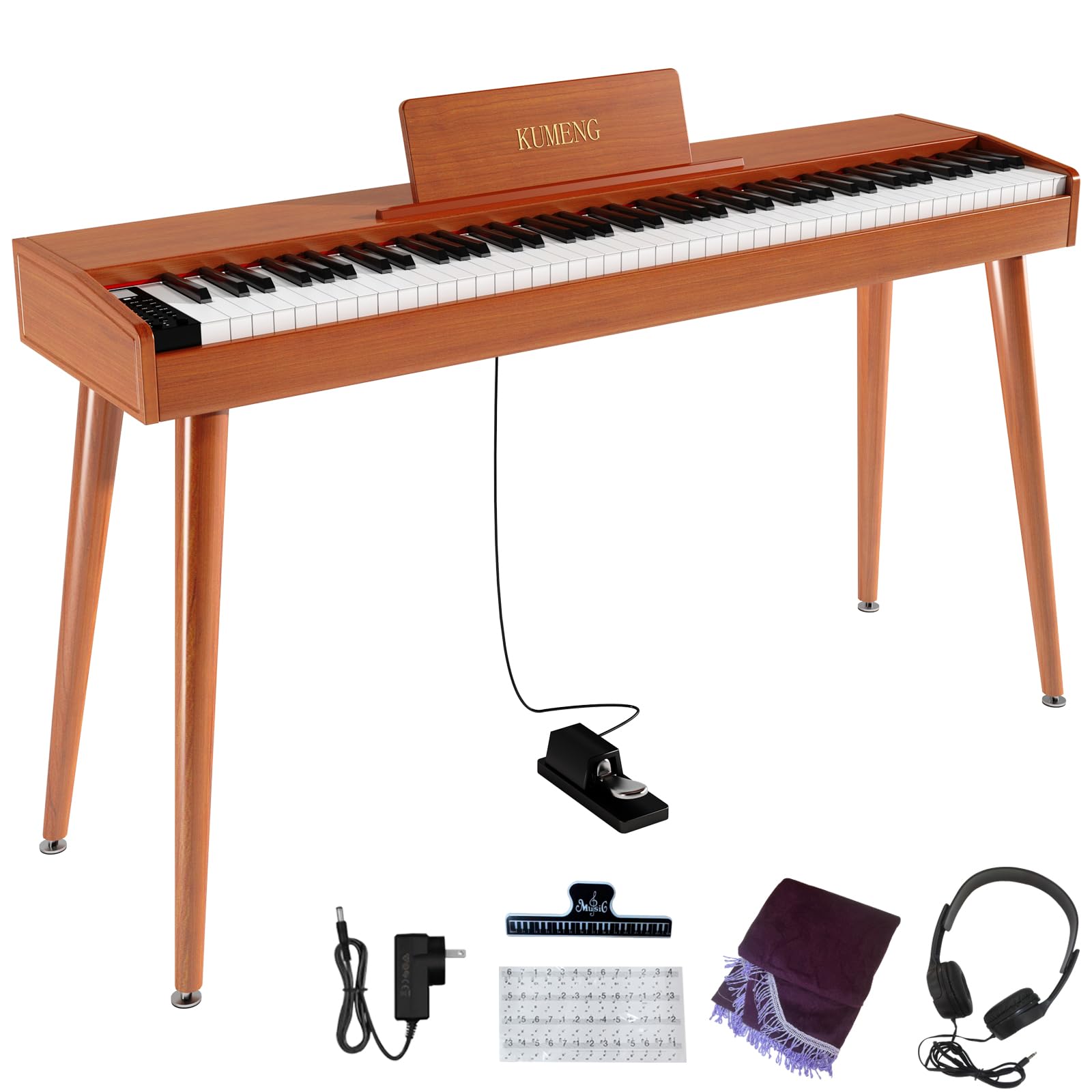
The KUMENG KU-3506 is the first keyboard in this list that doubles as legitimate furniture—its woodgrain cabinet with matte paint finish looks like a mid-century modern sideboard, not a piece of musical gear. The 88 semi-weighted keys provide some resistance, bridging the gap between unweighted keyboards and the heavier hammer-action models.
The sound engine is surprisingly capable, with 800 tones and 128-note polyphony that handles complex pedal work without choking. The dual keyboard split mode lets you assign different instruments to each hand—great for practicing bass lines in the left hand while playing melody with the right. USB-MIDI connectivity works with tablets and phones for app-based learning.
The included sustain pedal and sheet music stand mean nothing else is required to start playing. Assembly is minimal—the legs attach to the main body in minutes. The semi-weighted keys are not as heavy as a true acoustic piano, but they offer more resistance than any 61-key portable in this guide, making this a strong choice for the style-conscious player.
Why it’s great
- Elegant woodgrain cabinet doubles as home decor
- 88 semi-weighted keys provide realistic resistance
- 800 tones and 128-voice polyphony for versatile playing
- Dual keyboard split mode for creative practice
Good to know
- Semi-weighted action is lighter than fully-weighted hammer keys
- Keys are slightly narrower than full acoustic piano width
- Speaker quality is adequate but not room-filling
8. Amazon Basics Portable Electric Keyboard Piano with 61 Keys

The Amazon Basics 61-Key Keyboard proves that a budget-priced instrument can still deliver solid build quality and a feature set that punches above its weight. The 61 full-size keys have good resistance for an entry-level keyboard—several reviewers note they feel “semi-weighted” despite the non-weighted spec—and the upward-facing speakers produce adequate volume for solo practice.
The 255 timbres, 255 rhythms, and 50 demo songs are generous for the tier. The included headphones, sheet music stand, and note stickers make this a true out-of-box solution. The transposition feature is a standout at this price, allowing you to shift the key without learning new fingering—essential for playing along with recordings.
The most notable quirk is the proprietary 6-pin sustain pedal port: only the included pedal works, and you’ll need a PS/2 extension cable to use it while standing. The keys are not velocity-sensitive, so dynamic expression is absent. For a travel keyboard that you won’t cry over if it gets bumped around, this is a smart, lightweight pick at 12.5 pounds.
Why it’s great
- Solid key resistance that feels semi-weighted despite being unweighted
- 255 timbres and rhythms provide massive variety
- Transposition feature is rare at this price point
- Includes headphones, music stand, and note stickers
Good to know
- Proprietary sustain pedal port limits replacement options
- Keys not velocity-sensitive—no touch-based dynamics
- Power cord is awkwardly angled for tight spaces
9. Liquid Stands Piano Keyboard Stand and Bench Set

While not a keyboard itself, the Liquid Stands stand and bench set is the best investment you can make for any budget keyboard you buy. The Z-style design is dramatically more stable than the ubiquitous X-style stands, eliminating the wobble that plagues cheaper alternatives. The 250-pound weight capacity means even the heaviest 88-key console is secure.
The bench is adjustable in height, padded for comfort, and supports over 250 pounds without flexing. The included headphone hook keeps cables organized, and the two anchoring straps secure the keyboard to the stand—crucial if you have kids or pets who might bump into it. The stand width adjusts to fit everything from 54-key portables to full 88-key consoles.
Assembly takes about 15 minutes with clear instructions. The stainless steel construction resists rust and looks professional on stage or at home. If you pair this with any of the keyboards above, you’ll have a setup that feels rock-solid and will last through years of practice. This is the unsung hero of a great practice environment.
Why it’s great
- Z-style design eliminates wobble common with X-stands
- Adjustable width fits 54 to 88-key keyboards
- 250-pound capacity handles heavy digital pianos
- Includes headphone hook and anchoring straps
Good to know
- Heavier than basic X-stands at 9 pounds
- Requires assembly with basic tools
- Bench padding is firm—may not suit all preferences
FAQ
Can I learn proper piano technique on a keyboard with unweighted keys?
How many keys do I actually need as a beginner?
Does a sustain pedal matter for a budget keyboard?
Final Thoughts: The Verdict
For most users, the best budget piano keyboard winner is the Yamaha PSR-E383 because it delivers genuine touch-sensitive keys and an authentic grand piano sound from the world’s most trusted keyboard manufacturer, all at a price that leaves room for a sustain pedal and stand. If you want fully-weighted hammer-action that simulates an acoustic grand, grab the STRICH SDP-120. And for a complete furniture-grade setup with 88 velocity-sensitive keys and a triple pedal, nothing beats the Donner DEP-08.

Mo Maruf
I created WellFizz to bridge the gap between vague wellness advice and actionable solutions. My mission is simple: to decode the research and give you practical tools you can actually use.
Beyond the data, I am a passionate traveler. I believe that stepping away from the screen to explore new environments is essential for mental clarity and physical vitality.