Our readers keep the lights on and my smoothie glass nicely filled. As an Amazon Associate, I earn from qualifying purchases.
A dull knife is a dangerous knife, forcing you to apply extra pressure that inevitably leads to slips and cuts. The best budget knife sharpener fixes this problem by restoring a razor-sharp edge in seconds without requiring any skill or guesswork.
I’m Mohammad Maruf — the founder and writer behind WellFizz. I focus on analyzing consumer hardware specifications, evaluating pull-through angles, abrasive grit composition, and base stability to identify which sharpeners truly deliver for the price.
After reviewing dozens of models against real kitchen and outdoor knife needs, I’ve narrowed the field to the five sharpeners that actually work. This guide details the best budget knife sharpener options for restoring your blades without breaking the bank.
How To Choose The Best Budget Knife Sharpener
A pull-through sharpener is the right choice for budget-conscious buyers who want immediate results without practicing on a whetstone. The key is picking one whose abrasive materials and angle alignment match the knives you own most.
Stage Count and Abrasive Quality
Two-stage sharpeners (coarse carbide + fine ceramic) handle the majority of maintenance. A third or fourth stage adds diamond rods or scissor slots, extending versatility. Tungsten carbide aggressively removes steel to set a new edge, while ceramic rods hone and polish. Diamond rods fall between them, offering faster cutting than ceramic but less aggressive removal than carbide.
Sharpening Angle Compatibility
Most pull-through sharpeners lock you into a fixed angle, typically 20 degrees per side. This works well for Western-style knives (German, French, American). If you own Asian blades (Japanese, Chinese) with 15-degree edges, an adjustable-angle sharpener like the Cangshan model preserves their geometry without regrinding the blade face.
Base Stability and Ergonomic Grip
A sharpener that slides on the counter is both frustrating and dangerous. Look for a non-slip rubber base or a suction cup system. An ergonomic handle with soft-touch grip reduces hand fatigue, especially if you sharpen several knives at once or have limited hand strength.
Quick Comparison
On smaller screens, swipe sideways to see the full table.
| Model | Category | Best For | Key Spec | Amazon |
|---|---|---|---|---|
| Bochionyu 4-Stage | Mid-Range | Most Versatility | 4 stages (diamond + ceramic + carbide) | Amazon |
| SHARPAL 191H | Mid-Range | Suction Cup Stability | 3-stage, suction base | Amazon |
| Smith’s Pull-Thru | Mid-Range | Consistent Pre-Set Angle | 2-stage, carbide + ceramic | Amazon |
| Cangshan 1026108 | Premium | Adjustable Angle (14°-24°) | 3-stage, 14-24° adjustable | Amazon |
| Edgemaker Pro 331 | Premium | Serrated & Wavy Blades | Crossed-steel rods, serrated-safe | Amazon |
In‑Depth Reviews
1. Bochionyu 4-Stage Knife Sharpener

The Bochionyu delivers the widest abrasive variety in this price tier with four dedicated slots: carbide blades for reprofiling dull edges, diamond rods for intermediate sharpening, and ceramic rods for final honing and polishing. The separate ceramic scissor slot means you don’t compromise your knife edge to touch up shears. Made from solid ABS and stainless steel, the body feels robust, and the rubberized non-slip base holds firm during aggressive pulls.
The 4-stage system works in a logical sequence: you start with carbide if the blade is truly blunt, move to diamond to refine the burr, and finish with ceramic to achieve a polished, shaving-sharp edge. Users report consistently sharp results after three to six pulls per slot. The included finger guard adds a safety layer for less confident cooks. The unit weighs 0.3 kg, making it heavy enough to stay planted but light enough to store in a drawer.
Customer feedback highlights its effectiveness on both kitchen knives and outdoor blades, though a minority noted that the carbide slot can be aggressive if you press too hard—light, consistent pressure is the key. A small number of users experienced difficulty holding the sharpener steady due to arthritis, pointing to the need for a stronger suction mechanism on smoother countertops.
Why it’s great
- Four distinct abrasive stages cover every step from reprofiling to polishing
- Includes a dedicated scissor sharpening slot
- Non-slip rubber base stays secure during use
- Finger guard included for beginner safety
Good to know
- Carbide stage can remove too much metal if heavy pressure is applied
- Suction could be stronger; may slide on glossy granite surfaces
2. SHARPAL 191H 3-Stage Sharpener
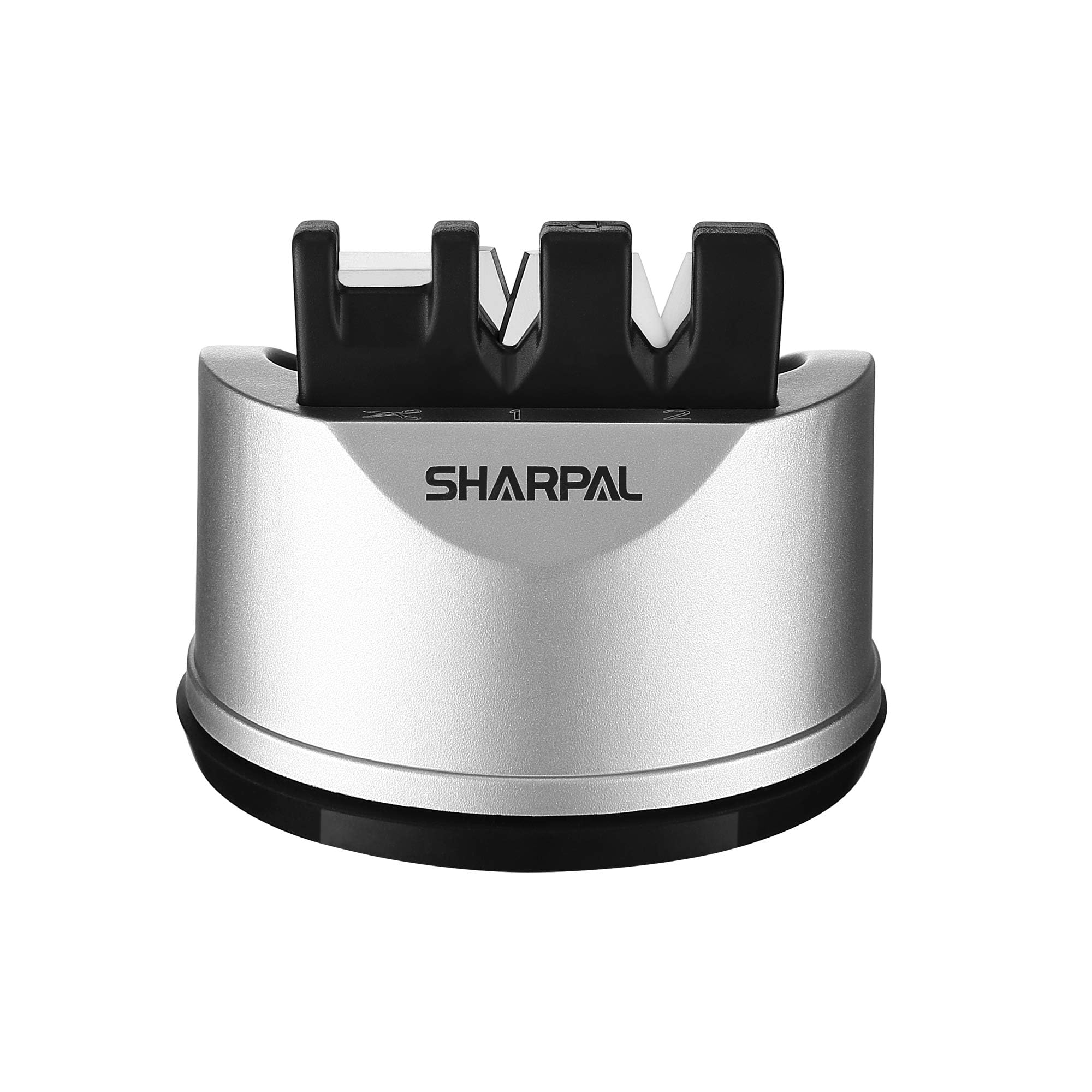
The SHARPAL 191H measures just 2.76 inches in each direction, making it the most space-efficient sharpener in this lineup. Its defining feature is the enhanced suction cup base that creates a strong vacuum seal on smooth surfaces, eliminating any sliding even during one-handed operation. The 3-stage system uses tungsten carbide blades for initial edge setting, ceramic blades for honing, and a dedicated tungsten carbide scissor slot, so you never cross-contaminate abrasives.
Because the suction base does the holding, you don’t need to grip the sharpener at all—just press the black switch to activate suction, pull the knife through, and the unit stays planted. This makes it especially suitable for users with arthritis or limited hand strength. The compact shape also stores easily in a crowded drawer or hangs on a magnetic strip. The construction feels dense and well-assembled, with ceramic and carbide components that hold up to regular use.
Long-term owners report that the suction remains effective after months of use, and the sharpener produces noticeably sharper edges on kitchen knives and pocket knives with just a few passes. The three-year warranty from SHARPAL, a US-headquartered company, adds peace of mind. The trade-off is that the small form factor limits the number of stages, so extremely dull blades may need more passes through the carbide slot.
Why it’s great
- Strong suction cup base holds securely without hand pressure
- 3-stage system handles knives and scissors in one tool
- Ultra-compact footprint fits any drawer or counter
- Backed by a 3-year warranty
Good to know
- Requires a perfectly smooth, clean surface for suction to work
- Smaller size means fewer stages for very dull blades
3. Smith’s Pull-Thru Knife Sharpener
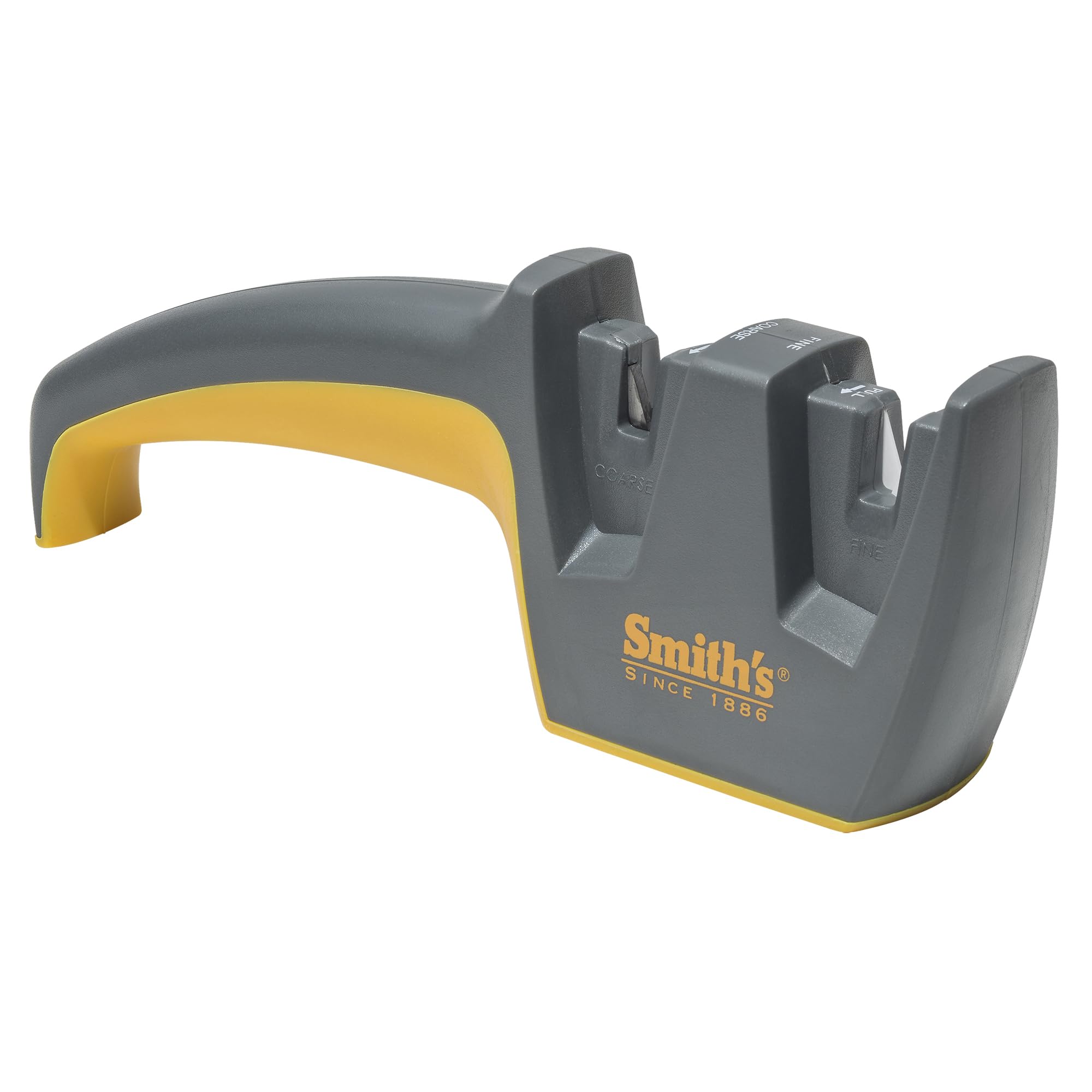
The Smith’s Pull-Thru is the simplest, most straightforward option for someone who just wants sharp knives without fussing over multi-stage sequences. Its 2-stage design pairs a coarse carbide slot for restoring dull and damaged straight-edge knives with a ceramic slot for final honing. Both slots feature pre-set sharpening angles that deliver consistent results every time, eliminating the variable of hand angle that plagues freehand sharpening.
The body features a soft-grip handle that fits comfortably in hand and a non-slip rubber base that keeps the unit stable on the counter. The abrasive components are replaceable, extending the sharpener’s lifespan well beyond what you’d expect at this price level. Users can sharpen straight-edge, serrated, and sports knives using the ceramic slot for serrated blades, which is a rare inclusion at this price point. The compact dimensions (6 inches tall) let it sit unobtrusively next to the knife block.
Customer reviews consistently praise its ease of use—even complete novices get sharp edges on the first try. Several users specifically noted that it works well for maintaining already-sharp knives and restoring mildly dull edges, but it is not designed to fix severely chipped or damaged blades. A small number of users felt the coarse carbide slot cut too aggressively, though this is typical of budget two-stage sharpeners and is mitigated by using light pressure.
Why it’s great
- Pre-set sharpening angles guarantee consistent edge geometry
- Replaceable carbide and ceramic components extend product life
- Soft-grip handle and non-slip rubber base improve control
- Ceramic slot works on serrated blades
Good to know
- Not suitable for severely chipped or deeply damaged blades
- Coarse carbide slot can remove metal quickly if overused
4. Cangshan 1026108 Adjustable Sharpener

The Cangshan 1026108 stands apart from every other sharpener on this list by allowing you to adjust the sharpening angle from 14 to 24 degrees in 2-degree increments. This is critical for anyone who owns both Western knives (typically 20 degrees) and Asian knives (typically 15–16 degrees). Using a fixed 20-degree sharpener on a 15-degree Japanese blade will grind down the edge geometry, eventually ruining the knife’s cutting profile.
Its 3-stage system uses industrial-grade tungsten carbide for coarse edge restoration on high-alloy steel blades and fine ceramic for honing and finishing. The separate scissor slot is engineered to sharpen two-piece kitchen shears without disassembly. Cangshan spent 16 months developing the carbide components, which explains why the sharpener performs well on harder, premium steels like D2. The handle-shaped grip improves safety by keeping fingers away from the blade path, and the rubberized non-slip base adds counter stability.
Early adopters who own Cangshan, Wusthof, and Shun knives reported excellent results at the 14- and 16-degree settings, with edges sharp enough to slice ripe tomato skin without crushing the flesh. Some users noted that the red angle dial could feel less fluid during adjustment, and that the suction base is less necessary since the unit’s 10.9-ounce weight keeps it planted. It is not intended for serrated knives or single-bevel blades like sashimi knives.
Why it’s great
- Adjustable 14–24 degree angle preserves both Western and Asian blade geometry
- Industrial-grade carbide handles high-alloy and D2 steels
- Separate scissor slot sharpens shears without disassembly
- Comfortable handle-shaped grip and rubberized base
Good to know
- Angle dial can feel stiff during adjustment
- Not for serrated or single-bevel blades
5. Edgemaker Pro 331

The Edgemaker Pro 331 uses a unique crossed-steel rod system rather than fixed abrasive slots. Two high-carbon steels cross at a pre-set angle, and you simply draw the blade through them. This design is exceptionally gentle on blade edges—it won’t scratch the blade face or remove excessive metal—making it ideal for maintaining expensive knives and for sharpening serrated and wavy blades that would be damaged by carbide slots.
The high-impact plastic body is rated as unbreakable in normal use. The steel rods can be pulled out, rotated 180 degrees to expose a fresh surface, and reinserted—effectively doubling the sharpener’s lifespan before you need to replace it. Users report that the tool gives tactile feedback, allowing you to feel the edge improving and preventing over-sharpening. The Ergonomic shape fits comfortably in one hand, although it does require holding the sharpener during use rather than relying on a suction base or non-slip feet.
Long-term owners are the strongest advocates: multiple reviews mention using the same Edgemaker for 8 to 35 years, with replacements bought only when the original was finally worn out. It works on all knife types, including kitchen knives, hunting knives, pocket knives, and swords. The trade-off is that it requires more passes than a carbide-based sharpener to restore a truly dull blade, and it is not ideal for severely damaged edges that need aggressive metal removal.
Why it’s great
- Crossed-steel design works on serrated blades without damage
- Rotatable steel rods double the usable life
- Decades of proven durability with many users reporting 10+ year lifespans
- Tactile feedback prevents over-sharpening
Good to know
- Slower edge restoration compared to carbide-based sharpeners
- Must be hand-held; no counter-suction or non-slip base
FAQ
How many passes should I pull my knife through a budget sharpener?
Can I use a pull-through sharpener on a serrated bread knife?
Will an entry-level sharpener ruin my expensive Japanese knives?
Final Thoughts: The Verdict
For most users, the best budget knife sharpener winner is the Bochionyu 4-Stage because its four distinct abrasive stages cover every sharpening need from reprofiling to polishing, and it includes a dedicated scissor slot. If you want a space-saving sharpener with a rock-solid suction base, grab the SHARPAL 191H. And for owners of both Western and Asian knives who need adjustable-angle precision, nothing beats the Cangshan 1026108.

Mo Maruf
I created WellFizz to bridge the gap between vague wellness advice and actionable solutions. My mission is simple: to decode the research and give you practical tools you can actually use.
Beyond the data, I am a passionate traveler. I believe that stepping away from the screen to explore new environments is essential for mental clarity and physical vitality.