Our readers keep the lights on and my smoothie glass nicely filled. As an Amazon Associate, I earn from qualifying purchases.
Optical wrist sensors on fitness watches are convenient, but they commonly lag during interval sprints, miss the spike at the start of a hill climb, and drift when your sweat rate goes up. A dedicated strap or armband solves that with electrode-level or optical real-time data that your training app actually trusts.
I’m Mohammad Maruf — the founder and writer behind WellFizz. My research into this category focused on cross-referencing thousands of verified user reports against manufacturer spec sheets, battery life claims, and real-world connectivity logs to isolate the units that actually keep a lock through a full workout.
This guide breaks down the top-rated chest straps and armbands so you can find a reliable budget heart rate monitor without wasting time on units that drop signal after a few weeks of use.
How To Choose The Best Budget Heart Rate Monitor
The market for affordable HRMs has exploded, but not every low-cost unit delivers reliable data. The key is knowing which spec trade-offs matter for your specific sport and which ones will ruin your training data.
Sensor Type: ECG Chest vs. Optical Armband
Chest straps use electrical conductivity to detect the heart’s electrical signal (ECG). This method gives you beat-by-beat accuracy, including Heart Rate Variability (HRV) data that optical sensors struggle to match. The catch is that the strap must maintain skin contact — dry air or heavy sweat can cause dropouts until the electrodes are wet again. Optical armbands, like the Scosche or CooSpo models, use LEDs to measure blood volume changes. They are more comfortable for long sessions and avoid the “wet the strap” ritual, but they can lag during rapid heart rate changes, such as during interval training or fast starts on a bike.
Connectivity Protocol: Bluetooth vs. ANT+
Modern sports watches, cycling computers (Garmin, Wahoo, Hammerhead), and gym equipment often rely on ANT+ for a stable, low-latency connection. Bluetooth is the standard for phone apps (Strava, Zwift, Peloton). A dual-mode monitor that supports both protocols gives you the widest compatibility. Single-mode Bluetooth units, while cheaper, will not pair with older Garmin Edge computers or many smart trainers. Always check whether your primary device uses ANT+, and if it does, prioritize a monitor that includes it.
Battery Life vs. Rechargeability
Chest straps typically run on a CR2032 coin cell battery, offering 500 to 1200 hours of use — that is years of training without worrying about charging. The downside is that you must buy replacements. Armbands use rechargeable lithium-ion batteries, which is convenient, but many models deliver only 20 to 110 hours per charge. A unit with exceptionally long battery life, like the CYCPLUS H1 at 110 hours, reduces the charging hassle. If you dislike managing small batteries, a rechargeable armband is better. If you want a set-it-and-forget-it device that works for years, a chest strap is the way to go.
Waterproofing and Sweat Resistance
Sweat and rain are constants for most users. An IPX7 rating means the sensor can be submerged in water up to one meter for 30 minutes — plenty for heavy sweat or rain. IP67 adds dust resistance and is often used on armbands. The critical detail is the strap material: polyester and silicone straps hold up better than nylon over months of salt exposure. Rinsing the strap after each workout prevents corrosion of the electrode snaps and extends the life of the unit.
Quick Comparison
On smaller screens, swipe sideways to see the full table.
| Model | Category | Best For | Key Spec | Amazon |
|---|---|---|---|---|
| iGPSPORT HR50 | Chest Strap | Cyclists on a tight budget | 1200-hour battery life | Amazon |
| CYCPLUS H2Pro | Chest Strap | HRV tracking for scientific training | ECG algorithm, 500h battery | Amazon |
| Magene H603 | Chest Strap | Multi-platform dual recording | 1000-hour battery, IP67, LED indicator | Amazon |
| FITCENT CL830 | Armband | Peloton and cycling app users | Rechargeable, 60-hour battery | Amazon |
| CYCPLUS H1 Armband | Armband | All-day wear with fast charging | 30-min charge, 110h battery, HR zone LED | Amazon |
| CooSpo HW807 | Armband | Gym equipment and treadmill pairing | HR zone LED, HRV, 20h battery | Amazon |
| Scosche Rhythm+ 2.0 | Armband | HRV data for recovery and sleep analysis | IP68, 24h battery, RRi data | Amazon |
In‑Depth Reviews
1. Magene H603 Chest Strap Heart Rate Monitor

The Magene H603 splits the difference between budget pricing and premium features with a split chest strap design that lets you detach the sensor module easily for battery access. Its self-research algorithm claims to filter out movement and sweat noise, and multiple verified users report that it matches the accuracy of athletic watches during steady-state and interval efforts alike. The 1000-hour battery life on a single CR2032 cell means you can train four times a week for nearly two and a half years before replacing the battery.
Dual-mode connectivity (Bluetooth and ANT+) allows simultaneous broadcasting to two devices — a bike computer can log the ride while a phone app records the same workout. The LED indicator flashes red to confirm the sensor is active and locked onto your heart rate, a small but reassuring touch during pre-ride setup. The unit also includes four colorful shells that resist fading under sweat exposure, though the real durability comes from the IP67 rating that keeps dust and water out during wet rides.
User reports at the six-month mark are largely positive, with one reviewer noting zero corrosion after daily rinses under fresh water. A minority of reports mention erratic readings after roughly a month of use, with a 30-40 BPM offset that persisted across multiple head units. This appears to be a sensor failure rather than a strap issue, so the Magene H603 is best suited for users who will take advantage of the warranty period. For the price, the combination of dual-stream output and extreme battery life makes it the most versatile entry-level chest strap available.
Why it’s great
- Simultaneous ANT+ and Bluetooth recording to two devices at once
- 1000-hour CR2032 battery eliminates frequent charging
- Lightweight 16-gram sensor with comfortable woven strap
Good to know
- Some units develop 30-40 BPM offset errors after one month of use
- Battery is non-replaceable by the user on certain early batches
2. CYCPLUS H2Pro Chest Strap Heart Rate Monitor
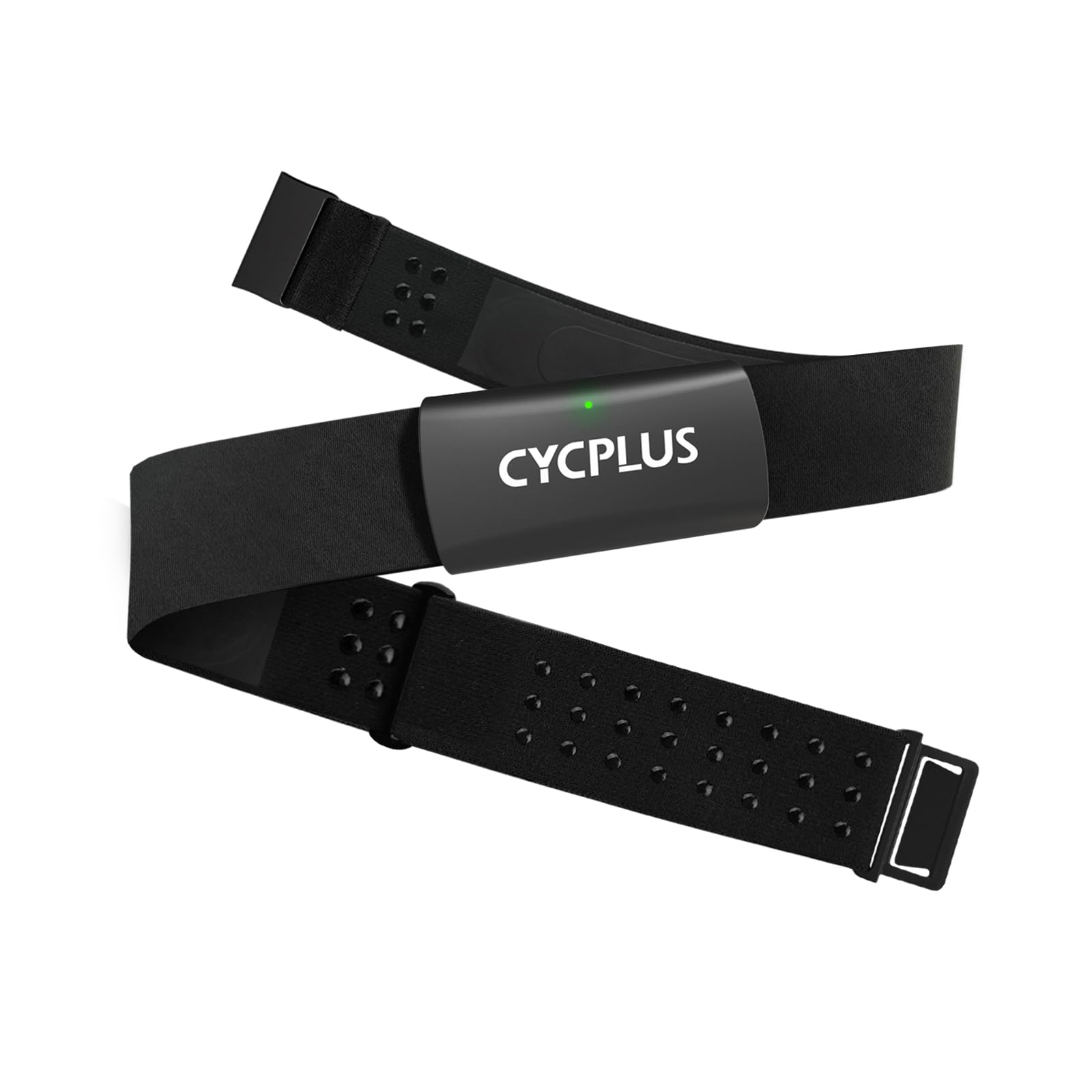
The CYCPLUS H2Pro distinguishes itself from the budget pack with its explicit focus on Heart Rate Variability (HRV) data. It uses an ECG algorithm designed to identify R-wave peaks, which allows the sensor to capture instantaneous heartbeat changes for HRV analysis — a metric endurance athletes and recovery-focused users rely on to gauge training fatigue. Weighing only 21 grams without the strap, it is one of the lightest chest sensors on the market, and the soft, breathable strap material has received specific praise from women users for being comfortable under a sports bra band.
The 500-hour battery life covers roughly three years of typical use at three sessions per week. One user found that leaving the sensor attached to the band post-workout caused the battery to drain, so detaching the module after each session is a necessary habit. The H2Pro pairs with Strava, Zwift, Wahoo, and CYCPLUS FIT via Bluetooth or ANT+ but notably cannot connect directly to a phone’s Bluetooth settings — pairing is done exclusively through the app interface. This protocol quirk trips up some first-time users, but once paired, the connection is reliable.
User reviews show a split between athletes who find the H2Pro every bit as accurate as a Garmin chest strap and those who could not get the unit recognized by their app at all. The failure rate appears linked to firmware compatibility with specific phone models rather than a hardware flaw. The IPX7 rating gives peace of mind for rainy rides, and the adjustable strap fits chest circumferences from roughly 26 to 47 inches. For the price, the HRV capability alone justifies the slight setup learning curve.
Why it’s great
- ECG-level HRV tracking for recovery monitoring
- 21-gram sensor with comfortable strap for all-day wear
- 500-hour battery life on standard CR2032 cell
Good to know
- Battery drains if sensor is left attached to strap after use
- Pairing requires app interface — not direct phone Bluetooth connection
3. iGPSPORT HR50 Cycling Sensor Chest Strap
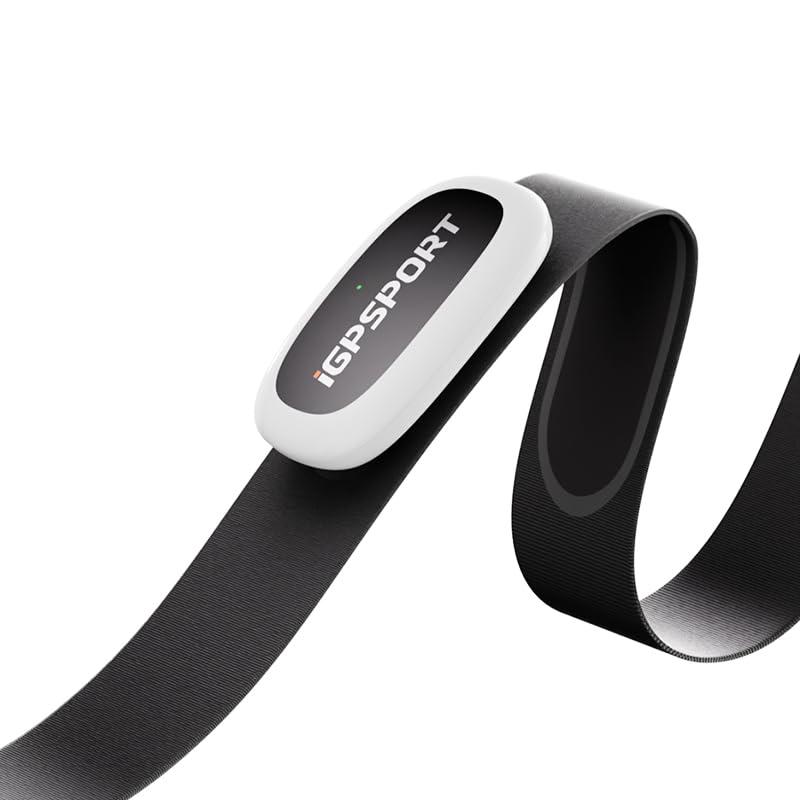
The iGPSPORT HR50 is the most basic, no-frills chest strap in this lineup, and that simplicity is its strongest asset. It provides real-time heart rate data to the iGPSPORT app with no delay, and one verified user strapped it on alongside a Garmin HR monitor and confirmed matching readings. The elastic strap adjusts from 25.5 to 47 inches in chest circumference, accommodating a wide range of body types. The maximum battery life claim of 1200 hours on a CR2032 battery is the highest in this group, and the IPX7 waterproof rating protects against sweat and rain during outdoor rides.
The HR50 pairs via Bluetooth and ANT+, and users report seamless connections to Rouvy, Zwift, and cycling computers. The lack of any on-device display or LED means there is no feedback to confirm pairing — you have to check your app. The unit has no HRV support and no dual-recording capability, so it’s purely a real-time BPM broadcaster. Some users note that in high-heat rides exceeding six hours, sweat salt buildup on the electrodes can cause erratic readings, but rinsing the strap restores accuracy.
The HR50’s weakness is inconsistency over time. Several early reviews praised it, but a notable minority report that the sensor becomes unreliable after two to three months, dropping connections mid-ride and eventually becoming useless. The 2-year warranty from iGPSPORT covers this, but it means the HR50 is best for users who want a cheap backup or who are willing to return a faulty unit. For pure value per hour of battery life, nothing beats this, but reliability at the three-month mark is a gamble.
Why it’s great
- 1200-hour battery life — the longest in this guide
- Wide 25.5 to 47-inch chest fit range
- Inexpensive and accurate, matching Garmin HR readings
Good to know
- Some units fail after two to three months with connectivity issues
- No HRV or dual-recording capability
4. CYCPLUS H1 Armband Heart Rate Monitor

The CYCPLUS H1 armband is an optical sensor that uses patented technology to deliver accuracy of ±1 BPM, a figure that rivals many chest straps. The key differentiator is the charging speed: a full charge takes only 30 minutes, and that charge delivers 110 hours of continuous use. That combination is exceptional for a rechargeable armband, where the norm is a one- to two-hour charge for 20 to 60 hours of battery. The H1 also includes a heart rate zone LED indicator that glows green (≤80 BPM), orange (80-140 BPM), or red (≥140 BPM), giving you instant visual feedback without checking your phone.
The strap is made of silicone with a tang buckle closure, and it stays on the upper or lower arm without slipping during dynamic movement. The Bluetooth 5.1 and ANT+ connectivity is reliable with Garmin, Wahoo, and Specialized bike computers. One user noted that the strap came undone during a ride — the velcro-free buckle may loosen under certain arm positions. The magnetic charging cable is proprietary and weak; if you bump the sensor off the charger, it will stop charging. A case includes the cable, but losing it means hunting for a replacement.
User feedback is overwhelmingly positive for battery life and accuracy, with several reviewers calling it the best HRM they have used. A minority of users report slow initial connection to NordicTrack equipment and occasional disconnects. The H1 is IP67 rated, so it handles rain and sweat without issue, but it is not intended for swimming. For users who dislike chest straps and want a fast-charging, long-lasting armband, the H1 is a standout option at this price tier.
Why it’s great
- 30-minute full charge provides 110 hours of runtime
- ±1 BPM optical accuracy with heart rate zone LED indicator
- Comfortable silicone strap for upper or lower arm wear
Good to know
- Weak magnetic charger — unit falls off if bumped
- Some users report strap loosening during high-movement sessions
5. CooSpo HW807 Armband Heart Rate Monitor

The CooSpo HW807 occupies the sweet spot between budget pricing and feature depth. It uses a patented optical sensor with ±1 BPM accuracy and supports Heart Rate Variability (HRV) data — rare in an armband at this price point. The HW807 also includes a multi-color LED indicator for heart rate zones, which helps you stay in your target range without glancing at your phone. It is one of the few armbands in this guide that directly pairs with gym equipment like Concept2 rowers, NordicTrack treadmills, Bowflex Max Trainers, and Peloton bikes without needing a phone as a bridge.
The battery life is 20 hours per charge, which is shorter than the CYCPLUS H1 but still covers a week of daily training for most athletes. The included two arm straps (one standard, one soft) and a magnetic charger are solid extras. CooSpo also offers a free replacement cable service within 12 months of purchase, which offsets the proprietary charger concern.
Accuracy reports are mixed. While many users find it matches their Samsung watch or Garmin during steady-state runs, one reviewer recorded a 175 BPM reading during a walk, which was 55 BPM higher than a Samsung watch. This discrepancy suggests the optical sensor can be fooled by arm movement or poor strap placement. The IP67 waterproof rating covers rain and sweat but not swimming. For users who want HRV data from an armband and own gym equipment with ANT+ or BLE compatibility, the HW807 delivers strong value.
Why it’s great
- Supports HRV tracking from an optical armband sensor
- Pairs directly with Concept2, Peloton, NordicTrack, and other gym gear
- Two arm straps included for size and comfort flexibility
Good to know
- 20-hour battery requires charging every few sessions
- Optical accuracy can spike during fast arm movements
6. Scosche Rhythm+ 2.0 Armband Heart Rate Monitor

The Scosche Rhythm+ 2.0 is the premium option in this guide, and it earns that position with IP68 waterproofing (submersible to one meter), HRV and RRi data streaming, and a comfortable dual-band strap that fits the forearm, bicep, or tricep. It is one of the very few armbands that streams raw RR interval data to HRV analysis apps like HRV4Training and Morpheus, giving recovery-focused athletes a tool that was previously the domain of high-end chest straps. The 24-hour battery life is standard for this segment, and the unit supports both Bluetooth and ANT+ connectivity.
User feedback is bifurcated. Long-time athletes praise the Rhythm+ 2.0 for solving wrist-based reliability issues and for keeping a steady lock during runs and cycling sessions. One user who switched from a Garmin chest strap reported that the Scosche graphs matched the chest strap beat for beat during interval changes. On the other side, a significant number of reviews cite random dropouts and wildly inaccurate readings that swing between 40 and 190 BPM for no apparent reason. This performance appears to be user-specific, possibly linked to skin tone, arm hair, or how tightly the band is worn.
The Rhythm+ 2.0 uses a proprietary magnetic charger, which is a notable downside. If you forget or lose it, the device is unusable until you buy a replacement. Scosche offers lifetime tech support, which adds peace of mind. The strap also requires careful adjustment — it is not infinitely adjustable like a velcro strap, and some users find it either too tight or too loose with no middle ground. For those who want HRV data from an armband and are willing to pay a premium for the Scosche ecosystem, the Rhythm+ 2.0 is the most capable unit here.
Why it’s great
- IP68 waterproof — submersible for swimming and recovery analysis
- Streams RRi and HRV data to third-party recovery apps
- Comfortable design that solves wrist-based sensor lag issues
Good to know
- Proprietary magnetic charger — loss renders the unit unusable
- Some users report random dropouts and inaccurate BPM swings
7. FITCENT CL830 Armband Heart Rate Monitor

The FITCENT CL830 is a straightforward optical armband designed for compatibility with over 200 fitness apps, including Peloton, Polar Beat, Wahoo Fitness, and DDP Yoga. It uses dual-band Bluetooth and ANT+ connectivity, so it works with phones, GPS watches, and bike computers. The rechargeable lithium battery offers 60 hours of use, and the magnetic charger fully charges the unit in about 1.5 hours with an LED indicator that turns solid green when ready.
The CL830 is praised for its immediate pairing with Peloton bikes — several users noted that it connected within seconds and stayed locked throughout a 45-minute session. The rubberized armband is comfortable for most arm sizes, though one user with an above-average build noted that the strap was too short for the upper arm. The unit has no auto-shutoff feature, meaning the battery will drain if you forget to press and hold the button to power it down. Some users also reported that the strap stretched out over time, requiring more frequent tightening.
The main drawback reported by a small percentage of users is a failure to connect to any fitness app, with the support team being unresponsive. This appears to be a unit-specific defect rather than a design flaw. For the price, the CL830 is a capable armband that works best for Peloton users who want a reliable optical sensor without the premium price tag of the Scosche. The 60-hour battery is a strong middle ground between the short-lived CooSpo and the extremely long-lasting CYCPLUS H1.
Why it’s great
- Seamless pairing with Peloton bikes and other smart trainers
- 60-hour battery life with magnetic charging and LED indicator
- Compatible with over 200 fitness apps including Zwift and Strava
Good to know
- No auto-shutoff — battery drains if left powered on
- Strap may be too short for larger upper arms
FAQ
Why do chest straps need to be wet before use?
Can I use an armband for swimming?
How do I know if my device needs ANT+ or Bluetooth?
What is HRV and why do some monitors track it?
Will a budget HRM work with Peloton and Zwift?
Final Thoughts: The Verdict
For most users, the budget heart rate monitor winner is the Magene H603 because it combines dual-stream ANT+ and Bluetooth recording, a 1000-hour battery, and a comfortable split strap design at an entry-level price. If you want an armband with fast charging and long battery life, grab the CYCPLUS H1. And for HRV data from an armband for recovery monitoring, nothing beats the Scosche Rhythm+ 2.0.

Mo Maruf
I created WellFizz to bridge the gap between vague wellness advice and actionable solutions. My mission is simple: to decode the research and give you practical tools you can actually use.
Beyond the data, I am a passionate traveler. I believe that stepping away from the screen to explore new environments is essential for mental clarity and physical vitality.