Our readers keep the lights on and my smoothie glass nicely filled. As an Amazon Associate, I earn from qualifying purchases.
The hardest part about finding a sub- headset isn’t the sound quality. It’s the microphone. Most budget models treat the mic as an afterthought, delivering a thin, distant voice that forces you to repeat yourself on calls. Between cheap drivers that mush out vocals and boom arms that pick up every rustle in the room, the budget market is a minefield of bad communication gear. The goal here is simple: find wired and wireless options where the mic actually works, the sound is balanced, and the build won’t snap in a backpack.
I’m Mohammad Maruf — the founder and writer behind WellFizz. I’ve analyzed the bill of materials, customer durability reports, and real-time audio latency specs for over 40 budget headphones to isolate the models that deliver a usable mic without the usual cheap-headphone compromises.
Whether you’re taking work calls from a noisy home office or hopping into a Discord channel with friends, the following breakdown will steer you toward the budget headphones with mic that actually hold up under daily use. No fluff, just the data that matters for your next purchase.
How To Choose The Best Budget Headphones With Mic
When your budget is constrained, every dollar needs to land on a spec that directly affects your daily experience. Here are the three decisions that separate a usable budget headset from a frustrating one.
Connection type: USB vs. 3.5 mm vs. Bluetooth
A USB headset is the simplest path for computer users — plug-and-play with no separate audio drivers, and the USB connection powers a dedicated sound card that usually delivers cleaner mic input than a laptop’s shared jack. A 3.5mm headset, on the other hand, works across phones, tablets, and older laptops but relies on the device’s own DAC, which can introduce static on cheaper ports. Bluetooth adds freedom of movement but introduces latency for voice calls and a battery that will degrade after a year. For pure call reliability, USB wins for desktop users; 3.5mm is the universal fallback.
Microphone type: boom vs. inline
A boom mic that extends physically toward your mouth gives you dramatically better voice isolation versus an inline mic dangling on the cable. The boom places the capsule closer to your voice, so background noise — keyboard clicks, room fans, traffic — fades relative to your speech. Inline mics, common on cheaper 3.5mm models, pick up more ambient noise and often force you to hold the cable near your mouth for clarity. For any serious calling, a rotating or fixed boom arm is the feature to chase in this price tier.
Driver size and fit for vocal clarity
A 30mm to 40mm dynamic driver is standard at this price point, but tuning matters more than diameter. Look for models that emphasize the mid-range (1–4 kHz) because that’s where human speech lives. Over-ear cups with leatherette padding provide enough passive noise reduction to let you hear voices clearly without cranking the volume. On-ear or earbud-style budget headsets bleed sound and let ambient noise in, forcing you to compete with the room during calls. Over-ear is the safe bet for both comfort and isolation.
Quick Comparison
On smaller screens, swipe sideways to see the full table.
| Model | Category | Best For | Key Spec | Amazon |
|---|---|---|---|---|
| Vic Firth Bluetooth Isolation | Bluetooth / Wired | Musicians & loud environments | Passive isolation rating (NRR ~22 dB) | Amazon |
| JBL Tune 510BT | Bluetooth | Wireless daily commute & gym | 40-hour battery / USB-C | Amazon |
| Logitech H390 | Wired USB-A | Office calls & remote work | Noise-canceling boom mic | Amazon |
| OneOdio Pro-10 | Wired 3.5mm / 6.35mm | Studio monitoring & music production | 50mm drivers with neodymium magnets | Amazon |
| AILIHEN C90 | Wired 3.5mm | Budget everyday listening | 40mm DLC driver / 7 oz weight | Amazon |
In‑Depth Reviews
1. Vic Firth Bluetooth Isolation Headphones

Vic Firth designed these primarily for drummers, but the high passive noise reduction rating makes them a weapon for anyone working in a genuinely loud environment — open-plan offices, near construction, or home studios with AC roar. The ear cups clamp with enough force to create a seal that blocks roughly 22 dB of ambient sound, so you can monitor a call at low volume without raising your voice. The flat frequency response also means vocals come through without artificial bass boosts that muddy speech.
The dual connectivity is the real differentiator here. Bluetooth 5.0 gives you cable-free movement, but the included 3.5mm cable allows wired backup when the battery runs out — a rare fail-safe on a budget wireless headset. Users consistently report the passive isolation is strong enough to hear subtle track details at 33% of the volume required on consumer headphones. That’s a huge margin for protecting your hearing over long shifts.
Durability is the only asterisk. Multiple long-term reviews note that while the first pair lasted two years of heavy use, a replacement unit had a charging port failure within weeks. The battery life is excellent — two-plus hours daily for a week between charges — but the internal electronics and stiff cable connection are points of failure. If you need isolation more than you need fancy features, this is the best value in the list for noise-critical environments.
Why it’s great
- Exceptional passive noise reduction for the price — blocks drum/machinery levels of sound
- Bluetooth + wired dual-mode with replaceable cable extends usable life
- Flat frequency response keeps vocal clarity high without distortion
Good to know
- QC can be inconsistent; some units develop charging or power-button failures within weeks
- Tight clamping force may cause ear fatigue for glasses wearers during extended sessions
2. JBL Tune 510BT

JBL’s Tune 510BT is the wireless champion of the budget Bluetooth tier, and the headline feature is the 40-hour battery life with a 5-minute quick charge that gives you 2 hours of playback. That endurance is rare under — most Bluetooth headphones in this bracket tap out at 20 hours. Combined with multipoint Bluetooth pairing, you can jump between your laptop for a Zoom call and your phone for music without re-pairing. The on-ear controls (volume, track skip, call answer) are mechanical buttons, not touch-sensitive pads, so they don’t misfire when you adjust the fit.
Sound is textbook JBL Pure Bass, which means the low end is intentionally boosted. For podcasts and calls, that’s a minor drawback because the bass can slightly obscure mid-range vocal tones, but for music and gaming it delivers a fun, energetic signature that most budget headphones lack. The on-ear design is lighter than over-ear models (approximately 160 grams), making it more portable, but the trade-off is less passive isolation — you’ll hear background chatter more easily in a coffee shop.
The mic is embedded in the ear cup rather than on a boom arm, so voice clarity is average for calls in quiet rooms but degrades in windy or noisy environments. The build is solid for the price: after two years of daily gym use, reviewers report the pads compress but the headband and hinges hold up. If you prioritize wireless freedom, long battery life, and JBL’s bass tuning over absolute mic isolation, this is the easy pick.
Why it’s great
- Industry-leading 40-hour battery life with USB-C fast charging
- JBL Pure Bass sound is engaging for music and media
- Multipoint Bluetooth lets you switch between two devices seamlessly
Good to know
- On-ear design provides less passive isolation than over-ear models
- Ear cup mic picks up wind and background noise in challenging environments
3. Logitech H390 Wired Headset

The Logitech H390 is the closest you’ll get to a contact-center headset at a consumer price. The USB-A connector integrates a built-in sound card, so the digital signal path bypasses your laptop’s often-noisy analog audio jack entirely. The result is a clean, noise-free audio stream for both listening and talking. The rotating noise-canceling boom mic is mounted on a flexible arm that tucks away when not in use, and the cardioid pickup pattern actively rejects keyboard clatter and room reverb — reviewers confirm it handles loud AC units and barking dogs in the background without the other party hearing it.
Comfort is the primary consideration here. The leatherette ear cushions are swivel-mounted and padded, and the adjustable headband distributes weight evenly across the crown. Reviewers wearing glasses note that the clamping pressure can cause ear ache over multi-hour shifts, requiring periodic adjustment. However, for pure audio quality per dollar, the 30mm drivers deliver surprisingly clear vocals for a sub- headset — fine-tuned specifically for voice applications, so music reproduction is adequate but not exciting.
The most overlooked advantage of the H390 is the Chromebook certification. It’s tested and approved under Google’s compatibility standards, meaning it works without driver hunting on Chrome OS, Windows, and macOS. The 6.23-foot cable gives enough slack to stand during long conversations. For anyone whose primary use case is work calls, Zoom classes, or softphone dialing, the H390 is the safest, most reliable wired choice you’ll find at this entry-level price point.
Why it’s great
- USB sound card eliminates analog noise for clean call audio
- Noise-canceling boom mic rejects room chatter effectively
- Chromebook certified and works across all major OS without drivers
Good to know
- Leatherette pads can cause ear ache for glasses wearers during long sessions
- Music quality is adequate but not as rich as studio-oriented headphones
4. OneOdio Pro-10

The OneOdio Pro-10 is the outlier in this list because its primary audience is musicians, producers, and DJs — not call-takers. But the big 50mm neodymium drivers, combined with a sealed over-ear design, deliver a level of soundstage and bass punch that no other headphone in this budget group can match. The included 1/4-inch adapter means you can plug directly into audio interfaces, guitar amps, or keyboard mixers without an extra adapter. The 90° swiveling ear cups also allow single-ear monitoring, a feature that matters if you need to keep one ear open for a room mic or conversation.
Vocal clarity is strong because the 50mm drivers push enough mid-range energy to keep dialog crisp even at low volumes. The passive noise isolation from the thick padding is good enough for monitoring in a live room, though it’s not as aggressive as the Vic Firth’s isolation. The build is solid: a self-adjusting headband, detachable cable (replaceable if the original frays), and a protective case included in the box. Multiple reviewers report five-plus years of daily use with the only failure point being the ear cushion coating peeling after two years — a cosmetic rather than functional issue.
The trade-off is weight and portability. These are heavier than typical budget headphones, and the coiled cable is long and somewhat cumbersome for mobile use. There’s no inline mic — the microphone is included as a detachable cable with a mic module, which works but is not as elegant as a dedicated boom arm. If you want a single headphone that works for music production, casual gaming, and occasional calls, and you value driver size and build longevity, the Pro-10 is the best-constructed option here.
Why it’s great
- Large 50mm drivers deliver superior bass and mid-range clarity for music
- Dual 1/4-inch and 3.5mm connectivity works with studio gear and consumer devices
- Detachable cable and included case improve long-term durability
Good to know
- Heavier design and coiled cable make them less portable for commuting
- Ear cushion coating can peel after two-plus years of heavy use
5. AILIHEN C90 Wired Headphones
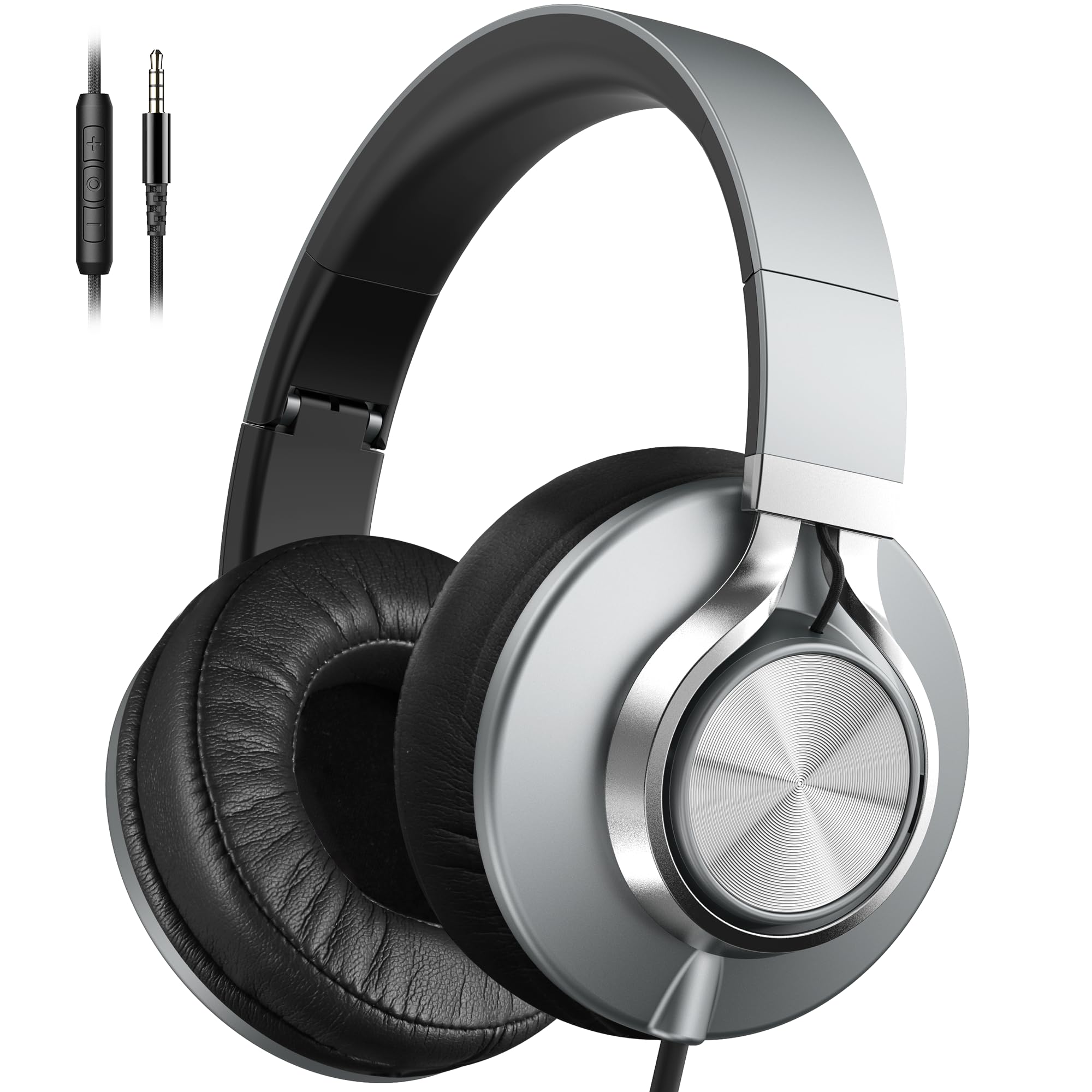
The AILIHEN C90 fills the “grab-and-go” slot in this lineup. At 7 ounces with a foldable frame and a tangle-free nylon braided cable, it’s the most portable wired option on this list. The 40mm DLC (diamond-like carbon) drivers are a surprise in this price bracket — typically reserved for slightly more expensive models — and they deliver a balanced sound signature with decent bass extension and clear highs. The noise isolation claim of blocking over 90% of ambient noise is optimistic for a passive seal, but the over-ear cups and protein cotton padding definitely muffle TV chatter and office hum effectively.
The inline microphone is the weak point compared to the boom-mic models above. It works fine for quiet rooms and short calls, but it captures more ambient noise than a dedicated boom arm. The volume control on the inline module has a known compatibility quirk: it may not work with computers, only with phones and tablets. If your primary use is mobile — iPad videos, phone music, Switch gaming on the go — this limitation won’t matter. If you need a headset for laptop calls, the Logitech or OneOdio are better choices.
Comfort is the AILIHEN’s strongest asset. The protein cotton earpads are softer and more breathable than standard foam padding, and the lightweight frame reduces clamp force. However, a few reviews mention the cable’s fabric cover starts fraying at the plug connection after about a month — a reminder that the ultra-budget build means you’re trading a bit of long-term durability for immediate comfort and low weight. For a student or casual user who needs something comfortable for daily media consumption and occasional calls, it’s a reliable, budget-friendly companion.
Why it’s great
- Ultra-lightweight at 7 oz with foldable design for easy packing
- 40mm DLC drivers provide surprisingly balanced sound for the price
- Protein cotton earpads are soft, breathable, and reduce clamp pressure
Good to know
- Inline mic picks up more ambient noise than dedicated boom-arm models
- Cable fabric may fray at the plug connection after extended use
FAQ
Why do boom microphones sound clearer than inline mics on budget headphones?
Can I use a 3.5mm headset with a USB-C only laptop?
What is passive noise reduction and how much does a budget headphone need for calls?
Final Thoughts: The Verdict
For most users, the budget headphones with mic winner is the Logitech H390 because of its reliable USB connectivity, rotating noise-canceling boom mic, and proven performance across thousands of contact-center users. If you value wireless freedom and marathon battery life, grab the JBL Tune 510BT. And for musicians or anyone working in genuinely loud environments where isolation saves your hearing and improves call clarity, nothing beats the Vic Firth Bluetooth Isolation Headphones.

Mo Maruf
I created WellFizz to bridge the gap between vague wellness advice and actionable solutions. My mission is simple: to decode the research and give you practical tools you can actually use.
Beyond the data, I am a passionate traveler. I believe that stepping away from the screen to explore new environments is essential for mental clarity and physical vitality.