Our readers keep the lights on and my smoothie glass nicely filled. As an Amazon Associate, I earn from qualifying purchases.
A budget graphic design monitor must deliver two non-negotiable things: accurate sRGB coverage and a Delta E (ΔE) rating under 2. The wrong panel will show you muddy blues and crushed shadows, wrecking your client proofs and print output before you ever hit “export.”
I’m Mohammad Maruf — the founder and writer behind WellFizz. I spend my days dissecting panel specs, color gamut data sheets, and real-world calibration reports so you don’t have to guess which monitor actually holds its color fidelity under load.
Whether you are a freelance designer, video editor, or production artist working with a lean setup, this roundup is built around the only monitors worth your desk space. Buying a budget graphic design monitor means choosing the right IPS panel with verified coverage and ergonomic flexibility, and this guide shows you exactly which models deliver.
How To Choose The Best Budget Graphic Design Monitor
Choosing a budget graphic design monitor starts with knowing which specs actually drive color accuracy and which ones simply inflate the price. You need a panel that calibrates well, an ergonomic stand that supports long hours, and the right connectivity to keep your desk clean. Here is what to focus on.
Color Gamut & Delta E
For graphic design, sRGB is the baseline standard. Look for at least 99% sRGB coverage. The Delta E (ΔE) rating tells you how far the monitor deviates from true color; anything under 2 is considered excellent and will keep your prints matching your screen. Some monitors come factory-calibrated with a report, saving you the cost of a hardware calibrator on day one.
Panel Type & Resolution
Stick with IPS (In-Plane Switching) panels. IPS delivers consistent color and brightness across wide viewing angles, which is critical when you share your screen with a client or rotate it for portrait work. For resolution, 1440p (QHD) on a 27-inch panel offers a sharp pixel density at a lower GPU cost, while 4K (UHD) gives you that extra workspace for palettes and timelines—but it demands more from your computer.
Connectivity & Power Delivery
A single USB-C cable with power delivery (PD) of 60W to 90W keeps your laptop charged and connected with one cord. This reduces cable clutter and makes your monitor a true productivity hub. Ensure the monitor also has HDMI and DisplayPort for secondary input sources.
Ergonomic Adjustability
Height adjustment, tilt, swivel, and pivot (90° rotation) are not luxuries—they are necessities for reducing neck and eye strain during long design sessions. A monitor that lacks these adjustments will force you into poor posture, and no budget monitor is cheap enough to sacrifice your physical comfort.
Quick Comparison
On smaller screens, swipe sideways to see the full table.
| Model | Category | Best For | Key Spec | Amazon |
|---|---|---|---|---|
| ASUS ProArt PA279CV | Premium 4K | Critical color work | 4K, 100% sRGB/Rec. 709, ΔE < 2 | Amazon |
| ViewSonic VP2756-4K | Professional 4K | Pantone-validated editing | 4K, 100% sRGB, Pantone Validated | Amazon |
| LG 32UN650-W | Large 4K | Multi-window layout | 32″ 4K, DCI-P3 95% | Amazon |
| LG 27UP850K-W | 4K USB-C Hub | MacBook one-cable setup | 4K, DCI-P3 95%, 90W USB-C PD | Amazon |
| Dell 27 Plus S2725QC | 120Hz 4K | Smooth scrolling & video | 4K, 99% sRGB, 120Hz | Amazon |
| ASUS ProArt PA278CV | QHD Color Accuracy | Budget color-critical work | QHD, 100% sRGB/Rec. 709, ΔE < 2 | Amazon |
| INNOCN 27″ 4K USB-C | Affordable 4K | Entry-level 4K design | 4K, ΔE < 2, HDR400 | Amazon |
| Dell S2722DC | QHD USB-C Hub | Versatile office & design | QHD, 99% sRGB, 65W USB-C PD | Amazon |
| Samsung ViewFinity S50GC | Ultra-Wide | Multi-tasking & timeline work | 34″ UWQHD, 100Hz, 3000:1 VA | Amazon |
In‑Depth Reviews
1. ASUS ProArt Display PA279CV

The ASUS ProArt PA279CV is the king of the budget graphic design monitor category because it delivers true 4K resolution with factory-calibrated Delta E < 2 accuracy and full 100% sRGB and Rec. 709 coverage. The 27-inch IPS panel produces consistent brightness at 350 cd/m², and the Calman Verification means you spend more time designing and less time tweaking your screen.
Connectivity is where this monitor punches above its price: USB-C with 65W power delivery handles both video and laptop charging, plus a four-port USB 3.1 hub for your peripherals. The ergonomic stand includes height, pivot, swivel, and tilt adjustments, making it easy to switch between landscape and portrait layouts for long coding or vertical design work.
Reviewers consistently report that the PA279CV matches MacBook screens out of the box, with vibrant colors and excellent text clarity. A few note a slight green tint on some units that is easily corrected by adjusting the tint setting by -7. The 60Hz refresh rate is standard for design monitors. This is the model to buy for critical color work without breaking the bank.
Why it’s great
- Factory-calibrated ΔE < 2 with Calman Verification
- 100% sRGB and Rec. 709 for print-accurate colors
- Full ergonomic stand with height, pivot, swivel
- USB-C 65W PD with integrated USB hub
Good to know
- 60Hz refresh rate caps smooth scrolling
- Occasional sleep/wake glitch with MacBooks
- Speakers are basic and tinny
2. ViewSonic VP2756-4K
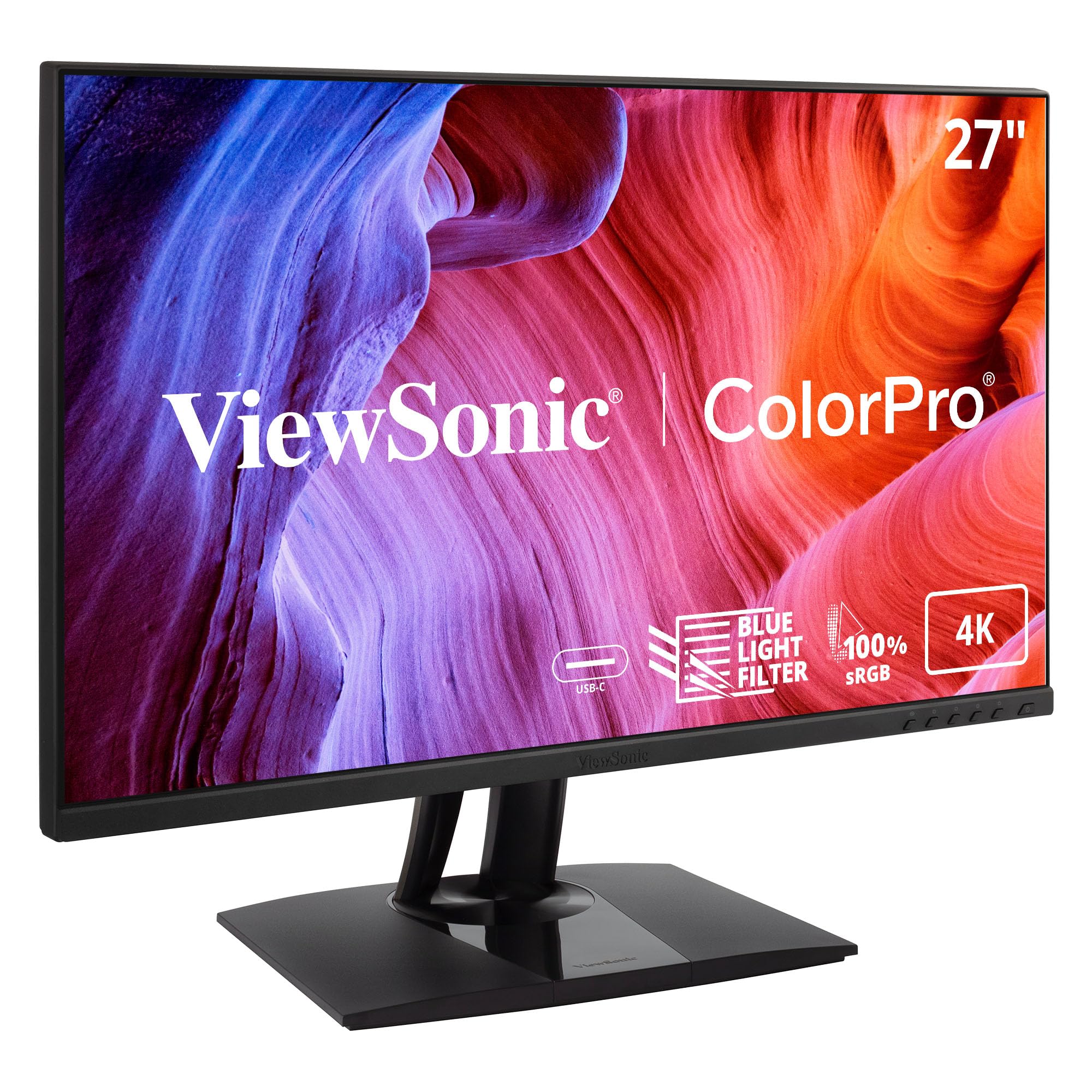
ViewSonic’s VP2756-4K is one of the few monitors under the premium tier to carry Pantone Validation, meaning its color reproduction has been formally certified for professional design and photography workflows. The 27-inch 4K IPS panel covers 100% sRGB with Delta E < 2 accuracy, and the matte finish reduces glare during long editing sessions.
The USB-C connection delivers 60W of power delivery, enough to charge most ultrabooks and MacBooks during use. The advanced ergonomic stand provides height, tilt, swivel, and pivot adjustments. Reviewers praise its color match with MacBook screens for Adobe Illustrator and Photoshop work, and the built-in speakers are functional for system audio, though external monitors are better.
Users note that the OSD menu is somewhat clunky to navigate, but the ViewSonic desktop software gives you full PC-based control over settings. One important callout: the Pivot (90-degree rotation) feature does not work properly when connected to a Mac, despite the product images. For macOS users who rely on portrait mode, this is a limitation worth considering before purchase.
Why it’s great
- Pantone Validated and Delta E < 2 certified
- Thin 8mm bezel for clean multi-monitor setups
- 60W USB-C PD with data and video
- Professional ergonomic stand
Good to know
- Pivot feature not functional on macOS
- OSD menu is unintuitive
- Speakers are acceptable but not great
3. LG 32UN650-W

The LG 32UN650-W is a visual workstation. Its 32-inch 4K IPS panel provides DCI-P3 95% color gamut coverage, which is essential for video editing and HDR content creation. The 350 cd/m² brightness and HDR10 compatibility bring out detail in shadows and highlights, while the 178° viewing angles ensure consistent color from any position.
The ergonomic stand offers height and tilt adjustments, though it lacks pivot rotation. The three-side borderless design looks sleek on any desk and is ideal for dual-monitor setups. Reviewers consistently note that this panel uses the same high-quality LED technology found in monitors costing significantly more, making it a tremendous value for photo and video editing.
One tradeoff: the 32UN650-W has no USB-C port with power delivery. It uses DisplayPort and HDMI inputs, so you will need a separate laptop charger. The built-in speakers are minimal, and the single joystick for OSD control can be annoying when adjusting settings mid-session. For pure screen real estate and color fidelity, this monitor is hard to beat at its price point.
Why it’s great
- DCI-P3 95% for video and photo work
- 32-inch 4K IPS panel with high brightness
- Three-side borderless design for multi-screen
- Solid metal stand with height/tilt
Good to know
- No USB-C port or power delivery
- No pivot adjustment for portrait mode
- Minimal built-in speakers
4. LG 27UP850K-W
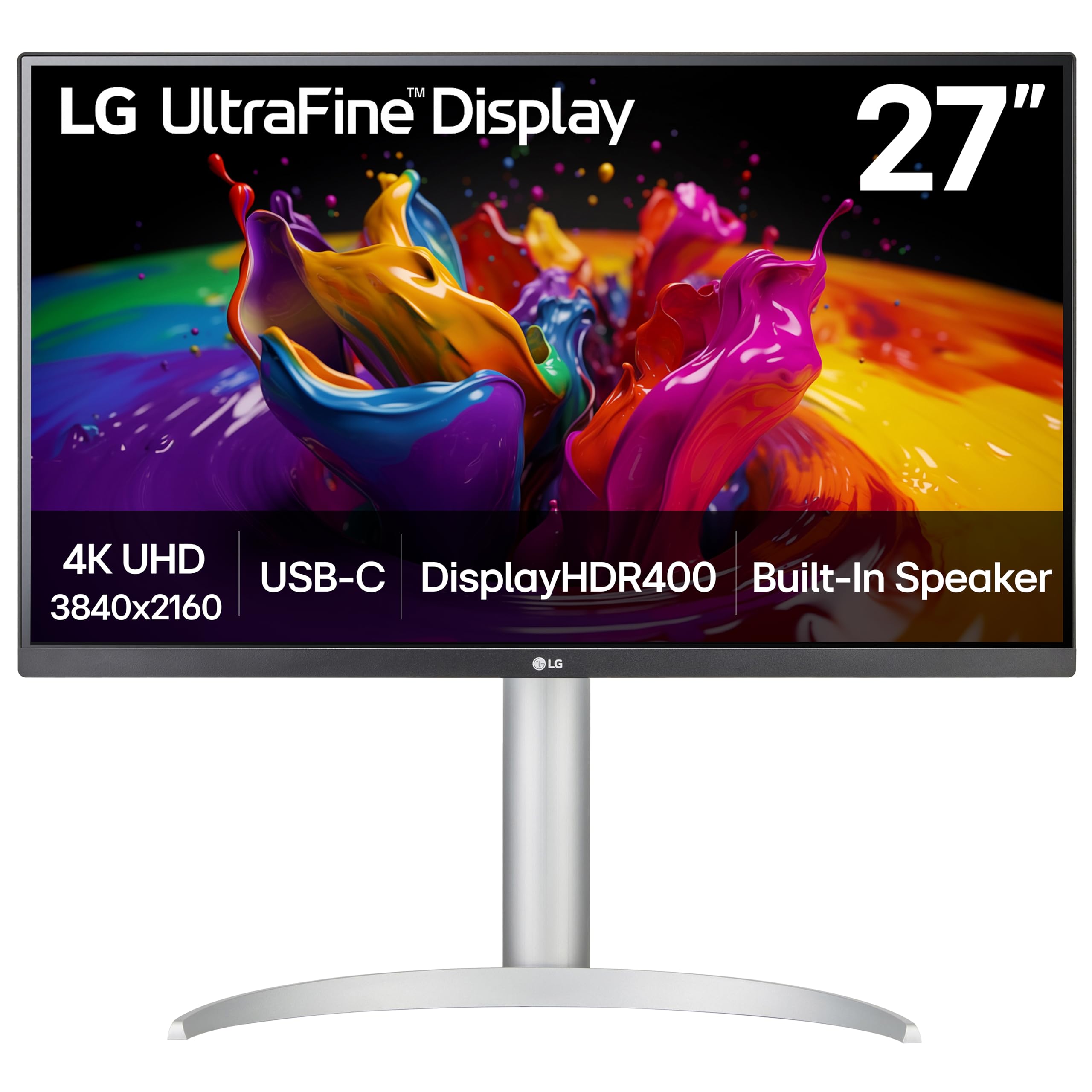
The LG 27UP850K-W is the premier choice for MacBook users because it delivers 90W of USB-C power delivery—the highest wattage on this list. A single cable charges your laptop at full speed while transmitting 4K video and data. The 27-inch IPS panel covers DCI-P3 95% color gamut and supports VESA DisplayHDR 400 for vibrant, high-contrast visuals.
The Ultrafine series has long been a favorite among designers for its color accuracy and build quality. The ergonomic stand offers full height, tilt, swivel, and pivot adjustments. Built-in stereo speakers with Waves MaxxAudio provide decent audio for video reviews, though external speakers remain the better option for serious listening.
Reviewers describe the image as sharp, vibrant, and accurate out of the box. The 60Hz refresh rate is fine for design work but less ideal for fast-paced gaming. The white color finish is a nice aesthetic departure from standard black monitors. Some users note the audio is too quiet, and the joystick control is not as intuitive as a remote would be.
Why it’s great
- 90W USB-C PD for full-speed laptop charging
- DCI-P3 95% and DisplayHDR 400
- Full ergonomic stand with pivot
- Sharp, vibrant, accurate out of box
Good to know
- 60Hz refresh rate limits smooth scrolling
- Built-in speakers are quiet
- Joystick OSD control can be tedious
5. Dell 27 Plus S2725QC
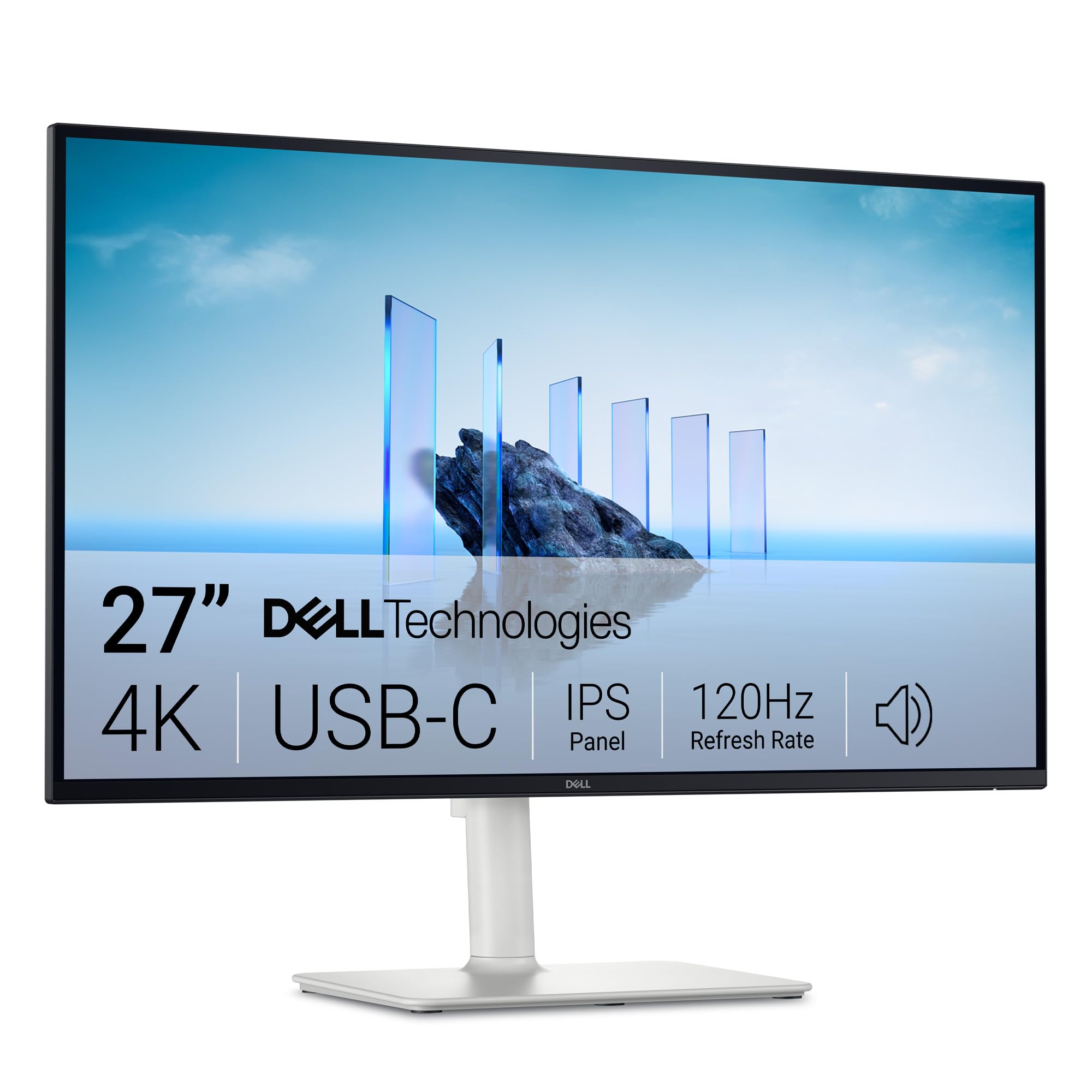
The Dell S2725QC stands out in this category because it delivers 4K resolution with a 120Hz refresh rate and AMD FreeSync Premium. This makes it ideal for design work that also benefits from smooth scrolling, video playback, and occasional gaming. The IPS panel achieves 99% sRGB coverage with a 1500:1 contrast ratio, producing deeper blacks than typical IPS monitors.
USB-C connectivity provides up to 65W power delivery. The ComfortView Plus technology reduces harmful blue light output to ≤35% without washing out colors, a significant benefit for designers who spend all day on screen. The re-engineered speakers offer better sound depth than the previous generation, with more frequency range and output power.
Reviewers rate this monitor highly for its vibrant colors, near-OLED black levels, and responsive 0.03ms response time. The adjustable stand is solid, and the sleek ash white design looks modern on any desk. Note that the recessed VESA mount requires M4x10mm standoffs for arm mounting. This is a top-tier choice for users who want 4K resolution but refuse to sacrifice smooth motion.
Why it’s great
- 4K 120Hz with FreeSync Premium
- 1500:1 contrast ratio for deep blacks
- ComfortView Plus reduces blue light
- Re-engineered speakers with better sound
Good to know
- Recessed VESA mount needs specific standoffs
- Only two HDMI and one USB-C port
- Not suitable for pro HDR color grading
6. ASUS ProArt Display PA278CV

The ASUS ProArt PA278CV proves that you do not need 4K for professional color accuracy. With WQHD (2560 x 1440) resolution, 100% sRGB and 100% Rec. 709 coverage, and Calman Verified Delta E < 2, this monitor delivers the same calibration rigor as its 4K sibling at a lower price. The 27-inch IPS panel offers a 75Hz refresh rate and Adaptive-Sync for tear-free scrolling.
USB-C with 65W power delivery keeps your desk clean, and DisplayPort daisy-chaining lets you connect up to four displays. The ergonomic stand includes height, pivot, swivel, and tilt adjustments. Reviewers praise the color accuracy for game development and photo editing, noting that text appears exceptionally crisp for a QHD panel.
The 65W USB-C power delivery is sufficient for most laptops but may struggle to charge a fully loaded workstation under heavy load. The built-in speakers are basic, and the HDMI port lacks MST support for daisy-chaining. This is the perfect choice for designers who prioritize color accuracy over raw pixel count and want to save on GPU costs.
Why it’s great
- Factory-calibrated ΔE < 2 with Calman Verification
- 100% sRGB and Rec. 709 wide gamut
- 75Hz with Adaptive-Sync for smooth motion
- Full ergonomic stand with pivot
Good to know
- 65W PD may not charge large laptops fully
- HDMI port does not support MST
- Basic built-in speakers
7. INNOCN 27″ 4K USB-C Monitor

The INNOCN 27C1U-D delivers genuine 4K UHD resolution with Delta E < 2 color accuracy and HDR400 support, all at a price that challenges large brands. The IPS panel covers 1.07 billion colors (8-bit + FRC) with a 178° viewing angle, making it suitable for photo editing, video work, and general design. The 60Hz refresh rate is standard for this tier.
USB-C connectivity handles video and data, though it does not specify exact power delivery wattage (likely 65W based on user reports). The ergonomic stand offers height, pivot, swivel, and tilt adjustments. Reviewers note that the monitor works flawlessly with M2 MacBook Air and other USB-C laptops, with plug-and-play functionality and crisp, vibrant colors out of the box.
Some users report a sleep/wake issue where the monitor fails to wake up after the MacBook goes to sleep, requiring a cable reconnect or power cycle. The built-in speakers are poor and the menu buttons are unintuitive. For the price, this is an excellent entry point into 4K design work, provided you can tolerate the minor quirkiness.
Why it’s great
- True 4K UHD with ΔE < 2 accuracy
- HDR400 support for improved contrast
- Full ergonomic stand with pivot
- Plug-and-play with MacBooks
Good to know
- Sleep/wake issue with MacBooks reported
- Terrible built-in speakers
- Menu buttons are unintuitive
8. Dell S2722DC

The Dell S2722DC is a solid all-rounder that balances design usability with general office productivity. The 27-inch QHD IPS panel (2560 x 1440) provides 99% sRGB coverage and a 75Hz refresh rate with AMD FreeSync, making it decent for both design work and light gaming. Brightness hits 350 cd/m² with a standard 1000:1 contrast ratio.
USB-C connectivity delivers 65W of power delivery, keeping your laptop charged with a single cable. The ergonomic stand offers height, pivot, swivel, and tilt adjustments. Reviewers praise the sharp image quality and the ease of adjusting the monitor to any viewing angle. The built-in speakers are present but are widely criticized as being very quiet and tinny.
The main drawbacks are the speakers, which users describe as worse than laptop speakers, and a minor issue where the screen sits slightly off-center when rotated to portrait mode counter-clockwise.
Why it’s great
- QHD 2560 x 1440 resolution with 99% sRGB
- 65W USB-C PD with single-cable connectivity
- Full ergonomic stand with pivot
- 75Hz with FreeSync for smooth motion
Good to know
- Built-in speakers are very quiet and tinny
- Portrait mode is slightly off-center
- Not suitable for critical 4K color work
9. Samsung ViewFinity S50GC

The Samsung ViewFinity S50GC is not a traditional graphic design monitor, but its ultra-wide 34-inch UWQHD (3440 x 1440) resolution offers unmatched screen real estate for timelines, asset libraries, and multi-window layouts. The VA panel provides a 3000:1 static contrast ratio, delivering much deeper blacks than IPS panels, though color accuracy is less critical at 72% color gamut.
The 100Hz refresh rate and AMD FreeSync make motion feel fluid. HDR10 support displays over 1 billion colors, though it is not factory-calibrated for Delta E standards. The borderless design and ambient light sensor for auto-brightness are thoughtful additions. The ergonomic stand is height-adjustable, but reviewers note it sits high and works best with a monitor arm.
Users find the Picture-by-Picture (PBP) and Picture-in-Picture (PIP) features exceptionally useful for running two computers on one screen. The VA panel may show color shifting at extreme angles, and this monitor is not suitable for color-sensitive work without hardware calibration. This is a productivity-first choice for designers who need maximum horizontal space over absolute color accuracy.
Why it’s great
- Ultra-wide 34-inch UWQHD resolution
- 3000:1 contrast ratio for deep blacks
- 100Hz with FreeSync for smooth motion
- PBP/PIP for multi-computer workflows
Good to know
- 72% color gamut not suitable for color-critical work
- VA panel has color shift at extreme angles
- Stand is too high, recommended with arm
- No VESA screws included
FAQ
Can a budget graphic design monitor be used for print work without calibration?
Is 1440p (QHD) enough for graphic design or do I need 4K?
Why do budget graphic design monitors often have poor built-in speakers?
Does a higher refresh rate (75Hz or 120Hz) matter for graphic design work?
Final Thoughts: The Verdict
For most users, the budget graphic design monitor winner is the ASUS ProArt PA279CV because it combines factory-calibrated 4K color accuracy with a full ergonomic stand and USB-C connectivity at a price that leaves the competition behind. If you want the smoothest motion and deepest blacks without sacrificing resolution, grab the Dell 27 Plus S2725QC. And for maximum screen real estate in an ultra-wide format, nothing beats the Samsung ViewFinity S50GC for timeline-heavy and multi-window workflows.

Mo Maruf
I created WellFizz to bridge the gap between vague wellness advice and actionable solutions. My mission is simple: to decode the research and give you practical tools you can actually use.
Beyond the data, I am a passionate traveler. I believe that stepping away from the screen to explore new environments is essential for mental clarity and physical vitality.