Our readers keep the lights on and my smoothie glass nicely filled. As an Amazon Associate, I earn from qualifying purchases.
Staring at a 1440p monitor with a card that chokes on modern titles is a specific kind of frustration—micro-stutters during firefights, texture pop-in during cutscenes, and that sinking feeling when you realize you spent money on the wrong tier. The “budget” segment for 1440p gaming has never been more competitive, with the – range now offering genuine high-refresh potential thanks to aggressive pricing on new silicon and last-gen stalwarts that refuse to age out.
I’m Mohammad Maruf — the founder and writer behind WellFizz. I’ve spent the last several weeks dissecting VRAM budgets, core clocks, and memory bandwidth figures across these nine cards to find which ones actually deliver playable frame rates at 2560×1440 without forcing you into low settings. This market moves fast, and the wrong pick can cost you performance for years.
The goal is simple: find the best budget gpu for 1440p gaming that balances raw rasterization, VRAM headroom, and long-term driver support without pushing past what most mid-range builders can justify spending.
How To Choose The Best Budget GPU For 1440p Gaming
Picking a budget-friendly card for 1440p is trickier than assembling a parts list for 1080p. At this resolution, the pixel count jumps 78%, which directly punishes both VRAM limits and core clock deficiencies. You need to be strategic about where you compromise.
VRAM Capacity — The 8GB Ceiling
Modern titles like Hogwarts Legacy, Cyberpunk 2077: Phantom Liberty, and Alan Wake 2 can push past 8GB of video memory at 1440p with high-resolution texture packs enabled. An 8GB card will still run these games, but you may need to dial texture quality to high instead of ultra, or accept occasional texture streaming hitches. Cards with 12GB or 16GB provide genuine future-proofing, especially if you use texture mods or play simulation games that cache heavily. In this list, the RX 9060 XT models (16GB) offer a meaningful buffer over the RTX 5060 and RX 7600 (8GB).
Memory Bandwidth and Interface Width
Bandwidth matters more at 1440p than 1080p because the GPU has to move larger frames to and from memory every cycle. A 128-bit interface is standard in this price tier, but the type of memory makes a difference. GDDR7 (found on all RTX 5060 cards here) pushes bandwidth significantly higher than GDDR6 at the same bus width, which directly improves 1% low frame rates during intense scenes. Cards like the RX 7600 (GDDR6, 128-bit) will trail in bandwidth-bound scenarios despite competitive core clocks.
Rasterization vs. Ray Tracing at This Budget
At the budget 1440p tier, raw rasterization performance is the primary driver of value. Ray tracing at this price point—even on the RTX 5060—will require substantial upscaling to hit playable frame rates. AMD’s RX 9060 XT cards offer competitive raster performance with better VRAM pools and FSR 4 support, making them stronger choices for longevity if you prioritize native resolution gaming. NVIDIA cards win on DLSS 4 image quality, but the 8GB VRAM cap limits their ray tracing ceiling at higher resolutions.
Cooling and Physical Fit
Many of these cards are compact enough for small form factor builds, but triple-fan models and larger heatsinks (like the GIGABYTE RX 9060 XT Gaming OC) extend past 11 inches. Check your case clearance and PSU wattage—most of these cards run efficiently under 200W, but older power supplies may lack the required PCIe connectors. Dual-fan designs from MSI and ASUS run quietly enough for open-air setups, while the XFX SWFT210 stays compact at under 10 inches.
Quick Comparison
On smaller screens, swipe sideways to see the full table.
| Model | Category | Best For | Key Spec | Amazon |
|---|---|---|---|---|
| Sapphire Pulse RX 9060 XT | Mid-Range | Best Overall 1440p Value | 16GB VRAM, 3290 MHz Boost | Amazon |
| GIGABYTE RX 9060 XT Gaming OC | Mid-Range | Quiet 16GB Cooling | 16GB VRAM, 2700 MHz Boost | Amazon |
| PowerColor Reaper RX 9060 XT | Mid-Range | Compact 16GB Build | 16GB VRAM, 2620 MHz Boost | Amazon |
| PNY RTX 5060 Epic-X ARGB | Premium | Triple-Fan GDDR7 Cooling | 8GB GDDR7, 2280 MHz Boost | Amazon |
| MSI RTX 5060 Shadow 2X | Premium | DLSS 4 Upgrade | 8GB GDDR7, 2535 MHz Boost | Amazon |
| ASUS Dual RTX 5060 OC | Premium | Compact GDDR7 NVIDIA | 8GB GDDR7, 2565 MHz Boost | Amazon |
| GIGABYTE RTX 5060 WINDFORCE OC | Premium | Blackwell Entry Point | 8GB GDDR7, 2512 MHz Boost | Amazon |
| XFX Speedster SWFT210 RX 7600 | Budget | Value 1080p & Light 1440p | 8GB GDDR6, 2655 MHz Boost | Amazon |
| ASRock Challenger RX 6600 | Budget | Jar 1440p or eSports | 8GB GDDR6, 2491 MHz Game | Amazon |
In‑Depth Reviews
1. Sapphire Pulse AMD Radeon RX 9060 XT Gaming OC 16GB

The Sapphire Pulse RX 9060 XT is the frontrunner in the budget 1440p space because it combines a full 16GB GDDR6 frame buffer with an aggressively clocked 3290 MHz boost speed without demanding a premium. Early adopters report edge temps in the mid-50s Celsius under load, and the dual-fan Pulse cooler runs quietly enough that you won’t hear it over case fans. Full PCIe 5.0 x16 interface ensures no bandwidth bottleneck exists even as future games demand more throughput.
Users upgrading from older RX 570 or GTX 1060 cards describe this as a generational leap—running modern titles at 1440p ultra with FSR 4 enabled delivers smooth 90+ FPS, and the 16GB VRAM pool handles high-resolution texture packs without the stutter that plagues 8GB cards. Linux support is plug-and-play, which matters for the dual-boot crowd. The card maintains low power draw (single 6+2 pin connector) and stays compact enough for SFF cases if you remove the backplate mount.
The trade-off is uninspiring ray tracing performance—AMD’s RT cores at this tier struggle to maintain playable frame rates without upscaling, so native raster remains the strength here. Some units may run slightly warm at stock voltage, but a quick undervolt to 1050mV stabilizes thermals without losing clocks. For the price, this is the most balanced 1440p value on the market right now.
Why it’s great
- 16GB VRAM eliminates texture streaming issues in modern titles
- Excellent thermals for a compact dual-fan cooler
- Full PCIe 5.0 x16 bandwidth
Good to know
- Newer card with rapidly evolving firmware
- Ray tracing performance lags behind NVIDIA equivalents
2. GIGABYTE Radeon RX 9060 XT Gaming OC 16G

GIGABYTE’s take on the RX 9060 XT uses the WINDFORCE cooling system with Hawk fans and server-grade thermal conductive gel, making this the coolest-running card in the 16GB class. Boost clock sits at 2700 MHz out of the box, and users report that the card stays whisper-quiet even under sustained load thanks to the zero-RPM fan mode that keeps fans off during lighter gaming. It also includes RGB lighting for those who want case aesthetics to match performance.
The extra cooling headroom pays off when overclocking—this card can push past 2800 MHz stable without thermal throttling. AV1 encoding support makes it a solid choice for streamers who want to record or broadcast at 1440p without a dedicated capture card. FSR 4 support helps stretch performance in demanding titles, though the card’s native raster output is already strong enough to keep high settings playable in most games.
Dimensions are the main point to verify before buying: at 11.06 inches long, this is a large dual-slot card that won’t fit in compact cases. The WINDFORCE cooler adds depth that can conflict with front-mounted radiators. Ray tracing remains a weak point compared to the RTX 5060 class, but the 16GB VRAM pool means you’ll get more consistent texture quality at 1440p ultra than any 8GB competitor.
Why it’s great
- Best thermal performance among budget 1440p cards
- Zero-RPM mode for silent browsing and light workloads
- 16GB VRAM plus AV1 encoding
Good to know
- Length may cause fitment issues in smaller cases
- Ray tracing requires FSR 4 for playable frames
3. PowerColor Reaper AMD Radeon RX 9060 XT 16GB

The PowerColor Reaper is the smallest 16GB card in this roundup at just 200mm long, making it the obvious choice for small form factor builds or anyone upgrading a prebuilt with limited chassis room. Despite the compact size, it uses a single 8-pin PCIe power connector and requires only a 500W PSU minimum, which simplifies upgrades for older systems that lack modern power supplies.
Users upgrading from decade-old cards like the RX 580 describe this as a silent revolution—fan noise is minimal even during extended sessions, and the card runs cool enough that many report coil whine is absent even under stress testing. At 1440p high settings, the 16GB buffer handles texture-heavy environments without the VRAM-related stuttering that can plague 8GB alternatives. Linux compatibility is excellent, and the card works out of the box on most modern distributions.
The drawback is a lower boost clock compared to the Sapphire and GIGABYTE variants—2620 MHz peak means you’ll see slightly lower raw FPS in GPU-bound titles when both cards are at stock. The trade-off is worth it if case clearance is your primary constraint. Driver stability on early firmware has been solid per user reports, and the card easily handles 4K at 60 FPS in well-optimized games when you aren’t chasing competitive frame rates.
Why it’s great
- Compact 200mm length fits most small form factor cases
- Silent operation with no reported coil whine
- 16GB VRAM in a sub-8-inch package
Good to know
- Slightly lower stock boost clock than rival 9060 XT cards
- Only one HDMI port may limit multi-monitor setups
4. PNY NVIDIA GeForce RTX 5060 Epic-X ARGB OC Triple Fan
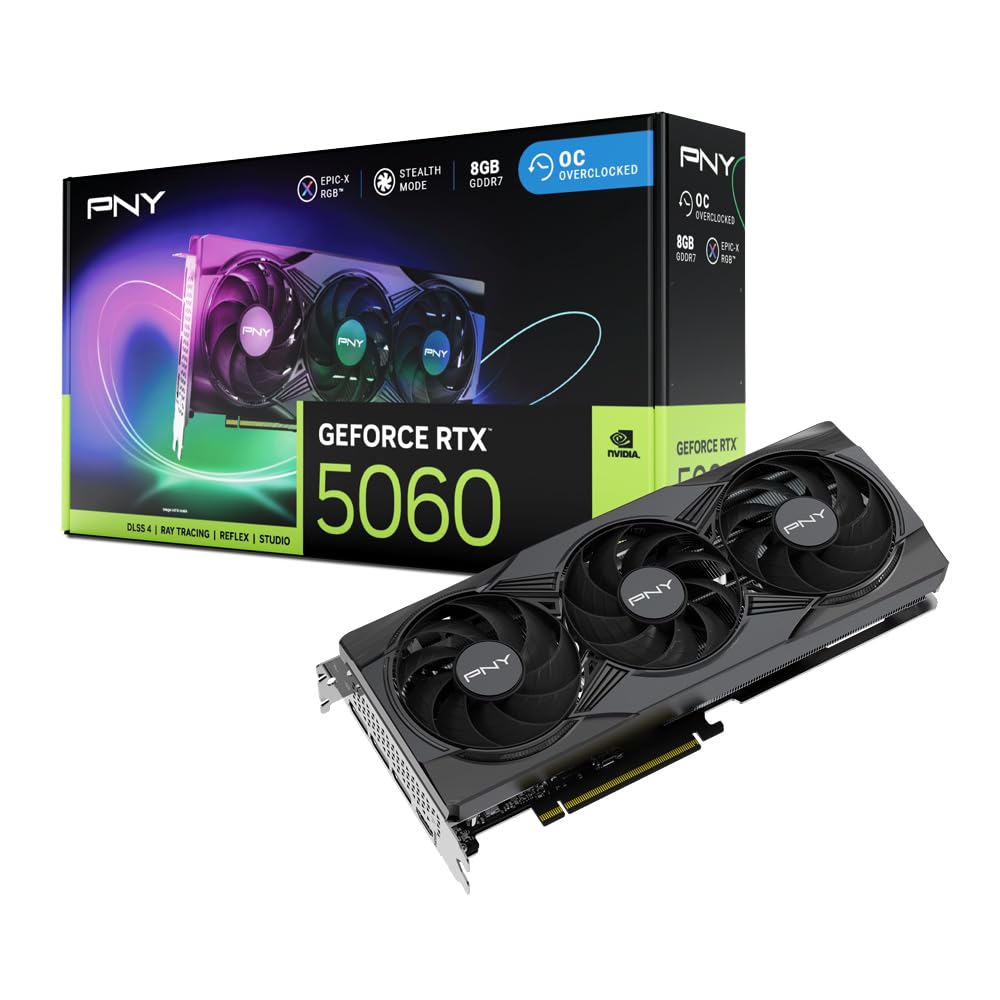
PNY’s Epic-X ARGB brings triple-fan cooling to the RTX 5060 tier, which means this card runs remarkably cool and quiet even during extended gaming sessions at 1440p. The GDDR7 memory offers bandwidth that helps maintain smooth 1% lows even when the 8GB VRAM buffer is under pressure. It supports DLSS 4, which at 1440p provides a noticeable image quality improvement over earlier upscaling versions, especially in titles that rely heavily on temporal reconstruction.
Users report hitting 100+ FPS on high settings in most competitive titles and solid 60-80 FPS in demanding single-player games with DLSS enabled. The ARGB lighting adds visual flair without being overbearing, and the card’s dimensions fit comfortably in mid-tower cases. NVIDIA Reflex reduces system latency in competitive shooters, making this a strong choice for players who split time between single-player campaigns and multiplayer matches.
The triple-fan cooler adds cost without adding VRAM—at 8GB, this card will hit the same texture memory ceiling as every other RTX 5060 in this list. Users running mod-heavy games or high-resolution texture packs will need to manage settings carefully. The card is also PCIe 4.0 x8 electrically, so bandwidth-sensitive workloads may see a minor penalty compared to x16 designs.
Why it’s great
- Triple-fan design keeps thermals and noise very low
- DLSS 4 with Reflex for smooth competitive gaming
- GDDR7 memory improves 1% low frame rate consistency
Good to know
- 8GB VRAM is the ceiling for texture-heavy 1440p
- PCIe 4.0 x8 interface
5. MSI Gaming RTX 5060 8G Shadow 2X OC

MSI’s Shadow 2X OC distills the RTX 5060 experience into a clean, no-RGB dual-fan package that runs silently and efficiently. The TORX Fan 5.0 design with ring arc stabilization directs airflow straight to the nickel-plated copper baseplate, which users report keeps temps under 53°C in gaming loads—a significant improvement over the 70-75°C range of older cards like the RTX 3050. The card operates on a 150W TDP, often drawing closer to 100W in real-world gaming, making it a strong candidate for builds with limited PSU headroom.
At 1440p medium-high settings, this card delivers smooth frame rates in titles like Elden Ring and Witcher 3 without stutter. DLSS 4 provides a meaningful visual fidelity boost over earlier versions, and the GDDR7 memory bandwidth ensures the 8GB buffer is used efficiently. Users upgrading from older NVIDIA cards (GTX 10-series or RTX 20-series) will see roughly 2x performance improvement with better power efficiency. The card is SFF-ready, fitting easily into compact cases without sacrificing cooling.
The central compromise remains the 8GB VRAM—users running modern titles at 1440p ultra with ray tracing will run into memory limits, especially in open-world games. MSI’s cooler, while effective, doesn’t include a zero-RPM mode on all fan profiles, so the fans may spin at idle depending on your setup. For pure raster 1440p without RT, this is one of the most efficient and quiet options available.
Why it’s great
- Excellent power efficiency drawing under 100W in many titles
- Very quiet dual-fan cooler with stable sub-53°C temps
- DLSS 4 and Reflex for competitive edge
Good to know
- 8GB VRAM requires careful texture settings
- No zero-RPM idle fan mode on some BIOS profiles
6. ASUS Dual NVIDIA GeForce RTX 5060 8GB GDDR7 OC Edition

ASUS Dual RTX 5060 OC Edition clocks higher than most RTX 5060 variants at 2565 MHz (OC mode), powered by the NVIDIA Blackwell architecture with fifth-gen tensor cores and fourth-gen ray tracing cores. The Axial-tech fan design with a smaller hub and barrier ring creates higher downward air pressure, which users confirm keeps the card stable during extended sessions without aggressive fan curves. GDDR7 memory and PCIe 5.0 support deliver 623 AI TOPS for DLSS 4 processing.
Real-world performance at 1440p is strong—this card matches or beats last-gen RTX 2080 Ti and RTX 3070 rasterization levels while drawing just 150W. Users report 140+ FPS in Fortnite at high settings and smooth 60 FPS in story-driven titles with DLSS quality mode enabled. The compact dual-fan design (9 inches long) fits a wide range of cases, and the 3-year warranty from ASUS adds peace of mind. The card is also SFF-ready, which simplifies compatibility with small form factor builds.
The 8GB VRAM constraint applies here as with all RTX 5060s, but the higher memory bandwidth from GDDR7 helps the card handle texture-swapping more gracefully than GDDR6 designs. ASUS removed RGB lighting to keep the card affordable and focused on performance. Users upgrading from older hardware note that Display Driver Uninstaller (DDU) should be run before installation to avoid conflicts.
Why it’s great
- Highest stock boost clock among RTX 5060 cards in this list
- GDDR7 memory and PCIe 5.0 for future-ready bandwidth
- 3-year warranty with proven ASUS build quality
Good to know
- 8GB VRAM ceiling limits ultra texture settings at 1440p
- No RGB for buyers who want case lighting
7. GIGABYTE GeForce RTX 5060 WINDFORCE OC 8G

The GIGABYTE RTX 5060 WINDFORCE OC is the shortest RTX 5060 in this lineup at just 7.83 inches, making it ideal for tight cases or secondary gaming rigs where space is at a premium. Despite its compact size, the WINDFORCE dual-fan cooling system keeps temps in check, and users report the card runs quietly even during extended sessions. The 2512 MHz boost clock is slightly below the ASUS variant, but real-world performance differences are minor in most gaming scenarios.
Users running Ryzen 5700X builds with 750W PSUs report over 250 FPS in well-optimized esports titles and smooth performance in Cyberpunk and DOOM at 1440p high settings. DLSS 4 provides a noticeable image quality uplift in supported titles. The card works well for productivity tasks as well—photo and video editing at 1440p is smooth, and the card handles music production software without driver issues. The 128-bit GDDR7 memory interface ensures the bandwidth doesn’t bottleneck modern textures.
The 8GB VRAM is the primary limitation for heavy 1440p work—users running texture mods or AAA titles with ray tracing will need to adjust settings. The WINDFORCE cooler works effectively but lacks the zero-RPM mode found on higher-end GIGABYTE cards, meaning the fans may be audible at idle. For the price, this is a solid entry into the Blackwell ecosystem without overspending on features you don’t need.
Why it’s great
- Very compact at 7.83 inches for tight case fits
- DLSS 4 and GDDR7 memory in budget Blackwell package
- Works well for both gaming and creative productivity
Good to know
- Fan spins at idle—no zero-RPM mode on this card
- 8GB VRAM limits ultra texture fidelity at 1440p
8. XFX Speedster SWFT210 Radeon RX 7600 8GB

At 9.49 inches long with a dual-fan SWFT cooling solution, this card runs quietly and draws very little power, making it a viable upgrade for prebuilt PCs with limited PSU headroom. The 2655 MHz boost clock is competitive with previous-gen mid-range cards, and users report stable 60 FPS in 1440p high settings for most titles.
Customer reviews highlight the card’s strong Linux compatibility, with users reporting Arch Linux and Mint setups where all three display outputs worked immediately after installing Vulkan drivers. VR performance is solid for the price—Half-Life Alyx runs smoothly at higher settings, and Assetto Corsa handles perfectly at 1440p. The card runs cooler after proper driver updates, with users reporting mid-70s temperatures at 60% fan speed without crashes. It’s also a strong pick for emulators and indie games that don’t stress the VRAM buffer.
The 8GB GDDR6 buffer and 128-bit bus are the limiting factors here. Modern AAA titles at 1440p ultra will push the VRAM capacity quickly, requiring texture quality to be dialed back. The card also lacks ray tracing hardware capable of playable performance at this resolution—FSR support helps, but the native raster is the real draw. For budget builds where 1440p/60 is the target, this card delivers excellent dollar-per-frame value.
Why it’s great
- Low power draw works with older PSUs and prebuilts
- Excellent Linux support with plug-and-play DisplayPort
- Strong performance at 1440p/60 for non-RT gaming
Good to know
- 8GB GDDR6 is the minimum for modern 1440p
- Ray tracing performance is not usable at this resolution
9. ASRock AMD Radeon RX 6600 Challenger D 8GB

The ASRock Challenger D RX 6600 is the purest budget option here—it’s capable of 1440p gaming but primarily designed for high-refresh 1080p with occasional 1440p for less demanding titles. The RDNA 2 architecture with 8GB GDDR6 memory delivers stable 60+ FPS in esports and story-rich games at 1440p medium settings, and the dual-fan Challenger cooling runs quietly with zero-fan mode under light loads. At 10.59 inches, it’s longer than some newer cards but still fits most mid-tower cases.
Users report that after undervolting to 1100mV, the card runs significantly cooler and quieter while maintaining stable clocks around 2700-2900 MHz. Idle temperatures sit around 56°C, and under full load the card stays under 80°C even in warm ambient rooms. Performance is competitive with the GTX 1660 Ti and RTX 2060 in terms of raw raster, and the card excels at breathing new life into older Intel systems (like i7-3770K builds) where CPU bottlenecks limit what newer, faster GPUs can achieve.
The RX 6600 doesn’t support ray tracing at usable performance levels, and the 128-bit GDDR6 bus limits memory bandwidth compared to newer cards. For 1440p, this card is best suited for players who prioritize smooth frame rates in titles like World of Tanks, CS2, Rocket League, or older AAA games. Users playing modded Skyrim or Fallout 4 report stability with the 8GB buffer. If your goal is entry-level 1440p without spending more on the case or PSU, this card gets the job done.
Why it’s great
- Zero-RPM fan mode for silent idle operation
- Excellent undervolting headroom for lower temps
- Great for older system upgrades with limited PSU
Good to know
- Not compatible with all OEM prebuilt systems
- 1440p performance requires medium settings in modern titles
FAQ
Will 8GB VRAM be enough for 1440p gaming in 2025 and beyond?
Which is better for 1440p right now: DLSS 4 or FSR 4?
Can I run an RX 9060 XT or RTX 5060 on a 500W power supply?
Should I buy an RX 7600 now or wait for further price drops?
Final Thoughts: The Verdict
For most users, the budget gpu for 1440p gaming winner is the Sapphire Pulse RX 9060 XT 16GB because it offers the largest VRAM pool at the most competitive price, with quiet cooling and excellent Linux support. If you want DLSS 4 upscaling and GDDR7 bandwidth in a compact package, grab the MSI RTX 5060 Shadow 2X OC. And for the tightest small form factor 1440p build with 16GB of headroom, nothing beats the PowerColor Reaper RX 9060 XT 16GB.

Mo Maruf
I created WellFizz to bridge the gap between vague wellness advice and actionable solutions. My mission is simple: to decode the research and give you practical tools you can actually use.
Beyond the data, I am a passionate traveler. I believe that stepping away from the screen to explore new environments is essential for mental clarity and physical vitality.