Our readers keep the lights on and my smoothie glass nicely filled. As an Amazon Associate, I earn from qualifying purchases.
Building a 1080p gaming rig on a tight budget means every dollar spent on the graphics card must translate directly into visible frame rates. The market is flooded with older architectures, confusing model numbers, and tempting deals that look good on paper but stumble under real game loads—making it easy to waste money on a card that feels outdated within a year. The key is knowing which generation delivers the right balance of raster performance, VRAM capacity, and driver support without breaking your build budget.
I’m Mohammad Maruf — the founder and writer behind WellFizz. I’ve spent countless hours analyzing benchmark results, poring over spec sheets, and cross-referencing real user feedback to separate the genuine 1080p performers from the overhyped also-rans in this crowded price bracket.
This guide cuts through the noise to deliver a curated selection of cards that genuinely excel at 1920×1080, helping you build a system that plays modern titles smoothly without overspending. This is the definitive best budget gpu for 1080p research you need before clicking “buy.”
How To Choose The Best Budget GPU For 1080p
Selecting the right GPU for a budget 1080p build requires looking past the flashy marketing and focusing on a few hard metrics that determine real-world performance. Architecture generation, VRAM capacity, power draw, and software feature support all play a role in whether a card feels fast today and stays relevant tomorrow. Here are the critical factors to evaluate.
VRAM Capacity — 6GB vs 8GB at 1080p
For modern AAA titles at 1080p with medium-to-high textures, 6GB of VRAM is the absolute floor. Games like Hogwarts Legacy, The Last of Us Part I, and Call of Duty: Modern Warfare III routinely exceed 5GB of video memory usage at reasonable settings. An 8GB card gives you headroom for texture quality, future-proofing, and prevents stuttering when assets need to swap in and out of system RAM. Between two similarly priced cards, choose the one with 8GB every time.
Architecture Generation — RDNA, Ampere, and Blackwell
A newer architecture brings efficiency gains, better driver optimization pipelines, and access to modern upscaling technologies. AMD’s RDNA 3 (RX 7600 series) and NVIDIA’s Ampere (RTX 3050) and Blackwell (RTX 5060) offer hardware-accelerated ray tracing and superior power efficiency compared to the Polaris and Pascal generations. An older card like the RX 580 (Polaris) can still game, but it lacks feature support for DirectX 12 Ultimate and consumes more power for the same performance level as a modern entry-level card.
Power Connectors and PSU Requirements
Budget builds often use older or lower-wattage power supplies. Cards that pull power solely through the PCIe slot (75W maximum) are ideal for pre-built office PCs with weak PSUs. Most dedicated gaming GPUs in this price range require a single 6-pin or 8-pin PCIe power connector. Verify your power supply has the necessary cable before purchasing. A card requesting 185W (like the RX 580) may require a PSU upgrade, adding hidden cost to your budget.
Upscaling and Software Ecosystem
At the budget end of 1080p gaming, upscaling technologies like AMD FidelityFX Super Resolution (FSR) and NVIDIA DLSS are not just nice-to-haves — they can mean the difference between a playable 40 FPS and a smooth 60 FPS in demanding scenes. FSR works on nearly any GPU, while DLSS is exclusive to NVIDIA RTX cards. For a budget card that you plan to keep for multiple years, DLSS support provides a meaningful longevity advantage.
Quick Comparison
On smaller screens, swipe sideways to see the full table.
| Model | Category | Best For | Key Spec | Amazon |
|---|---|---|---|---|
| ASUS RTX 5060 8GB | Premium | Future-proof 1080p with DLSS 4 | 8GB GDDR7 / PCIe 5.0 | Amazon |
| ASRock RX 7600 8GB | Mid-Range | Silent 1080p with RDNA 3 efficiency | 8GB GDDR6 / 2695 MHz Boost | Amazon |
| XFX Speedster RX 7600 | Mid-Range | VR-ready 1080p with dual fan cooling | 8GB GDDR6 / 2655 MHz Boost | Amazon |
| maxsun RTX 3050 6GB | Mid-Range | SFF / low-profile builds | 6GB GDDR6 / 1470 MHz Boost | Amazon |
| MSI RTX 3050 LP 6GB | Mid-Range | Quiet SFF with no extra power needed | 6GB GDDR6 / 1492 MHz Boost | Amazon |
| ZER-LON GTX 1660 Super | Budget | Stable classic 1080p with VR support | 6GB GDDR6 / 1530 MHz Core | Amazon |
| AISURIX RX 5500 8GB | Budget | Low power 1080p with 8GB GDDR6 | 8GB GDDR6 / 1750 MHz Memory | Amazon |
| Kelinx AISURIX RX 580 | Budget | Entry-level 1080p with 8GB VRAM | 8GB GDDR5 / 1750 MHz Memory | Amazon |
| MOUGOL RX 580 8GB | Budget | Ultra-budget 1080p with 256-bit bus | 8GB GDDR5 / 1206 MHz Core | Amazon |
In‑Depth Reviews
1. ASUS Dual NVIDIA GeForce RTX 5060 8GB GDDR7 OC Edition

The ASUS RTX 5060 sits at the upper edge of the budget category, but its Blackwell architecture and GDDR7 memory deliver a generational leap that justifies the stretch. With 8GB of VRAM running on a 128-bit interface and boosted by the memory bandwidth of GDDR7, this card handles 1080p ultra settings in demanding titles while sipping only 150W of power. The included DLSS 4 support provides frame generation and ray reconstruction that pushes playable frame rates well beyond the card’s raw raster performance, giving it longevity that older architectures cannot match.
The dual-fan Axial-tech design with 0dB technology keeps the card inaudible during desktop use and remains quiet even under sustained gaming load. At 9 inches long, it fits comfortably in most mid-tower cases, and the SFF-ready designation means it can slot into smaller builds without clearance issues. Early user reports confirm stable 140 FPS in titles like Fortnite at 1080p high settings, with excellent compatibility on older systems thanks to PCIe 5.0 backward compatibility.
For the budget-focused builder who wants a card that will still feel modern three years from now, the RTX 5060 represents the smartest long-term investment in this roundup. The 8GB GDDR7 buffer handles texture-heavy games without the VRAM bottleneck that plagues 6GB cards, and DLSS 4 gives you an upgrade path for future titles without a hardware swap. It costs more than entry-level options, but the performance-per-watt and feature set make it the true value leader when measured by years of service.
Why it’s great
- GDDR7 memory delivers significantly higher bandwidth than GDDR6 equivalents
- DLSS 4 provides frame generation for smoother 1080p gaming
- Extremely power-efficient at 150W TDP with cool thermals
- Compact SFF-friendly design fits in smaller cases
Good to know
- Premium price point compared to last-gen budget cards
- 8GB VRAM may limit ultra textures at 1440p in future titles
- Requires a PCIe 5.0-compatible motherboard for full bandwidth utilization
- No RGB lighting for users who prefer minimal aesthetics
2. ASRock Radeon RX 7600 Challenger 8GB OC
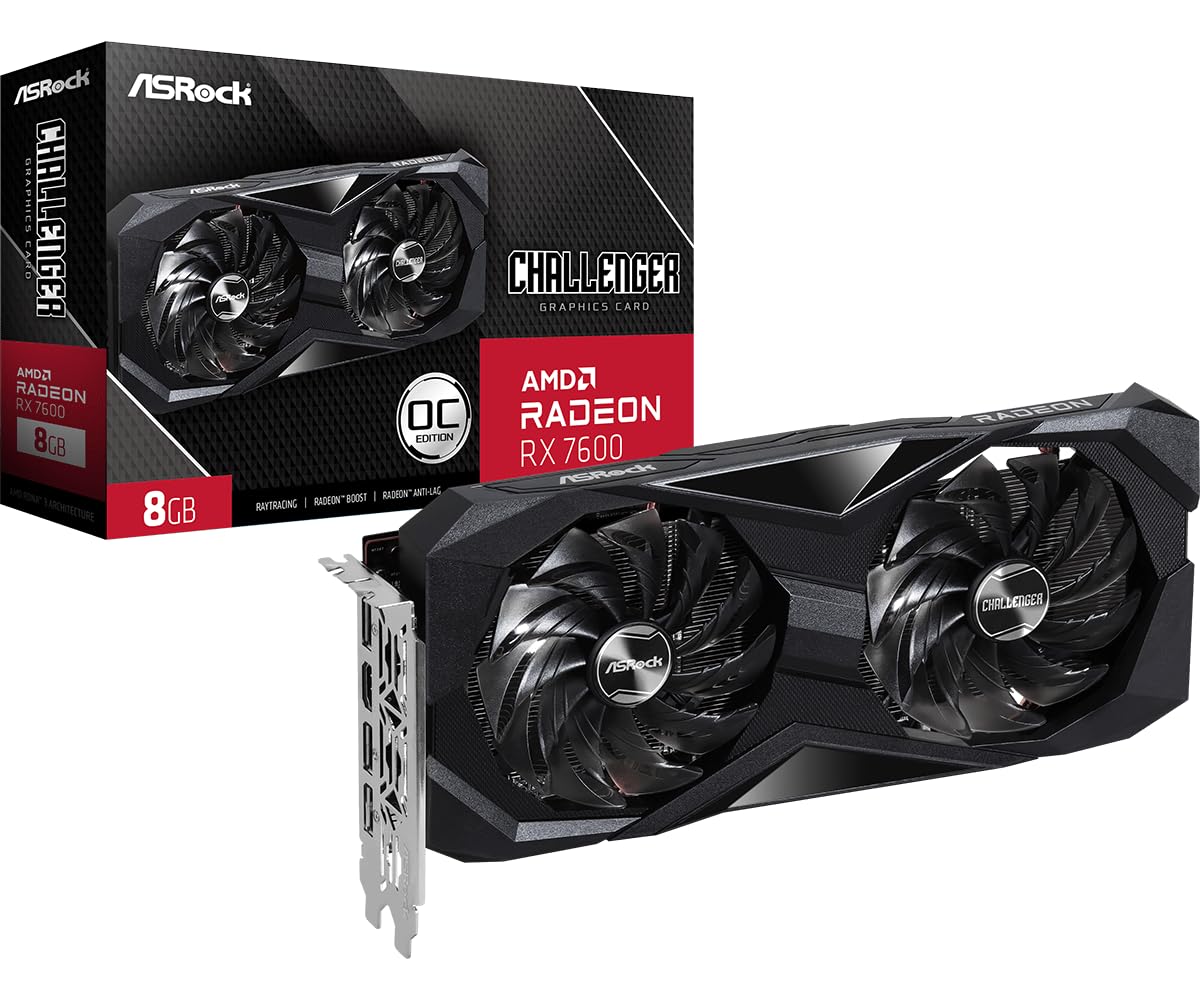
The ASRock RX 7600 Challenger hits a sweet spot for 1080p gaming with RDNA 3 architecture that brings improved efficiency and hardware-accelerated ray tracing to the budget segment. Its 2048 stream processors and boost clock up to 2695 MHz deliver consistent 60+ FPS in AAA titles at high settings, with the 8GB GDDR6 buffer preventing the VRAM-related stutter that can ruin immersion. The 0dB Silent Cooling feature stops fans completely during light loads, making this one of the quietest options in its class for desktop use and web browsing.
The dual-fan striped axial design and ultra-fit heatpipe keep temperatures under control, with users reporting idle temps around 32-36°C and full-load temps staying below 80°C even in cases with modest airflow. The metal backplate adds structural rigidity and a clean aesthetic, while the PCIe 4.0 x8 interface provides ample bandwidth for 1080p gaming without bottleneck concerns on modern motherboards. Setup is straightforward with a single 8-pin power connector and a recommended 550W PSU.
For the builder who prioritizes a quiet system without sacrificing gaming performance, the RX 7600 Challenger is a compelling choice. AMD’s FSR upscaling extends its usability in newer titles, and the 8GB VRAM ensures compatibility with current-generation game requirements. It performs admirably across a wide range of popular titles including Fortnite, Call of Duty, and Baldur’s Gate 3, making it a versatile workhorse that won’t annoy you with fan noise during non-gaming hours.
Why it’s great
- 0dB fan stop makes it completely silent at idle and light loads
- RDNA 3 architecture brings strong efficiency and modern feature support
- 8GB GDDR6 at 18 Gbps provides excellent memory bandwidth
- Metal backplate adds durability and premium feel
Good to know
- PCIe 4.0 x8 interface may limit performance on PCIe 3.0 motherboards
- Ray tracing performance is modest compared to NVIDIA equivalents
- Requires a 550W power supply minimum
- Dual-slot design at 269mm may not fit in ultra-compact cases
3. XFX Speedster SWFT210 Radeon RX 7600 8GB

The XFX Speedster SWFT210 brings a familiar RDNA 3 recipe with a focus on VR performance and stable drivers across both Windows and Linux. Users upgrading from older GPUs like the GTX 1650 Super report massive gains in VR titles such as Half-Life Alyx, Assetto Corsa, and Project Cars 2, with smooth frame rates at the highest settings. The dual-fan SWFT cooling solution keeps the card running in the upper 70s under load after a driver update, with a max fan speed of around 60% for a balance of cooling and noise.
With 8GB of GDDR6 memory clocked at 17.5 GHz and a boost clock up to 2655 MHz, this card handles 1080p and 1440p/60 gaming with confidence. The compact design works well in smaller cases, and Linux users appreciate the seamless swap from Nvidia cards thanks to open-source AMD drivers and Mesa support. The card draws power from a single 8-pin connector and works with a 550W PSU, making it compatible with a wide range of budget builds.
XFX has a strong reputation for solid build quality, and the SWFT210 delivers a clean, no-nonsense design without unnecessary frills. The card is a particularly strong choice for VR enthusiasts on a budget who need consistent frame pacing and driver stability. While it doesn’t push the absolute highest clock speeds in the RX 7600 lineup, its real-world game performance and thermal behavior make it a reliable workhorse for years of 1080p gaming.
Why it’s great
- Excellent VR performance with stable frame pacing in demanding titles
- Strong Linux support with plug-and-play AMD drivers
- Compact size fits most mid-tower and smaller cases
- Good thermals after driver updates with quiet fan operation
Good to know
- Initial users reported high temps before driver updates were applied
- No RGB lighting for those who prefer customizable aesthetics
- Essentially identical performance to other RX 7600 cards
- Requires at least a 550W power supply
4. maxsun GeForce RTX 3050 6GB Low Profile

The maxsun RTX 3050 6GB is built specifically for small form factor (SFF) and low-profile builds, measuring just 6.65 x 2.71 inches and drawing all its power from the PCIe slot. This makes it an ideal drop-in upgrade for Dell Optiplex, HP ProDesk, and other office PCs that lack dedicated PCIe power cables. The Ampere architecture brings DLSS support to the budget segment, allowing playable frame rates in modern titles at 1080p with the upscaling advantage intact.
With 6GB of GDDR6 memory on a 96-bit interface, the card is VRAM-limited in the most demanding games but handles esports titles like Fortnite, Warzone, and Arc Raiders comfortably at 1080p medium settings. The single fan runs audibly under load, which is expected given the compact form factor and passive cooling constraints of SFF cases, but the card stays within thermal limits even in constrained environments. Users report successful use in Solidworks and 3D design work with registry tweaks for real view support.
For anyone building a compact HTPC, office gaming rig, or upgrading a pre-built SFF system without PSU changes, this card is the most powerful option that doesn’t require external power. The included low-profile bracket makes installation straightforward, and the PCIe 4.0 interface ensures compatibility with modern motherboards. It’s a niche product, but within that niche it has no direct competition at this feature level.
Why it’s great
- No external power needed — runs entirely on PCIe slot power
- Ultra-compact low-profile design fits Dell Optiplex and similar SFF cases
- DLSS support provides playable frame rates in demanding titles
- Works with 3D design software like Solidworks with registry tweaks
Good to know
- 6GB VRAM is a limitation for modern AAA games at high textures
- Single fan runs audibly under gaming load
- 96-bit memory interface constrains memory bandwidth
- Runs hot in SFF cases without additional case fan modifications
5. msi Gaming RTX 3050 LP 6G OC

The MSI RTX 3050 LP 6G OC is another low-profile contender, but it differentiates itself with MSI’s Twin Frozr cooling technology and Zero Frozr fan stop. The dual fans mean better thermal performance and lower noise under load compared to single-fan SFF cards, while still fitting within the constraints of a low-profile bracket. With a boost clock of 1492 MHz and 6GB of GDDR6, it handles 1080p gaming at medium-high settings with DLSS Quality mode engaged for titles that support it.
The card draws its power solely from the PCIe slot, eliminating the need for PSU cable management in tight cases. Users have successfully installed this card in Dell Inspiron 3471 SFF units and HP desktops without any modifications, reporting GPU temps around 78°C under sustained load. The Zero Frozr feature stops the fans completely at idle, making this one of the quieter options for SFF office machines that double as gaming rigs after hours.
Ray tracing performance is modest on the RTX 3050, requiring settings to be lowered for playable frame rates in RT-enabled titles, but the DLSS implementation helps bridge the gap. For budget builders looking at a low-profile card with good cooling and a trusted brand name, the MSI LP variant offers a quieter experience than most competitors in the same form factor. The RGB lighting on the card is a nice touch for those who want a bit of visual flair in their SFF build.
Why it’s great
- Twin Frozr cooling with Zero Frozr fan stop for quiet operation
- No extra power cable needed — ideal for pre-built upgrades
- Low-profile bracket included for SFF compatibility
- Good thermals at ~78°C under sustained gaming load
Good to know
- 6GB VRAM limits texture quality in newer AAA games
- Ray tracing performance requires significant settings compromises
- One user reported intermittent fan clatter on startup
- Not suitable for 1440p gaming at high settings
6. ZER-LON GeForce GTX 1660 Super 6GB

The GTX 1660 Super remains a benchmark in the budget GPU conversation for good reason — it delivers reliable 1080p performance without the complexity of ray tracing or the higher price of RTX branding. The ZER-LON implementation features 6GB of GDDR6 memory on a 192-bit interface, which provides better memory bandwidth than many newer budget cards with narrower buses. The 1530 MHz core clock with boost capabilities handles modern titles at high settings with consistent frame rates.
The dual-fan cooling system with composite heat pipes keeps thermals in check, and the card supports up to 8K display output through its HDMI, DisplayPort, and DVI ports. Users upgrading from older cards like the GTX 1060 report significant gains in game smoothness, with the card handling Plex transcoding, multi-monitor setups, and VR applications without issue. The 120W power draw is manageable with a single 8-pin connector, making it compatible with most budget power supplies.
The main trade-off is the lack of DLSS support, which means the GTX 1660 Super relies entirely on raw rasterization performance. In titles that heavily lean on upscaling, it will fall behind RTX 3050 cards of similar price. However, for users who prioritize native resolution gaming and don’t care about ray tracing, the 1660 Super’s tried-and-true Turing architecture offers stable, proven performance that still feels fast in 2025 for 1080p gaming.
Why it’s great
- Proven Turing architecture with stable, mature drivers
- 192-bit memory bus provides solid bandwidth for 1080p textures
- Supports VR gaming with NVIDIA VRWorks
- Low power draw at 120W with good thermal management
Good to know
- No DLSS or ray tracing support limits future-proofing
- 6GB VRAM can be a bottleneck in newer texture-heavy games
- ZER-LON packaging lacks included accessories like driver disks
- Older architecture lacks DirectX 12 Ultimate feature support
7. AISURIX RX 5500 8GB GDDR6

The AISURIX RX 5500 brings RDNA architecture and 8GB of GDDR6 memory to a price point where most competitors offer only 4GB or 6GB. This VRAM advantage is significant for texture-heavy games at 1080p, as the extra 2GB over similarly priced cards prevents the stuttering and texture pop-in that occurs when video memory fills up. The card features three DisplayPort outputs and one HDMI 2.0b, supporting up to 4 displays with resolutions up to 7680×4320.
The 130W power draw is managed through a single 8-pin connector, and the semi-automatic intelligent fan system stops the fans entirely at low GPU temperatures for silent office use. Composite heat pipes directly contact the GPU core for efficient heat transfer, with users reporting idle temps around 32-36°C and full-load temps under 60°C in well-ventilated cases. The card delivers smooth 60 FPS at medium-high settings in titles like Resident Evil 4 remake at 1080p.
Quality control is a concern with this model, as some users report receiving units with bent PCBs or defective DisplayPorts. The card’s performance when working correctly is impressive for the price, but buyers should consider extended warranty options given the mixed reliability feedback. For budget builders who prioritize VRAM quantity above all else and are comfortable with potential returns, the RX 5500 offers the best memory-to-price ratio in the entry-level segment.
Why it’s great
- 8GB GDDR6 at a budget-friendly price point is rare
- Silent fan-stop feature for quiet operation at idle
- Low power draw at 130W with excellent temps under load
- Supports high-resolution multi-monitor setups
Good to know
- Quality control issues reported including bent cards and dead ports
- RDNA 1 architecture lacks modern feature set of RDNA 3
- Limited driver support lifespan compared to newer GPUs
- Fan curve has all-or-nothing behavior at minimum speed
8. Kelinx AISURIX RX 580 2048SP 8GB

The Kelinx AISURIX RX 580 is a modern take on the Polaris architecture that defined budget gaming for years, packing 8GB of GDDR5 memory on a 256-bit bus that provides generous memory bandwidth for 1080p textures. The 2048 stream processors and 1750 MHz memory clock deliver playable frame rates in current esports titles like Fortnite, Valorant, and Apex Legends, as well as older AAA games. The dual-fan cooling system with semi-automatic intelligent fan stop keeps noise down during light use.
The card supports up to 4K display output through its dual DisplayPort and single HDMI connections, making it suitable for media consumption and productivity tasks beyond gaming. Installation is straightforward with a single 8-pin power connector, and the 185W power draw is manageable with a quality 500W PSU. Linux users report good compatibility out of the box, with the card working well in KVM setups and streaming applications.
The RX 580’s age shows in its lack of DirectX 12 Ultimate features, no hardware ray tracing, and higher power consumption compared to newer architectures. User reviews note occasional instability in demanding AAA games, with some units failing within the first week. At this price, the card offers the most VRAM per dollar, but the reliability and driver support risks make it a calculated gamble best suited for users who understand the limitations of decade-old GPU architecture.
Why it’s great
- 8GB VRAM with 256-bit bus for excellent memory bandwidth
- Works well with Linux and KVM virtualization setups
- Fan stop feature for silent operation at idle
- Good performance in esports titles at 1080p
Good to know
- Polaris architecture lacks modern features like ray tracing and DLSS
- Higher power draw at 185W than newer budget cards
- Some units reported as DOA or failing within days
- Can struggle with frame rate stability in demanding AAA games
9. MOUGOL AMD Radeon RX 580 8GB
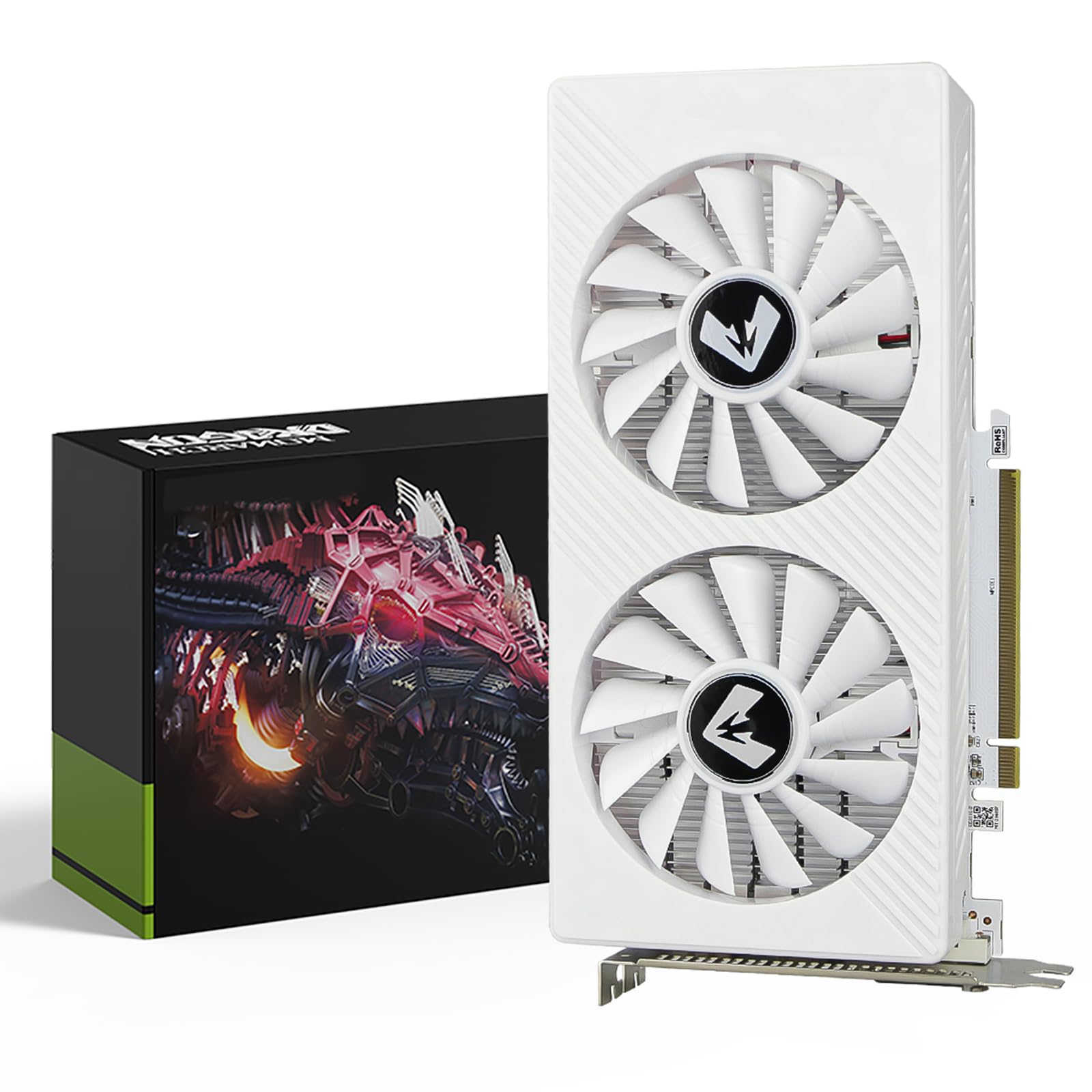
The MOUGOL RX 580 is the absolute entry point for 1080p gaming with 8GB of VRAM, offering the same Polaris architecture that has powered budget builds for years at a price that undercuts nearly every competitor. The 1206 MHz core clock and 2048 stream processors deliver baseline 1080p performance in Fortnite, GTA V, and Valorant, with the 8GB GDDR5 buffer ensuring that texture quality doesn’t need to be dropped to low. The dual-fan cooling system and durable backplate provide adequate thermal management for a card of this era.
The compact 240x135x45mm form factor fits in standard ATX and micro-ATX cases, and the card supports triple-monitor setups through its HDMI, DisplayPort, and DVI outputs. Users upgrading from integrated graphics or very old cards report significant improvements in game smoothness, with surprisingly quiet operation under load. The card works with AMD Adrenaline software for driver management and game optimization, and supports DirectX 12 and Vulkan for modern game compatibility.
At this price floor, compromises are expected. The Polaris architecture has no hardware ray tracing, no DLSS or FSR support (FSR works via software but with less efficiency), and the 14nm process means higher power consumption than modern alternatives. The outer housing has been described as feeling cheap, and while most units work fine, the budget manufacturing may affect long-term reliability. This card is best suited for the most constrained budgets where any 8GB VRAM GPU is a massive upgrade from integrated graphics.
Why it’s great
- Lowest price entry point for 8GB VRAM at 1080p
- Dual-fan cooling with quiet operation under load
- Compact size fits smaller cases easily
- Works in both Windows and Linux with good driver support
Good to know
- Polaris architecture is outdated with no modern feature support
- Higher power draw than newer budget cards at 185W
- Build quality feels inexpensive compared to brand-name cards
- Performance is limited in modern demanding AAA titles
FAQ
Can a budget GPU really handle modern AAA games at 1080p?
Is 6GB of VRAM enough for 1080p gaming in 2025?
Should I buy an older high-end card or a newer budget card?
Does PCIe generation matter for budget 1080p GPUs?
Final Thoughts: The Verdict
For most users, the best budget gpu for 1080p winner is the ASUS RTX 5060 8GB because it delivers Blackwell architecture, GDDR7 memory, and DLSS 4 support at a price that will keep it relevant for years of 1080p gaming. If you want silent operation with excellent efficiency, grab the ASRock RX 7600 Challenger. And for the tightest budgets where every dollar counts, the MOUGOL RX 580 8GB offers the most VRAM for the lowest price, though you accept older architecture and higher power consumption in exchange.

Mo Maruf
I created WellFizz to bridge the gap between vague wellness advice and actionable solutions. My mission is simple: to decode the research and give you practical tools you can actually use.
Beyond the data, I am a passionate traveler. I believe that stepping away from the screen to explore new environments is essential for mental clarity and physical vitality.