Our readers keep the lights on and my smoothie glass nicely filled. As an Amazon Associate, I earn from qualifying purchases.
That moment your phone screen goes black at mile six, with no service bars and a fading charge, is the exact reason dedicated hiking GPS units exist. Unlike a smartphone that chews through battery hunting for a signal it will never find, a purpose-built handheld uses satellite constellations designed for remote positioning and sips power measured in days, not hours. The category split is clear: do you need an emergency beacon to call for help, a land surveyor’s meter for measuring acreage, or a navigation tool to follow a trail and mark waypoints for the return trip?
I’m Mohammad Maruf — the founder and writer behind WellFizz. For years, I’ve analyzed GPS receiver sensitivity, battery endurance under continuous tracking, and the real-world durability of buttons and seals that determine whether a device survives a drop on a rocky ridgeline.
Across every price tier, the underlying question remains the same: how much positional accuracy and mapping complexity do you actually need for the terrain you walk? This guide breaks down nine distinct options to help you find the setup that matches your pack weight and your risk tolerance, delivering a clear verdict on the best budget gps for hiking.
How To Choose The Best Budget GPS For Hiking
A capable hiking GPS does not need to cost north of three hundred dollars, but it does need to solve a specific problem you will actually face on the trail. Pinpointing the right unit means separating the features that keep you safe and on course from the specs that just look good on a box.
Satellite Lock and Signal Reliability
The fundamental job of any GPS is to hold a position fix, and that depends on how many satellite constellations the receiver can access. A unit limited to GPS alone will struggle in a canyon or under dense pine cover, while multi-GNSS support that adds GLONASS, Galileo, BeiDou, or QZSS gives the receiver more birds to lock onto. Look for a receiver that can see at least three constellations; the positional drift matters less on an open fire road and a great deal more when the trail disappears into a boulder field.
Battery Endurance and Power Source
Battery life claims vary wildly between “standard mode,” which assumes intermittent use, and “expedition mode,” which stretches time by sampling position less frequently. For a multiday trip, a device that runs on standard AA alkaline or lithium cells is a tactical advantage because you can carry spares without worrying about a proprietary charging cable. Rechargeable lithium packs are convenient for day hikes, but if the USB port fails or you forget the cord, that device becomes a brick. A practical budget hiking GPS should deliver at least 20 hours of continuous tracking on a single charge or set of batteries.
Map Detail and Navigation Logic
Not every budget GPS comes with a basemap that shows trails and roads. Some units are coordinate trackers that display lat/long and a compass bearing but no cartography. If you need to follow a specific trail without pulling out a paper map, a device preloaded with topo maps or capable of accepting a microSD card with map data is essential. Units that pair with a phone app can use the phone’s larger screen for mapping while the GPS handles the satellite lock, which is a compromise that works well as long as the app stays functional.
Durability and Interface Design
A hiking GPS will take rain, drops onto granite, and gloved fingers poking at buttons. An IPX7 water-resistance rating means the unit can survive submersion in one meter of water for 30 minutes, which is the minimum standard for a device you might cross a stream with. Physical buttons with tactile feedback are vastly more reliable than a touchscreen that smudges and fails in a downpour. The screen should be a transflective or sunlight-readable LCD that stays visible without cranking the backlight to max, saving battery in the process.
Quick Comparison
On smaller screens, swipe sideways to see the full table.
| Model | Category | Best For | Key Spec | Amazon |
|---|---|---|---|---|
| Garmin eTrex SE | Navigator | All-day tracking with phone pairing | 168 hrs standard / 1800 hrs expedition | Amazon |
| Garmin eTrex 22x | Navigator | Preloaded topo maps and routeable trails | 25 hrs GPS mode, 8 GB internal | Amazon |
| Garmin GPSMAP 64sx | Navigator | Off-trail use with quad helix antenna | 16 hrs, multi-GNSS + Galileo | Amazon |
| Spot Gen 4 | Messenger | SOS beacon and one-way check-in | Globalstar satellite, SOS button | Amazon |
| Bushnell BackTrack Mini | Retrace | Point-to-point return to trailhead | 35 hrs, Bluetooth phone sync | Amazon |
| NiesahYan A6 | Tracker | Lightweight track recording without maps | 20 hrs USB-C, 4 satellite support | Amazon |
| NiesahYan 3.2″ | Navigator | USA topo maps on a large screen | 36 hrs, 32 GB, 3-axis compass | Amazon |
| YuisyNie ZL660 | Surveyor | Large-area land measurement | 48 hrs, 6 satellites, area error <0.002 ac | Amazon |
| NiesahYan ZL180 | Surveyor | Entry-level property area measuring | GPS + GLONASS, area error 0.003 ac | Amazon |
In‑Depth Reviews
1. Garmin eTrex SE

The eTrex SE delivers the longest battery endurance in this roundup, running up to 168 hours in standard mode and an extraordinary 1,800 hours in expedition mode on two AA batteries. That figure is not a marketing gimmick — expedition mode polls the satellites at a slower interval, which is perfectly adequate for recording a track log over multiple days without draining cells. Multi-GNSS support across GPS, GLONASS, Galileo, BeiDou, and QZSS gives it a reliable lock even in the kind of mixed canopy cover you find on Appalachian ridges.
The 2.2-inch sunlight-readable display is small but crisp, and the transflective LCD stays legible without cranking the backlight to full brightness. Pairing with the Garmin Explore app on an Android or iPhone unlocks wireless software updates, trip planning, Active Weather, and smart notifications. Geocaching Live pushes cache updates automatically when paired, which matters if that hobby is part of your trail routine. The digital compass provides accurate bearing even when you are standing still, removing the need to walk a few steps to orient yourself.
The water-resistant IPX7 rating means it survives rain, stream splashes, and an accidental dunk in a puddle. No batteries are included, but AA cells are available at any gas station on the way to the trailhead. The center-press joystick button requires some finger pressure, and the menu logic has a small learning curve, but the device is small enough to clip to a backpack shoulder strap and forget about until you need to check your position. For a budget-tier unit that pairs reliability with ridiculously long runtime, this is the standard.
Why it’s great
- Exceptional 168-hour standard battery life on common AA batteries
- Multi-GNSS (GPS + GLONASS + Galileo + BeiDou + QZSS) for reliable lock
- Bluetooth pairing with Garmin Explore app for maps and weather
Good to know
- Built-in basemap is basic; full mapping requires app pairing
- No barometric altimeter — elevation comes from GPS data only
- Joystick button requires firm press, not ideal for thick gloves
2. Garmin eTrex 22x

The eTrex 22x bridges the gap between a pure tracker and a full navigation system by shipping with Topo Active maps preloaded. These maps include routable roads and trails for cycling and hiking, which means you can see the actual path on the 2.2-inch sunlight-readable color display rather than just a coordinate grid. The 240 x 320 pixel resolution is adequate for trail-level detail, and the 8 GB of internal memory allows additional map downloads, supplemented by a microSD card slot that accepts cards up to 32 GB.
Support for GPS and GLONASS satellite systems gives it a tracking advantage over single-constellation units, and the satellite acquisition is noticeably faster than older Garmin models. Battery life is rated at 25 hours in GPS mode from two AA batteries, which is solid for a device that is actively rendering map tiles. The button interface, while lacking a touchscreen, is familiar to anyone who has used a Garmin handheld in the past two decades — the page and enter keys let you navigate menus without swiping or tapping.
The IPX7 water resistance and the ruggedized casing protect against rain, dust, and drops onto rocky soil. The form factor fits easily into a bib pocket or the side pouch of a hiking pack. It is not a touchscreen, but that is a benefit when your fingers are wet or muddy. The learning curve for navigating the menu system is moderate, and the lack of a built-in compass means you will need to be moving for the GPS to determine heading. For hikers who want a dedicated map screen without relying on a phone app, the 22x is a strong mid-range contender.
Why it’s great
- Preloaded Topo Active maps with routable trails and roads
- 8 GB internal memory plus microSD expansion for more maps
- Rugged IPX7 construction with physical buttons for wet conditions
Good to know
- Battery life of 25 hours is shorter than the eTrex SE
- No barometric altimeter or electronic compass
- AA batteries not included in the box
3. Garmin GPSMAP 64sx

The GPSMAP 64sx is the premium unit in this roundup, distinguished by a quad helix antenna that provides significantly better signal reception under heavy tree cover and in steep terrain than the patch antennas found in the eTrex line. That antenna pairs with multi-GNSS support for GPS, GLONASS, and Galileo, giving the receiver more satellites to track in challenging environments. The 2.6-inch sunlight-readable color display is the largest among the Garmin units here, and it ships preloaded with Topo Active maps for the US and Australia that include routable roads and trails.
Unlike the eTrex models, the 64sx includes a 3-axis compass with barometric altimeter, which means the device shows accurate heading and elevation even when stationary. This matters for off-trail navigation where you need to orient yourself without walking a few paces. Wireless connectivity via Bluetooth and ANT+ allows pairing with heart rate monitors, temperature sensors, and the Garmin Explore app for trip planning and data transfer. The button-operated interface is waterproof and glove-friendly, with a dedicated joystick for panning across the map.
Battery life is rated at 16 hours in GPS mode from two AA batteries, which is shorter than the eTrex SE but reasonable given the larger screen and the constant power draw of the quad helix antenna. The internal memory is limited, so loading additional maps will require a microSD card. The menu system is dense — users familiar with Garmin’s interface will feel at home, but newcomers should budget time to learn the workflow. For someone who regularly hikes below dense canopy or in steep canyon country, the superior antenna and altimeter justify the investment.
Why it’s great
- Quad helix antenna for superior signal in thick tree cover
- 3-axis compass and barometric altimeter for stationary heading and elevation
- Preloaded TopoActive maps with routable trails
Good to know
- 16-hour battery life is the shortest in this lineup
- Limited internal memory requires microSD for extra map data
- Premium price point pushes past strict budget territory
4. Spot Gen 4

The Spot Gen 4 is not a navigator — it is a one-way satellite messenger designed for emergency communication when cellular coverage is absent. It uses the Globalstar satellite network to send pre-programmed check-in messages and GPS coordinates to a list of contacts, and it includes a dedicated SOS button that alerts emergency responders with your location. For solo hikers or those venturing into areas where a broken ankle could mean hours before anyone notices, this device fills a critical safety gap that no navigation GPS can address.
The device weighs just 142 grams and comes with a carabiner for clipping to a pack strap or belt loop. The four-button interface is simple: check-in, custom message, SOS, and tracking. There is no map display and no route guidance; the Gen 4 transmits location data but does not show you a trail. Battery life depends on the tracking interval — at the default 10-minute ping, AA batteries last for several days of continuous use. The magnetic button design is an improvement over older Spot models, and the firmware update process, while requiring a screwdriver to access the battery compartment, is manageable.
A mandatory subscription activates the service, and the cost varies depending on whether you want basic check-in or added tracking features. That recurring fee is a factor that does not apply to pure GPS receivers. Some users report the device powers off after an hour of inactivity, requiring a manual restart to resume tracking. For the hiker whose primary concern is being found in an emergency, the Gen 4 is the right tool; for anyone who needs to navigate a trail system, a standard GPS navigator is a better fit.
Why it’s great
- Dedicated SOS button sends GPS coordinates to emergency responders
- Lightweight and compact with carabiner attachment
- Globalstar satellite works beyond cell tower range
Good to know
- Requires an ongoing subscription for service
- No map display or navigation functions
- Device may power off automatically after inactivity
5. Bushnell BackTrack Mini

The BackTrack Mini is a minimalist retrace tool designed for one job: get you back to where you started. It captures a waypoint at the trailhead and then shows direction and distance back to that point, using a simple arrow on the LCD screen. There are no topo maps, no route planning, and no satellite messaging — the interface shows bearing, distance, elevation gain and decline, barometric pressure, and sunrise/sunset times. For day hikers who stick to established trails and just want insurance against taking a wrong fork, that simplicity is a feature, not a flaw.
The display is readable in sunlight, and the large, glove-friendly buttons are a genuine advantage when your hands are cold or wet. Bluetooth pairing with the Bushnell Connect app allows you to view and sync trips and waypoints on a smartphone, though the app has been flagged by some users as unreliable and slow to update. The rechargeable lithium battery runs up to 35 hours on a full charge and charges via Micro USB, an older connector that is increasingly rare on modern devices.
The unit is rugged and waterproof, and it comes with a carabiner and adapter plate for mounting on a pack strap. The buttons are stiff, requiring deliberate pressure, which prevents accidental presses but can be frustrating in quick use. Distance measurements have been reported to overestimate by up to 60 percent in some user tests, and elevation readings can be off by 200 feet or more. As a backup directional reference for a hiker who already carries a paper map, the BackTrack Mini works; as a primary navigation device, its limitations become apparent quickly.
Why it’s great
- Simple point-to-point arrow navigation for returning to trailhead
- 35-hour rechargeable battery with Micro USB charging
- Large buttons work well with gloves
Good to know
- No built-in maps — shows only bearing and distance
- Significant distance and elevation overestimation reported
- Bushnell Connect app has known reliability issues
6. NiesahYan A6
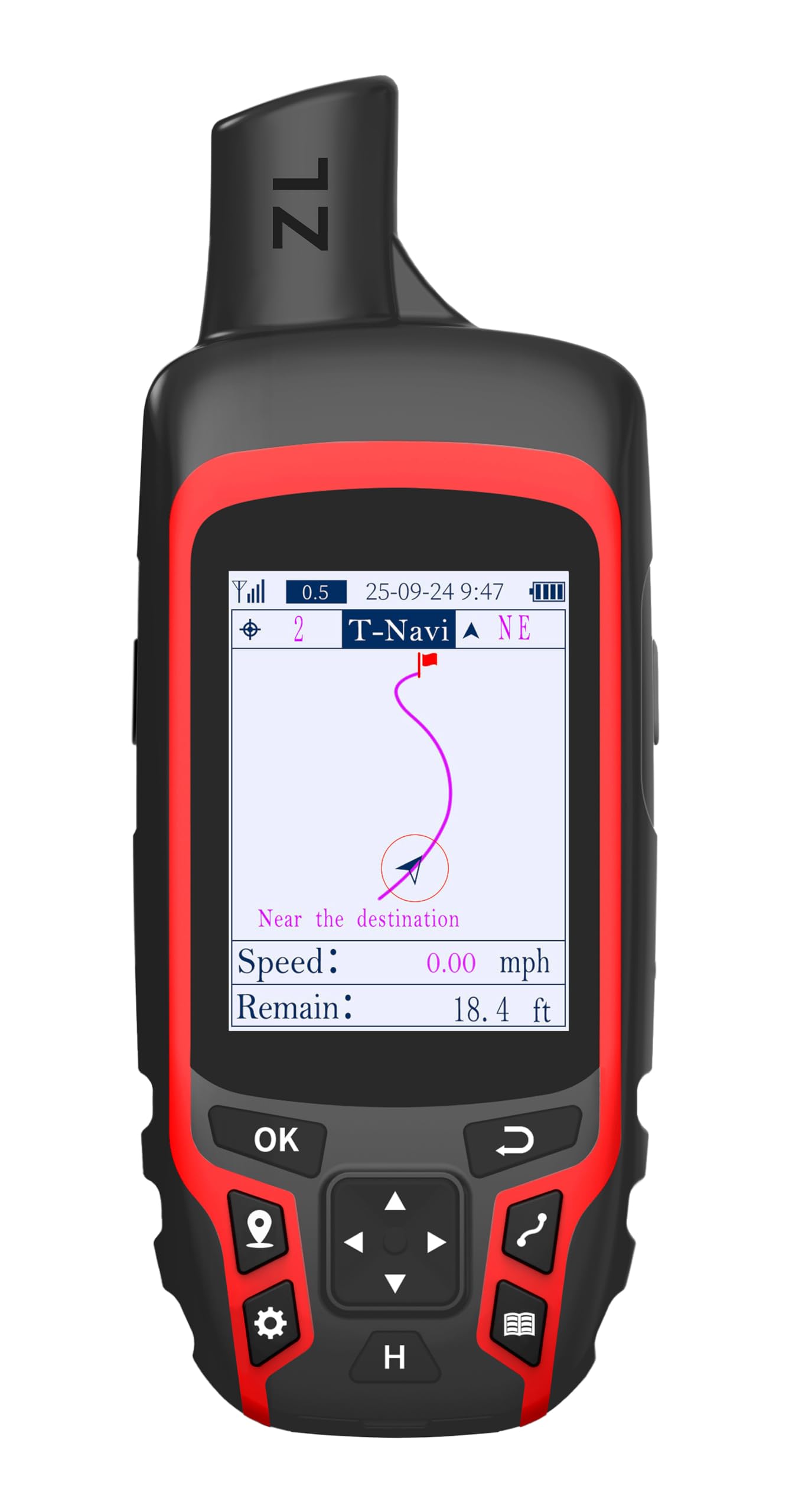
The A6 is a lightweight coordinate tracker that keeps things simple: it records tracks, stores waypoints, and can guide you back to a starting position along the recorded path, but it does not display any maps. The 2.4-inch color screen is bright enough to read under direct sun, and the physical button interface allows operation with gloves. Multi-GNSS support covers GPS, Galileo, BeiDou, and QZSS, giving it four constellations to lock onto for solid positional accuracy in most outdoor settings.
The rechargeable battery delivers up to 20 hours of continuous use and charges via USB-C, which is a welcome modern touch that means you can use the same cable as your phone and power bank. The GPS compass provides heading, and the barometric altimeter tracks elevation changes. The track record and navigation features let you drop waypoints along a trail and follow the breadcrumb path back, which is the core function most hikers actually need.
The critical limitation is the absence of any map layer. The A6 displays coordinates and a compass bearing but not trails, roads, or terrain contours. For hikers who navigate by following a line on a phone or paper map and just need a GPS for position confirmation and backtracking, that is fine. For anyone expecting to see a trail network on the screen, the lack of maps will be disappointing. The menu navigation requires a read of the manual before the first hike, and the rubber plug covering the USB port can be fiddly to reseat securely.
Why it’s great
- 20-hour battery life with convenient USB-C charging
- Four-satellite support (GPS, Galileo, BeiDou, QZSS) for reliable lock
- Compact and lightweight for easy pocket carry
Good to know
- No built-in maps — operates as a coordinate and track tracker only
- Menu system requires manual study for effective use
- Accurate on flat terrain but drift increases on steep, winding trails
7. NiesahYan 3.2″ Handheld GPS
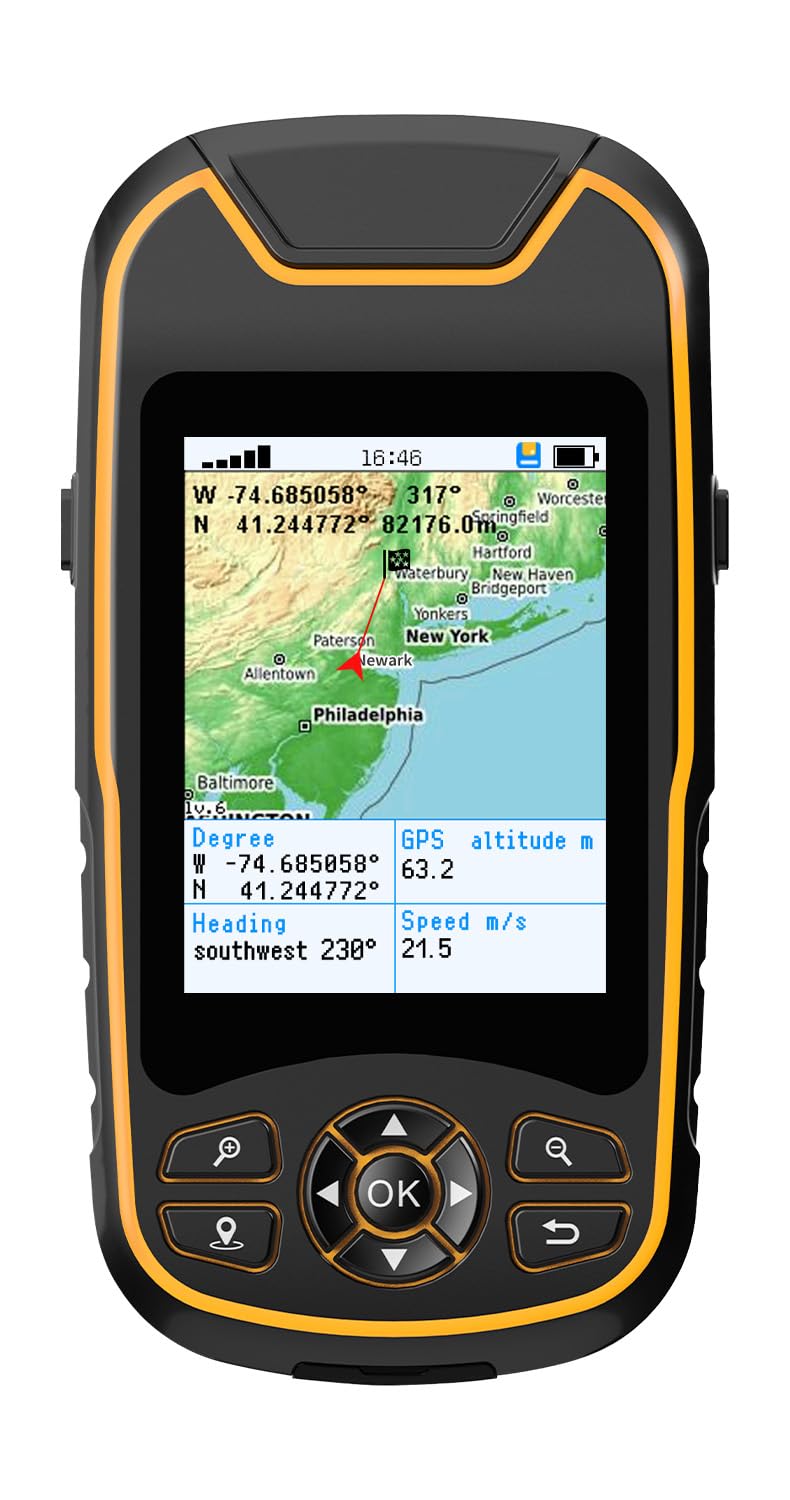
This NiesahYan model stands out for its 3.2-inch sunlight-readable color display, which is the largest screen in this entire comparison. That extra real estate makes a tangible difference when you are trying to read a trail name or identify a junction on the preloaded USA topo maps without squinting. The anti-slip design and textured grip provide a secure hold even with wet hands, and the physical buttons give tactile feedback that a touchscreen cannot match in rain or with gloves on.
Multi-GNSS support across GPS, Galileo, BeiDou, and QZSS delivers positional accuracy within 6 feet under open sky, and the device includes a 3-axis compass and barometric altimeter for heading and elevation readings when stationary. The 36-hour rechargeable battery is one of the best endurance figures among units with actual map displays, and USB-C charging means you can top it off from a standard power bank on a multi-day trip. The 32 GB of internal memory is ample for storing additional map tiles or GPX files.
Quality control is a notable concern. A small number of users report the unit entering an infinite boot loop after initial use, and the UTM coordinate accuracy has been inconsistent in some units. The included interface accepts only primitive GPX 1.0 files, limiting compatibility with newer track formats. The user manual is sparse, with confusing instructions for basic operations like saving a waypoint with a custom name. When the unit works correctly, the large screen and long battery make it a compelling option; the risk of a defective unit is higher than with established brands.
Why it’s great
- Large 3.2-inch sunlight-readable color screen for easy map viewing
- Preloaded USA topo maps with 32 GB internal memory
- 36-hour battery with USB-C charging supports multi-day trips
Good to know
- Inconsistent quality control with reports of boot loop failures
- Confusing user manual with sparse instructions
- Limited GPX file compatibility (GPX 1.0 only)
8. YuisyNie ZL660
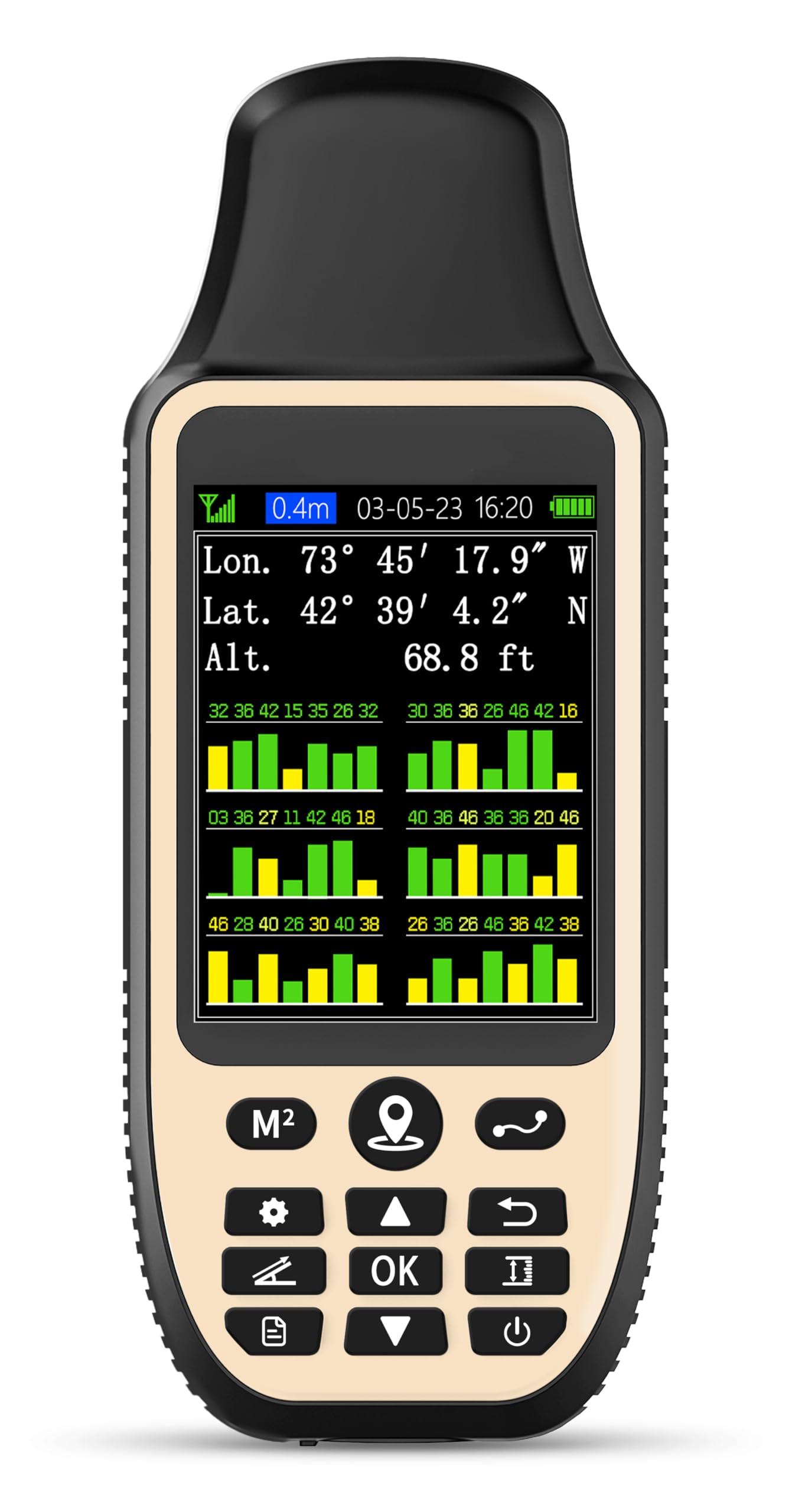
The ZL660 is a dedicated land surveying tool, not a trail navigator. It supports six satellite systems for fast positioning and reports area measurements with an error under 0.002 acres and distance errors under 5 feet. The 3.2-inch color screen remains readable even in full noon sun, which is essential when you are using it to measure field boundaries or pasture acreage. The seven dedicated measurement modes — area, straight distance, curved distance, height, slope, and coordinate saving — each have a single button for one-key access, making operation straightforward for someone who does not want to scroll through menus in the field.
The built-in 4000 mAh lithium battery provides up to 48 hours of continuous surveying operation, which is the longest runtime of any unit here. The rugged housing is waterproof and dustproof, with an ergonomic contoured grip that prevents slipping. A rear flashlight is a welcome addition for marking boundary stakes at dusk. The device stores coordinate points, but those points cannot be edited or renamed later — you get a numbered list of lat/long pairs. For pure navigation like following a trail or retracing a path, this device lacks the breadcrumb track-back function that hiking GPS units provide.
Accuracy degrades on small areas; below half an acre, variance can reach 20 percent compared to a tape measure. The recommended minimum measurement area is 0.16 acres, and the minimum distance is 328 feet. For large property surveys, farmland assessments, or measuring a parking area, the ZL660 delivers usable results faster than walking the perimeter with a wheel. For hiking, it is a niche tool — useful if you need to mark the corners of a backcountry parcel but not a substitute for a navigator that shows trails and waypoints.
Why it’s great
- 48-hour battery life from a 4000 mAh rechargeable battery
- Seven one-button measurement modes for quick field data collection
- Six-satellite support for fast, accurate positioning
Good to know
- Designed for land surveying, not trail navigation — no breadcrumb track-back
- Saved coordinate points cannot be edited or named
- Accuracy drops significantly on areas under half an acre
9. NiesahYan ZL180

The ZL180 is the most accessible entry point into GPS-based land measurement, providing GPS and GLONASS satellite coverage for area and distance calculations with an area error within 0.003 acres. The 2.4-inch FSTN LCD panel with backlight displays measurement results directly on the screen, and the device weighs just 180 grams, making it easy to carry in a pocket while walking a property line. The four-in-one measurement modes cover two types of area measurement and two types of distance measurement (straight and curve).
The rugged design includes a contoured groove pattern that makes the device easy to hold securely for extended periods. It runs on batteries and includes a set in the box. The device functions exclusively as a surveying tool — it cannot save waypoints for navigation and does not provide any directional guidance for hiking. The altitude displayed is GPS-derived and fluctuates with satellite signal strength, so it should not be relied upon for elevation tracking. Accuracy is best on measurements above 0.16 acres and distances above 328 feet; smaller measurements introduce larger relative errors.
Users consistently note that the ZL180 is accurate enough for ballpark property estimates but not for precise boundary marking. Several reviewers report that it gives them a usable sense of acreage for gardens and pastures in a fraction of the time it would take to walk the perimeter with a measuring wheel. The device requires a clear view of the sky and cannot acquire a signal indoors. For the hiker whose primary need is measuring a parcel of land rather than navigating a trail, the ZL180 is a functional budget pick; for trail navigation, look to the dedicated hiking units in this guide.
Why it’s great
- Very affordable entry point for basic GPS land measurement
- Lightweight 180 g design with ergonomic groove grip
- GPS + GLONASS satellite support for global coverage
Good to know
- Cannot save waypoints or provide navigation guidance
- Inaccurate on areas under 0.16 acres and distances under 328 feet
- GPS altitude fluctuates and should not be trusted for elevation data
FAQ
Can I use a budget GPS hiking unit without downloading any software?
How does a budget hiking GPS compare to a GPS running watch?
What does “expedition mode” actually do to battery life?
Why does my GPS altitude reading change when I stand still?
Can I upload GPX files from AllTrails or Gaia to a budget GPS?
Final Thoughts: The Verdict
For most users, the best budget gps for hiking winner is the Garmin eTrex SE because it combines exceptional AA battery life, multi-GNSS reliability, and phone app integration for mapping at a price point that undercuts the competition’s mid-tier models. If you want preloaded topo maps without needing a phone at all, grab the Garmin eTrex 22x for its routable trail maps and expandable storage. And for solo hikers or anyone venturing deep into areas without cell service, nothing beats the Spot Gen 4 as a dedicated SOS beacon that prioritizes your safety over navigation features.

Mo Maruf
I created WellFizz to bridge the gap between vague wellness advice and actionable solutions. My mission is simple: to decode the research and give you practical tools you can actually use.
Beyond the data, I am a passionate traveler. I believe that stepping away from the screen to explore new environments is essential for mental clarity and physical vitality.