Our readers keep the lights on and my smoothie glass nicely filled. As an Amazon Associate, I earn from qualifying purchases.
Finding a fan that cools your room without rattling your nerves or emptying your wallet is a specific kind of challenge. The market is flooded with cheap plastic models that promise “whisper-quiet” operation but deliver a noisy hum that keeps you awake, or worse, a weak puff of air that barely stirs the curtains. For anyone trying to sleep, focus, or simply survive a heatwave on a budget, the difference between a good fan and a frustrating one comes down to a few critical specs.
I’m Mohammad Maruf — the founder and writer behind WellFizz. My research focuses on dissecting the real-world performance of household essentials by analyzing motor technology, decibel ratings, and user longevity data to separate marketing claims from actual results.
After reviewing dozens of models, these five picks stand out as the most reliable options available today. This guide helps you find the very best budget fan that balances airflow, noise, and durability without demanding a premium price.
How To Choose The Best Budget Fan
When shopping for a budget fan, it’s easy to get distracted by flashy features or a low sticker price. But a fan’s real value lies in three core areas: how much air it moves, how much noise it makes while doing it, and how long it will last. Here’s what to look for.
Motor Type: AC vs. DC
The motor is the heart of the fan. AC motors are common in budget-friendly models and are generally cheaper, but they consume more power and can be noisier. DC motors, often found in mid-range and premium fans, are far more energy-efficient and operate at a much lower decibel level—ideal for bedrooms where silence matters. A DC motor typically allows for more speed settings and finer control over airflow.
Noise Level (Decibels)
Manufacturers often use the word “quiet” loosely. The only reliable metric is the decibel rating. A fan operating at 20–30 dB is genuinely whisper-quiet, suitable for light sleepers. Between 30–40 dB, it’s similar to a library hum—still acceptable for most. Anything above 45 dB is noticeable and can disrupt conversation or sleep. Always check for a stated dB rating in the specs.
Airflow and Oscillation
Airflow is measured in feet per second (ft/s) or cubic feet per minute (CFM). For a compact tower fan, 20–23 ft/s is decent for personal cooling. Wider oscillation angles (70–90 degrees) circulate air more evenly across a room. Pedestal fans with larger blades (16 inches) move more volume but are less focused. Think about whether you need a gentle personal breeze or whole-room circulation.
Quick Comparison
On smaller screens, swipe sideways to see the full table.
| Model | Category | Best For | Key Spec | Amazon |
|---|---|---|---|---|
| LEVOIT Tower Fan | Mid-Range | Silent sleep & personal cooling | DC motor, 20 dB noise floor | Amazon |
| Amazon Basics Pedestal Fan | Mid-Range | Whole-room circulation | 16-inch dual-layer blades, 60W motor | Amazon |
| PELONIS Tower Fan | Mid-Range | Dorm rooms & small bedrooms | 30-inch height, 847 CFM | Amazon |
| Comfort Zone Tower Fan | Budget-Friendly | Budget-conscious households | 90° oscillation, carry handle | Amazon |
| PNTCK Tower Fan | Budget-Friendly | Desktop & tight spaces | 13-inch height, 29 dB operation | Amazon |
In‑Depth Reviews
1. LEVOIT Tower Fan
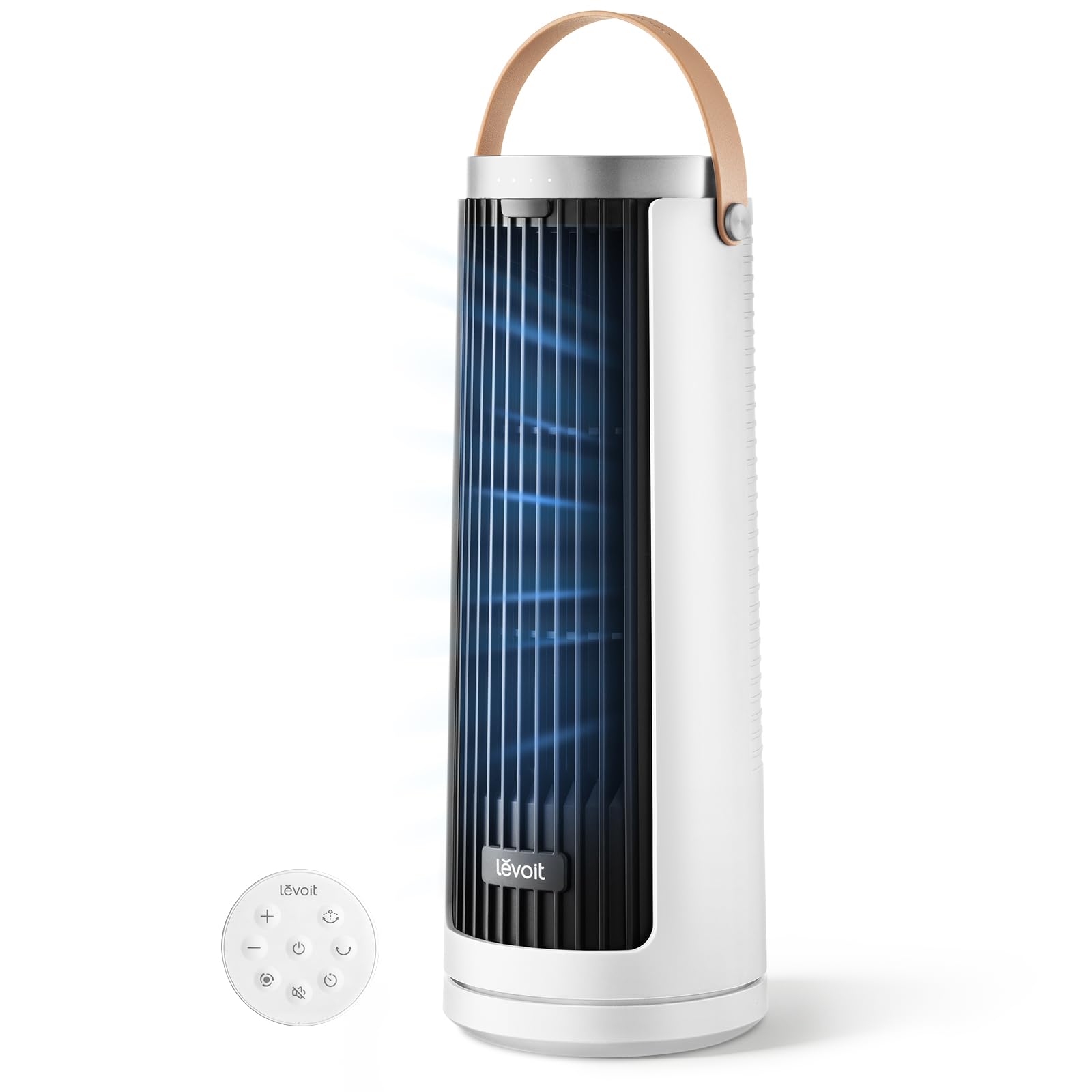
The LEVOIT strikes an exceptional balance for a budget-friendly fan thanks to its efficient DC motor. It delivers a focused breeze of up to 23 ft/s while keeping noise as low as 20 dB on the lowest setting—genuinely silent enough for the lightest sleepers. The multi-angle oscillation (30, 60, or 90 degrees) lets you tailor coverage precisely without blasting your entire desk or bed.
At just 13 inches tall, this is a compact tabletop unit, not a floor-standing tower. It includes a remote and a 12-hour timer, features more common in premium models. The five speed settings plus a turbo mode offer fine control, though the narrow air column means it won’t cool a whole room effectively—it’s designed for personal, directed comfort.
The build quality feels sturdy for its weight class, and the soft carrying handle makes it easy to move between rooms. A few users noted the remote lacks a backlight, which is a minor inconvenience in the dark. Overall, this is the top pick for anyone who prioritizes silent operation and precise, personal airflow.
Why it’s great
- Exceptionally quiet DC motor starts at 20 dB
- Five speeds plus turbo mode for fine-tuned airflow
- Includes remote and 12-hour timer
Good to know
- Designed for tabletop use only, not floor-standing
- Narrow air column, not for whole-room cooling
2. Amazon Basics 16″ Pedestal Fan

For medium to large rooms, the 16-inch pedestal fan from Amazon Basics is a workhorse that moves serious air. Its dual-layered blades and 60W AC motor generate a powerful, wide breeze that reaches across a living room or master bedroom. The adjustable height (up to 53 inches) and tilt head let you direct airflow precisely where needed.
It offers three speeds and three modes (normal, nature, and sleep), plus a full-function remote. The nature mode, which cycles speeds to simulate a natural breeze, is a standout feature often missing at this price tier. Assembly is straightforward, though the front grille clip can be finicky. On low speed, it’s surprisingly quiet; on high, it’s more audible but still appropriate as white noise.
The build is solid and stable, with a weighted base that resists tipping. As a mid-range option, it avoids the cheap wobble that plagues many budget pedestal fans. The main drawback is the sensitive remote buttons, which require a light touch. This is the best choice for anyone who needs to cool an entire room without breaking the bank.
Why it’s great
- Excellent whole-room airflow with 16-inch blades
- Quiet on low, sturdy build with weighted base
- Nature and sleep modes offer versatile comfort
Good to know
- Assembly instructions are poor
- Remote buttons are overly sensitive
3. PELONIS 30-Inch Tower Fan

The PELONIS is a solid 30-inch tower fan that fits neatly into small bedrooms, dorms, or apartments. At 847 CFM, it pushes a respectable volume of air, and the 90-degree oscillation ensures that breeze spreads across the room rather than hitting a single spot. The compact footprint (just under 10 inches square) means it tucks into corners easily.
It operates at roughly 37 dB on lower settings—quiet enough for background white noise but not silent. The touch-sensitive top control panel is sleek but hard to see; the included remote solves this. Assembly is tool-free: just snap the base together and twist the locking nut. Users report the fan holds up well over a couple of years of daily use, which is good for this price tier.
The main design issue is that the airflow stops roughly two feet off the ground, making it less effective for direct cooling on a low bed or while sitting on the floor. For seated desk work or sleeping on a standard-height bed, it works fine. The remote can occasionally be unresponsive on the first press. A reliable, space-efficient choice for general room circulation.
Why it’s great
- Wide 90° oscillation for even room coverage
- Tool-free assembly in minutes
- Compact design fits tight spaces
Good to know
- Airflow is weak near the floor (under 24 inches)
- Top control panel is hard to read without the remote
4. Comfort Zone 32-Inch Tower Fan
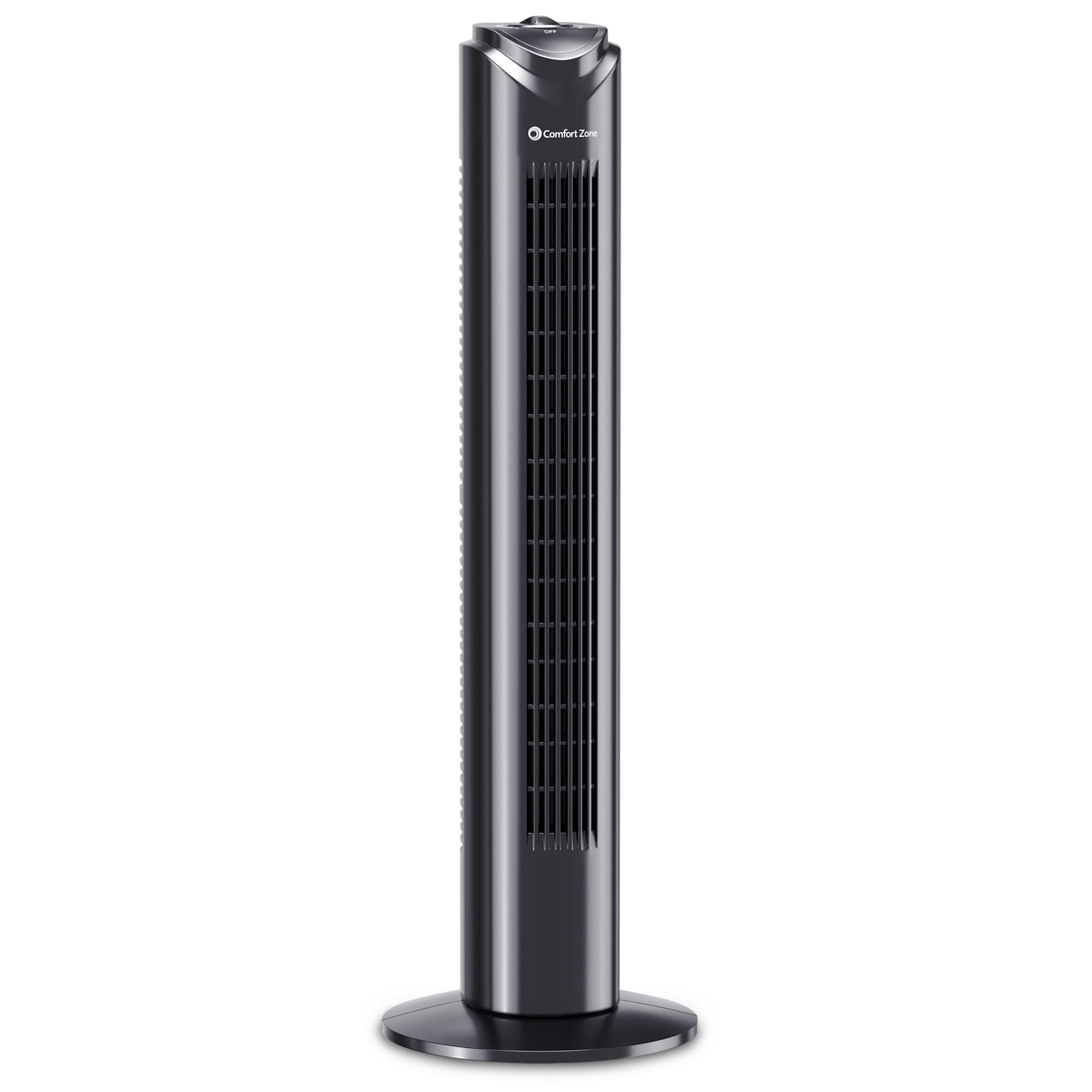
If you need a tall tower fan that covers a lot of room without a steep investment, the Comfort Zone is a compelling option. Its 90-degree oscillation is generous, and the 32-inch height provides good air distribution for a bedroom or home office. The bladeless design is a definite safety plus for homes with children or pets, as there are no exposed spinning parts.
This model uses a simple knob control, which is refreshingly intuitive—no fumbling with touch panels or complex remote menus. The built-in carry handle makes it genuinely portable. On the high setting, it moves a decent amount of air for its class, though a few users report the airflow feels less concentrated compared to pedestal fans.
The main drawbacks are stability and noise during oscillation. The base is a bit narrow for its height, causing some wobble when the fan oscillates. Some units also emit a clicking or rattling sound during oscillation, which can be distracting in a quiet room. It’s ETL certified for safety. For the price, it offers good coverage and safety, but it isn’t the quietest option.
Why it’s great
- Safe bladeless design with wide 90° oscillation
- Tall 32-inch profile covers more vertical space
- ETL certified for electrical safety
Good to know
- Can be wobbly during oscillation
- Some units have clicking noise when rotating
5. PNTCK 13″ Tower Fan

The PNTCK is the most affordable option here, designed for ultra-tight spaces where every inch counts. At just 13 inches tall and weighing under 3 pounds, it’s ideal for a desk, nightstand, or dorm shelf. The knob control is as simple as it gets—turn to choose from three speeds—making it hassle-free for anyone who doesn’t want to fuss with remotes.
It claims a max airflow of 23 ft/s, though several users note it provides a “nice breeze” rather than powerful cooling—perfect for not blowing papers off a desk. At 29 dB, it is genuinely quiet on the lowest setting, suitable for a light sleeper. The 70-degree oscillation helps distribute that breeze across a small area without being invasive.
The main concern is durability. Several reports mention the fan developing a humming noise or random mode-switching after a few months of use. This places it firmly in the “entry-level” category—fine for occasional or temporary use, but not a long-term investment. The built-in handle is convenient for moving it around the house. Best for someone on a very tight budget who needs basic, quiet desk cooling.
Why it’s great
- Very compact and lightweight for desktop use
- Quiet operation at 29 dB on low speed
- Simple knob control, requires no setup
Good to know
- Long-term durability is questionable based on reports
- Airflow is moderate, not powerful
FAQ
Is a tower fan or pedestal fan better for a small bedroom under a strict budget?
What fan noise level is considered acceptable for sleeping?
Final Thoughts: The Verdict
For most users, the budget fan winner is the LEVOIT Tower Fan because it combines DC motor quietness with precise controls and a remote, all at a mid-range price. If you need whole-room air circulation for a living room or larger bedroom, grab the Amazon Basics 16″ Pedestal Fan. And for a true entry-level desk companion, nothing beats the PNTCK 13″ Tower Fan.

Mo Maruf
I created WellFizz to bridge the gap between vague wellness advice and actionable solutions. My mission is simple: to decode the research and give you practical tools you can actually use.
Beyond the data, I am a passionate traveler. I believe that stepping away from the screen to explore new environments is essential for mental clarity and physical vitality.