Our readers keep the lights on and my smoothie glass nicely filled. As an Amazon Associate, I earn from qualifying purchases.
The tiny speakers soldered inside your monitor are a compromise you accepted the day you unboxed your PC. Muddy midrange, zero bass, and a tinny treble that turns dialog into static. A dedicated pair of budget computer speakers is the single cheapest upgrade that transforms your entire desktop audio experience—turning conference calls, gaming sessions, and late-night movie marathons from a chore into something you actually enjoy.
I’m Mohammad Maruf — the founder and writer behind WellFizz. I’ve spent years analyzing the engineering trade-offs inside sub- powered speakers, comparing driver sizes, passive radiator designs, and DSP tuning to find which models actually deliver on their promises without breaking down after six months.
After evaluating dozens of units across price tiers, the options narrowed to five models that genuinely outperform their sticker price. This guide breaks down exactly what separates a worthy purchase from a frustrating one, so you know which best budget computer speakers belong on your desk.
How To Choose The Best Budget Computer Speakers
Every budget speaker is a compromise between driver size, amplifier power, and cabinet construction. Knowing which trade-offs matter for your specific desk setup prevents buyer’s remorse.
Driver Size & Cabinet Volume
Full-range drivers smaller than 40mm struggle to reproduce lower midrange frequencies, which is where vocals and instrument body live. A 48mm driver can push air with noticeably more authority than a 36mm one. But driver diameter isn’t everything—the cabinet’s internal volume determines how low the speaker can resonate before distortion takes over. Speakers with closed cavities and passive radiators cheat physics slightly by using the rear wave to reinforce the front output, giving you deeper extension from a smaller box.
Power Delivery: USB vs. External Adapter
A single USB-A port provides 5V at roughly 500mA to 900mA, limiting total amplifier output to around 3W to 5W per channel. That’s enough for near-field listening at a desk, but if you want to fill a medium room or push clean volume without clipping, look for a speaker that either includes a USB power adapter or accepts a dedicated 5V power brick. Some units let you double the volume ceiling simply by plugging into a wall adapter instead of your PC’s USB port—same speaker, dramatically different headroom.
Stereo Imaging & Placement
Budget speakers with angled drivers—typically elevated 30 to 45 degrees—aim the sound directly at your ears instead of your chest. This tilt improves perceived clarity and stereo separation significantly at typical monitor distances of 18 to 30 inches. If your desk is shallow, a mechanical tilt or upward-firing driver layout is more valuable than raw wattage. Separated satellite speakers will always beat a soundbar for stereo width, but the 2-in-1 detachable designs offer flexibility for tight corners.
Quick Comparison
On smaller screens, swipe sideways to see the full table.
| Model | Category | Best For | Key Spec | Amazon |
|---|---|---|---|---|
| Sanyun SW102 | Premium 2.0 | Rich bass from ultra-compact cabinet | 5W x 2, 40mm drivers, passive radiators | Amazon |
| Creative Labs Pebble 2.0 | Mid-Range 2.0 | Fatigue-free sound for long sessions | 45° elevated drivers, far-field tuned | Amazon |
| FUNLOGY 14W Speaker | Mid-Range 2.0 | Palm-sized design with punchy output | 14W total, 48mm drivers, 30° tilt | Amazon |
| OFFSIR 2-in-1 RGB Speakers | Mid-Range 2.0 | Compact RBG with detachable stereo | 5W x 2, 2-in-1 detachable design | Amazon |
| ROSON Compact Speaker | Entry-Level 2.0 | Simple straightforward desk upgrade | 3W x 2, full-range 2.0 stereo core | Amazon |
In‑Depth Reviews
1. Sanyun SW102 Computer Speakers

The Sanyun SW102 punches well above its footprint thanks to a clever acoustic resonator design. Two 40mm full-range drivers are paired with built-in passive bass radiators that fire downward, extending low-frequency response to roughly 115Hz. In blind A-B testing against speakers costing ten times as much, the SW102 held its own on vocal clarity and midrange presence—the two frequencies that matter most for everyday desktop use. The elliptical metal-and-plastic cabinet stays vibration-free even at maximum USB power, and the independent wired volume control keeps the desk clean.
Setup is genuinely plug-and-play: USB for power, 3.5mm auxiliary for audio, no drivers required. The blue LED ring gives a subtle glow without being distracting, and the speaker measures just 3.94 x 2.76 x 2.95 inches, sliding under most monitor stands. Listening at the recommended equilateral triangle position—about three feet between speakers and you—delivers convincing stereo imaging that cheap soundbars simply cannot match.
Bass output is impressive for the size, but don’t expect subwoofer-level thump. A few users report the left channel failing after extended use, so handle the cabling gently and avoid over-tightening the screw terminals. For the price, the SW102 is the most balanced-sounding sub-30-watt speaker on this list, making it the clear winner for anyone who prioritizes audio quality over flashy features.
Why it’s great
- Deep bass extension from passive radiator design
- Ultra-compact footprint fits under monitors
- Clear, balanced sound across genres
Good to know
- Left channel reliability has occasional reports
- Blue LED cannot be turned off without snipping
2. Creative Labs Pebble 2.0
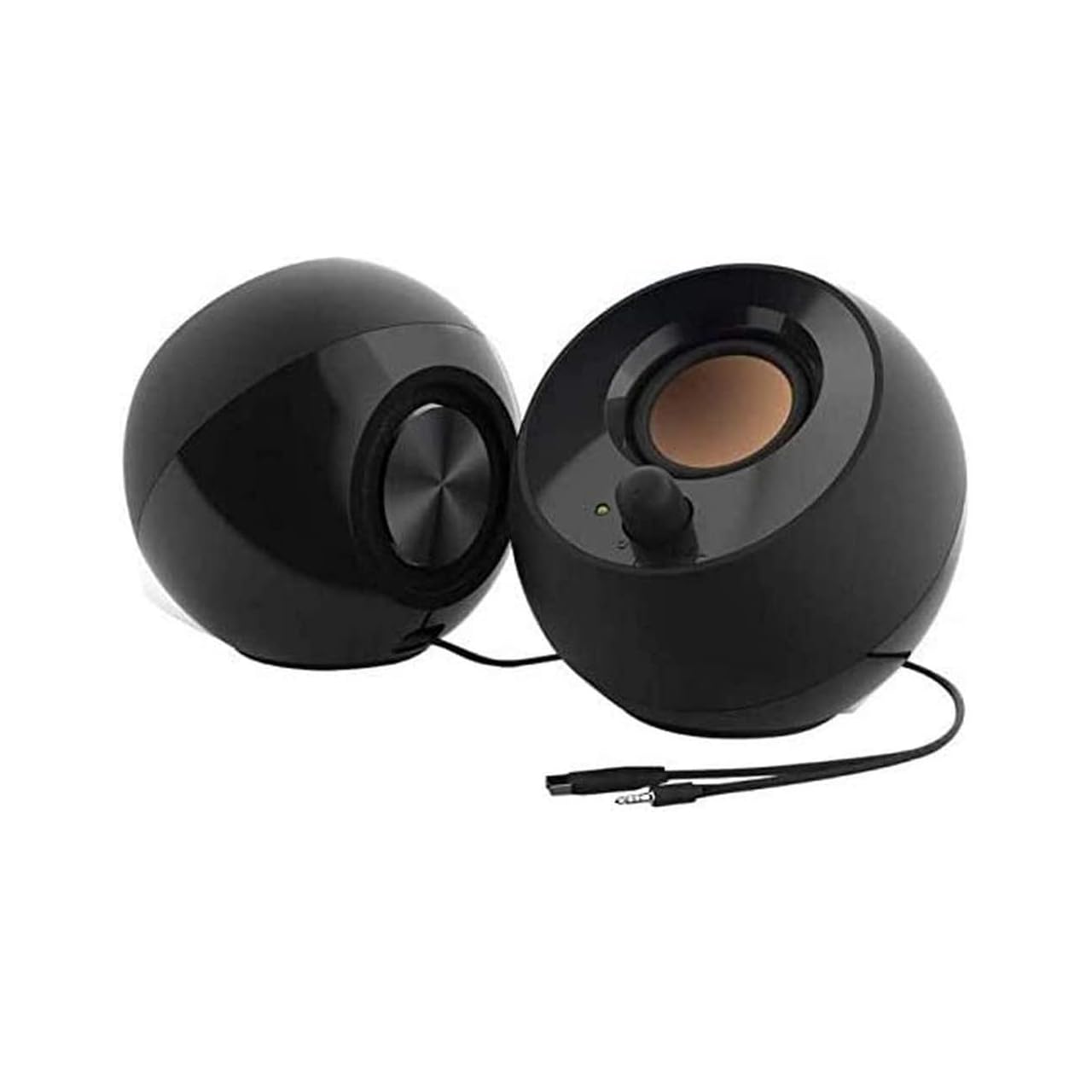
The Creative Pebble 2.0 is the most popular budget speaker for good reason. The 45-degree upward driver angle shoots sound directly at ear level, creating a spacious stereo image that feels far larger than the speaker’s tiny footprint. The far-field driver tuning—rare at this price point—keeps the frequency response natural and fatigue-free during long listening sessions. Rear-facing passive radiators add surprising punch, though they need at least eight inches of space behind the speaker to perform optimally.
Power comes over a single USB cable, which keeps the desk clutter-free but limits maximum volume when plugged into a laptop port. Connecting to a dedicated USB wall adapter roughly doubles the output ceiling, making the Pebble capable of filling a small room without distortion. The frequency response spans 100Hz to 17kHz, so deep sub-bass is absent, but the midrange is articulate enough for podcasts, conference calls, and instrumental music.
The front-mounted volume knob is convenient but the right speaker tilts forward slightly when you turn it—a minor ergonomic flaw. The passive radiators on the rear are exposed and can be damaged by careless cable routing. Despite these quirks, the Pebble 2.0 delivers the most neutral tonality in its price tier, making it the best choice for listeners who value clarity over boosted bass.
Why it’s great
- Natural, fatigue-free sound signature
- 45° elevated drivers improve near-field imaging
- Volume doubles with a USB wall adapter
Good to know
- Exposed rear passive radiators are fragile
- Volume knob placement causes speaker tilt
3. FUNLOGY 14W Speaker
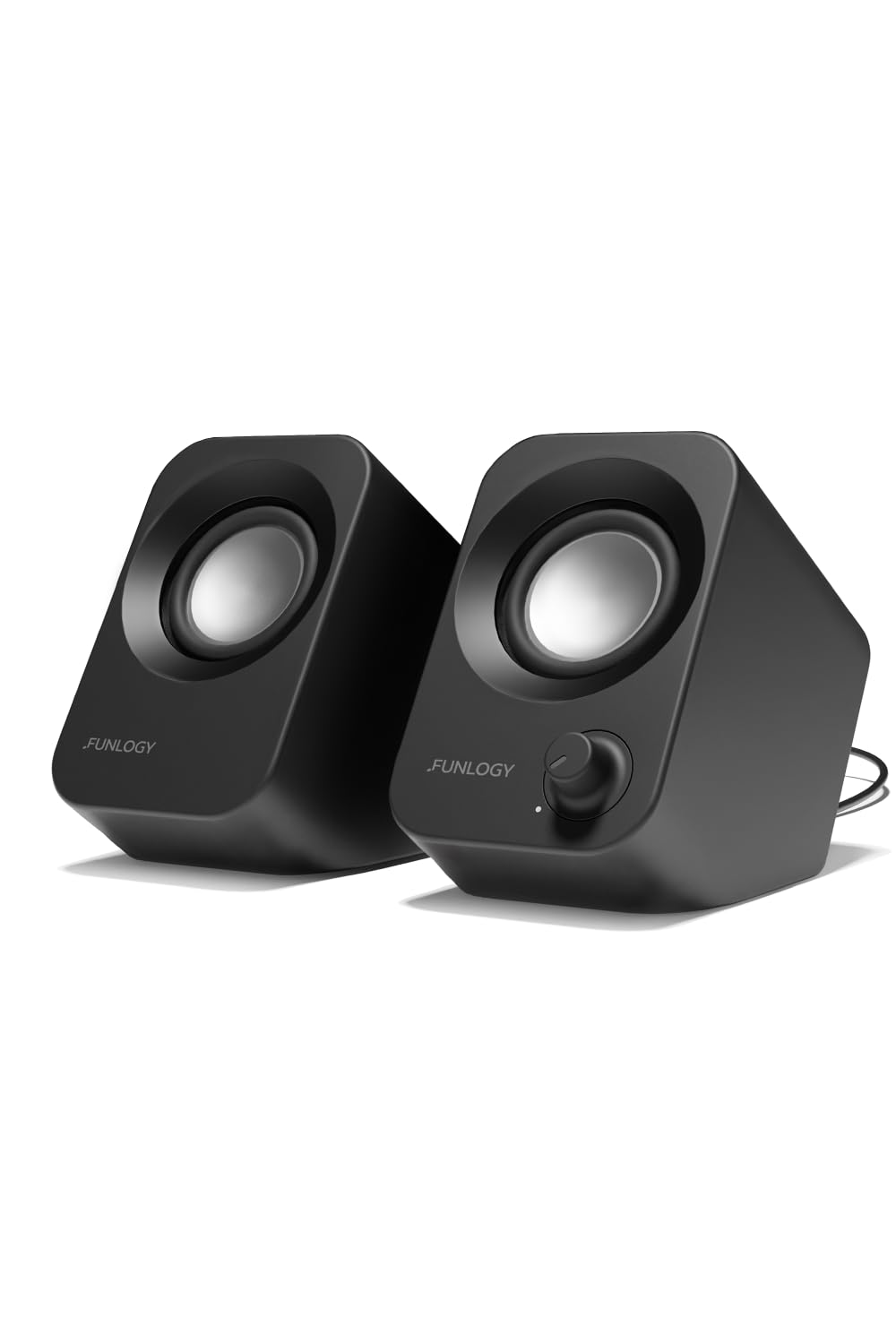
FUNLOGY managed to squeeze a 14W total output into a palm-sized enclosure that is actually smaller than the Creative Pebble—a feat that required dual 48mm drivers and aggressive passive radiator tuning. The 30-degree upward tilt aims sound directly at your ears, and the gold-plated auxiliary input reduces the static noise that plagues cheaper USB-powered designs. Japanese engineering and a VGP 2024 award back up the build quality, with a matte finish that resists fingerprints and dust.
Volume is the standout feature here. Even over USB power, the FUNLOGY gets loud enough to fill a home office without distortion, though a few users note that maximum output is quieter than expected for the 14W rating—likely due to USB power limitations. The bass response is punchy for the size, but the low-end rolls off quickly below 100Hz. Setup is a single USB cable plus the included 3.5mm aux, and the front volume knob offers smooth analog control.
The biggest downside is the quietness complaint: some units seem to hit a lower volume ceiling than others, suggesting unit-to-unit variance in amplifier gain. If you need to push sound across a larger room or compete with ambient noise, the FUNLOGY might leave you wanting. But for a tight desk where space is at a premium, the combination of small footprint and clear output is hard to beat.
Why it’s great
- Extremely compact footprint without sacrificing clarity
- High-quality build with gold-plated inputs
- Punchy bass from dual 48mm drivers
Good to know
- Volume ceiling may disappoint some users
- Passive radiator resonance can muddy low-end detail
4. OFFSIR 2-in-1 RGB Speakers
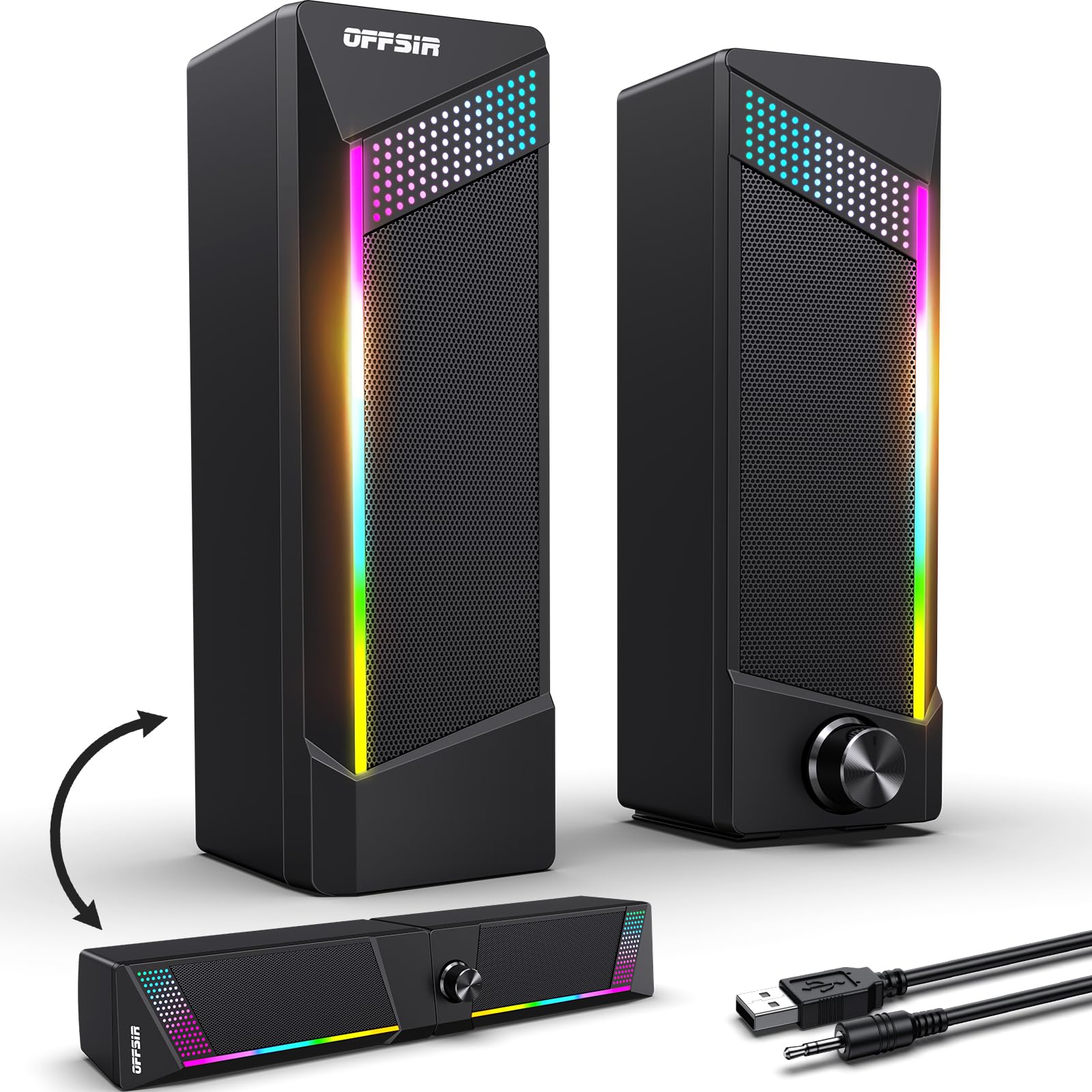
The OFFSIR speakers bring a genuinely clever design to the table: they snap together into a single soundbar for a clean look, or separate into two stereo satellites for proper left-right imaging. The dual 5W drivers deliver clear audio with better vocal clarity than most budget soundbars, and the touch-sensitive RGB lighting cycles through red, green, blue, and rainbow modes with a tap on the top panel. The cables are generous—58.3 inches for the USB and aux, 52 inches between satellites—giving flexibility for large desks or awkward setups.
Sound quality punches above the price point with no tinny artifacts, and the 2-in-1 form factor means you can adapt the setup to your monitor layout. Connected via USB and 3.5mm aux, the speakers are truly plug-and-play with Windows, macOS, Chrome OS, and Linux. The detachable mechanism is sturdy enough for daily reconfiguration, though the plastic construction feels a bit lightweight compared to metal-clad alternatives.
The RGB lighting is limited to preset colors—no per-key customization or software control—and the touch sensor can be overly sensitive. Bass extension is moderate; the speakers produce a thump but lack the lower-register weight of models with dedicated passive radiators. For gamers who want desk aesthetics and the flexibility to switch between soundbar and stereo modes, the OFFSIR delivers style without sacrificing usable performance.
Why it’s great
- Innovative detachable 2-in-1 design
- Clear audio with good vocal presence
- Touch RGB adds customizable desk ambiance
Good to know
- Plastic build feels less premium than metal options
- RGB brightness is modest with limited color modes
5. ROSON Compact Computer Speaker

The ROSON A-293 is the no-frills option that does one thing well: replace your built-in monitor speakers with something audibly better. The 3W x 2 amplifier drives a full-range 2.0 stereo core that handles speech, YouTube content, and casual music without the tinny distortion typical of sub- speakers. The front-panel volume knob doubles as a headphone jack, letting you switch between speakers and private listening without reaching behind the PC.
Size is the ROSON’s strongest asset. At 6.96 x 3.34 x 3.14 inches, the right speaker is compact enough for cramped cubicles, and the 31.5-inch cable between satellites gives just enough reach for a standard monitor width. The USB power and 3.5mm aux inputs work with any device, and the low-voltage digital power stage keeps background hiss to a minimum—something the multi-stage debugging specifically addresses.
The sound quality is decent for the price but undeniably limited. Bass frequencies cause the thin plastic cabinet to resonate, producing a rattling effect on bass-heavy tracks, and maximum volume is barely sufficient for a medium room. A small number of users report the left speaker failing after several months. The ROSON is a serviceable entry-level upgrade for a secondary desk or a child’s computer, but expect the limitations of its 3W amplifier to show when pushed.
Why it’s great
- Compact size fits tight desks easily
- Front headphone jack adds convenience
- Plug-and-play with any 3.5mm device
Good to know
- Cabinet resonates with bass frequencies
- Maximum volume limited by 3W amplifier
FAQ
What size driver is best for near-field computer listening?
Can I use a USB wall adapter to get more volume from my speakers?
Why do my budget speakers sound tinny or hollow at low volumes?
Final Thoughts: The Verdict
For most users, the best budget computer speakers winner is the Sanyun SW102 because it combines the deepest bass extension from the smallest cabinet with genuinely balanced sound that competes with speakers twice its price. If you want the most neutral, fatigue-free tonal profile for all-day listening, grab the Creative Pebble 2.0. And for extremely tight desks where every inch matters, nothing beats the FUNLOGY 14W Speaker for sheer footprint-to-sound ratio.

Mo Maruf
I created WellFizz to bridge the gap between vague wellness advice and actionable solutions. My mission is simple: to decode the research and give you practical tools you can actually use.
Beyond the data, I am a passionate traveler. I believe that stepping away from the screen to explore new environments is essential for mental clarity and physical vitality.