Our readers keep the lights on and my smoothie glass nicely filled. As an Amazon Associate, I earn from qualifying purchases.
A shot that channels honey, chocolate, and stone fruit instead of battery acid begins with a single, often overlooked variable: the burr set. The difference between a pressurized basket hack job and true espresso is the ability to adjust grind size in precise, repeatable steps. For anyone building a home setup without a commercial budget, the challenge is finding a grinder that delivers that precision without demanding a second mortgage.
I’m Mohammad Maruf — the founder and writer behind WellFizz. My research into affordable espresso gear focuses on burr geometry, step resolution, and grind retention at the sub- price point, separating the machines that actually pull shots from those that just look the part.
Whether you are pairing it with a Gaggia Classic, a Breville Bambino, or a Flair lever machine, the right budget coffee grinder for espresso must produce a consistent, clump-free dose that chokes a standard basket at the finest settings.
How To Choose The Best Budget Coffee Grinder For Espresso
Choosing a grinder for espresso on a budget requires focusing on four key areas. Skimping on any one of them will undermine the quality of your shot, regardless of how expensive your espresso machine is.
Burr Type and Material
Blade grinders are useless for espresso. You need a conical or flat burr set. Conical burrs are more common at budget price points because they are simpler to manufacture and generally quieter. Look for stainless steel burrs, as they stay sharp longer than ceramic alternatives and handle light roasts without excessive wear.
Step Resolution and Adjustment Range
Espresso is unforgiving. A burr set with 48 macro settings sounds like a lot, but if those settings span from Turkish to cold brew, the espresso zone might only cover three to five clicks. The best budget espresso grinders offer micro-adjustments within the fine range, typically through a stepped collar or a threaded ring with clear detents. A grinder that cannot step fine enough to choke a non-pressurized basket is simply not an espresso grinder.
Grind Retention and Dose Consistency
Retention refers to the coffee grounds that stay inside the burr chamber after grinding. For single-dosing espresso, a grinder that retains 0.5 grams or less per dose is ideal. Higher retention leads to stale coffee mixing into your fresh dose and throws off your weight-based recipe. Bellows systems and anti-static coatings help reduce retention, but the burr chamber geometry itself is the deciding factor.
Manual vs. Electric
Manual grinders require zero counter space and deliver excellent grind quality for the price. They also let you grind directly into a portafilter without static. The trade-off is physical effort — grinding 18 grams of light roast espresso takes 45 to 60 seconds of steady cranking. Electric grinders offer convenience and hands-free operation, but the cheapest electric models often lack the fine adjustment range that manual grinders provide. Your choice depends on whether you value speed or absolute grind consistency per dollar spent.
Quick Comparison
On smaller screens, swipe sideways to see the full table.
| Model | Category | Best For | Key Spec | Amazon |
|---|---|---|---|---|
| SHARDOR CG018 | Electric | Entry-level electric with timer | 51 grind settings / 0.1s timer | Amazon |
| TIMEMORE Chestnut C2S | Manual | Precision manual grinding | 38mm S2C steel burr / 36 clicks | Amazon |
| NewlukPro M6 | Manual | Best value hand grinder | SUS 420 hexagonal burr / 25g cap | Amazon |
| OXO Brew Compact | Electric | Quiet compact electric | 15 settings + 29 micro adj. | Amazon |
| AMZCHEF CG209 | Electric | Large hopper + touchscreen | 48 settings / 10.6 oz hopper | Amazon |
| Aromaster Burr Grinder | Electric | Anti-static + quiet operation | 48 settings / 3.9 oz capacity | Amazon |
| Tuni G1 | Electric | Full-featured electric value | 48 settings / 450 RPM burr | Amazon |
In‑Depth Reviews
1. SHARDOR Conical Burr Espresso Coffee Grinder CG018

The SHARDOR CG018 occupies a rare spot: an electric grinder with 51 stepped settings and a 0.1-second precision timer, all at a price where most competitors offer a third fewer adjustment steps. The 40-millimeter stainless steel conical burr runs at 165 watts and produces grounds that are uniform enough to choke a non-pressurized basket on the finest settings. Real-world users report using it daily with Breville Bambino and Gaggia Classic machines without jamming or overheating, which speaks to the burr alignment quality.
The touchscreen interface allows you to select dose time in 0.1-second increments, making repeatable dosing straightforward once you dial in. The integrated portafilter cradle works with 54-millimeter baskets, so you can grind directly into the filter rather than transferring from a cup. This reduces mess and preserves the fluffy texture of freshly ground coffee. Anti-static technology keeps the chute from coating itself in fines, a common complaint with cheaper electric burr grinders.
At 6.15 pounds, the stainless steel body provides enough mass to stay planted during grinding. The main durability concern revolves around the plastic clips that secure the bean hopper; several long-term owners note that these can snap after repeated removal. The manufacturer honors warranty claims for this issue, and the overall failure rate remains low relative to comparable machines. For a budget electric grinder that can genuinely produce espresso-fine grounds, this is the most complete package available right now.
Why it’s great
- 51 grind settings cover espresso to cold brew with fine step resolution in the espresso zone.
- 0.1-second timer precision allows repeatable single dosing without a scale.
- Portafilter cradle grinds directly into a 54-millimeter basket, reducing transfer mess.
Good to know
- Bean hopper retaining clips are plastic and may fail after repeated removal.
- Portafilter holder can sag under heavier baskets, requiring hand support during grinding.
2. TIMEMORE Chestnut C2S Manual Coffee Grinder

The TIMEMORE Chestnut C2S is the upgraded version of the legendary C2, fixing the main complaint of the original: the plastic top cap. The C2S uses a full CNC-machined aluminum unibody with a stainless steel S2C conical burr that measures 38 millimeters across, a burr size that usually appears on grinders costing twice as much. The dual-bearing central axis eliminates wobble, which means every rotation shears beans evenly rather than crushing them unevenly against the outer burr.
The 36-click adjustment ring offers stepped detents that are clearly tactile. Turning the nut clockwise brings the burrs closer together in increments fine enough to dial in espresso. Users report that the espresso sweet spot sits around 6 to 9 clicks from zero, depending on bean density. The handle features a magnetic catch that prevents it from falling off mid-grind, and the crank keeps spinning for several rotations after you let go — a sign of well-lubricated bearings.
Grind speed is respectable: 18 grams of medium-roast espresso beans takes roughly 40 seconds with consistent effort. The total weight is 700 grams, making it light enough for travel but dense enough to feel substantial. The main limitation is capacity — the chamber holds about 25 grams, which is sufficient for single shots but requires a refill for larger double baskets. If you want espresso grind quality that punches above its weight class without plugging anything in, this hand grinder delivers that precision.
Why it’s great
- 38-millimeter stainless steel S2C burr produces uniform espresso grounds with minimal fines.
- Dual-bearing axis eliminates wobble for consistent particle distribution across the full range.
- All-metal unibody construction fixes the plastic top cap breakage issue of the original C2.
Good to know
- Grind adjustment is frustrating if you switch between espresso and drip frequently; best left at one setting.
- 25-gram capacity requires a refill for larger 20-gram double baskets.
3. OXO Brew Compact Conical Burr Coffee Grinder

OXO’s compact conical burr grinder stands out for its unusually quiet operation and low-vibration motor. Most budget electric grinders sound like a blender running a brick; this one hums at a volume low enough not to wake a sleeping household. The grind chamber uses 15 primary settings that are further divided into 29 micro-adjustments, giving a total of 44 positions. This stepped ring allows you to make incremental changes within the espresso range, a feature rare at this price tier among electric grinders.
Grind consistency is solid for the mid-range settings. At the finest espresso settings, the particle distribution shows slightly more bimodal spread than premium flat burrs, but it is tight enough to produce a balanced 30-second shot from a standard 18-gram basket. The upper and lower burrs are removable for cleaning, and the grinding assembly twists off without tools. A light spritz of water on the beans — the manufacturer even includes a small spray bottle — virtually eliminates static cling in the grounds bin.
The total footprint is just 4 inches wide and 11 inches tall, fitting under standard upper cabinets. The stainless steel conical burr is durable, and the hopper holds 50 grams of beans, enough for about six cups. Some users report that the grind adjustment wheel can be tricky to turn when the hopper is full, and the plastic construction, while solid, lacks the heft of all-metal competitors. For a compact electric grinder that is genuinely quiet and can span espresso to French press, this is a strong contender.
Why it’s great
- Exceptionally quiet motor and low vibration make it ideal for early-morning espresso.
- 15 settings plus 29 micro-adjustments provide fine control within the espresso range.
- Small 4-inch wide footprint fits easily under cabinets and on crowded countertops.
Good to know
- Plastic housing lacks the premium feel and weight of metal-bodied competitors.
- Disassembly for cleaning can leave residue that spills onto the counter if not done carefully.
4. NewlukPro M6 Manual Coffee Grinder
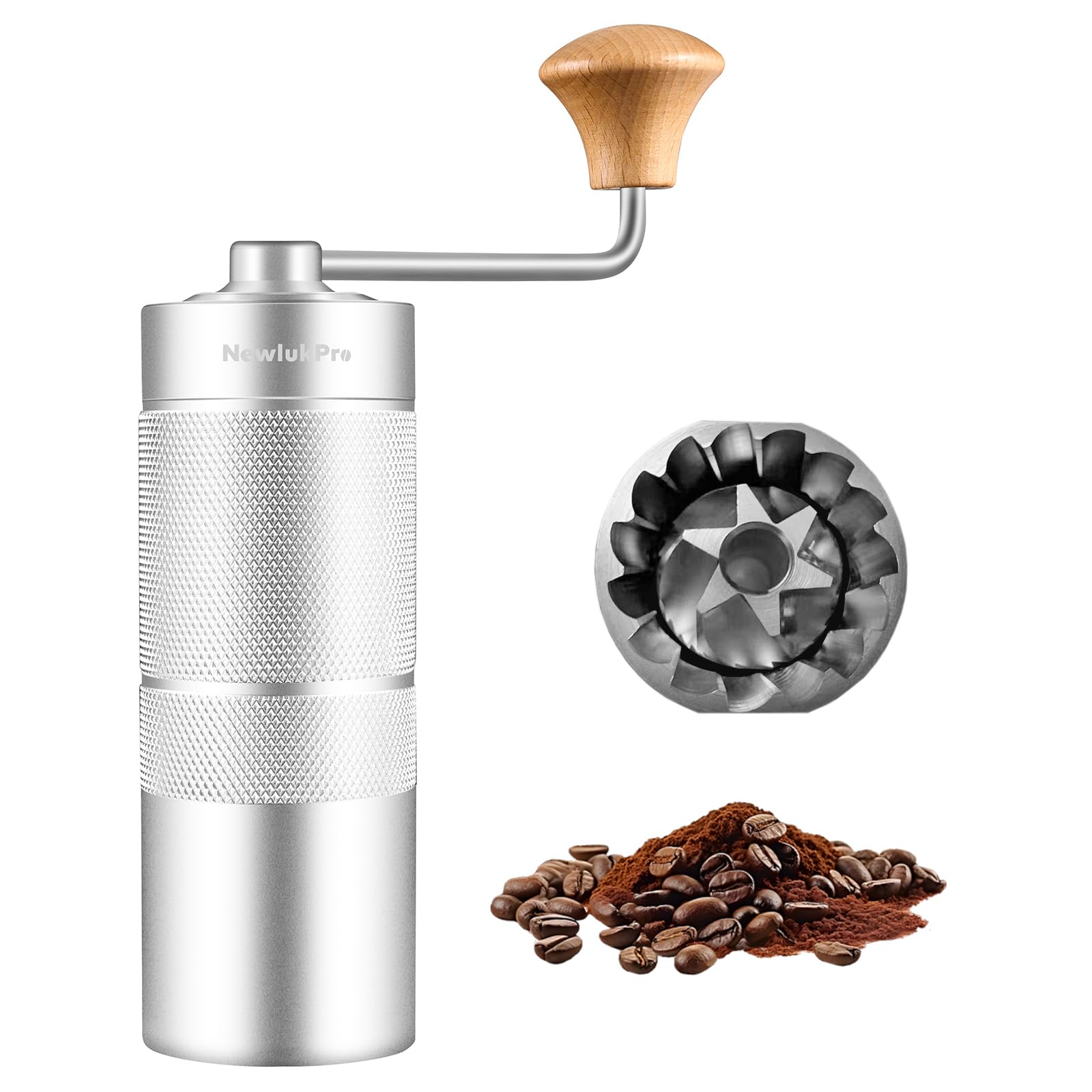
The NewlukPro M6 disproves the assumption that you need to spend a premium to get a conical burr grinder capable of espresso. This hand grinder uses a SUS 420 stainless steel hexagonal burr core with double bearing support, a design that resists the burr wobble that ruins grind consistency in cheap manual grinders. The adjustment mechanism uses a threaded ring at the bottom of the burr shaft — you bottom out the burrs, then back off by counting clicks. Users report that 6 to 8 clicks from zero produces powder fine enough to choke a standard espresso basket.
Build quality is surprisingly high for the price point. The body is machined aluminum rather than plastic or low-grade zinc alloy. The ergonomic handle has a comfortable grip and the crank arm is long enough to provide mechanical advantage without being unwieldy. Grinding 18 grams of light roast espresso takes about 50 seconds at a steady pace. The disassembly is tool-free — the bottom cap unscrews by hand, and the included brush makes cleaning straightforward.
Customer feedback consistently highlights the grind quality as comparable to manual grinders costing three times as much. Several users mention that it outperforms their previous 1Zpresso model in terms of burr alignment and finish. The main limitation is the 25-gram capacity, which is fine for single doses but requires refilling for larger batches. The grind setting markings are printed rather than engraved and can be hard to read in dim light. For the price, this hand grinder delivers espresso-capable precision without the brand markup.
Why it’s great
- SUS 420 hexagonal burr with double bearing support produces wobble-free espresso grind at a fraction of the cost of premium brands.
- Full aluminum construction feels solid and durable, with no plastic parts in the grinding path.
- Tool-free disassembly and included brush make cleaning quick and thorough.
Good to know
- Grind setting markings are printed and difficult to read in low light.
- 25-gram capacity is sufficient for single doses but requires a refill for larger double baskets.
5. AMZCHEF Conical Burr Coffee Grinder CG209

The AMZCHEF CG209 brings a large 10.6-ounce bean hopper and an LED touchscreen to the budget electric grinder segment. The 48 grind settings span from Turkish fine to French press coarse, but the espresso zone — approximately settings 1 through 12 — offers enough step resolution to dial in most beans. The 40-millimeter stainless steel conical burr runs at a moderate speed to minimize heat transfer, preserving volatile oils that contribute to crema production.
The touchscreen allows you to select grind time in 0.5-second increments up to 40 seconds, and you can store your preferred dose by cup count (2 to 12 cups). The anti-static technology works well; the grounds cup collects coffee with minimal cling, and the included brush sweeps out the chute without leaving a coating of fines. The removable hopper features a UV-blocking tint and a trapdoor that prevents beans from spilling when you lift it off for refilling.
Real-world testing shows consistent grind size across the espresso range, with minimal retention inside the burr chamber. Users running it with Breville machines note that the grind quality matches grinders that cost substantially more. The main drawback is that the touchscreen is not completely intuitive — the presets require some experimentation to dial in, and there is a slight delay between pressing the button and the burrs engaging. For the price, this grinder combines a large bean capacity, precise time-based dosing, and clean operation in a single package.
Why it’s great
- 10.6-ounce hopper holds enough beans for a week of daily espresso without refilling.
- LED touchscreen with 0.5-second timer precision enables repeatable dose control.
- Anti-static design and trapdoor hopper minimize mess during grinding and refilling.
Good to know
- Touchscreen presets require trial and error to match your exact dose weight.
- At 5 pounds, the grinder is heavier than most compact options, making countertop placement more permanent.
6. Aromaster Coffee Bean Grinder

The Aromaster electric burr grinder prioritizes two things that matter in a shared kitchen: quiet operation and a clean counter. The motor noise is lower than most grinders in its class, and the anti-static chamber design means coffee grounds land in the cup rather than migrating across the countertop. The 48 grind settings are arranged on a clear stepped dial, and the timer adjusts in continuous increments up to 40 seconds, which covers doses from 12 grams up to about 40 grams depending on the setting.
Grind consistency is a clear step above blade grinders and on par with other electric conical burr machines at this price. The stainless steel burrs produce a narrow particle distribution that works well for espresso, though the finest setting may require a shim for light-roast beans that need an extremely tight gap. Users report that the grinder handles medium and dark roasts without clogging, and the removable ring burr makes cleaning straightforward — a quick brush-out between roast changes prevents flavor carryover.
The 3.9-ounce capacity is appropriate for home use but feels limited if you are pulling shots for multiple people in one session. The tapered bin design includes a UV-blocking tint to slow staling, a thoughtful touch that most budget grinders ignore. One notable durability point: the manufacturer offers a 12-month repair warranty, and customers report prompt replacement service for any defects. For anyone who wants an electric burr grinder that runs quietly and leaves the counter clean, this is a solid choice.
Why it’s great
- Quiet motor and anti-static chamber keep the kitchen noise down and the counter clean.
- 48 stepped grind settings provide fine control across espresso to cold brew.
- 12-month repair warranty with responsive customer service for defect replacements.
Good to know
- 3.9-ounce capacity is sufficient for home use but requires refilling for larger groups.
- Light roasts may need a DIY shim to achieve a fine enough grind for some espresso machines.
7. Tuni G1 Conical Burr Coffee Grinder

The Tuni G1 enters the budget electric grinder conversation with a feature set that rivals grinders costing significantly more. The 48 grind settings are driven by a patented conical burr that spins at a low 450 RPM, which reduces frictional heat and static buildup. Lower burr speed means the coffee particles shear cleanly rather than being pulverized by high-speed impact, resulting in a more uniform particle distribution that translates to better extraction yields.
The integrated portafilter holder accommodates 54-millimeter and 58-millimeter baskets, covering the vast majority of home espresso machines. You can grind directly into the portafilter or use the included dosing cup for larger batches. The touchscreen interface allows grind time adjustments in 0.5-second increments up to 40 seconds, and the memory function retains your last setting between uses. The body features an anti-fingerprint stainless steel finish that actually works — the surface stays clean even after weeks of daily use.
Users report exceptionally low grind retention — around 0.1 to 0.2 grams per dose — which is remarkable at this price and makes single-dosing practical. A soft brush clips magnetically to the hopper lid for quick cleaning. The main caveat is that light-roast espresso may require the included shim to achieve a fine enough grind on some machines. For a feature-rich electric grinder that genuinely performs for espresso without breaking the bank, the Tuni G1 is an outstanding value.
Why it’s great
- Low 450 RPM burr speed minimizes heat and static, producing clean espresso grind consistency.
- Portafilter holder fits both 54mm and 58mm baskets for direct grinding into most home machines.
- Extremely low grind retention (0.1-0.2g) makes single-dosing practical and efficient.
Good to know
- Light-roast beans may require the included shim to reach a fine enough grind for some espresso machines.
- Touchscreen interface has a slight learning curve for setting custom grind times.
FAQ
Can a manual grinder produce fine enough coffee for espresso?
How many grind settings do I need for espresso?
What does grind retention mean and why does it matter?
Is anti-static technology important in a budget espresso grinder?
Can I use a grinder made for drip coffee for espresso?
Final Thoughts: The Verdict
For most users, the budget coffee grinder for espresso winner is the SHARDOR Conical Burr Grinder CG018 because it combines 51 grind settings with a precision 0.1-second timer and a direct-to-portafilter grinding cradle, giving you repeatable espresso dosing without manual effort. If you want the absolute highest grind consistency for your dollar and do not mind cranking, grab the TIMEMORE Chestnut C2S. And for a fully-featured electric grinder with low retention, a two-size portafilter holder, and a quiet 450 RPM burr set, the Tuni G1 delivers remarkable value.

Mo Maruf
I created WellFizz to bridge the gap between vague wellness advice and actionable solutions. My mission is simple: to decode the research and give you practical tools you can actually use.
Beyond the data, I am a passionate traveler. I believe that stepping away from the screen to explore new environments is essential for mental clarity and physical vitality.