Our readers keep the lights on and my smoothie glass nicely filled. As an Amazon Associate, I earn from qualifying purchases.
The gap between “professional cinema” and “affordable gear” has collapsed. Modern budget cinema cameras now deliver 12-bit RAW recording, 13+ stops of dynamic range, and Super 35 sensors that were exclusively found in + bodies just five years ago. The real challenge isn’t finding a good camera—it’s knowing which trade-offs in codec support, lens mounts, and ergonomics actually matter for your specific production workflow.
I’m Mohammad Maruf — the founder and writer behind WellFizz. I’ve spent years analyzing the specifications, codec support, and sensor performance of budget cinema cameras to separate genuine value from misleading marketing claims on Amazon.
Whether you’re shooting a short film, corporate content, or documentary work, this guide breaks down the true contenders for the title of best budget cinema camera by examining measurable specs like bit depth, dynamic range stops, rolling shutter performance, and lens ecosystem flexibility.
How To Choose The Best Budget Cinema Camera
A budget cinema camera is a tool designed around codec flexibility, dynamic range, and manual control over the image pipeline. Unlike consumer camcorders, these cameras prioritize flat log profiles, high bit depth recording, and external recording options. The first decision you make—sensor size and lens mount—will cost or save you thousands in glass down the road.
Sensor Size and Lens Mount Compatibility
Super 35 sensors (APS-C) are the standard for cinema work because they match traditional film frame sizes. Micro Four Thirds (MFT) bodies like the Blackmagic Pocket 4K are smaller but limit shallow depth of field. Full-frame sensors (like the Sony A7 IV) offer wider angles but usually have heavier rolling shutter and require more expensive lenses. The lens mount determines which glass you can use—EF mount gives you access to the largest library of affordable cinema lenses, while RF and Sony E-mount offer native autofocus but fewer budget manual lens options.
Codec Support and Bit Depth
Recording in 10-bit or 12-bit depth allows you to push shadows and highlights in post without banding. The best budget cinema cameras support Apple ProRes or Blackmagic RAW internally. H.264 and H.265 are efficient but tax your computer during editing. Cameras that record to external SSDs via USB-C (like Blackmagic models) let you bypass expensive CFast cards and keep storage costs reasonable.
Dynamic Range and Dual Native ISO
13 stops of dynamic range is the minimum threshold for a budget cinema camera. Dual native ISO (typically 400 and 3200 on Blackmagic sensors) gives you clean low-light performance without amplifying noise. If you shoot interviews, run-and-gun documentaries, or indoor events, prioritize cameras with at least 13 stops and dual gain architecture.
Quick Comparison
On smaller screens, swipe sideways to see the full table.
| Model | Category | Best For | Key Spec | Amazon |
|---|---|---|---|---|
| Blackmagic Pocket Cinema Camera 6K Pro | Cinema Camera | Professional short films | 6K Super 35 / 13 stops DR | Amazon |
| Sony FX30 | Cinema Line | Autofocus-heavy shoots | 6K oversampled 4K / S-Cinetone | Amazon |
| Canon EOS C70 | Cinema EOS | Netflix-approved productions | 4K DGO / 16+ stops DR | Amazon |
| Blackmagic Pocket Cinema Camera 4K | Cinema Camera | Entry-level RAW workflow | 4K MFT / 13 stops DR | Amazon |
| Sony Alpha 7 IV | Hybrid | Hybrid photo/video work | 33MP FF / 4K 60p 10-bit | Amazon |
| Canon XA60 | Pro Camcorder | Long-event recording | 4K UHD / 20x optical zoom | Amazon |
| Blackmagic Micro Studio Camera 4K G2 | Studio Camera | Live multicam production | 12G-SDI / 12-bit RAW | Amazon |
| Canon EOS RP | Mirrorless | Entry-level full-frame stills | 26.2MP FF / 4K (cropped) | Amazon |
| Sony FDR-AX43 | Camcorder | Point-and-shoot family video | 20x zoom / Balanced OIS | Amazon |
In‑Depth Reviews
1. Blackmagic Design Pocket Cinema Camera 6K Pro

The Pocket 6K Pro is the closest thing to an industry-standard cinema body at a mid-range price. Its Super 35 sensor delivers 6144 x 3456 native resolution with 13 stops of dynamic range and dual native ISO up to 25,600, giving you the latitude to push shadows in post without introducing noise. The built-in 2, 4, and 6-stop ND filters eliminate the need for external matte box filters, which alone saves hundreds in accessories.
Recording to CFast 2.0 or SD UHS-II cards is standard, but the USB-C port allows direct recording to external SSDs—a practical advantage for long shoots where swapping cards is disruptive. The tilting 5-inch HDR LCD is bright enough for most indoor environments, though direct sunlight still requires an optional viewfinder or hood. The active Canon EF mount gives you access to the largest ecosystem of affordable cinema glass, including Rokinon, Sigma, and vintage lens collections.
The included DaVinci Resolve Studio license unlocks professional grading tools without additional cost. The main downsides are the LP-E6 battery life (expect about 45 minutes of recording) and the lack of reliable continuous autofocus—this is a manual-focused cinema body. If you’re shooting narrative work or controlled interviews, the image quality per dollar is unmatched in this bracket.
Why it’s great
- Built-in 2-6 stop ND filters for quick exposure control outdoors
- Records 6K Blackmagic RAW to external SSD via USB-C
- 13-stop dynamic range with dual native ISO for clean shadows
Good to know
- LP-E6 battery lasts ~45 minutes; external battery recommended
- No reliable continuous autofocus—manual focus only
- Screen is difficult to read in bright sunlight
2. Sony Cinema Line FX30

The FX30 brings Sony’s Cinema Line features—Cine EI, S-Log3, and user LUTs—into an APS-C body that costs half the FX3. The 20.1 MP Exmor R sensor oversamples 6K down to 4K, producing exceptionally sharp footage with dual base ISO (typically 800 and 2500) for usable low-light performance. The active cooling system means you can record 4K 60p 10-bit 4:2:2 indefinitely without overheating, a critical advantage over hybrid mirrorless cameras.
Autofocus is where the FX30 separates itself from Blackmagic bodies—Sony’s phase-detection AF with real-time Eye Tracking locks onto subjects reliably, making it the better choice for gimbal work, run-and-gun docs, or single-operator interviews. The full-size HDMI port and dual SD card slots (both UHS-II compatible) simplify on-set storage and monitoring. S-Cinetone color science delivers pleasing skin tones straight out of camera, reducing grading time for corporate or social media content.
Battery life is adequate at roughly 1 to 1.5 hours with the NP-FZ100, but heavier use requires an external V-mount solution. The APS-C sensor limits shallow depth of field compared to full-frame options, and 4K 120p has a significant crop factor. For content creators who need reliable autofocus and a compact cinema rig, the FX30 is a strong contender.
Why it’s great
- Reliable phase-detection autofocus with real-time Eye Tracking
- Active cooling allows unlimited 4K 60p recording
- S-Cinetone color science for pleasing skin tones out of camera
Good to know
- APS-C sensor limits shallow depth of field vs. full-frame
- Battery life runs 1-1.5 hours under normal use
- 4K 120p mode has a significant crop factor
3. Blackmagic Design Pocket Cinema Camera 4K

The Pocket 4K uses a 4/3-inch image sensor with a native 4096 x 2160 resolution and an active MFT lens mount. With 13 stops of dynamic range and dual gain ISO up to 25,600, it captures the same latitude and noise profile as its Super 35 siblings in a smaller, lighter package. The MFT mount gives you access to affordable cine lenses (like the Meike and Rokinon Cine series) and adapters for almost every vintage lens mount ever made.
Recording options are flexible: SD UHS-II cards, CFast 2.0 cards, or external SSDs via USB-C. The included DaVinci Resolve Studio license covers the full grading and editing pipeline. The 5-inch LCD touchscreen is functional for framing and focus peaking, though battery life with the included LP-E6 is short—roughly 30 to 40 minutes—so budget for external power or a battery grip.
The Pocket 4K lacks in-body stabilization, continuous autofocus, and a tilting screen, making it less suited for handheld gimbal work or vlogging. However, for tripod-based interviews, narrative short films, or any scene where you control the lighting and movement, this body delivers cinema-quality codecs at a fraction of the cost of comparable systems.
Why it’s great
- Records 12-bit Blackmagic RAW internally at 4K DCI
- USB-C port enables direct recording to affordable SSDs
- Active MFT mount adapts to almost any vintage lens
Good to know
- LP-E6 battery life is roughly 30-40 minutes
- No in-body stabilization or continuous autofocus
- Screen is difficult to see in bright outdoor conditions
4. Canon EOS C70 Cinema Camera
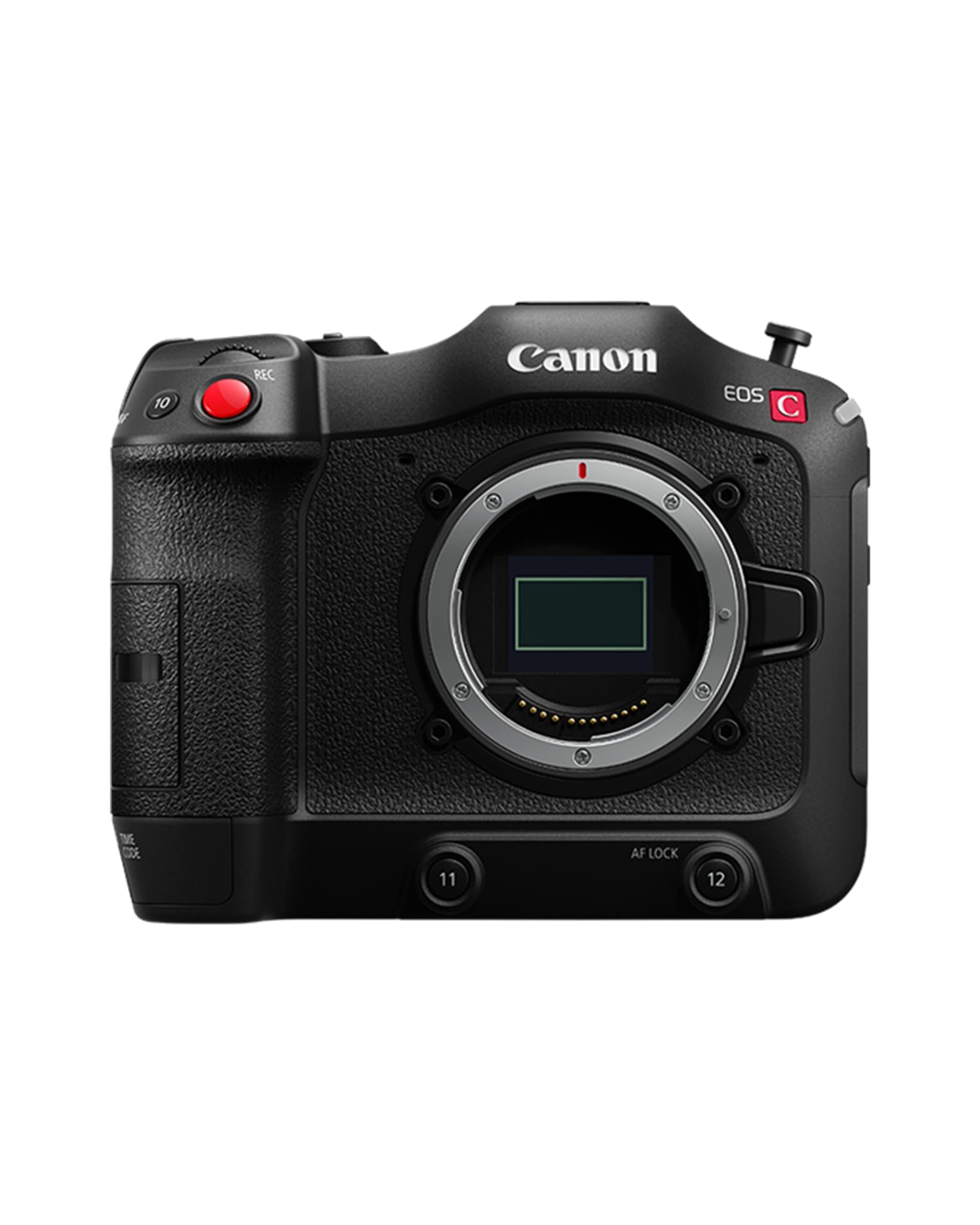
The Canon EOS C70 is built around the 4K Super 35 Dual Gain Output sensor, an advanced design that captures two gain readings per pixel to combine highlight retention with low-noise shadows. The result is 16+ stops of dynamic range, surpassing every other body on this list in latitude and shadow recovery. The camera is officially approved for Netflix productions, which speaks to its reliability in professional pipelines.
The RF mount gives native compatibility with Canon’s RF lenses, and the included 0.71x EF adapter lets you mount EF glass with a focal reduction benefit. Dual SD card slots support simultaneous recording in XF-AVC and MP4, and the built-in ND filters (2 to 10 stops—yes, 10 stops) handle exposure transitions smoothly. The fully articulating LCD screen and vertical shooting mode make this adaptable for both traditional cinema and vertical social media content.
Weaknesses include the lack of a built-in electronic viewfinder, a plastic body that scratches easily, and reports of the LCD hinge becoming unreliable over time. The digital image stabilization introduces noticeable jitter in handheld shots unless paired with an RF lens with optical IS. At this price point, the C70 targets production houses and experienced shooters who need Netflix-grade compliance, not beginners building their first kit.
Why it’s great
- 16+ stops of dynamic range from the Dual Gain Output sensor
- Built-in ND filters covering 2 to 10 stops
- Netflix-approved for professional production workflows
Good to know
- No built-in electronic viewfinder (EVF)
- Plastic body is prone to scratching
- Digital IS can introduce jittery footage without stabilized lenses
5. Sony Alpha 7 IV

The Sony A7 IV is fundamentally a hybrid stills/video camera, not a dedicated cinema body, but its video specs place it firmly in the budget cinema conversation. The 33MP full-frame Exmor R sensor oversamples 7K down to 4K 30p in 10-bit 4:2:2, producing rich detail with full pixel readout. The BIONZ XR processor enables 4K 60p (with an APS-C crop) and supports S-Log3, S-Cinetone, and S-Gamut color spaces for flexible grading.
Autofocus is the standout feature here—693 phase-detection points with real-time Eye AF for both humans and animals. For run-and-gun video work, it locks onto subjects faster than any Blackmagic or Canon cinema body at this price. The IBIS system provides 5.5 stops of stabilization, which is effective enough for handheld gimbal-free shooting in controlled conditions.
The main drawbacks for cinema use are the 4K 60p crop (1.5x is significant), the lack of internal RAW recording (only 10-bit Long GOP H.265 or All-I), and the absence of a built-in ND filter. For shooters who also need high-resolution stills work and prioritize autofocus, the A7 IV is a strong hybrid tool.
Why it’s great
- Exceptional phase-detection autofocus with real-time Eye AF
- 7K oversampled 4K 30p with 10-bit 4:2:2 color
- 5.5-stop IBIS for smooth handheld footage
Good to know
- 4K 60p mode introduces a 1.5x APS-C crop
- No internal RAW recording—ProRes or RAW requires external recorder
- No built-in ND filters; requires third-party VND
6. Canon XA60 Professional Camcorder

The Canon XA60 is a traditional camcorder with a 1/2.3-inch CMOS sensor and a 20x optical zoom lens (26.8mm wide to 536mm telephoto). This is not a cinema camera—it lacks RAW recording, log profiles, and interchangeable lenses—but for event videography, lectures, or live streaming, the immediate convenience of built-in zoom and XLR audio inputs makes it a practical tool. The DIGIC DV6 processor handles 4K UHD 160 Mbps recording in both XF-AVC and MP4 formats.
Infrared mode and optical image stabilization provide steady footage in low light and during handheld operation. Dual SD card slots allow relay or simultaneous recording, which is critical for multi-hour events. The detachable handle unit includes two XLR terminals with phantom power, plus a 3.5mm audio input, giving you professional audio control without external interfaces.
Reviews note that the video quality is grainy in all settings and poor in low light compared to cinema bodies with larger sensors. The autofocus is adequate but not fast enough for unpredictable movement. The XA60 is a specialized tool for controlled environments where 4K recording and audio flexibility matter more than cinematic depth of field or color grading latitude.
Why it’s great
- Built-in 20x optical zoom eliminates lens swapping
- Dual XLR inputs with phantom power on detachable handle
- Dual SD card slots for relay recording of long events
Good to know
- 1/2.3-inch sensor produces grainy footage in low light
- No RAW or log recording—minimal grading flexibility
- Autofocus is slow for fast-moving subjects
7. Blackmagic Design Micro Studio Camera 4K G2

The Micro Studio Camera 4K G2 is a compact live-production camera designed for multicamera setups with ATEM switchers. It uses an MFT sensor with similar 4K resolution and 13 stops of dynamic range as the Pocket 4K, but the form factor and connectivity are completely different. The body is stripped down—no screen, no EVF, no internal recording to SD cards—relying on 12G-SDI output for video transport and an HDMI port for monitoring.
Dual native ISO of 400 and 3200 keeps noise manageable in broadcast lighting environments. The built-in tally light, remote camera control over SDI, and color correction tools make it a natural fit for studio chat shows, sports coverage, and conference presentations. The USB-C 3.1 port allows recording to external SSDs or connection to Blackmagic accessories like the Video Assist 12G.
The biggest limitation is the lack of an integrated screen—you must pair it with an external monitor or a Blackmagic Video Assist for framing and menu navigation. The DIN connectors are non-standard and require adapters for conventional audio gear. This camera is not a standalone cinema tool; it’s a specialist broadcast component that excels when integrated into a multicamera workflow.
Why it’s great
- Ultra-compact body designed for multicamera studio rigs
- 12G-SDI input and output for seamless ATEM integration
- Dual native ISO and 13 stops of dynamic range for clean broadcast footage
Good to know
- No built-in screen—requires external monitor or Video Assist
- DIN connectors need adapters for standard audio gear
- LP-E6 battery gives roughly 30 minutes of runtime
8. Canon EOS RP

The Canon EOS RP is the lightest and most compact full-frame mirrorless camera in Canon’s lineup. The 26.2MP CMOS sensor and DIGIC 8 processor deliver excellent still-image quality with pleasing color science, and the Dual Pixel CMOS AF provides fast, accurate autofocus in live view. The RF mount opens access to Canon’s modern lens lineup, and the optional adapter works with older EF and EF-S glass.
For video, the EOS RP records 4K 25/30p, but with a significant 1.6x crop factor and no C-Log or 10-bit output. The 1080p 60p footage is usable for casual content, but the lack of log profiles, internal 10-bit recording, and flat color profiles limits grading potential. The camera can function as a webcam via the EOS Utility for streaming, which is a handy bonus for creators building a home studio.
This is not a dedicated cinema camera—it lacks the codec flexibility, dynamic range, and color depth needed for serious grading work. Its strength is as a lightweight full-frame photography camera that can shoot acceptable video for vlogging, interviews, or B-roll that won’t be heavily color-graded. For pure photography, it’s a bargain entry into full-frame RF mount.
Why it’s great
- Lightest full-frame EOS body; comfortable for all-day carry
- Excellent still-image quality with warm color science
- Dual Pixel CMOS AF provides fast, reliable autofocus
Good to know
- 4K video has a heavy 1.6x crop and no C-Log or 10-bit
- Limited video frame rate choices at 4K resolution
- Not suitable for professional grading workflows
9. Sony FDR-AX43 Handycam

The Sony FDR-AX43 is a compact camcorder designed for family videography and point-and-shoot convenience. Its 1/2.5-inch Exmor R CMOS sensor and BIONZ X processor record 4K video with Balanced Optical SteadyShot stabilization—a built-in gimbal mechanism that smooths handheld walking shots impressively well. The 20x optical zoom (30x Clear Image Zoom in 4K, 40x in HD) reaches distant subjects without pixelation.
The microphone input allows basic external audio upgrades, and the Wi-Fi connectivity enables remote control via smartphone. The Highlight Movie Maker feature automatically edits short highlight reels from recorded footage, which is helpful for casual users. The battery life is decent for a compact camcorder, lasting through a full family outing.
The AX43 lacks any manual exposure controls, log profiles, or flat gamma curves needed for color grading. The small sensor struggles in low light, and the lack of internal memory requires you to supply a separate SD card. This is not a budget cinema camera—it’s a family camcorder that happens to shoot 4K. Buyers serious about cinema-level image quality should look at the Blackmagic or Sony cinema line options.
Why it’s great
- Built-in Balanced Optical SteadyShot functions like a gimbal
- 20x optical zoom reaches subjects without swapping lenses
- Wi-Fi remote control via smartphone app
Good to know
- Small 1/2.5-inch sensor struggles in low light
- No log profiles or manual exposure for grading
- Requires separate SD card; no internal memory
FAQ
Why do budget cinema cameras often lack in-body stabilization (IBIS)?
Can I use vintage lenses with a Blackmagic Pocket Cinema Camera?
How much do I need to budget beyond the camera body for a working cinema kit?
Final Thoughts: The Verdict
For most users, the best budget cinema camera winner is the Blackmagic Pocket Cinema Camera 6K Pro because it combines professional 6K RAW recording, built-in ND filters, and 13 stops of dynamic range in a body designed around a cinema workflow. If you need reliable autofocus and a more compact run-and-gun setup, grab the Sony FX30. And for Netflix-approved productions with the highest dynamic range, nothing beats the Canon EOS C70.

Mo Maruf
I created WellFizz to bridge the gap between vague wellness advice and actionable solutions. My mission is simple: to decode the research and give you practical tools you can actually use.
Beyond the data, I am a passionate traveler. I believe that stepping away from the screen to explore new environments is essential for mental clarity and physical vitality.