Our readers keep the lights on and my smoothie glass nicely filled. As an Amazon Associate, I earn from qualifying purchases.
A chop saw that binds, drifts, or stalls on a 2×4 isn’t a bargain — it’s a frustration. In the entry-level tier, the difference between a capable tool and a workshop headache comes down to motor torque, blade quality, and the rigidity of the fence and base. This guide separates the few that deliver clean, repeatable cuts from the ones that will cost you more in material waste than you saved at checkout.
I’m Mohammad Maruf — the founder and writer behind WellFizz. I’ve spent years analyzing power-tool specifications, customer durability reports, and real-world cutting performance data to identify the specific motor specs, arbor designs, and blade configurations that actually hold up under moderate use.
Whether you are trimming out a room, cutting metal conduit, or framing a shed, this research cuts through the noise to find the best budget chop saw that won’t compromise accuracy or longevity.
How To Choose The Best Budget Chop Saw
Buying a budget-friendly chop saw means prioritizing where the money goes. The three most important areas are motor power, blade compatibility, and the rigidity of the cutting bed. A weak motor will bog down on hardwoods, a proprietary arbor limits blade upgrades, and a flexible fence makes repeatable angle cuts nearly impossible.
Motor Amperage and Torque
A 15-amp motor running at 5,000 RPM is the sweet spot for cutting through pressure-treated lumber, hardwoods, and soft metals without stalling. 10-amp motors are lighter and fine for trim and PVC, but they lack the thermal mass to sustain cuts on dense material without slowing down. Look for copper-wound motors — they dissipate heat better and last longer under load.
Blade Size and Arbor Compatibility
Most budget-friendly saws use 7-1/4-inch, 8-1/2-inch, or 10-inch blades. A 10-inch blade offers the deepest cut (roughly 3-1/2 inches at 90 degrees), which is necessary for 4×4 posts and thick stock. The arbor hole is usually 5/8-inch, but some multi-material saws use a proprietary arbor that limits blade selection. If you plan to swap blades for different materials, a standard 5/8-inch arbor is essential.
Bevel and Miter Range
For crown molding, baseboards, and picture frames, a single-bevel saw with 0-45 degrees of tilt on one side is sufficient. Dual-bevel saws tilt both left and right, saving time on complex cuts but adding cost. On a budget, single-bevel with positive miter stops at common angles (15, 22.5, 30, 45 degrees) gives you the most utility per dollar.
Quick Comparison
On smaller screens, swipe sideways to see the full table.
| Model | Category | Best For | Key Spec | Amazon |
|---|---|---|---|---|
| Metabo HPT C10FCG2 | Miter Saw | Precision Woodworking | 15A / 5,000 RPM / 24.2 lbs | Amazon |
| Evolution R210CMS | Multi-Material | Metal & Wood Cutting | 1200W / 8-1/4″ / TCT Blade | Amazon |
| BOSCH CM8S | Sliding Compound | Compact Professional Use | 8-1/2″ / 37 lbs / Sliding Rail | Amazon |
| DOVAMAN DMS01A | Sliding Miter | Multi-Material DIY | 15A / Dual Speed / 3 TCT Blades | Amazon |
| Evolution R185SMS+ | Sliding Multi-Mat. | Versatile Jobsite Work | 1500W / 7-1/4″ / Laser Guide | Amazon |
| SKIL MS6306-00 | Sliding Miter | Compact Trim Work | 10A / 7-1/4″ / LED Shadow Line | Amazon |
| Genesis GMS1015LC | Compound Miter | Homeowner Trim Projects | 15A / 10″ / Laser Guide | Amazon |
| MarvTool JS-1017C3 | Compound Miter | Lightweight DIY Cutting | 15A / 10″ / 20.5 lbs | Amazon |
| Hoteche 7-1/4-Inch | Compound Miter | Small Job Starter Saw | 7.5A / 7-1/4″ / Laser Guide | Amazon |
In‑Depth Reviews
1. Metabo HPT 10-Inch Single Bevel Compound Miter Saw C10FCG2
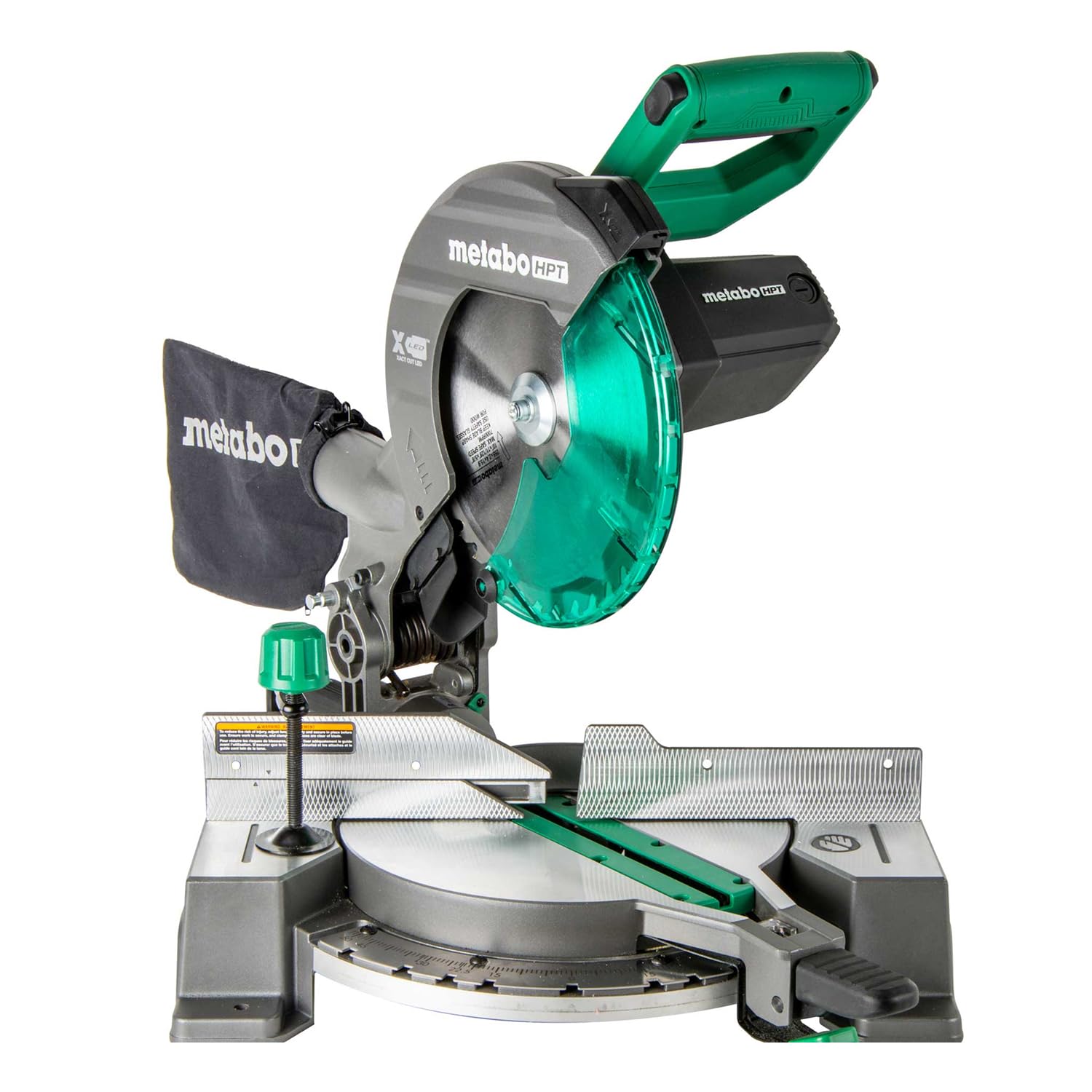
Metabo HPT’s C10FCG2 delivers the strongest motor-to-weight ratio in this lineup. The 15-amp, 5,000 RPM motor cuts through oak and pressure-treated lumber without bogging, yet the saw weighs only 24.2 pounds — light enough to carry between job sites without a dedicated stand. The Xact Cut shadow line eliminates the alignment hassle of lasers and stays accurate even after the saw has been bounced around in a truck bed.
The 10-inch blade provides a 3-5/8-inch depth of cut at 90 degrees, enough for 4×4 dimensional lumber. Miter range covers 0-52 degrees left and right, and the bevel tilts 0-45 degrees left with adjustable stops. Users reported the saw arrived square out of the box, requiring only minimal tweaking to the detent plate for perfect 90-degree cuts. The vice clamping system grips workpieces firmly without slipping, and the large table offers solid support for baseboards and trim.
Dust collection is adequate for a bag system but improved significantly with a shop-vac adapter. A few users noted the motor had a brief break-in period with an initial odor that dissipated after several cuts. The 5-year tool body warranty provides peace of mind that is rare at this price tier. For anyone needing a versatile, lightweight saw that does not compromise on power, this is the clear first pick.
Why it’s great
- 15-amp motor delivers consistent, stall-free cuts on hardwoods and pressure-treated lumber
- Shadow line alignment is more durable and accurate than laser guides on other budget models
- Lightweight 24.2-pound design makes transport and storage effortless
Good to know
- Dust collection bag works but benefits from an aftermarket vacuum adapter
- Some units require initial calibration of the bevel detent for true 90-degree cuts
2. Evolution Power Tools R210CMS Compound Miter Saw

The Evolution R210CMS is the only saw in this price range that ships with a Japanese TCT blade capable of cutting steel, aluminum, wood with embedded nails, and plastic without changing blades. The 1200W hi-torque motor and optimized gearbox deliver smooth, burr-free cuts on 2020 aluminum extrusions and mild steel tubing. The 8-1/4-inch blade size keeps the saw compact while offering enough depth for most residential and light fabrication work.
Miter range spans 45 degrees left and right, and the bevel tilts from 0 to 45 degrees. The onboard angle markings are printed rather than engraved, so serious users will want to verify cuts with a machinist’s square. The 3-year manufacturer’s warranty covers defects and is notably better than the 1-year terms common on budget tools. The arbor is convertible to 5/8-inch by flipping a collar, allowing aftermarket blade upgrades for woodworking-specific applications.
Chip management is the saw’s primary trade-off. The included dust bag captures minimal debris, and metal shavings tend to fly everywhere despite vacuum attachment. Some users reported that extended metal cutting causes chips to melt into the plastic guard, so cleaning after each session is recommended. For a dedicated multi-material saw that transitions between wood and metal instantly, this Evolution model is the specialist pick.
Why it’s great
- Patented TCT blade cuts steel, aluminum, wood, and plastic without blade changes
- Convertible arbor accepts standard 5/8-inch blades for woodworking upgrades
- 3-year warranty provides exceptional coverage for a budget-priced tool
Good to know
- Angle markings are printed, not engraved — verify with a square for precision work
- Dust collection is poor especially during metal cutting; shop vac is essential
3. BOSCH 8-1/2 Inch Single Bevel Sliding Compound Miter Saw CM8S

The Bosch CM8S delivers 12-1/4-inch crosscut capacity in a footprint that is 30 percent lighter than a typical 10-inch sliding saw. At 37 pounds, it rides easily on a cart or job-site stand, and the compact rail system lets you position it flush against a wall — a critical advantage in tight workshops. The bevel lock lever and turret stops are located on the side of the saw, eliminating the need to reach behind the tool for adjustments.
Cut quality is excellent out of the box, with users reporting true 90-degree cuts on pine and oak without calibration. The integrated expanding base extends up to 29 inches left to right, supporting longer workpieces without sagging. The clear lower guard provides good visibility of the cut line, though the included dust collection falls short — even with a shop vac, some fine dust escapes. Several long-term owners report owning this model for 8 years without mechanical issues, confirming Bosch’s reputation for durability.
The 8-1/2-inch blade limits depth of cut to roughly 2-1/2 inches at 90 degrees, which is adequate for 2x4s but insufficient for 4×4 posts. The saw also lacks a positive detent at 35 degrees for crown molding, requiring manual measurement for compound cuts. For finish carpenters and trim specialists who prioritize portability and crosscut capacity over raw depth, the CM8S is the premium choice.
Why it’s great
- Compact sliding rail design provides 12-1/4-inch crosscut capacity in a small footprint
- Side-mounted bevel controls allow quick adjustments without reaching behind the saw
- Proven long-term durability with many units still running after 8 years of use
Good to know
- 8-1/2-inch blade limits depth to about 2-1/2 inches; not suitable for 4×4 lumber
- Dust collection is underwhelming even with a shop vac; expect some cleanup
4. DOVAMAN Updated 10-Inch Sliding Miter Saw DMS01A

The DOVAMAN DMS01A bundles a 15-amp motor, dual-speed settings (5,000 RPM for wood and 3,200 RPM for metals), and three TCT blades in one package. The dual-speed selector lets you switch between aggressive wood cutting and slower, cooler metal cuts without swapping the blade — a feature normally reserved for saws twice the price. The sliding rail provides a 13-inch travel range, and the extendable side tables push the maximum cut width to 13.4 inches, handling wide panels and shelving material.
Ambidextrous dual lock switches make the saw equally comfortable for left- and right-handed operators, a thoughtful design detail often missing from budget tools. The laser guide is bright and adjustable, though some users found it required recalibration after transporting the saw. The included 40- and 48-tooth TCT blades are serviceable out of the box, but several owners recommend upgrading to a Diablo blade for noticeably smoother cuts in hardwoods.
Build quality is solid for the price point, with a robust steel sliding mechanism and minimal play in the rails. One unit arrived with shipping damage, but the seller resolved it quickly, suggesting responsive customer support. The saw weighs 37.4 pounds — heavier than the Metabo HPT but reasonable for a sliding model. For DIYers who cut multiple material types and want a ready-to-use kit, the DOVAMAN offers the most accessories per dollar.
Why it’s great
- Dual-speed motor (5,000 / 3,200 RPM) optimizes cut quality for wood vs. metal
- Includes three TCT blades and spare carbon brushes — ready to work out of the box
- Ambidextrous switches make it accessible for both left- and right-handed users
Good to know
- Included blades are functional but upgrading to a premium blade improves cut finish
- Laser guide may drift after transport; recalibration is straightforward
5. Evolution Power Tools R185SMS+ Sliding Miter Saw

The Evolution R185SMS+ upgrades the fixed-head design of the R210CMS to a sliding compound configuration, giving you wider crosscut capacity in a 7-1/4-inch blade package. The 1500W hi-torque motor and optimized gearbox are tuned for multi-material cutting, and the included TCT blade slices through mild steel with virtually no sparks, heat, or burrs. The miter range spans 50 degrees left and right, with a bevel capacity of 0-45 degrees, covering every common angle for trim and structural work.
Ball-bearing slides provide smooth, wobble-free travel, and the laser cutting guide aids alignment on dark or patterned materials where shadow lines struggle. The carry handle and 0.01-ounce shipping weight (actual unit weight is approximately 35 pounds) make it portable enough for job-site rotation. Users praised the customer support team, noting that a replacement clamp arrived within three days after a shipping issue. The 3-year manufacturer’s warranty backs the tool, which is competitive with much pricier options.
The primary downsides are the lack of a grounded plug (the cord uses a two-prong design) and the small-ish 7-1/4-inch blade, which maxes out at about 2-1/4-inch depth of cut. This is adequate for 2x4s and metal tubing but insufficient for thicker stock. The dust collection bag is present but largely decorative for metal work — expect chips to scatter. For a sliding saw that cuts wood and metal without compromise, this Evolution model is a strong mid-range contender.
Why it’s great
- Sliding rail design with ball bearings delivers smooth, accurate crosscuts on wide material
- Multi-material TCT blade cuts steel, aluminum, and wood without sparks or burrs
- 3-year warranty and responsive customer support provide strong post-purchase protection
Good to know
- Two-prong cord lacks a ground plug; not ideal for all job-site safety requirements
- 7-1/4-inch blade limits depth of cut to roughly 2-1/4 inches
6. SKIL 10 Amp 7-1/4″ Single Bevel Miter Saw MS6306-00

SKIL’s MS6306-00 uses a compact rail system that minimizes the saw’s benchtop-to-wall footprint, allowing you to work flush against a wall — a significant advantage in cramped garages and workshops. The 10-amp motor spins at 4,800 RPM and handles 2×10 crosscuts at 90 degrees, making it capable for flooring and shelving projects despite the lower amperage. The LED shadow line projects a bright, sharp cut indicator that is more reliable than lasers because there are no batteries or alignment screws to drift.
The miter capacity spans 47 degrees left and 50 degrees right, with positive stops at 0, 15, 22.5, 31.6, and 45 degrees on both sides. The bevel tilts 45 degrees left only — a single-bevel limitation that is typical at this price but means you must flip the workpiece for opposite-angle bevel cuts. The quick-work clamp secures materials quickly, and the overall weight of under 25 pounds makes it one of the most portable sliding saws on the market.
A 30-year carpenter with a larger Metabo 12-inch saw in his main shop reported buying this SKIL for portability and was impressed by its accuracy. The included 24-tooth carbide blade is adequate for framing lumber but rough on trim — swapping to a 40-tooth finish blade improves cut quality noticeably. For smaller shops where space is the primary constraint, the SKIL’s wall-friendly rail system and shadow line make it a smart, space-efficient choice.
Why it’s great
- Compact rail system allows flush-to-wall positioning, saving valuable benchtop space
- LED shadow line provides precise cut indication without batteries or laser drift
- Lightweight sub-25-pound design is easy to carry and store between projects
Good to know
- 10-amp motor may stall on dense hardwoods or thick pressure-treated lumber
- Single-bevel design requires flipping material for opposite-angle bevel cuts
7. Genesis GMS1015LC 15-Amp 10-Inch Compound Miter Saw

The Genesis GMS1015LC brings a 15-amp motor and a 60-tooth carbide-tipped blade to the entry-level tier, delivering clean cuts on 2x4s, baseboards, and trim right out of the box. The 10-inch blade provides a 3-1/2-inch depth of cut at 90 degrees, and the electric brake stops the blade in seconds after trigger release — a critical safety feature that is not universal at this price. The integrated laser guide is powered by two AAA batteries and helps beginners visualize the cut path, though it requires occasional calibration to stay aligned.
Miter adjustments feature 9 positive detent stops at commonly used angles, locking firmly into position for repeatable cuts. The die-cast aluminum base keeps the saw sturdy during operation while maintaining portability. Users consistently report that the Genesis cuts 4×4 posts easily, and the included hold-down clamp secures workpieces without slipping. The dust bag is present but nearly useless due to its poor angle of attachment — most users bypass it entirely with a shop-vac hose.
The saw is loud — ear protection is mandatory even for short sessions — and the extension wings provide only basic support for lumber over 8 feet. A few owners noted the motor uses bushings rather than ball bearings, which may limit long-term durability under heavy daily use. For weekend warriors and homeowners tackling trim, shelving, and occasional deck repairs, the Genesis delivers the highest power-to-cost ratio in this tier.
Why it’s great
- 15-amp motor with electric brake delivers safe, powerful cuts on 4×4 lumber
- 9 positive miter stops lock at common angles for repeatable, accurate cuts
- 60-tooth carbide blade included provides clean finish cuts on trim and molding
Good to know
- Dust bag is poorly angled and virtually ineffective; plan to use a shop vac
- Motor uses bushings instead of ball bearings, potentially limiting lifespan under heavy use
8. MarvTool 10-Inch Compound Miter Saw JS-1017C3
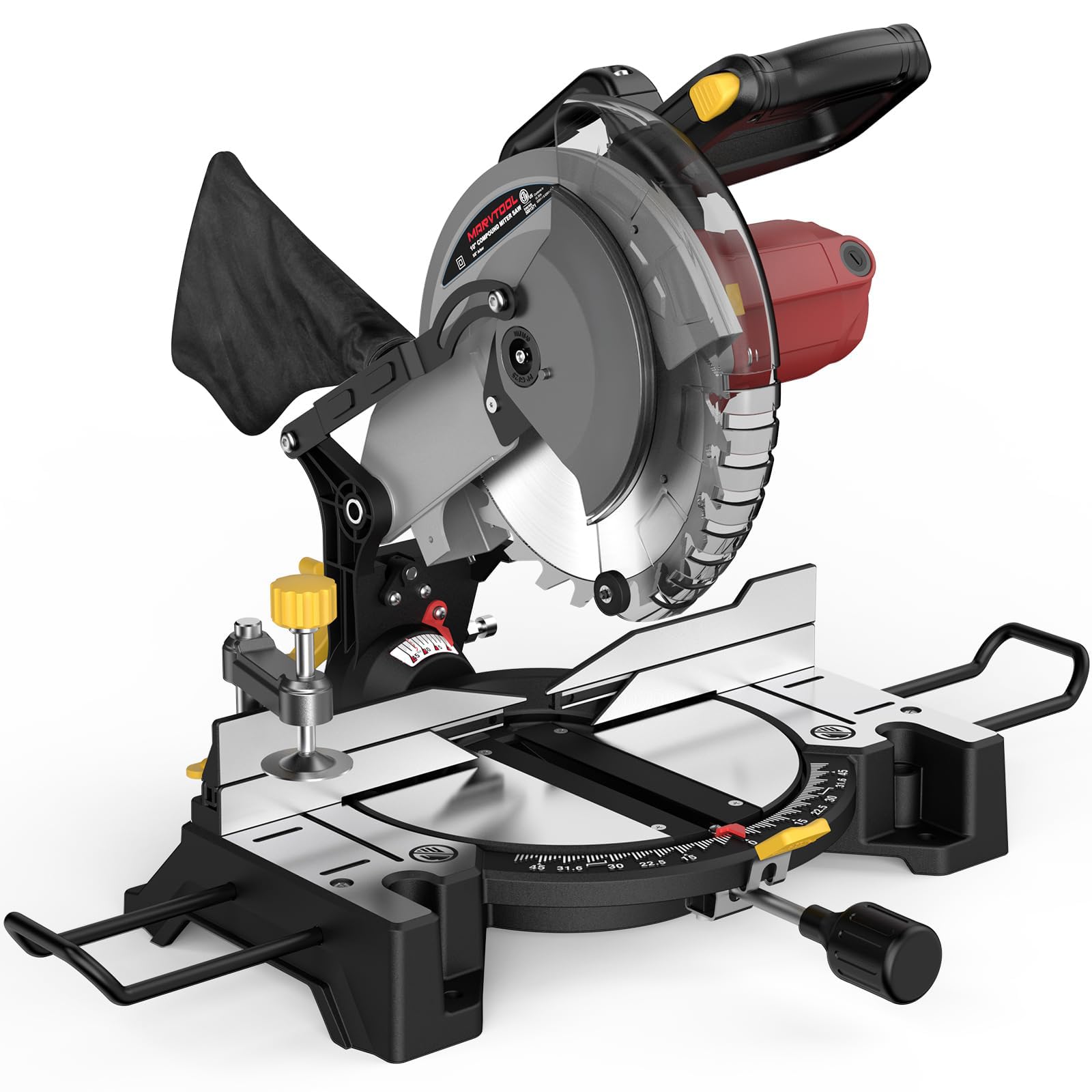
The MarvTool JS-1017C3 is the lightest 10-inch compound miter saw in this guide at only 20.5 pounds, making it the go-to option for users who need to carry the saw up stairs, into attics, or between workstations frequently. The 15-amp motor spins at 5,000 RPM and handles 2×4 and 4×4 pressure-treated lumber without stalling, according to users who reported over a hundred cuts with no performance drop. The 36-tooth TCT blade is sufficient for framing and rough cuts, but upgrading to a higher-tooth-count finish blade improves edge quality noticeably.
Miter adjustments cover 0-45 degrees left and right, and the bevel tilts 0-45 degrees left. The extension tables provide additional support for longer workpieces, and the included clamp secures materials during cutting. The transparent blade guard offers good visibility of the cut line, and the head locks securely into the base via a release knob for compact storage. Several users praised the quick setup, reporting they were making accurate cuts within minutes of unboxing.
The depth stop is functional but feels flimsy compared to metal stops on pricier saws, and rotating the saw to acute miter angles requires loosening the knob significantly, which slows down workflow. A few users recommended building a wood fence to replace the stock fence for improved accuracy on repeat cuts. For small-framed users, female DIYers, or anyone who prioritizes portability above all else, the MarvTool offers impressive power in the lightest package available.
Why it’s great
- Weighs only 20.5 pounds — the lightest 10-inch compound miter saw in this guide
- 15-amp motor delivers enough torque for 4×4 pressure-treated lumber cuts
- Quick setup out of the box with easy-to-use miter and bevel adjustments
Good to know
- Depth stop feels flimsy and may not hold up to frequent adjustments
- Rotating to acute miter angles requires significant knob loosening, slowing workflow
9. Hoteche 7-1/4-Inch Compound Single Bevel Chop Saw
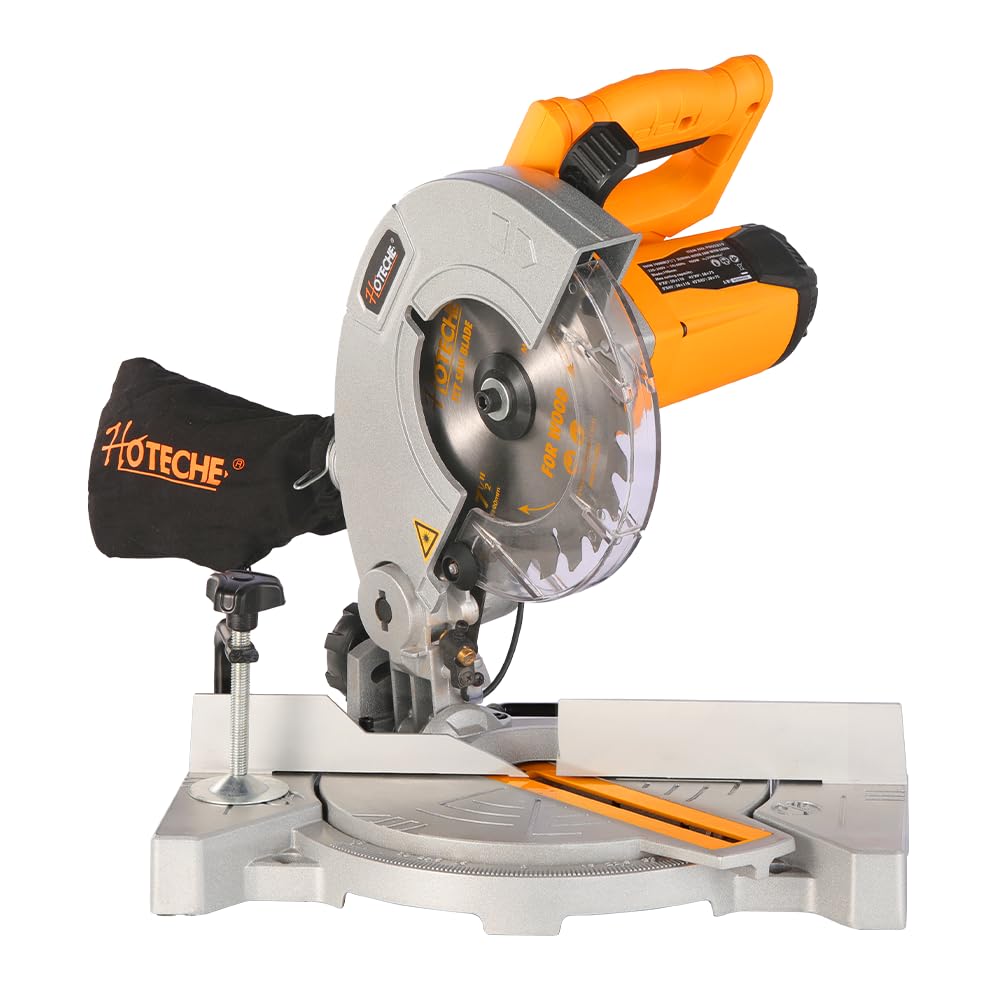
The Hoteche 7-1/4-inch saw is the most affordable entry point in this guide, designed for light-duty projects like window casing, picture frames, and small trim work. The 7.5-amp copper-wound motor delivers 5,500 RPM — higher spin speed than many 15-amp saws — which helps maintain clean cuts in softwoods and PVC. The built-in laser guide is responsive and helpful for beginners, though it requires occasional re-calibration. Users reported the saw worked perfectly for small molding projects right out of the box.
The sliding arm provides a maximum crosscut of 120mm x 45mm at 90 degrees, adequate for 2x4s but too small for wider boards. Miter stops lock at 0, 15, 22.5, 30, and 45 degrees, and the bevel tilts left for compound cuts. The included accessories — extension bars, hex wrenches, dust bag, and carbon brushes — provide good value for the price. The fence is slightly shallow, limiting the width of material that can be supported, but the saw remains stable thanks to the aluminum base with rubber feet.
The 7-1/4-inch blade size is the primary limitation — it cannot cut through 4×4 posts or thick hardwood beams. Users also noted the instruction manual is unclear about the blade lock release mechanism, though the seller provided a helpful video. For a complete beginner who is not sure how much they will use the tool, the Hoteche offers a functional, low-risk introduction to chop saws without a large financial commitment.
Why it’s great
- Lowest entry price point makes it an accessible starter saw for complete beginners
- High 5,500 RPM spin speed maintains clean cuts in softwoods and PVC
- Includes extension bars, wrenches, dust bag, and spare carbon brushes
Good to know
- 7-1/4-inch blade cannot cut 4×4 posts or thick hardwood beams
- Fence is shallow; supporting wider material requires careful setup
FAQ
Can a budget chop saw cut metal without damaging the tool?
What is the difference between a miter saw and a chop saw?
Is a 7-1/4-inch saw enough for home renovation projects?
Final Thoughts: The Verdict
For most users, the best budget chop saw winner is the Metabo HPT C10FCG2 because it combines a 15-amp motor with a lightweight 24.2-pound frame and a reliable shadow line at a competitive price. If you need to cut steel and aluminum regularly, grab the Evolution R210CMS for its genuine multi-material capability and 3-year warranty. And for a compact sliding saw that works flush against walls, nothing beats the BOSCH CM8S.

Mo Maruf
I created WellFizz to bridge the gap between vague wellness advice and actionable solutions. My mission is simple: to decode the research and give you practical tools you can actually use.
Beyond the data, I am a passionate traveler. I believe that stepping away from the screen to explore new environments is essential for mental clarity and physical vitality.