Our readers keep the lights on and my smoothie glass nicely filled. As an Amazon Associate, I earn from qualifying purchases.
Waking up on cold hard ground with a stiff back is the fastest way to ruin a camping trip, yet most budget pads under either leak air by 3 AM or feel like sleeping on a yoga mat. The difference between a restful night and a miserable one comes down to three numbers: thickness in inches, fabric denier rating, and the valve’s anti-leak seal — specs most budget buyers never check until it’s too late.
I’m Mohammad Maruf — the founder and writer behind WellFizz. I’ve spent the last few years analyzing outdoor gear specs, comparing foam densities, R-values, and inflation mechanisms to help campers separate genuine value from marketing gimmicks.
This guide breaks down five models under common budget thresholds to help you pick the right best budget camping mat that won’t leave you deflated before dawn.
How To Choose The Best Budget Camping Mat
Budget camping mats under share one trade-off: you get either thickness or pack weight, rarely both. Knowing which spec matters most for your sleep style and terrain is the shortcut to avoiding a regretful purchase.
Thickness and Your Sleep Position
Side sleepers need at least 4 inches of inflated height to keep hips from bottoming out. Back sleepers can get away with 2.2 to 3 inches. Every budget pad under 3 inches will eventually transfer ground pressure through the mat — that’s physics, not a defect. Check the inflated thickness spec before you buy, not the packed dimensions.
Fabric Denier and Puncture Resistance
The outer fabric is measured in denier — 40D nylon is the budget gold standard. Anything labeled 190T polyester is thinner and more prone to tearing on exposed roots or rocky tent floors. If you’re camping on well-groomed sites, polyester is fine. For rough terrain or backcountry use, 40D nylon with a TPU coating is worth the small price jump.
Inflation Mechanism: Foot Pump vs Mouth Inflation
Built-in foot pumps save breath and prevent moisture buildup inside the pad, which helps with long-term insulation. Some budget pads have a functional pump on paper but require precise stomping technique — read verified reviews about pump performance, not just the marketing claim. Manual mouth inflation works universally but introduces humidity that can reduce thermal performance over repeated uses.
Quick Comparison
On smaller screens, swipe sideways to see the full table.
| Model | Category | Best For | Key Spec | Amazon |
|---|---|---|---|---|
| OGERY Sleeping Pad | Premium | Comfort seekers & couples | 6 in thickness, 2.4 lbs | Amazon |
| VALEHOWL Ultralight Pad | Mid-Range | Backpackers & 3-season use | R-Value 3.0, 1.8 lbs | Amazon |
| Oramoose Sleeping Pad | Mid-Range | Side sleepers & larger adults | 4 in thick, 400 lb capacity | Amazon |
| KASIMO Sleeping Pad | Mid-Range | Budget pick with pillow | 3 in thick, 1.76 lbs | Amazon |
| Amazon Basics Camping Pad | Budget | Entry-level & casual car camping | 2.2 in thick, 1.4 lbs | Amazon |
In‑Depth Reviews
1. OGERY Sleeping Pad for Camping

The OGERY pad is the only model in this budget group hitting a full 6 inches of inflated thickness, which is a serious advantage for side sleepers and anyone who has woken up with a sore hip on thinner mats. At 79 by 27.5 inches, the surface area accommodates taller adults comfortably, and the built-in pillow is actually positioned to support the neck rather than sitting awkwardly under the shoulders. The foot pump inflates reliably when you let the airbag fully rebound between steps — a nuance several user reviews emphasize for efficiency.
Durability comes from the 50D polyester shell with a TPU waterproof coating, which handles abrasive tent floors and small debris better than the lighter 190T polyester found on entry-level pads. Weighing 2.4 pounds, it is a bit heavier than the ultralight competition, but the extra heft is the direct trade-off for the 6-inch loft. Multiple verified reviewers report that the pad stays fully inflated through temperature drops overnight, and the dual-layer valves prevent the slow leak that plagues cheaper designs.
The main downsides are the audible crinkling sound when shifting position — the same polyester fabric that resists tears also generates noise — and the fact that the built-in foot pump adds some bulk to the packed size. If silent midnight repositioning matters more than cushion depth, a smoother fabric pad might be a better fit. But for pure cold-weather comfort and ground isolation at this price tier, the OGERY pad sets the benchmark.
Why it’s great
- 6-inch thickness eliminates ground contact for most sleepers
- 50D polyester with TPU coating resists punctures on rough terrain
- Built-in foot pump inflates fully without extra gear
Good to know
- Crinkly fabric noise when moving; not silent
- Foot pump requires deliberate stomping technique
2. VALEHOWL Ultralight Camping Sleeping Pad
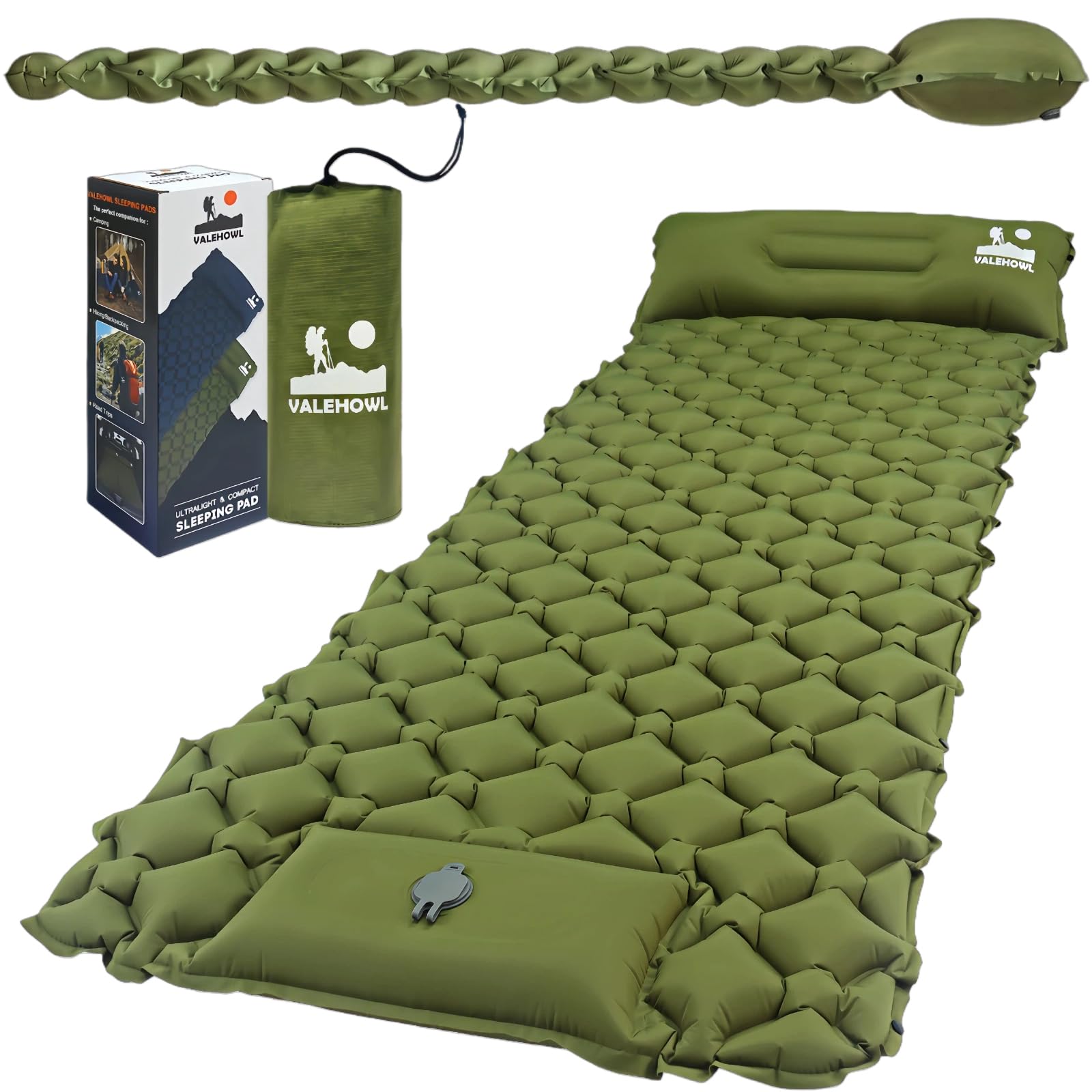
The VALEHOWL pad is the only option in this budget lineup that explicitly advertises an R-Value of 3.0, making it a legitimate three-season performer for campers facing temperatures down to freezing. The 40D nylon outer shell paired with a TPU inner coating delivers solid puncture resistance while keeping the total weight at 1.8 pounds — competitive with pads costing twice as much. The honeycomb air chamber pattern distributes body pressure evenly and helps the 2.7-inch thickness feel more substantial than the number suggests.
The built-in foot pump inflates the pad in about 40 seconds according to verified user reports, and the one-way valve prevents backflow during inflation. The two-stage deflation system lets you fine-tune firmness or completely dump air for packing. Side snap buttons allow connecting multiple pads into a double-wide setup, which is a nice bonus for couple camping without buying a separate double pad. At 75 by 25 inches, the width is adequate for most adults up to 6-foot-3, though broader-shouldered side sleepers may find the 25-inch width slightly narrow for arms-out sleeping.
The integrated pillow is positioned lower than some users prefer — a few reviewers mentioned needing an additional pillow for proper head elevation. The pad packs down to 10 by 5 inches, fitting easily into a backpack side pocket. For backpackers who need reliable insulation without the weight penalty, the VALEHOWL provides the best thermal performance in this price bracket. The 3.0 R-value is real, and that alone justifies the premium over thinner no-rating competitors.
Why it’s great
- R-Value 3.0 provides genuine 3-season insulation
- Lightweight at 1.8 lbs with small packed size
- 40D nylon shell resists punctures on rocky ground
Good to know
- Integrated pillow sits low; taller sleepers may need extra
- 2.7-inch thickness may feel thin for exclusive side sleepers
3. Oramoose Camping Sleeping Pad

The Oramoose pad hits the sweet spot for budget buyers who need actual 4-inch thickness without jumping to premium pricing. The V-shape internal support channels are designed to keep hips and shoulders suspended during side sleeping, and the 400-pound weight capacity signals stronger internal baffling than most budget pads. The built-in pillow contours to the neck curve rather than just being a raised bump — a detail that makes a real difference for cervical alignment over multiple nights.
Inflation via the single-foot pump takes about 30 seconds when done correctly, though several user reviews note that the pump requires full coverage of the foot pump area with your boot or the stomp won’t move air efficiently. Once inflated, the no-leak valve design maintains pressure for over 24 hours in real-world tests. The 40D nylon bottom fabric handles uneven ground, grass, and small rocks without issue, while the TPU coating blocks ground moisture. The pad also features side connection buttons to link multiple units for a double-wide sleep surface.
The pad weighs 1.9 pounds and packs down to 9.4 by 4.3 inches — slightly larger than the VALEHOWL but still manageable for backpack use. The main caveat is that the foot pump method can feel tedious if you are inflating two pads for a couple, requiring about three minutes of stomping per pair. A few users also note that the pump only works effectively when the pillow valve is sealed and the foot valve is open, so reading the instructions matters. For the price, the 4-inch thickness makes this the best choice for larger-framed campers who need real ground clearance.
Why it’s great
- 4-inch thickness provides genuine hip clearance for side sleepers
- 400-pound capacity with strong internal baffles
- 40D nylon base handles rough terrain without tearing
Good to know
- Foot pump requires precise full-foot coverage to work
- Inflation takes longer for multiple pads
4. KASIMO Camping Sleeping Pad

The KASIMO pad is designed for campers who prioritize pack weight and compact storage over maximum thickness. At 1.76 pounds and folding down to 11 by 3.9 inches, it fits inside a water bottle pocket on most hiking packs. The 3-inch thickness is enough for back sleepers and combination sleepers, though side sleepers over 200 pounds may feel the ground through the pad at pressure points. The 40D nylon top layer combined with a 50D pongee bottom provides a balanced durability-to-weight ratio.
The built-in foot pump inflates the pad in 30 to 60 seconds, and the edge heat-sealing reduces the risk of air leaks along the seams — a common failure point on ultra-budget sleeping pads. The side connection buttons let you pair two pads into a double bed, which is useful for couples. Verified users consistently report that the pad holds air all night without needing a top-off, and the integrated pillow eliminates one extra item from your sleep system. The anti-leak double-layer valve design adds an extra layer of security against slow deflation.
The core trade-off is the audible crinkling sound from the nylon fabric, which several reviewers noted as disruptive when shifting positions during the night. The 25.6-inch width is standard but may feel snug for broad-shouldered users. The pad also lacks an R-value rating, so it is best suited for three-season use in moderate temperatures. For backpackers who count every ounce and need a reliable pad that packs small, the KASIMO delivers consistent performance at a competitive weight.
Why it’s great
- Very compact packed size fits in water bottle pockets
- Heat-sealed edges reduce common leak points
- Dual-layer valve prevents slow air loss overnight
Good to know
- Crinkly fabric noise when moving
- 3-inch thickness may bottom out for heavier side sleepers
5. Amazon Basics Camping Sleeping Pad

The Amazon Basics pad is the lightest and most affordable entry in this lineup at just 1.4 pounds, making it a strong contender for ultralight backpackers who prioritize pack weight over plush comfort. The 190T polyester fabric paired with a TPU coating provides basic water resistance, and the built-in foot pump with Insta-Pump Technology is designed to inflate in under 60 seconds. At 75 by 22 inches, it is narrower than the other pads here, which reduces weight but also limits room for arm movement during sleep.
The 2.2-inch thickness is the main limiting factor — this pad works best for back sleepers or as an extra layer of cushioning inside a hammock or on an existing cot. Side sleepers and heavier users will likely feel the ground through the mat, especially on uneven tent floors. Verified reviews are split: many praise the value and lightweight design, while a notable number report issues with the built-in pump not functioning properly and needing to inflate manually. The leak reports are also more frequent here than on the thicker models, though some of those may stem from valve sealing technique rather than manufacturing defects.
For casual car campers, backup guests, or kids who don’t need full ground isolation, this pad works fine at a very low entry cost. The included stuff sack and compact packed size of 12 by 4 inches make it easy to stash in a car trunk or daypack. If you are upgrading from a foam roll or a worn-out air mattress and just need something that works for light-duty camping, the Amazon Basics pad delivers acceptable performance for its price tier. Just do not expect the same overnight hold or comfort as the 4-inch or 6-inch options.
Why it’s great
- Ultralight at 1.4 lbs — easiest to carry of the group
- Very affordable entry point for casual camping
- Compact packed size fits easily in a daypack
Good to know
- 2.2-inch thickness not sufficient for side sleepers
- Some units have unreliable foot pump performance
FAQ
Is 2.2 inches thick enough for a budget camping mat?
Why do some budget pads lose air overnight?
Does the built-in foot pump actually work on these pads?
Final Thoughts: The Verdict
For most campers, the best budget camping mat winner is the OGERY Sleeping Pad because its 6-inch thickness and durable 50D polyester construction provide genuine ground isolation at a price that undercuts premium brands by a wide margin. If you need true three-season insulation and ultralight portability, grab the VALEHOWL Ultralight Pad with its R-Value 3.0 rating. And for larger-framed side sleepers who need real hip clearance without spending more, nothing beats the Oramoose Camping Pad at 4 inches thick with a 400-pound capacity.

Mo Maruf
I created WellFizz to bridge the gap between vague wellness advice and actionable solutions. My mission is simple: to decode the research and give you practical tools you can actually use.
Beyond the data, I am a passionate traveler. I believe that stepping away from the screen to explore new environments is essential for mental clarity and physical vitality.