Our readers keep the lights on and my smoothie glass nicely filled. As an Amazon Associate, I earn from qualifying purchases.
Choosing a camera for video on a budget means balancing sensor size, autofocus reliability, and recording features. The key is finding a body that delivers sharp 4K footage without hidden limits like recording time caps or poor low-light performance.
I’m Mohammad Maruf — the founder and writer behind WellFizz. I’ve spent years analyzing camera specifications and sorting through performance data to find which models actually deliver for filmmakers working with a tight budget.
This guide covers 11 cameras that offer genuine value for videography, from mirrorless hybrids to cinema-oriented bodies. Here is your comprehensive look at the best budget camera for videography based on real-world specs and user experiences.
How To Choose The Best Budget Camera For Videography
Every budget videography camera is a compromise. Your job is to pick which compromises you can live with. Sensor size, autofocus speed, stabilization, and codec options will define your shooting experience more than megapixel count ever will.
Sensor Size and Crop Factor
A larger sensor captures more light and creates shallower depth of field. Full-frame sensors give the best low-light performance and dynamic range, but they are expensive. APS-C and Micro Four Thirds sensors offer a good balance between cost and quality. The crop factor matters for lens selection — a 50mm lens on a Micro Four Thirds body behaves like a 100mm equivalent, which changes your field of view significantly.
Autofocus Reliability
Phase-detection autofocus with eye tracking is critical for solo videographers. Contrast-based systems hunt more in low light and during movement. Sony Real-Time Eye AF and Canon Dual Pixel CMOS AF are industry leaders. Check whether the camera supports face and eye detection during 4K recording specifically — some models disable these features at higher resolutions.
In-Body Image Stabilization
IBIS compensates for camera shake without adding bulky gimbals. This is essential for handheld run-and-gun shooting. Panasonic leads in this area with its 5-axis Dual I.S., which works in conjunction with lens stabilization. Sony and Canon often rely on lens-based stabilization or electronic stabilization, which can introduce cropping or rolling shutter artifacts.
Recording Limits and Codec Choices
Some cameras impose a 29-minute 59-second recording limit for video. Others, like the Blackmagic Pocket Cinema Camera 4K, have no such limit. The codec matters too — 8-bit 4:2:0 is standard at this price, but 10-bit 4:2:2 gives more flexibility for color grading. Look for Log or flat picture profiles if you plan to color grade your footage professionally.
Quick Comparison
On smaller screens, swipe sideways to see the full table.
| Model | Category | Best For | Key Spec | Amazon |
|---|---|---|---|---|
| Sony a7 III | Full-Frame | Low-Light & Battery Life | 24.2MP BSI Full-Frame Sensor | Amazon |
| Canon EOS RP | Full-Frame | Travel & Entry-Level Full-Frame | RF 24-105mm f/4-7.1 IS STM Lens | Amazon |
| Blackmagic Pocket 4K | Cinema | Professional Color Grading | 13 Stops Dynamic Range | Amazon |
| Sony a6400 | APS-C | Fast Autofocus & Compact Size | 0.02 sec AF / 425 Phase Points | Amazon |
| Nikon Z fc | APS-C | Styling & Everyday Shooting | 20.9MP DX / EXPEED 6 | Amazon |
| Canon EOS R50 | APS-C | Beginners & Vlogging | Oversampled 4K / Dual Pixel AF II | Amazon |
| Sony ZV-E10 | APS-C | Vlogging & Content Creation | 24.2MP / Oversampled 4K from 6K | Amazon |
| Nikon Z 30 | APS-C | Streaming & Webcam Use | 4K 30p / 1080p 120p | Amazon |
| Panasonic LUMIX G100 | Micro Four Thirds | Audio Quality & Compact Travel | Built-in Mic with Tracking | Amazon |
| Panasonic LUMIX G85 | Micro Four Thirds | Stabilization & Low-Light Video | 5-Axis Dual I.S. / Weather-Sealed | Amazon |
| Canon EOS R100 | APS-C | Entry-Level Mirrorless | 24.1MP / DIGIC 8 / 4K 24p | Amazon |
In‑Depth Reviews
1. Sony a7 III

The Sony a7 III is the benchmark for budget full-frame videography. Its 24.2MP back-illuminated Exmor R sensor delivers 15 stops of dynamic range and exceptional low-light performance up to ISO 204,800. The 693 phase-detection AF points cover 93% of the sensor area, providing reliable subject tracking during 4K recording without hunting. The 10 fps continuous shooting with AE/AF tracking makes it suitable for both video and fast-action stills.
The NP-FZ100 battery offers approximately 710 shots per charge, which is class-leading for mirrorless cameras. The 5-axis in-body stabilization reduces handheld shake noticeably, though it is not as aggressive as Panasonic’s Dual I.S. system. The 4K video is oversampled from the full sensor width, delivering clean, detailed footage. The S-Log and HLG profiles provide latitude for color grading, though the 8-bit 4:2:0 internal recording limits extreme grading flexibility.
Build quality feels sturdy with magnesium alloy construction and basic weather sealing. The menu system is dense and complex, but the customization options are extensive. The kit 28-70mm f/3.5-5.6 lens is decent for starting but benefits from an upgrade to a faster prime. This camera remains a top choice for hybrid shooters who need reliable video and photo performance in one body.
Why it’s great
- Outstanding low-light performance with 15-stop dynamic range.
- Excellent battery life for long shoots.
- Reliable real-time eye AF for video.
Good to know
- 8-bit internal recording limits color grading.
- Complex menu system requires learning curve.
- Kit lens is average; budget for a better lens.
2. Canon EOS RP

The Canon EOS RP offers an accessible entry into full-frame mirrorless video. The RF 24-105mm f/4-7.1 IS STM kit lens provides up to 5 stops of optical stabilization and a versatile zoom range, making it practical for travel and general videography. The 26.2MP full-frame sensor produces sharp 1080p video with excellent face-detecting autofocus, though the 4K mode introduces a significant crop factor that reduces the wide-angle capability.
The body weighs just 485 grams with the battery and card, making it one of the lightest full-frame options available. The vari-angle touchscreen is responsive and useful for vlogging, though the lack of a fully articulating screen can be limiting for overhead shots. The Dual Pixel CMOS AF delivers fast, quiet autofocus for video, and the touch-to-focus functionality works intuitively. The menu system is straightforward for Canon users upgrading from DSLRs.
The biggest compromise is the 4K video mode — it uses a 1.7x crop and lacks Dual Pixel AF support, limiting its utility for serious videographers. The 1080p footage, however, is excellent with full autofocus capabilities. Battery life is moderate; a spare LP-E6 pack is advisable. The RF lens ecosystem is growing but premium-priced. This camera shines for hybrid shooters who prioritize photo quality and 1080p video over 4K performance.
Why it’s great
- Very lightweight and compact for a full-frame body.
- Excellent 1080p video with Dual Pixel AF.
- Good low-light performance with high ISO.
Good to know
- 4K video has heavy crop and no Dual Pixel AF.
- Battery life is average.
- RF lenses are more expensive than EF alternatives.
3. Blackmagic Design Pocket Cinema Camera 4K

The Blackmagic Pocket Cinema Camera 4K is a dedicated cinema camera that prioritizes image quality above all else. It features a native 4096 x 2160 resolution sensor with 13 stops of dynamic range and dual native ISO up to 25,600, producing clean, detailed footage even in challenging lighting. It records in Blackmagic RAW and Apple ProRes, giving editors maximum flexibility for color grading with the included DaVinci Resolve Studio activation key.
The 5-inch LCD touchscreen is bright and large enough to eliminate the need for an external monitor in most situations. The MFT lens mount provides a wide range of lens options, including compatibility with vintage glass via adapters. Professional audio inputs include mini XLR with phantom power and a 3.5mm stereo input, far superior to consumer-level cameras. The USB-C port allows direct recording to external SSDs, reducing media costs significantly.
This camera demands accessories — it has no in-body stabilization, no continuous autofocus, and the LP-E6 battery lasts roughly 30 minutes. A cage, external battery solution, and gimbal or tripod are essential for practical use. It is not a vlogging camera or an all-day event shooter. But for narrative filmmaking, interviews, music videos, or any project where you want to color grade in post, the image quality is exceptional for the price.
Why it’s great
- Professional-grade color science and RAW recording.
- 13 stops of dynamic range for grading flexibility.
- No recording limit; records to SSDs.
Good to know
- No IBIS or continuous AF; requires extra gear.
- Battery life is very poor.
- Screen is hard to see in direct sunlight.
4. Sony Alpha a6400

The Sony a6400 is defined by its autofocus system. With 425 phase-detection points covering 84% of the sensor and Real-Time Eye AF for humans and animals, it locks onto subjects with almost zero latency. This is the fastest AF you will find at this price point. The 24.2MP APS-C sensor produces sharp 4K video oversampled from the full sensor width, delivering high detail without moire or aliasing.
The 180-degree flip-up touchscreen is useful for vlogging, though the screen resolution is average and the touch functionality is limited to focusing. The body is compact and lightweight at 403 grams, making it easy to rig for gimbal use. The 11 fps continuous shooting with real-time tracking is fast enough for action and wildlife photography. The built-in flash and multi-interface hot shoe add versatility.
The biggest issue is the lack of in-body stabilization, meaning handheld footage will be shaky without a stabilized lens or gimbal. The 4K 30p recording does not support eye AF, and the rolling shutter is noticeable for quick pans. The menu system is characteristically dense. Battery life is average but manageable. For videographers who prioritize autofocus speed and intend to use gimbals, the a6400 is still a strong value.
Why it’s great
- Industry-leading real-time eye autofocus.
- Sharp 4K oversampled from 6K.
- Compact and lightweight build.
Good to know
- No IBIS; requires gimbal or stabilized lens.
- Rolling shutter is present in 4K.
- No headphone jack.
5. Nikon Z fc

The Nikon Z fc stands out for its retro-inspired design with analog dials for ISO, shutter speed, and exposure compensation, but it backs that style with solid video specs. The 20.9MP DX-format sensor paired with the EXPEED 6 processor delivers clean 4K UHD footage with full-time eye-detection autofocus. The vari-angle LCD screen flips out to the side, making it more practical for vlogging than the a6400’s upward-flip design.
The 16-50mm kit lens is compact and collapsible, providing a versatile range for everyday shooting. Autofocus is reliable for video, with good subject tracking for both people and pets. The built-in stereo microphone and external mic jack provide decent audio capture. The SnapBridge app allows wireless image transfer and remote control, though the connection can be inconsistent. The body feels solid with a largely metal construction.
The main compromises are the 4K recording, which uses a 1.5x crop (standard for DX), and the lack of in-body stabilization. The kit lens has VR, but it is not enough for smooth walking shots. The Z mount DX lens lineup is still limited. Battery life is moderate. This camera is best for creators who want a stylish, enjoyable shooting experience alongside capable video, and who plan to use it mainly for static or gimbal-based recording.
Why it’s great
- Beautiful retro design with analog controls.
- Solid 4K video with eye AF.
- Vari-angle flip-out screen.
Good to know
- No IBIS; relies on lens VR.
- Limited Z-mount DX lens selection.
- SnapBridge app can be unreliable.
6. Canon EOS R50
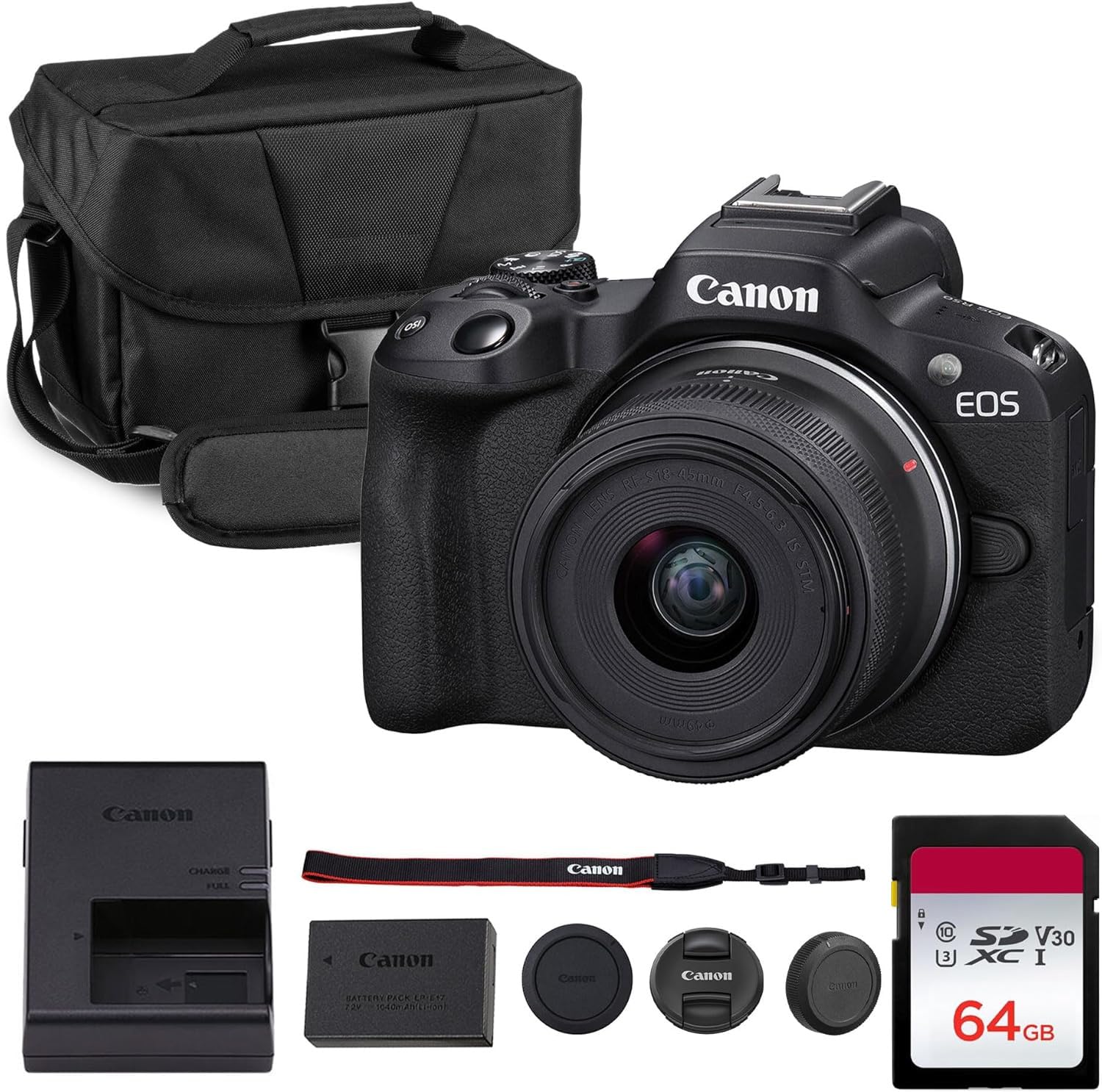
The Canon EOS R50 is designed for beginners who want serious video features without complexity. It captures oversampled 4K footage using the Dual Pixel CMOS AF II system, delivering sharp video with reliable face and eye tracking. The 24.2MP APS-C sensor is paired with Canon’s DIGIC X processor, providing fast performance and good image quality. The kit includes an 18-45mm lens, a shoulder bag, and a 64GB memory card.
The vari-angle touchscreen makes framing easy from any angle, and the Creative Assist mode helps beginners understand settings without guesswork. Vertical video mode is integrated for social media platforms, and the camera can shoot 4K at 30fps. The autofocus system tracks subjects during video and supports animal detection. The body is compact and lightweight at 375 grams, ideal for all-day carry.
The caveat is the lack of in-body stabilization, relying instead on the kit lens IS which is sufficient for static shots but not walking footage. The 4K recording is cropped by about 1.5x, and there is no headphone jack. The kit lens has a slow aperture range of f/4.5-6.3, limiting low-light performance. This camera is best for new creators who want an easy path to good video quality without learning complex menus.
Why it’s great
- User-friendly interface with Creative Assist.
- Oversampled 4K with Dual Pixel AF II.
- Lightweight and compact for travel.
Good to know
- No IBIS; kit lens IS is limited.
- No headphone jack for monitoring.
- Kit lens aperture is slow.
7. Sony ZV-E10
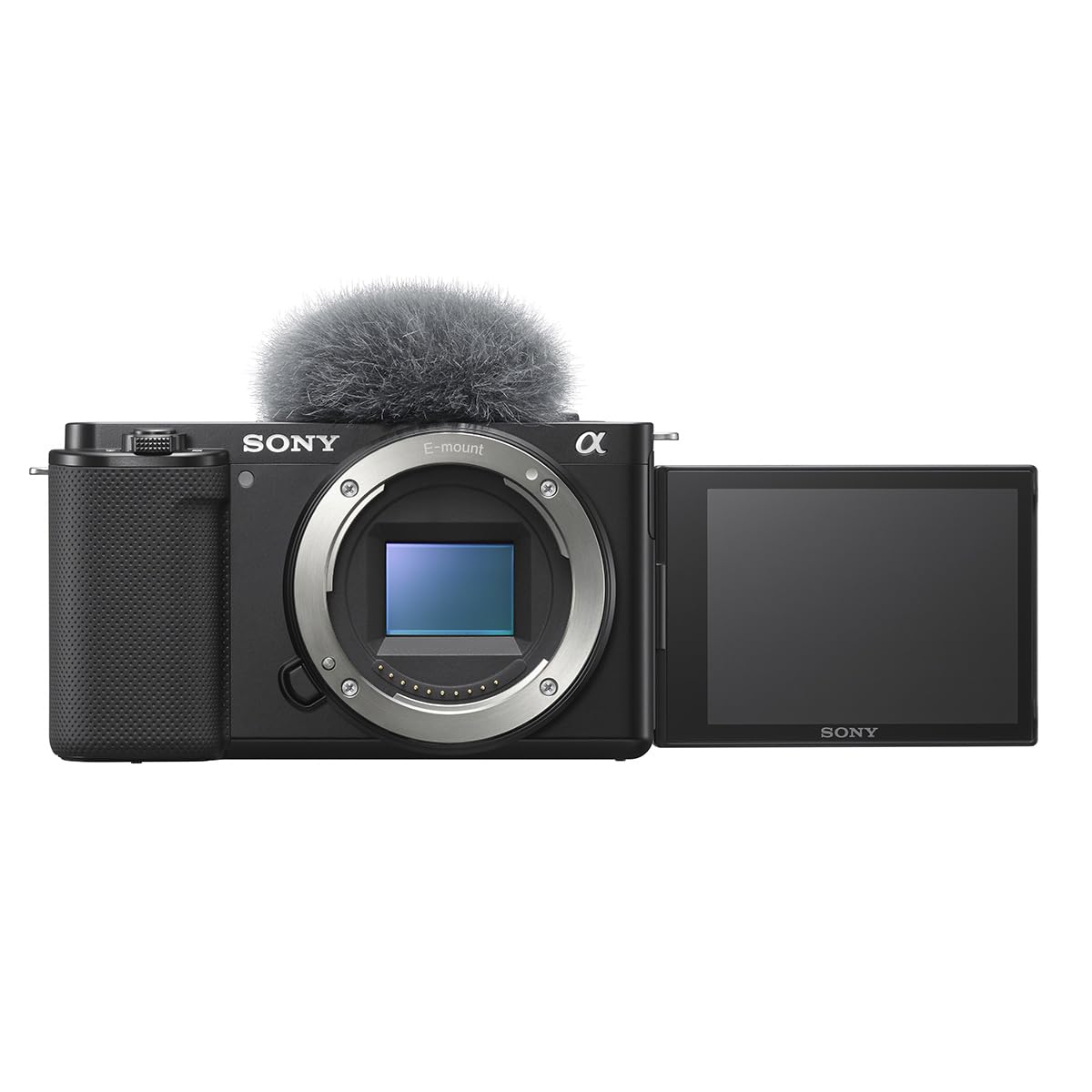
The Sony ZV-E10 is purpose-built for vloggers and content creators. It uses the same 24.2MP APS-C sensor as the a6400 but with a body designed for video-first operation. The oversampled 4K capture from a 6K readout delivers excellent sharpness and detail. The Product Showcase Setting transitions focus from your face to an object instantly, a killer feature for product reviews and unboxing videos.
The Background Defocus button toggles shallow depth of field on and off, making it easy for beginners to get that blur effect without understanding aperture. The directional three-capsule microphone captures better audio than most built-in mics, and the 3.5mm input allows external mic use. The flip-out screen is fully articulating, and the USB-C port enables easy live streaming without additional hardware.
The lack of in-body stabilization is the biggest drawback, as is the severe rolling shutter when panning quickly. The 4K 30p mode disables face and eye detection autofocus, which is a strange limitation. The battery lasts about 25 minutes in 4K recording, and the camera can overheat in warm environments. Despite these limits, the ZV-E10 remains one of the best values for dedicated video content creation thanks to its sharp 4K and creator-focused features.
Why it’s great
- Product Showcase and Background Defocus buttons.
- Sharp oversampled 4K video.
- Great built-in directional mic.
Good to know
- No IBIS; severe rolling shutter.
- 4K 30p disables eye AF.
- Battery life is short in 4K.
8. Nikon Z 30

The Nikon Z 30 is Nikon’s most compact mirrorless camera, built specifically for vloggers and streamers. It records 4K UHD with eye-tracking autofocus for people and pets, delivering crisp video with beautiful background blur from its APS-C sensor. The flip-out touchscreen selfie monitor makes framing easy, and the red REC light provides visual confirmation during recording.
The camera functions as a plug-and-play webcam via USB-C, streaming smooth Full HD at 60p without extra software. For higher quality, 4K 30p streaming over HDMI is supported, and the camera can be powered over USB-C for extended sessions. The built-in stereo microphone has adjustable sensitivity. The Z 30 is compatible with Nikon’s entire range of Z-mount lenses, including fast primes that improve low-light performance.
The lack of a viewfinder may bother traditional photographers, but it keeps the body extremely small and lightweight. There is no in-body stabilization, so handheld footage requires a steady hand or a gimbal. The 4K recording is limited to 29 minutes per clip, and the 1080p 120fps slo-mo mode is useful but has a noticeable crop. For dedicated streamers and vloggers who want a compact, always-plugged-in solution, the Z 30 is a smart choice.
Why it’s great
- Excellent plug-and-play webcam functionality.
- Compact and lightweight body.
- Good eye-tracking AF for video.
Good to know
- No viewfinder or IBIS.
- 4K recording limited to 29 minutes.
- 1080p 120fps has a crop factor.
9. Panasonic LUMIX G100

The Panasonic LUMIX G100 emphasizes audio quality in a compact body. It features a high-performance microphone with tracking audio that auto-adjusts its directionality based on the subject, recording clearly in crowds, one-on-one interviews, or quiet nature scenes. The Micro Four Thirds sensor delivers good 4K video quality, and the 12-32mm kit lens provides a versatile range for vlogging and everyday use.
The camera features 5-axis hybrid image stabilization that works with the lens OIS to reduce shake. The frame marker helps compose for social media vertical formats, and the V-Log L recording capability provides room for color grading. The camera connects seamlessly to a smartphone for file transfer and remote control. The intelligent auto mode makes it accessible for beginners, while manual modes give experienced users full control.
The G100 has a 20-minute recording limit for 4K video, which is restrictive for longer content. The build feels plasticky compared to more rugged alternatives, and the electronic viewfinder is small and awkward for glasses users. The kit lens is quite dark at f/3.5-5.6, limiting low-light performance without an upgrade to a fast prime like the 25mm f/1.7. This camera is best for vloggers and podcasters who prioritize audio quality above all else.
Why it’s great
- Tracking microphone captures excellent audio.
- Compact size with 5-axis hybrid I.S.
- V-Log L for color grading.
Good to know
- 20-minute 4K recording limit.
- Plasticky build quality.
- Kit lens is slow and dark.
10. Panasonic LUMIX G85

The Panasonic LUMIX G85 is renowned for its class-leading Dual Image Stabilization, which combines 5-axis in-body stabilization with lens-based OIS. This system allows smooth handheld footage even in low light, reducing the need for a gimbal. The 16MP Micro Four Thirds sensor has no low-pass filter, resulting in approximately 10% more fine detail resolving power than previous 16MP MFT sensors. The 12-60mm Power O.I.S. lens provides a versatile range equivalent to 24-120mm.
Weather sealing protects the camera from dust and light rain, making it a durable option for outdoor shooting. The electronic OLED viewfinder has 2360K dots resolution, and the 3-inch tilt touchscreen LCD adjusts for optimal viewing angles. The G85 records 4K video at 3840 x 2160, plus exclusive 4K Photo and Post Focus modes. The magnesium alloy front plate and comfortable grip provide good ergonomics.
The 16MP sensor is lower resolution than APS-C competitors for stills, and the 12-60mm kit lens is noticeably soft at the long end. Battery life is below average, and there is no headphone jack for audio monitoring. The autofocus can be sluggish in low light for 4K video. Despite these issues, the G85 offers the best stabilization at this price point, making it ideal for handheld documentary style, travel, and event videography.
Why it’s great
- Exceptional 5-axis Dual I.S. for handheld shooting.
- Weather-sealed build for tough conditions.
- Good ergonomics and tilt-screen.
Good to know
- 16MP sensor is lower resolution for stills.
- Kit lens is soft at long end.
- Poor battery life and no headphone jack.
11. Canon EOS R100

The Canon EOS R100 is the most affordable entry point into Canon’s RF mirrorless system. It uses a 24.1MP APS-C sensor with a DIGIC 8 processor, capable of 4K video at up to 24fps. The RF-S18-45mm kit lens provides a standard zoom range with optical image stabilization and STM autofocus. Dual Pixel CMOS AF covers up to 143 zones with face and eye detection for both humans and animals, making it easy to stay focused on subjects.
The camera is the smallest and lightest in the EOS R series, weighing only 356 grams, which makes it highly portable for travel and family documentation. The beginner-friendly GUI includes mode explanations that help new photographers understand settings. The continuous shooting speed of 6.5 fps in One-Shot AF is reasonable for capturing everyday action. Battery life is good, lasting a full day of heavy use according to many users.
The limitations are significant for videography. 4K recording is capped at 24fps, with no 30p or 60p option, and the sensor crops in 4K mode. The LCD screen is not touch-sensitive and has limited articulation, making vlogging and creative angles difficult. The kit lens aperture is slow at f/4.5-6.3, and there is no included charger, requiring an LP-E17 charger purchase. The R100 is best for total beginners who want an affordable mirrorless camera and prioritize photo quality over advanced video features.
Why it’s great
- Very affordable entry to Canon RF system.
- Compact and lightweight build.
- Good battery life for a day of shooting.
Good to know
- 4K only at 24fps with crop.
- Fixed, non-touch screen.
- No charger included; slow kit lens.
FAQ
What is the best sensor size for budget videography?
Why does my camera stop recording after 29 minutes?
Do I need in-body stabilization for video?
Final Thoughts: The Verdict
For most users, the budget camera for videography winner is the Sony a7 III because it offers full-frame quality, exceptional battery life, and reliable autofocus in a compact body. If you want professional-grade color grading and RAW recording, grab the Blackmagic Pocket Cinema Camera 4K. And for pure handheld stability and weather-sealed durability, nothing beats the Panasonic LUMIX G85.

Mo Maruf
I created WellFizz to bridge the gap between vague wellness advice and actionable solutions. My mission is simple: to decode the research and give you practical tools you can actually use.
Beyond the data, I am a passionate traveler. I believe that stepping away from the screen to explore new environments is essential for mental clarity and physical vitality.