Our readers keep the lights on and my smoothie glass nicely filled. As an Amazon Associate, I earn from qualifying purchases.
Freezing a fast-moving athlete on a dime requires a camera that can do two things flawlessly: acquire focus instantly and fire off frames without pause. A body that hesitates or hunts for focus in a split second will cost you the winning shot, which is why the burst rate and autofocus system matter more than megapixel count in a sports scenario. The heat of the moment does not care about your camera’s age or lens collection — only its ability to deliver a sharp frame at the exact right millisecond.
I’m Mohammad Maruf — the founder and writer behind WellFizz. I’ve spent countless hours poring over autofocus algorithms, burst speeds, buffer depths, and lens compatibility matrices to separate what actually works from what looks good on paper.
Whether you are shooting your child’s Saturday league or covering a local amateur tournament, the difference between a blurry miss and a career highlight reel often comes down to choosing the right budget camera for sports photography. It is a trade-off every action shooter must make intentionally.
How To Choose The Best Budget Camera For Sports Photography
Sports photography demands speed over resolution, tracking accuracy over pixel count, and lens flexibility over built-in gadgetry. A high-megapixel sensor does little good if the camera can only capture one frame per second or if the autofocus loses your runner as soon as they cross a painted line. Focus on three pillars: burst rate, autofocus coverage, and the lens ecosystem available at your budget range.
Burst Rate and Buffer Depth
The number of continuous frames a camera can capture per second (fps) determines how many chances you have to freeze peak action. A body that shoots 8 fps gives you a far better shot at nailing the moment than one limited to 3 fps. Equally important is the buffer — how many continuous shots the camera can hold before it slows down. A deep buffer lets you hold down the shutter during a full play sequence without stuttering.
Autofocus System and Tracking Intelligence
For sports, you need phase-detection autofocus with enough coverage to keep a subject in the frame even when they move unpredictably. More autofocus points and advanced subject-tracking algorithms (like real-time Eye AF for animals and humans) help the camera stay locked on a player weaving through traffic. Cameras with fewer than 9 AF points will struggle with action unless you pre-focus manually.
Lens Compatibility and Reach
A camera body is only as good as the glass in front of it. Telephoto zoom lenses in the 70-300mm or 100-400mm range give you the reach you need to fill the frame from the sideline or bleachers. Faster apertures (f/2.8 or f/4) let in more light, helping you keep shutter speeds high even under dimmer stadium lights. A mirrorless system often allows you to adapt older DSLR lenses, widening your options without breaking your budget.
Quick Comparison
On smaller screens, swipe sideways to see the full table.
| Model | Category | Best For | Key Spec | Amazon |
|---|---|---|---|---|
| Sony a7 III + 28-70mm | Premium Full-Frame | Low-light action & pro-level AF | 10 fps burst / 693 AF points | Amazon |
| Sony a6400 + 18-135mm | Mid-Range Mirrorless | Fast AF & 4K video for sports | 0.02 sec AF / 11 fps burst | Amazon |
| Nikon D7500 + 18-140mm | Mid-Range DSLR | Rugged build & deep buffer | 8 fps / 51 AF points | Amazon |
| Canon EOS RP + RF24-105mm | Premium Mirrorless | Entry-level full-frame for sports | 26.2 MP / Dual Pixel AF | Amazon |
| Canon EOS RP (Body Only) | Premium Mirrorless | Lightest full-frame body | 26.2 MP / 3:2 aspect ratio | Amazon |
| Tamron 150-500mm for Sony E | Telephoto Lens | Long reach for outdoor sports | 150-500mm / f/5-6.7 | Amazon |
| XbotGo Falcon AI Camera | Specialty AI Camera | Hands-free auto tracking | 4K / Dual-lens AI tracking | Amazon |
| Canon EOS R100 Double Zoom | Entry-Level Mirrorless | Beginner with telephoto reach | 6.5 fps / 24.1 MP | Amazon |
| Nikon D3200 + Dual Lenses | Entry-Level DSLR | Budget-friendly dual-zoom kit | 24.2 MP / 18-55 & 55-200mm | Amazon |
| Canon EOS Rebel T7 + 18-55mm | Entry-Level DSLR | Budget-friendly starter DSLR | 24.1 MP / 9 AF points | Amazon |
| Canon RF100-400mm Lens | Telephoto Lens | Lightweight RF telephoto | 100-400mm / f/5.6-8 | Amazon |
In‑Depth Reviews
1. Sony a7 III Full-Frame + 28-70mm Lens

The Sony a7 III brings full-frame performance with a 24.2MP back-illuminated sensor that delivers exceptional low-light sensitivity and 15 stops of dynamic range. Its 693 phase-detection AF points cover 93% of the frame, making subject tracking incredibly sticky even when a player cuts hard across the field. The 10 fps burst with continuous AE/AF tracking ensures you get a sequence of usable frames during peak action.
The included 28-70mm f/3.5-5.6 kit lens is a reliable walk-around zoom, but replacing it with a fast telephoto like a 70-200mm f/2.8 unlocks the body’s true sports potential. Battery life is the best in its class at roughly 710 shots per charge — you can shoot a full tournament without swapping. The 14-bit uncompressed RAW output gives you generous latitude in post to recover shadows or highlights.
Users upgrading from Canon DSLRs praise the autofocus speed and low-light performance as transformative for indoor sports. The menu system is dense with options, but the core AF and burst controls are easy to map to custom buttons. Weather sealing is present but moderate — a rain cover adds peace of mind for outdoor sideline use.
Why it’s great
- Excellent autofocus tracking with 693 phase-detection points.
- Superb battery life for all-day event shooting.
- Full-frame sensor provides clean high-ISO images for dim stadiums.
Good to know
- Kit lens aperture is slow for low-light action; plan a lens upgrade.
- Menu system is complex for beginners.
- Moderate weather sealing may require extra protection.
2. Sony a6400 + 18-135mm Lens

The Sony a6400’s claim to fame is the world’s fastest autofocus acquisition at 0.02 seconds, paired with 425 phase-detection and 425 contrast-detection points that cover 84% of the sensor. Coupled with Real-time Eye AF and object tracking, this camera locks onto a moving player and stays glued through erratic direction changes. The 11 fps continuous shooting buffers quickly into a UHS-I SD card.
The 18-135mm f/3.5-5.6 kit lens provides a versatile 27-202.5mm equivalent range on the APS-C sensor, covering everything from full-field views to tighter sideline plays. The tiltable LCD screen makes shooting from low angles near the field comfortable. For video shooters, the 4K capture with no record limit and 6K oversampling produces sharp footage that can double as game tape.
Owners switching from Canon note the eye-tracking AF and 4K quality as major reasons for the switch. The magnesium-alloy body feels sturdy, and the compact size is easy to pack alongside a longer telephoto lens. The 18-135mm lens is a solid all-rounder but will be the first upgrade for dedicated low-light or longer reach scenarios.
Why it’s great
- Blazing-fast 0.02 sec autofocus with Real-time Eye AF tracking.
- 11 fps continuous shooting with deep buffer for action sequences.
- Excellent 4K video with 6K oversampling and no record limit.
Good to know
- Kit lens is not optimized for low-light action; dim stadiums require faster glass.
- Menu system has many adjustment screens that can feel cluttered.
- No in-body image stabilization; lens-based stabilization is relied upon.
3. Nikon D7500 + 18-140mm VR Lens

The Nikon D7500 uses the same 20.9MP sensor and EXPEED 5 processor found in the flagship D500, delivering class-leading image quality and ISO performance that keeps noise low even at higher sensitivities. The 51-point AF system with 15 cross-type sensors and group-area AF tracks moving subjects reliably across the frame. The 8 fps burst rate matches many professional DSLRs from just a few years ago.
The 18-140mm f/3.5-5.6 VR lens is a superb all-around companion, offering a 27-210mm full-frame equivalent that handles everything from wide team shots to tighter individual action. The Optical VR compensates for handheld shake at full telephoto, which helps when you are shooting without a monopod. The tilting 3.2-inch touchscreen makes it easy to compose from low or high angles along the sideline.
Users upgrading from older DSLR bodies appreciate the fast, accurate autofocus that keeps up with fast-moving subjects like soccer players and runners. The weather-resistant construction gives confidence shooting in light rain or dusty conditions. Even though the model is from 2017, the D7500 remains one of the best APS-C DSLR values for action photography at this tier.
Why it’s great
- 51-point AF system with group-area AF for reliable subject tracking.
- 8 fps burst with deep buffer for sustained action sequences.
- Weather-resistant build and excellent battery life.
Good to know
- 20.9MP sensor offers less cropping headroom than higher-res competitors.
- Older 2017 model lacks modern tech like eye AF and flip-out screen.
- Single SD card slot limits backup options.
4. Canon EOS RP + RF24-105mm F4-7.1 IS STM

The Canon EOS RP is the lightest and smallest full-frame EOS R camera, making it easy to carry to multiple games without fatigue. The 26.2MP full-frame CMOS sensor and DIGIC 8 processor produce clean, high-detail images with excellent color science out of camera. Dual Pixel CMOS AF provides smooth and accurate autofocus for both stills and video.
The RF24-105mm F4-7.1 IS STM lens is a compact standard zoom with optical stabilization up to 5 stops, which helps keep subject sharp when panning. The 24-105mm range covers wide field views and moderate close-ups but lacks the telephoto reach for distant action. Adding a dedicated telephoto like the RF100-400mm is the natural upgrade path for sports shooters.
Reviews from real estate and portrait photographers also highlight the RP’s excellent full-frame quality and lightweight design. For sports, the burst rate is moderate at around 5 fps with AF, and the buffer fills quickly on continuous RAW. This camera favors shooting precision over spray-and-pray — ideal for experienced shooters who know when to time the shot.
Why it’s great
- Full-frame sensor offers shallow depth of field and great low-light performance.
- Lightweight and compact body ideal for carrying between venues.
- Dual Pixel AF ensures smooth, reliable focus for video and stills.
Good to know
- Burst rate of around 5 fps limits action coverage.
- Kit lens aperture is slow; supplemental telephoto needed for sports.
- Buffer depth is shallow for continuous RAW shooting.
5. Canon EOS RP Mirrorless Digital Camera (Body Only, Renewed)

The Canon EOS RP body-only option allows you to invest in a premium full-frame sensor while allocating your budget toward a fast telephoto lens of your choice. The 26.2MP full-frame CMOS sensor and DIGIC 8 processor produce clean, detailed files from ISO 100-40000, giving you usable shots under stadium lights without excessive noise. The RF mount is compatible with native RF lenses and accepts EF/EF-S lenses via an adapter, opening up a wide range of affordable used glass.
Weighing just over 1 pound, this body is the lightest full-frame EOS R camera, which reduces fatigue during long tournaments. The 3-inch vari-angle touchscreen is useful for overhead or ground-level angles. The autofocus uses Dual Pixel CMOS AF, which is fast and reliable for most scenarios, though the burst rate is more suited to timing a single peak moment than spraying a sequence.
Previous users upgrading from Canon DSLRs mention the jump in image quality and how lightweight and comfortable the body feels. The lack of in-body image stabilization means you will rely on stabilized lenses for handheld telephoto work. This body shines when paired with a high-quality telephoto lens for sports — it lets you prioritize glass over the body.
Why it’s great
- Full-frame sensor delivers excellent high-ISO performance for indoor sports.
- Very lightweight and compact — ideal for mobile shooters.
- RF mount compatibility with EF lenses via adapter expands lens options.
Good to know
- No in-body image stabilization; requires stabilized lenses.
- Burst rate is limited compared to dedicated sports cameras.
- No built-in flash — separate accessory needed.
6. Tamron 150-500mm f/5-6.7 Di III VC VXD for Sony E-Mount

The Tamron 150-500mm f/5-6.7 VC VXD lens brings ultra-telephoto reach to Sony full-frame and APS-C mirrorless bodies at a price point well below native alternatives. On an APS-C body like the Sony a6400, it provides a 225-750mm equivalent focal length, letting you fill the frame with a quarterback from the opposite end zone. The VC (Vibration Compensation) image stabilization offers three modes, including panning priority for tracking moving athletes.
The lens uses XLD and LD elements to reduce chromatic aberrations and color fringing, which is common with long telephoto zooms. Autofocus is powered by the VXD linear motor, providing fast, quiet, and accurate focusing suitable for tracking fast-moving subjects. The rotating Arca-type tripod mount includes strap attachment loops, making it easy to carry on a monopod during long games.
Users praise the sharpness and build quality relative to the price, though the f/6.7 maximum aperture at 500mm requires good light. For daytime outdoor sports like soccer, lacrosse, and baseball, this lens performs admirably. The external zoom design may collect dust in harsh conditions, and the lens is front-heavy on smaller Sony bodies without a battery grip.
Why it’s great
- Unmatched reach at 500mm for outdoor sports on a budget.
- VC image stabilization with panning mode for action.
- Fast and quiet VXD autofocus motor.
Good to know
- f/6.7 at 500mm limits low-light and indoor use.
- Heavy and front-heavy — requires a monopod for extended use.
- External zoom can accumulate dust in dusty environments.
7. XbotGo Falcon All-in-One AI Action Camera
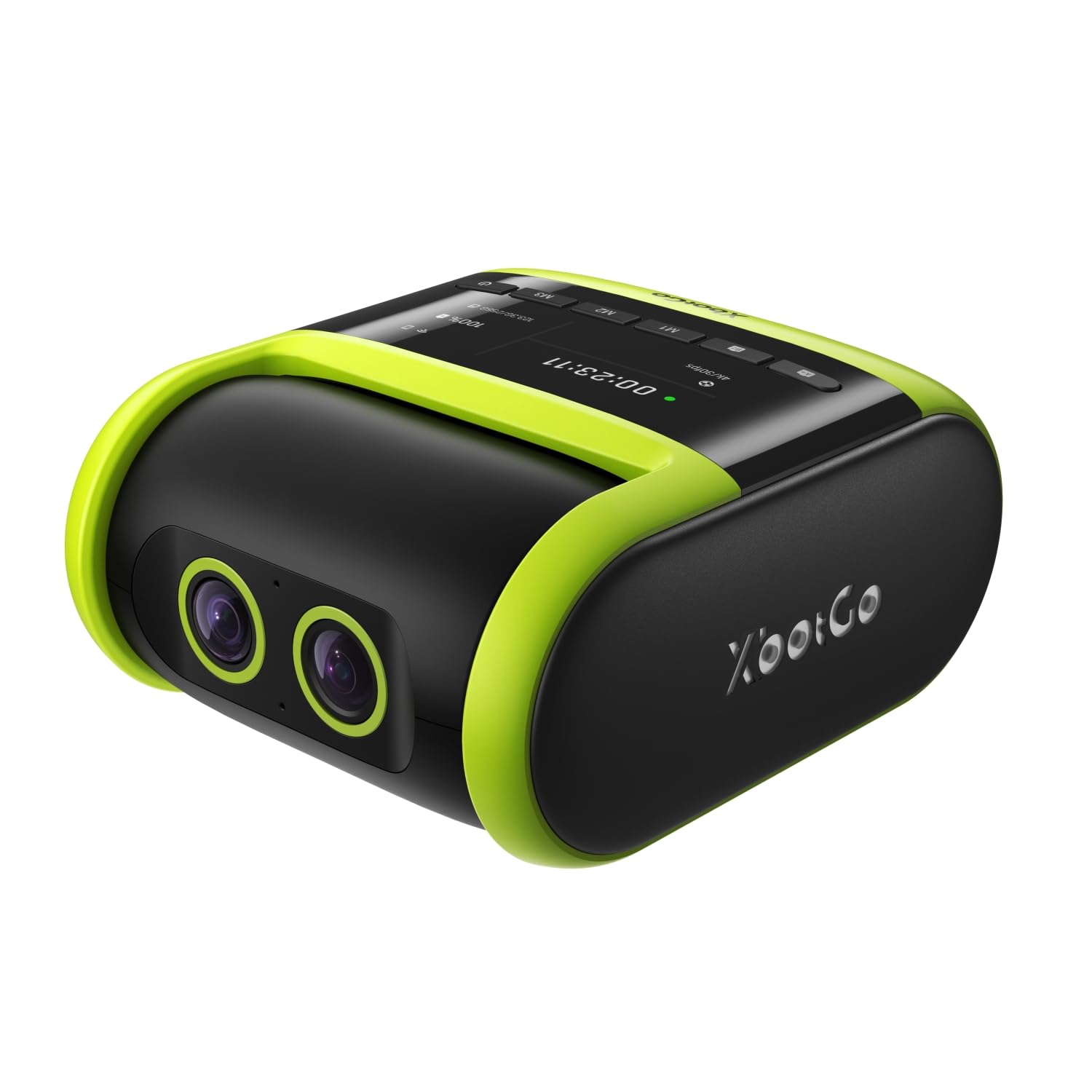
The XbotGo Falcon is a purpose-built sports recording camera that uses an 8-core processor and 6 TOPS AI performance to automatically track players and the ball in soccer, basketball, and football. The dual-lens system combines a 4K recording lens with an AI-assisted tracking lens, eliminating the need for a gimbal or camera operator. This is ideal for parents and coaches who want to record the game while focusing on the action live.
The IPX5 water-resistant body handles real sideline conditions, and the standard 1/4-inch screw mount works with most tripods. The built-in Wi-Fi allows instant live streaming to social platforms, making it easy to share games with remote family members. No subscription is required for the tracking or streaming features, which saves recurring costs compared to other auto-tracking solutions.
Most users report solid AI tracking that handles fast breaks and transitions, with occasional lag on extremely quick directional changes that self-corrects. The battery lasts a full game, and USB-C charging is convenient. A microSD card is required for recording and must be purchased separately. For users who want a hands-free, dedicated solution without learning manual camera controls, this is a unique option.
Why it’s great
- AI auto-tracking eliminates the need for a dedicated camera operator.
- No subscription required for tracking or live streaming.
- IPX5 weather rating for sideline use.
Good to know
- AI tracking can lag during very fast, erratic player movements.
- MicroSD card not included in the box.
- Not a replacement for a high-end ILC for professional-grade stills.
8. Canon EOS R100 Double Zoom Lens Kit
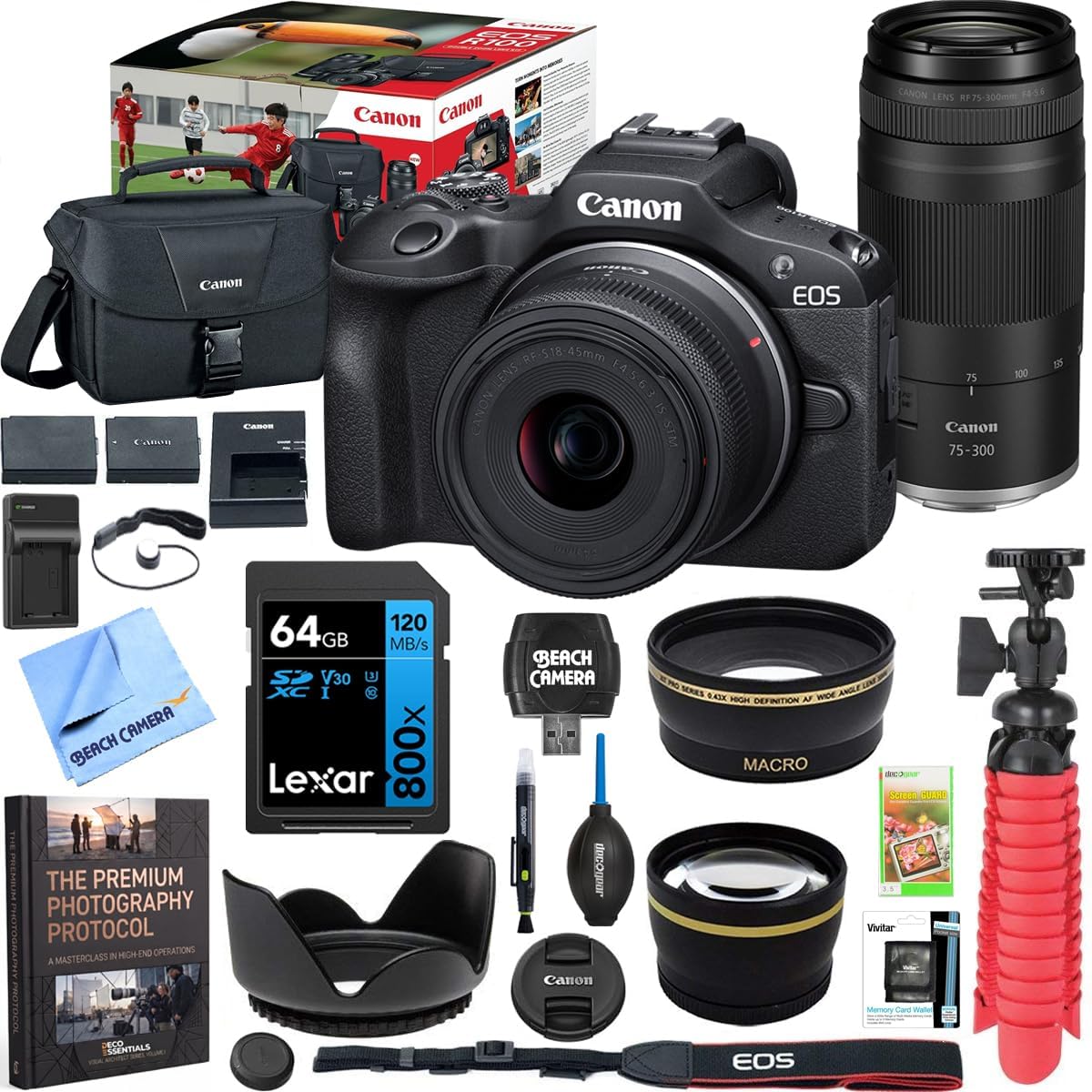
The Canon EOS R100 Double Zoom Kit bundles the compact R100 body with an RF-S 18-45mm f/4.5-6.3 IS STM lens and an RF 75-300mm f/4-5.6 telephoto zoom, giving you a full-spectrum focal range from wide to telephoto. The 24.1MP APS-C CMOS sensor and DIGIC 8 processor deliver sharp 4K video at 24 fps and Full HD at 60 fps. The Dual Pixel CMOS AF features face and eye detection to keep subjects sharp.
The RF 75-300mm lens provides the telephoto reach needed for sports, though the f/4-5.6 aperture is best suited for well-lit daytime games. The 6.5 fps continuous shooting is adequate for recreational action, though the buffer depth is moderate. The kit also includes a 64GB memory card, extra battery, camera bag, mini tripod, and cleaning kit, making it a complete starter setup.
New parents and beginner photographers find the R100 easy to use, with straightforward controls and decent autofocus for stationary and slow-moving subjects. The fixed LCD screen limits low-angle or overhead compositions. This kit is ideal for someone transitioning from a smartphone who wants a dedicated system for weekend sports without investing in separate accessories.
Why it’s great
- Includes wide-angle and telephoto lenses for full sports coverage.
- Comprehensive accessory kit saves additional purchases.
- Dual Pixel AF with face detection for reliable focus.
Good to know
- Fixed LCD screen limits creative angle flexibility.
- Telephoto lens aperture is slow; struggles in low light.
- Burst rate of 6.5 fps is moderate for fast action.
9. Nikon D3200 + 18-55mm & 55-200mm VR DX Lenses

The Nikon D3200 is a time-tested entry-level DSLR that pairs a 24.2MP CMOS sensor with two zoom lenses covering 18-55mm and 55-200mm focal ranges. The 55-200mm VR lens provides the telephoto reach needed for sports at a budget-friendly price point, with built-in vibration reduction to steady handheld shots. The 11-point autofocus system is basic but functional for slower or predictable action.
The compact body and intuitive Guide Mode make this camera an easy entry into sports photography for beginners. The 4 fps continuous burst rate limits your ability to capture fast sequences, but it can still freeze peak moments with careful timing. The 3-inch LCD screen is fixed, which is typical for entry-level DSLRs of its generation.
This kit is best suited for parents photographing younger children’s sports where the pace is moderate and lighting is good. The dual-lens bundle provides excellent value for someone building their first sports photography kit. As you progress, the lens stabilization will help, but upgrading the body with better autofocus and burst speeds will yield the biggest improvement in keeper rate.
Why it’s great
- Including both standard zoom and telephoto zoom lenses at a low entry point.
- 24.2MP sensor provides ample resolution for cropping.
- Drag-and-drop Guide Mode helps beginners learn manual controls.
Good to know
- 4 fps burst rate is low for fast-moving sports.
- 11-point AF system struggles with erratic subject movement.
- No video output above Full HD 1080p.
10. Canon EOS Rebel T7 + 18-55mm Lens

The Canon EOS Rebel T7 is a classic entry-level DSLR that offers a 24.1MP APS-C sensor and built-in Wi-Fi for quick image sharing. The 9-point AF system with AI Servo AF can track moving subjects in good light, but it lacks the coverage and speed needed for high-paced sports. The 3 fps burst rate is the biggest limitation for action — you must time shots carefully rather than spray and select.
The included 18-55mm f/3.5-5.6 IS II kit lens provides a standard zoom range ideal for landscape and casual shots but lacks the reach for field-level sports. Adding a telephoto lens like the Canon EF 70-300mm is essential if you want to step onto a sideline. The optical viewfinder offers 95% coverage, which is adequate but not as accurate as more advanced models.
User reviews highlight the Rebel T7 as a capable camera for beginners learning photography, with good image quality in well-lit conditions. The AF system and burst speed are the primary reasons to look elsewhere specifically for sports. This body makes the most sense when your budget is tight and you plan to invest more in lenses first, then upgrade the body later.
Why it’s great
- Great starter DSLR with easy beginner-friendly controls.
- Built-in Wi-Fi for instant image sharing from the field.
- Affordable entry point into the Canon EF lens ecosystem.
Good to know
- 3 fps burst rate is very limiting for capturing fast action.
- 9-point AF system lacks coverage for tracking moving athletes.
- Kit lens requires telephoto addition for sports.
11. Canon RF100-400mm f/5.6-8 IS USM Lens

The Canon RF100-400mm f/5.6-8 IS USM is a compact, lightweight telephoto zoom designed specifically for Canon RF-mount cameras. Its 100-400mm range provides the field reach essential for sports, wildlife, and distant action. The optical image stabilizer offers up to 5.5 stops of shake correction, and when paired with an EOS R body that features IBIS, the combined stabilization reaches up to 6 stops.
The Nano USM motor delivers fast, smooth, and near-silent autofocus, making it effective for tracking players in motion without disturbing the game. At 400mm, the maximum magnification of 0.41x allows tight framing of individual athletes. The minimum focusing distance of 2.89 feet at 200mm provides flexibility for closer detail shots.
This lens pairs exceptionally well with APS-C R series bodies like the R100 or R50, giving an effective 160-640mm field of view. The aperture range of f/5.6-8 is a compromise for low-light conditions, so daytime or well-lit field use is where it shines. Users praise the lightweight build, quiet operation, and excellent image quality for the price — it is a natural addition to any Canon RF sports kit.
Why it’s great
- Long 400mm reach in a surprisingly compact and lightweight barrel.
- Excellent optical stabilization for handheld shooting.
- Fast, quiet Nano USM autofocus for discreet action shooting.
Good to know
- Slow f/5.6-8 aperture limits use in low-light or indoor sports.
- No weather sealing — caution in dusty or damp conditions.
- Designed for RF mount only; requires adapter for EF cameras.
FAQ
How many autofocus points do I need for sports photography?
Is a full-frame sensor worth the extra money for budget sports photography?
Can I use a kit lens for sports photography?
What shutter speed should I use for freezing sports motion?
Is an optical viewfinder or electronic viewfinder better for sports?
Final Thoughts: The Verdict
For most users, the budget camera for sports photography winner is the Sony a7 III because it combines full-frame low-light performance with sticky autofocus and a 10 fps burst rate you can trust during game-winning plays. If you want dedicated tracking without operating the camera, grab the XbotGo Falcon. And for long-reach outdoor action on a tight budget, nothing beats the Tamron 150-500mm paired with a capable Sony APS-C body.

Mo Maruf
I created WellFizz to bridge the gap between vague wellness advice and actionable solutions. My mission is simple: to decode the research and give you practical tools you can actually use.
Beyond the data, I am a passionate traveler. I believe that stepping away from the screen to explore new environments is essential for mental clarity and physical vitality.