Our readers keep the lights on and my smoothie glass nicely filled. As an Amazon Associate, I earn from qualifying purchases.
Getting audiophile sound without an audiophile budget means picking speakers that invest in crossover design, driver materials, and cabinet bracing instead of marketing. The cheap route—thin MDF boxes with basic crossovers—produces honky mids and veiled highs that no equalizer can fix. The right pair, even at the ground floor of true hi-fi pricing, gives you a soundstage wide enough to place every instrument in the room.
I’m Mohammad Maruf — the founder and writer behind WellFizz. My research involves comparing crossover slopes, woofer cone materials, and impedance curves across every major speaker line to isolate the models that punch hardest at their price bracket.
This guide filters the noise to find the pair that nails the most critical ratio: soundstage depth per dollar spent. Here’s the final shortlist for the best budget audiophile speakers you can buy this year.
How To Choose The Best Budget Audiophile Speakers
The budget hi-fi aisle is filled with speakers that look the part but sound like clock radios. The difference between a good deal and a wasted one comes down to three non-negotiable hardware decisions: the crossover design, the tweeter material, and the cabinet construction. Ignore the spec sheet wattage numbers and focus on what actually shapes the sound.
Crossover Complexity Dictates Clarity
A single capacitor on the tweeter is the cheapest way to build a speaker, but it also produces the most ragged frequency response. The best value pairs in this category use multi-element crossovers with 18dB/octave slopes and air-core coils. These parts cost more to manufacture, but they separate the frequencies cleanly so the woofer and tweeter don’t fight each other. Look for at least a second-order (12dB/octave) crossover; fourth-order (24dB/octave) is even better for power handling and off-axis smoothness.
Tweeter Material and Dispersion
Silk dome tweeters are the default for warm, non-fatiguing highs, but they can roll off early if the magnet structure is weak. Titanium domes, especially with a horn waveguide, project further and reveal more micro-detail, but they risk harshness if the crossover isn’t voiced properly. The sweet spot at affordable prices is a coated fabric dome with a neodymium magnet or a metal dome with a phase plug that tames breakup.
Cabinet Rigidity and Port Tuning
Thin cabinet walls resonate at predictable frequencies, adding a cardboard-like coloration to vocals. Entry-level models that splurge on internal bracing and thicker MDF or HDF sound transparent because the cabinet doesn’t sing along with the music. Equally important is the port design: a flared port reduces chuffing noise at high output, and a front-firing port gives you placement flexibility near walls. Rear-ported speakers need at least six inches of breathing room behind them.
Quick Comparison
On smaller screens, swipe sideways to see the full table.
| Model | Category | Best For | Key Spec | Amazon |
|---|---|---|---|---|
| Triangle BOREA BR03 | Premium Bookshelf | Rich, natural bass and wide soundstage | 16cm cellulose cone woofer | Amazon |
| ELAC Debut 3.0 DB63-BK | Premium Bookshelf | Neutral reference with wide dispersion | Aramid fiber woofer 6.5″ | Amazon |
| Klipsch RP-500M | Premium Bookshelf | High sensitivity and horn-loaded detail | Titanium LTS vented tweeter | Amazon |
| Polk Audio ES20 | Mid-Range Bookshelf | Bass slam with Power Port technology | 6.5″ Dynamic Balance woofer | Amazon |
| Polk Monitor XT20 | Mid-Range Bookshelf | Punchy bass for home theater | 6.5″ Dynamic Balance woofer | Amazon |
| Audio-Technica AT-SP3X | Powered Bookshelf | All-in-one simplicity for turntables | Bluetooth 5.0, built-in amp | Amazon |
| Fluance Signature HFS | Mid-Range Bookshelf | Detailed midrange for vinyl | Neodymium tweeter, glass fiber cone | Amazon |
| Micca RB42 | Compact Bookshelf | Surprising bass from a tiny cabinet | 4″ long-throw woofer, 10-element crossover | Amazon |
| Klipsch RP-500SA | Dolby Atmos Module | Overhead immersion on a budget | 5.25″ cerametallic woofer | Amazon |
In‑Depth Reviews
8. Triangle BOREA BR03 Bookshelf Speakers

The Triangle BR03 uses a 16cm natural cellulose cone woofer paired with a 25mm silk dome tweeter to produce bass that is shockingly deep for a bookshelf cabinet. It ships with a sensitivity of 90 dB, meaning it stays lively even with lower-powered tube amplifiers. The bass reflex port is tuned tight enough to deliver genuine low-end extension without sounding boomy or one-note.
Reviewers consistently report that after a few hours of break-in the treble smooths out, revealing a spacious, holographic soundstage that rivals speakers costing double. The mids are slightly forward, which brings vocal clarity and makes rock guitars cut through without fatigue. Placement is critical—a 45-degree toe-in makes the stereo image snap into focus and the speakers disappear into the room.
Several buyers noted minor finish imperfections such as a corner where the wood veneer didn’t bond perfectly. This is the trade-off for getting premium driver engineering at this price point. If you prioritize raw sound quality over perfect cabinetry, the BR03 delivers the best sonic bang in the entire roundup.
Why it’s great
- Natural cellulose woofer produces rich, fast bass without a subwoofer
- Silk dome tweeter offers smooth highs that avoid listener fatigue
- Wide soundstage with proper toe-in placement
Good to know
- Build finish can be inconsistent at this price bracket
- Requires careful speaker positioning for best imaging
9. ELAC Debut 3.0 DB63-BK Bookshelf Speakers

The ELAC Debut 3.0 series re-engineered the woofer from the ground up, switching to a woven aramid-fiber cone that is stiffer and better damped than the polypropylene or paper cones found at this price. The aluminum dome tweeter now includes a waveguide and phase plug to widen the dispersion pattern, so the sound remains consistent whether you sit dead center or off to the side.
Owners describe the DB63-BK as neutral, accurate, and revealing—it surfaces details in recordings that cheaper speakers gloss over, including background reverb and mic bleed. The bass is tight rather than booming, extending down to 42 Hz. The internal bracing reduces cabinet coloration, making vocals sound open and natural. It handles 100 watts easily, though a clean 50-watt amplifier is sufficient for most rooms.
Some users felt the presentation leans slightly thin or hollow compared to warmer competitors like the Triangle BR03. It also demands a halfway decent source—a noisy DAC or a lossy Bluetooth stream will expose its limitations. This is a speaker for listeners who value precision and imaging over a forgiving, warm signature.
Why it’s great
- Woven aramid-fiber woofer delivers fast, detailed bass without cone breakup
- Waveguide and phase plug produce wide, even horizontal dispersion
- Heavily braced cabinet reduces resonance for transparent mids
Good to know
- Can sound thin or analytical with poor-quality source material
- May need a subwoofer for electronic or hip-hop bassheads
6. Klipsch RP-500M Bookshelf Speakers
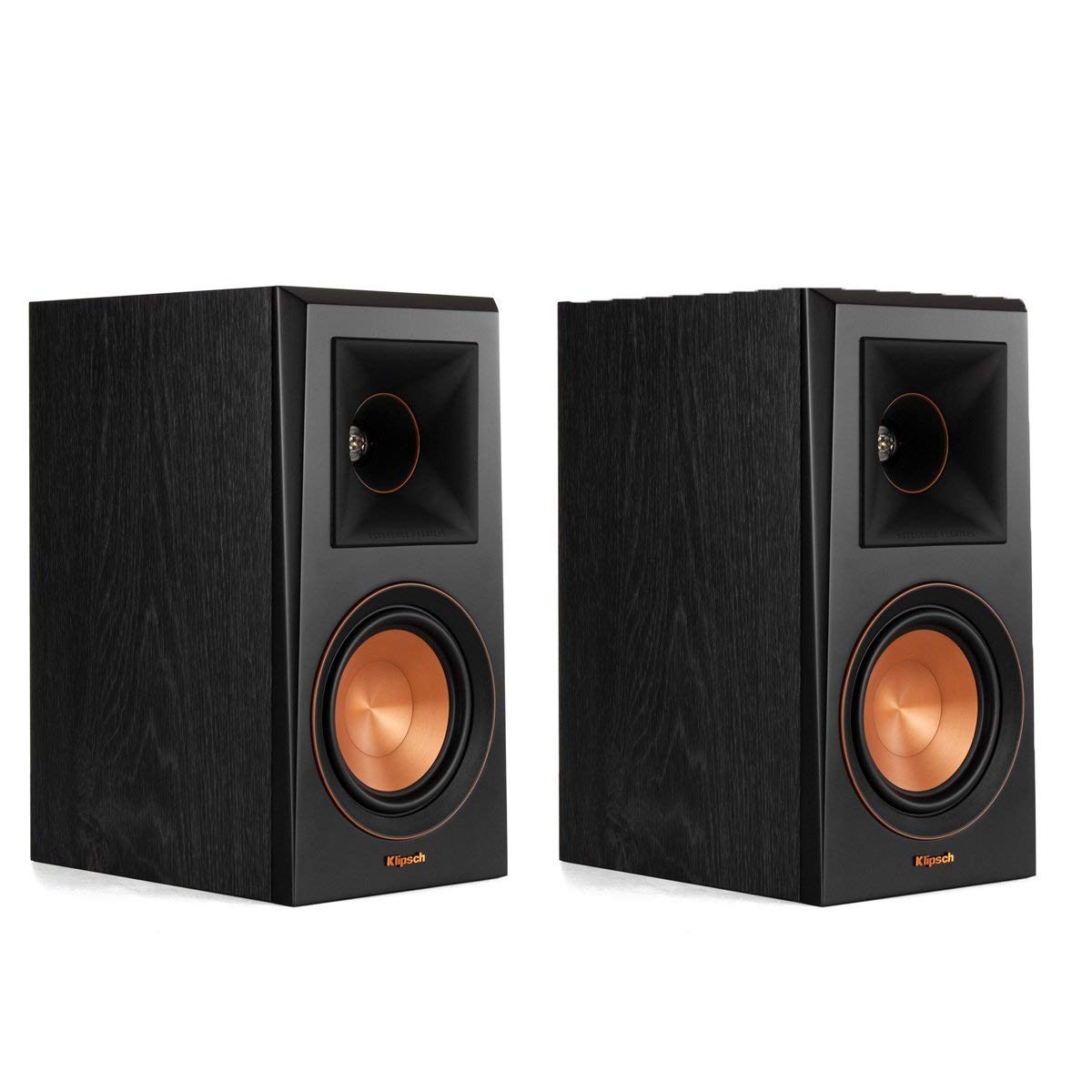
The RP-500M is built around a 1-inch titanium LTS vented tweeter loaded into a hybrid Tractrix horn and a 5.25-inch spun copper cerametallic woofer. The horn design gives this speaker high sensitivity, meaning it can produce substantial volume with as little as 20 or 30 watts per channel. That near-field liveliness makes it a favorite for desktop setups and surround-sound systems where the amplifier may not be a powerhouse.
Reviewers praise the crisp, detailed highs and the way the horn projects the sound into the room without sounding shouty. The cerametallic woofer stays rigid at higher excursions, avoiding the distortion that plagues paper cones when pushed. The bass-reflex port is rear-firing and flared to reduce turbulence. Owners report that the magnetic grille and scratch-resistant finish make the speaker look far more expensive than it is.
A minority of listeners find the horn-loaded tweeter fatiguing over long sessions, especially if the rest of the system is bright. Unlike silk dome speakers, the RP-500M does not sugarcoat poorly mastered recordings. It shines brightest with well-recorded acoustic music, live performances, and movies where the extra presence makes dialogue cut through.
Why it’s great
- Horn-loaded titanium tweeter delivers high sensitivity and dynamic detail
- Cerametallic woofer resists distortion at high volume levels
- Premium build with magnetic grille and scratch-resistant cabinet
Good to know
- Horn tweeter can sound bright or fatiguing to some ears
- Rear port requires clearance from the back wall for clean bass
7. Polk Audio Signature Elite ES20 Bookshelf Speakers

The ES20 features Polk’s patented Power Port design—a flared port tube that extends below the cabinet and directs airflow into the room rather than against the floor. This refinement reduces port noise and yields 3 dB louder bass compared to conventional ports. The 6.5-inch Dynamically Balanced woofer and 1-inch Terylene tweeter combine for a sound signature that is warm, full, and forgiving.
Owners describe the ES20 as having a “mini tower” presence, with bass that hits hard enough to make a subwoofer optional for music and movies. The high sensitivity (88 dB) means it pairs well with modest AV receivers, and the 4- and 8-ohm compatibility ensures it works with nearly any amplifier. After a brief break-in period, the treble settles into a smooth, non-fatiguing presentation that suits vocals and acoustic instruments.
The cabinet is deep—noticeably deeper than average—which can be a problem if you plan to place it on a shelf or next to a thin wall-mounted TV. Some users found the faux wood veneer cheap-looking under bright light. For a dedicated listening room or living room with proper stands, the ES20 offers the most bass extension in its price range without sacrificing midrange clarity.
Why it’s great
- Power Port design delivers louder, cleaner bass than conventional ports
- Warm, forgiving sound signature works with a wide range of music
- High sensitivity and impedance flexibility for easy amplifier pairing
Good to know
- Very deep cabinet may not fit shallow bookshelves or tight spaces
- Faux wood veneer finish looks less premium in person
4. Polk Monitor XT20 Bookshelf Speakers

The Monitor XT20 is the entry point into Polk’s latest Monitor series, featuring a 6.5-inch Dynamically Balanced woofer and a 1-inch Terylene tweeter inside a rigid cabinet. It is designed for home theater as much as music, with Dolby Atmos and DTS:X compatibility built into its crossover topology. The impedance is switchable between 4 and 8 ohms, making it flexible for older and newer amplifiers alike.
Reviewers consistently note that the XT20 produces surprisingly deep bass for a budget bookshelf, with some users reporting usable extension down to 38 Hz in smaller rooms. The tweeter is deliberately voiced to be tame rather than bright, which prevents listener fatigue during long movie sessions. It responds well to equalization—owners who dial in a slight treble lift and bass shelf report the speaker opens up significantly.
The speakers need break-in time and benefit from a dedicated EQ or room correction system. Without adjustment, the sound can be congested and slightly flat. They are best placed on 24-to-30-inch stands and toed in toward the listening position. If you are willing to invest time in calibration, the XT20 delivers performance that often beats speakers costing more.
Why it’s great
- 6.5-inch woofer reaches low, delivering real bass without a subwoofer
- Impedance flexibility works with vintage and modern amplifiers
- Timbre-matched for seamless integration into a full Polk home theater system
Good to know
- Sounds congested out of the box; needs break-in and EQ for best results
- Tweeter is intentionally tame; listeners who prefer energetic treble may be disappointed
3. Audio-Technica AT-SP3X Bookshelf Speakers

The AT-SP3X are powered speakers, meaning they contain the amplifier inside the cabinet and eliminate the need for a separate receiver or integrated amp. The built-in amplifier drives dual 3-inch full-range drivers, and the cabinet includes a bass boost feature for added low-end presence. Bluetooth 5.0 with multipoint pairing allows you to switch between two connected devices, such as a turntable and a phone, without re-pairing.
Despite their compact plastic enclosure, owners report that these speakers get surprisingly loud and fill a medium room with rich, full-bodied sound. The clarity is impressive for the size, with a clear midrange that makes vocals and acoustic instruments stand out. Setup is trivial: plug in the AC adapter, connect to a turntable via RCA or stream via Bluetooth, and dial the volume on the front control knob. The package even includes international plug adapters for travelers.
These are not passive speakers, so you cannot upgrade the amplifier separately. The plastic cabinet means they will never deliver the same bass extension or transparency as a larger wooden speaker. They are an ideal solution for desktop listeners, small apartments, or anyone who wants audiophile-adjacent sound without the complexity of separates.
Why it’s great
- Self-powered design eliminates the need for a separate amplifier
- Bluetooth multipoint allows seamless switching between two devices
- Compact size and international plug adapters for travel or small desks
Good to know
- Plastic cabinet limits bass depth and overall transparency
- No upgrade path for the internal amplifier or DAC
2. Fluance Signature HFS Bookshelf Speakers

The Fluance Signature HFS uses a neodymium tweeter and a woven glass fiber cone woofer to deliver what owners describe as “astonishingly good for the price.” The glass fiber cone is stiffer than polypropylene, which reduces cone breakup and keeps the midrange clean and articulate. The cabinet is constructed from engineered wood with internal bracing to produce a warm, distortion-free sound that pairs beautifully with turntables and tube preamps.
Reviewers often note that the HFS speakers require a break-in period of about 10 to 15 hours before the midrange smooths out. Out of the box, the mids can sound slightly peaky between 180 Hz and 600 Hz, but this resolves with use and can also be tamed with a gentle EQ cut. The bass is adequate for a bookshelf speaker, though most owners recommend adding a subwoofer for full-range listening. The keyhole slots on the back make wall mounting straightforward.
The build quality and packaging receive consistent praise—Fluance includes isolation foot pads, magnetic grilles, and a full lifetime warranty. Some buyers wish the speaker had a glossier finish at this price point, but the black ash vinyl looks clean and understated. For vinyl enthusiasts building a first hi-fi system, the HFS offers the most cohesive voice for under two hundred dollars.
Why it’s great
- Glass fiber cone woofer delivers clean, articulate midrange
- Neodymium tweeter produces clear, airy highs without glare
- Lifetime warranty and included accessories add long-term value
Good to know
- Midrange can sound peaky until the speakers break in
- Bass output is limited; a subwoofer is recommended for full-range music
1. Micca RB42 Reference Bookshelf Speakers

The Micca RB42 packs a 4-inch long-throw woofer with a coated pressed-paper cone and a 0.75-inch silk dome tweeter into a compact cabinet that is half the size of most bookshelf speakers. Despite its small footprint, the woofer’s large magnet structure and vented pole piece allow it to produce surprisingly robust bass. The 10-element crossover uses high-grade film capacitors and air-core coils to keep the frequency response smooth and the off-axis performance wide.
Owners consistently report that the RB42 sounds full-bodied and V-shaped, with bass that defies the enclosure size. The soundstage is impressive for near-field listening—desktop users describe instruments placing clearly across the sound field. The speakers are power-hungry for their size; they perform best with a clean 50-to-60-watt amplifier. With less power, the bass can sound compressed, and the woofer may bottom out at high volume on bass-heavy tracks.
The dark walnut vinyl wrap and magnetic grille give the RB42 a mature appearance that fits in a living room or office. The port is front-firing, so placement against a wall is not an issue. For a starter hi-fi system in a small room or a desktop upgrade from computer speakers, the RB42 delivers the most bass and clarity per cubic inch in the budget category.
Why it’s great
- Extraordinary bass output from a compact 4-inch woofer cabinet
- 10-element, fourth-order crossover for clean frequency separation
- Front-firing port allows flexible placement near walls
Good to know
- Requires a powerful amplifier (50-60 watts) to reach full potential
- Woofer can bottom out at very high volumes on bass-heavy music
5. Klipsch RP-500SA Dolby Atmos Speakers

The RP-500SA is a purpose-built Dolby Atmos speaker module that can sit on top of floor-standing tower speakers or be mounted on the wall. Inside is a 1-inch titanium LTS vented tweeter with a hybrid Tractrix horn and a 5.25-inch spun copper cerametallic woofer. The switchable crossover allows it to function as either a discrete Atmos elevation channel or a standard surround speaker, depending on your receiver’s configuration.
Reviewers who use the RP-500SA as upward-firing Atmos modules report a convincing overhead effect, especially with movies that mix objects into the height plane. The sealed cabinet is compact and finished with the same scratch-resistant ebony veneer as the RP-500M. The sound blends seamlessly with other Reference Premiere speakers, creating a cohesive front soundstage. When wall-mounted as rear surrounds, the keyhole slots simplify installation.
The RP-500SA is not designed for standalone music listening. The sealed enclosure and limited woofer size restrict bass extension, so it cannot pull double duty as a primary bookshelf speaker. Its value is in completing a home theater system. For buyers building a Klipsch RP-500M or RP-8000F-based setup, this module adds the height dimension without breaking the tonal consistency of the front array.
Why it’s great
- Switchable crossover for flexible placement as Atmos or surround channel
- Timbre-matched to the Klipsch Reference Premiere series for seamless blending
- Compact sealed design fits on top of towers or mounts easily on walls
Good to know
- Limited bass extension makes it unsuitable as a primary music speaker
- Overpriced as a standalone purchase; best value in a full Klipsch system
FAQ
Do I need a subwoofer with budget audiophile bookshelf speakers?
What amplifier power is right for entry-level hi-fi speakers?
Should I front-firing or rear-firing port for placement flexibility?
Final Thoughts: The Verdict
For most users, the best budget audiophile speakers winner is the Triangle BOREA BR03 because it combines a natural cellulose woofer, silk dome tweeter, and wide soundstage that rivals speakers at double the price. If you want a neutral reference that reveals every detail in the recording, grab the ELAC Debut 3.0 DB63-BK. And for desktop setups or small rooms where space is tight, nothing beats the Micca RB42 for its shockingly deep bass per cubic inch.

Mo Maruf
I created WellFizz to bridge the gap between vague wellness advice and actionable solutions. My mission is simple: to decode the research and give you practical tools you can actually use.
Beyond the data, I am a passionate traveler. I believe that stepping away from the screen to explore new environments is essential for mental clarity and physical vitality.