Our readers keep the lights on and my smoothie glass nicely filled. As an Amazon Associate, I earn from qualifying purchases.
Finding a soundbar that delivers genuine Dolby Atmos height effects without forcing you to remortgage your living room feels like chasing a ghost. The category is flooded with bars that slap a Dolby logo on the box but produce a soundstage as flat as a pancake. A true budget Atmos soundbar must use dedicated up-firing or psychoacoustic processing to bounce sound off your ceiling, creating that overhead bubble of rain, helicopter rotors, and thunder that standard 2.1 or 3.1 systems simply cannot replicate.
I’m Mohammad Maruf — the founder and writer behind WellFizz. I’ve spent dozens of hours dissecting channel configurations, driver topologies, DSP engines, and subwoofer cubic volumes to separate the genuine Atmos performers from the marketing noise in this crowded sub- segment.
For a clear, confident recommendation on the best budget atmos soundbar, you need to look past the badge and focus on real channel count, up-firing driver hardware, and HDMI eARC support for lossless audio — the three pillars that actually determine whether you’ll hear sound above your head or just a slightly wider front wall.
How To Choose The Best Budget Atmos Soundbar
The budget Atmos soundbar market is a minefield of virtual processing gimmicks. You need a systematic approach — channel count, driver configuration, codec support, and subwoofer engineering — to ensure you walk away with something that actually produces overhead sound rather than a glorified stereo bar with a sticker.
Channel Count: Why 3.1.2 Is the Entry Standard for True Atmos
A 3.1.2 configuration means three front channels (left, center, right), one subwoofer channel, and two height channels. The height channels are the heart of Atmos — they must be either physical up-firing drivers mounted on top of the bar or discrete upward-angled transducers. Anything less, including 3.1 or 5.0 systems without dedicated height processing, uses virtual surround algorithms that cannot reproduce the precise object-based placement Atmos demands. For budget buyers, 3.1.2 represents the highest genuine height-channel density available without jumping to premium five-figure systems.
Up-Firing Driver Quality: Neodymium Magnets and Voice Coil Diameter
Not all up-firing drivers are equal. Entry-level bars often use tiny 1.5-inch full-range drivers with lightweight ferrite magnets that produce weak, thin treble. Look for neodymium core magnets — they offer higher magnetic flux density in a smaller footprint, enabling better high-frequency extension and more convincing ceiling bounce. The voice coil diameter (18-core or larger) also matters: larger coils handle more power without distortion, meaning your Atmos height effects remain clear during loud action sequences rather than breaking up into harsh static.
Codec Support: Dolby Atmos vs. DTS:X and the eARC Bottleneck
Dolby Atmos is the headline codec, but DTS:X support adds flexibility for Blu-ray collections encoded in the competing object-based format. The bigger bottleneck is your connection: HDMI eARC supports up to 37 Mbps bandwidth, enough for lossless Dolby TrueHD Atmos and DTS:X Master Audio. Plain HDMI ARC caps at 1 Mbps and forces lossy Dolby Digital Plus Atmos — a noticeable step down in spatial precision and dynamic range. Always confirm your bar has HDMI eARC input, not just ARC, to future-proof your setup.
Subwoofer Cabinet Volume and Driver Excursion
Bass response below 50 Hz separates a convincing home theater from a thin-sounding bar. The subwoofer’s cabinet volume (measured in liters) and driver excursion (measured in millimeters) are the mechanical specs that determine how low and how hard the bass hits. A 6.5-inch driver with 18 mm excursion in a 7.2-liter wooden cabinet — as found in the Ultimea Skywave F30 Boom — can reach down to 38 Hz, which is deep enough for explosions and LFE tracks. Smaller plastic enclosures with 6.5-inch drivers rarely dip below 50 Hz, robbing action scenes of their physical punch.
Quick Comparison
On smaller screens, swipe sideways to see the full table.
| Model | Category | Best For | Key Spec | Amazon |
|---|---|---|---|---|
| ULTIMEA Skywave F30 Boom | 3.1.2ch Soundbar | Overhead Atmos effects on a budget | Up-firing neodymium drivers, 38 Hz sub | Amazon |
| Hisense AX3120Q | 3.1.2ch Soundbar | Balanced Atmos + DTS:X in a compact package | Up-firing speakers, 20 kHz frequency response | Amazon |
| Amazon Fire TV Soundbar Plus | 3.1ch with Sub | Seamless Fire TV integration and dialog clarity | Dedicated center channel, rear-firing surrounds | Amazon |
| Yamaha SR-B30A | All-in-One Soundbar | Built-in dual subwoofers for a clutter-free setup | Dual built-in subwoofers, Clear Voice | Amazon |
| Samsung HW-B630F | 3.1ch Soundbar | Samsung TV owners wanting Adaptive Sound | DTS Virtual:X, Voice Enhance Mode | Amazon |
| Samsung S60D | 5.0ch All-in-One | Small-room surround without a separate sub | Wireless Dolby Atmos, Q-Symphony | Amazon |
| LG S60T | 3.1ch Soundbar | LG TV synergy and AI Sound Pro optimization | WOW Orchestra, AI Sound Pro | Amazon |
| LG S40TR | 4.1ch Soundbar | Wireless rear speakers for true surround | Wireless rear surrounds, Dolby Audio | Amazon |
| Hisense AX3100Q | 3.1ch Soundbar | Entry-level Atmos with 7 EQ modes | 6.5-inch subwoofer, EzPlay feature | Amazon |
In‑Depth Reviews
1. ULTIMEA Skywave F30 Boom

The ULTIMEA Skywave F30 Boom is the rare entry-level bar that provides genuine height channel hardware — two dedicated up-firing drivers with neodymium core magnets and 18-core voice coils. This isn’t virtual processing; those drivers fire sound toward your ceiling, and the 38 Hz extension from the 6.5-inch wired subwoofer gives action scenes the low-end weight that budget bars typically lack. The 3.1.2 architecture, combined with HDMI eARC supporting up to 37 Mbps for lossless Dolby TrueHD Atmos, makes this the most complete budget Atmos package available.
VoiceMX and real-time DSP processing keep dialogue crisp even when the subwoofer is pounding, and the companion app offers a 10-band graphic EQ with 121 presets — an unusual level of tuning control at this price. Bluetooth 5.4 ensures low-latency streaming for gaming, and CEC synchronization lets the TV remote handle power and volume seamlessly. The wired subwoofer maintains a rock-solid connection with zero pairing dropouts, a common frustration with wireless subs in this tier.
One limitation: the system is not compatible with DTS, so if your Blu-ray collection relies on DTS:X or DTS-HD Master Audio, you will need to rely on the TV’s passthrough to convert to PCM. The subwoofer is wired, which may complicate placement if your listening position is far from an outlet. Still, the neodymium up-firing drivers and 7.2-liter wooden subwoofer cabinet deliver overhead effects that genuinely surprise listeners used to flat soundbars.
Why it’s great
- True 3.1.2 with physical up-firing neodymium drivers
- HDMI eARC for lossless Dolby TrueHD Atmos
- 38 Hz bass extension from 6.5-inch sub in 7.2L wooden cabinet
- App control with 10-band EQ and 121 presets
Good to know
- No DTS:X or DTS-HD MA support
- Wired subwoofer limits placement flexibility
- Bass integration can feel slightly disconnected from the main bar
2. Hisense AX3120Q
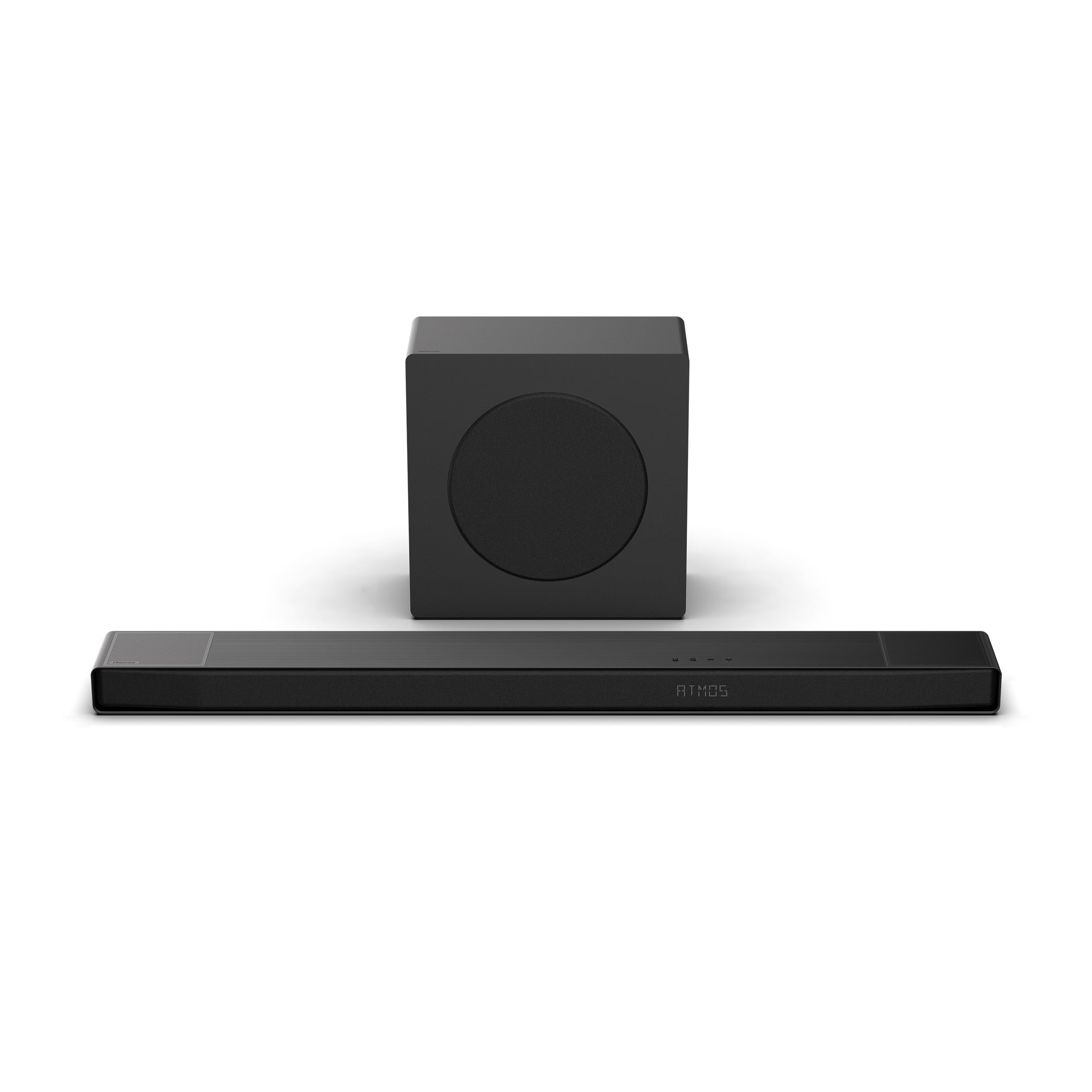
The Hisense AX3120Q brings a 3.1.2 channel layout with five front-firing and two up-firing speakers paired to a 6.5-inch wireless subwoofer. Where it differentiates itself from the competition is dual-format object-based support: Dolby Atmos and DTS:X are both natively decoded, meaning your Blu-ray collection in either format gets the full height-channel treatment. The up-firing speakers use a wide dispersion angle to maximize ceiling bounce in rooms with standard 8-foot ceilings.
Seven EQ modes — AI, Music, Night, Game, Movie, News, and Sport — allow quick tuning without diving into menus, and the EzPlay feature displays the soundbar’s settings directly on the TV screen when paired with a Hisense or Roku TV. Bluetooth 5.3 provides stable wireless streaming, and the 4K HDR pass-through means video quality is untouched when routing a source through the bar. The wireless subwoofer uses a 6.5-inch driver with decent excursion for its size.
In larger rooms, the rear-firing spatial effects may feel underpowered compared to systems with discrete rear satellites. The Bluetooth connection occasionally garbles audio with iPhones, though the issue appears inconsistent across units. For its price, the dual-codec support and genuine up-firing hardware make it a strong competitor for anyone with a mixed Dolby/DTS media library.
Why it’s great
- Native Dolby Atmos and DTS:X decoding
- 7 EQ modes with AI scene detection
- EzPlay TV-screen menu integration
- 4K HDR pass-through for uncompromised video
Good to know
- Rear spatial effects lose presence in large rooms
- Occasional Bluetooth audio garble with iPhones
- Roku TV integration works best with Hisense or Roku TVs
3. Amazon Fire TV Soundbar Plus with Subwoofer
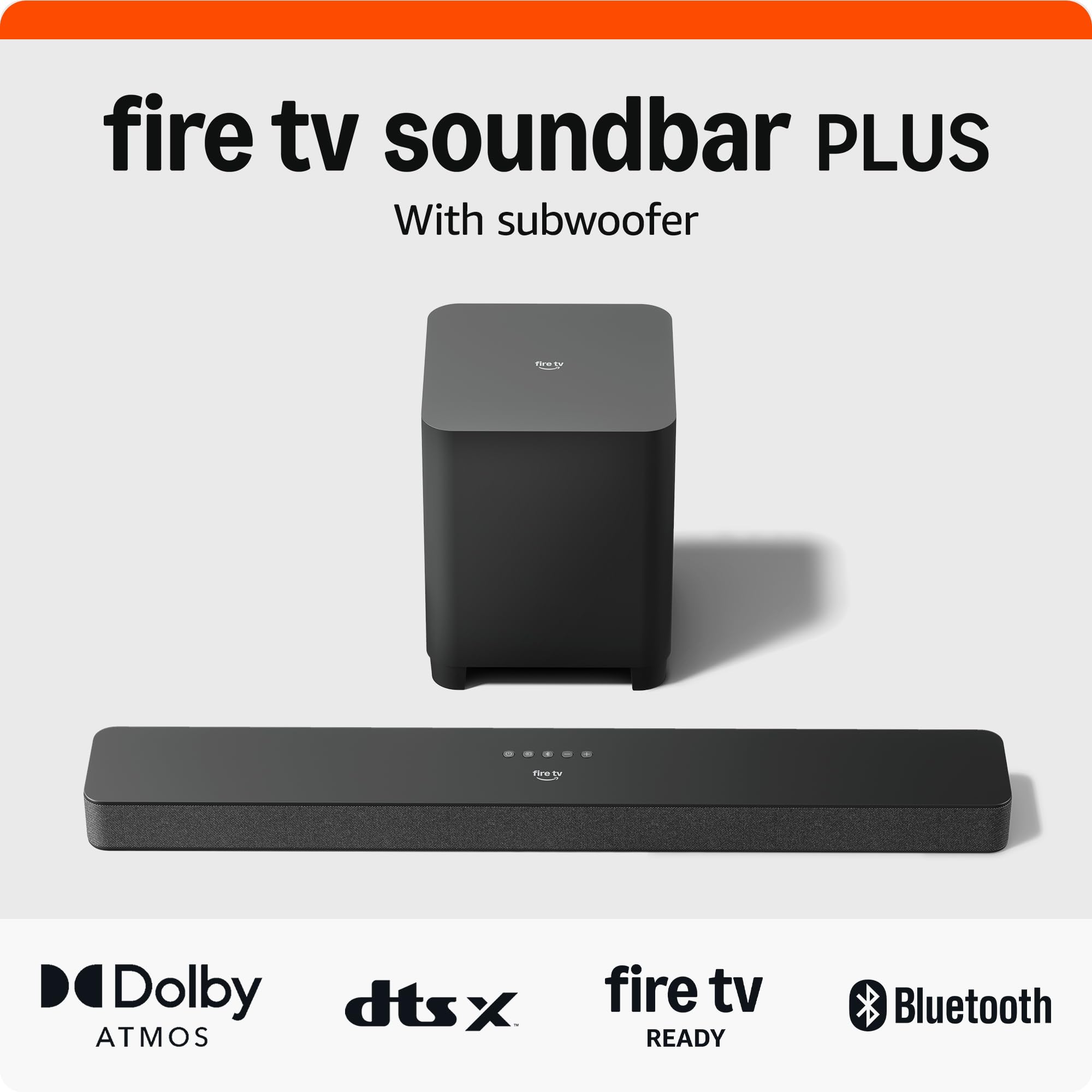
The Amazon Fire TV Soundbar Plus breaks the budget pattern by using real two-way left, center, and right channels with silk dome tweeters and individual amplifier channels — a construction normally reserved for bars costing twice as much. The dedicated center dialogue channel sharpens vocal intelligibility, and the bundled wireless subwoofer adds bass that fills medium-sized rooms without overwhelming the mids. Rear-firing surround drivers can be toggled off if wall placement is too close.
Integration with the Fire TV ecosystem is the headline feature: plug it into a Fire TV or Fire Stick, and the TV remote handles all control natively, with audio settings appearing in the Fire TV interface. Dolby Atmos and DTS:X decoding ensure compatibility with modern streaming services and discs. The subwoofer pairs automatically with the bar, and the system supports Bluetooth streaming from phones and tablets for casual music listening.
The soundbar is wide — over 40 inches — and may not fit between TV legs on smaller entertainment centers. The subwoofer connection is wireless but lacks the fine-tuning controls that power users want; you cannot adjust crossover frequency or phase delay. For households already invested in the Fire TV ecosystem, the seamless control and honest speaker design make this a compelling value.
Why it’s great
- Real two-way L/C/R with silk tweeters
- Seamless Fire TV remote and menu integration
- Dolby Atmos and DTS:X compatibility
- Rear-firing surround drivers with toggle
Good to know
- Soundbar too wide for many TV-leg setups
- No subwoofer crossover or phase adjustment
- Subwoofer alone is insufficient for large rooms
4. Yamaha SR-B30A
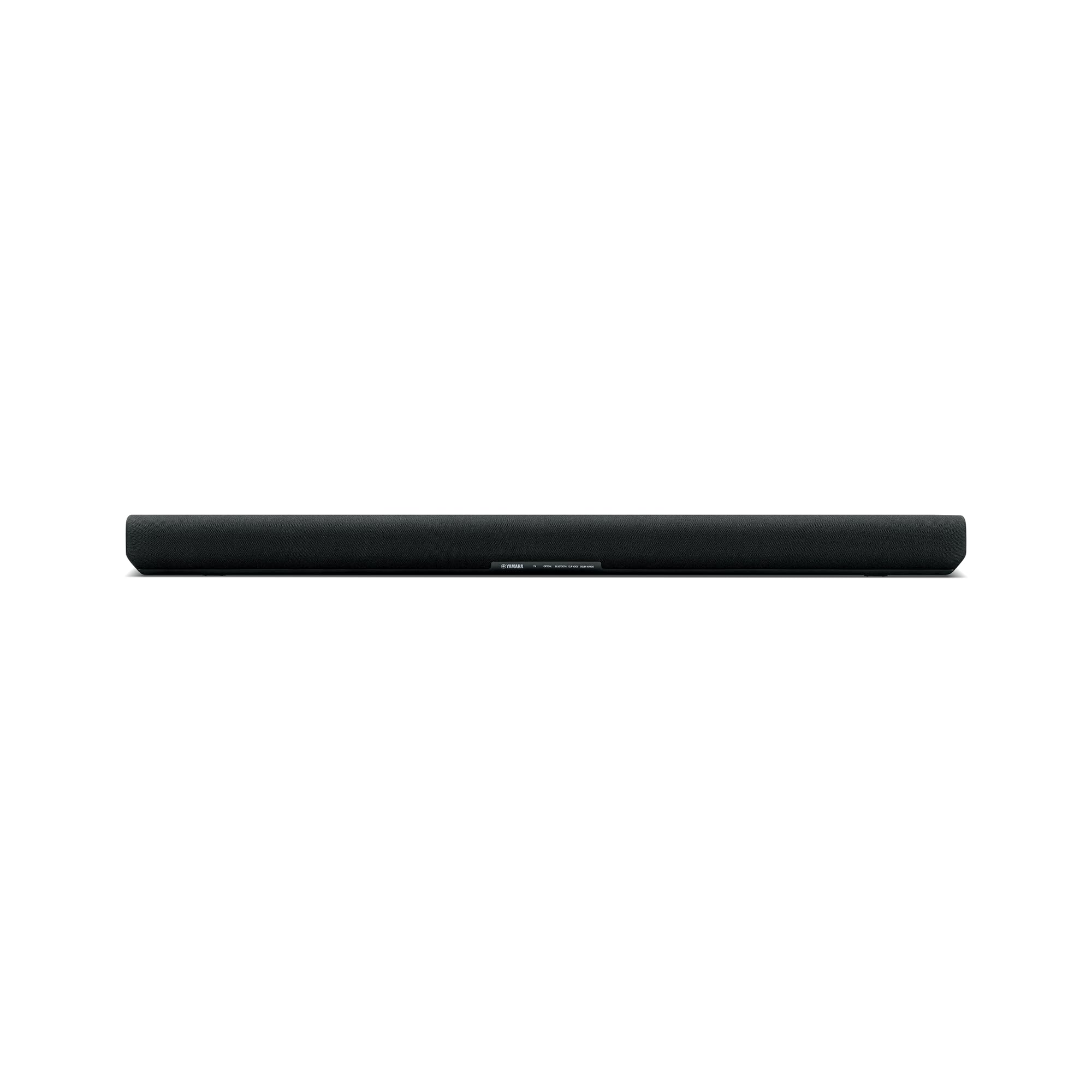
The Yamaha SR-B30A takes an all-in-one approach, integrating two built-in subwoofers directly into the soundbar chassis to eliminate the need for a separate subwoofer box. This design simplifies placement — no wireless pairing, no subwoofer power cable routing — and still manages to deliver satisfying low-end for everyday movies and music. The Clear Voice technology processes dialogue in real time to cut through background effects, a Yamaha hallmark that works well for news and complex action scenes.
Dolby Atmos decoding is paired with Yamaha’s True Sound philosophy, which focuses on natural tonal balance rather than aggressive frequency boosts. HDMI eARC support ensures lossless audio passthrough from the TV, and Bluetooth multipoint allows seamless switching between two paired devices — useful for taking a phone call while streaming from a tablet. Four sound modes (Movie, Stereo, Standard, Game) cover the main use cases without overwhelming choice.
The built-in subwoofer design means the bass extension is limited compared to separate subwoofer systems; it cannot reach below 50 Hz with authority. The subwoofer output (RCA) is present but passes bass signals that audiophiles describe as okay rather than seamless. Yamaha’s reputation for reliability and the two-minute setup time make this a low-fuss choice for users who prioritize simplicity over maximum low-end extension.
Why it’s great
- No separate subwoofer required — clean, simple setup
- Clear Voice technology enhances dialogue naturally
- HDMI eARC for lossless audio transmission
- Bluetooth multipoint for dual-device streaming
Good to know
- Built-in subs can’t match a dedicated 6.5-inch sub for depth
- Sub out port bass management is average
- No up-firing drivers — Atmos relies on virtual processing
5. Samsung B-Series HW-B630F

The Samsung HW-B630F leverages DTS Virtual:X processing to create a multi-directional sound field without dedicated height channel speakers. It uses a 3.1 channel layout (left, right, center, plus a wireless subwoofer) and applies psychoacoustic algorithms that trick the ear into perceiving overhead sounds. While this is not true Atmos via up-firing drivers, the effect is surprisingly convincing for a bar at this price, especially in small to medium-sized rooms with reflective ceilings.
The Adaptive Sound feature analyzes each scene in real time and adjusts EQ to emphasize dialogue or widen the soundstage automatically — a genuine convenience for mixed-content households. Samsung TV owners benefit from One Remote control, allowing power, volume, and sound mode changes directly from the TV remote without a second controller. The Voice Enhance Mode provides a quick boost to vocal frequencies during quiet dialog scenes, and the Game Mode Pro optimizes spatial audio for gaming with crosstalk cancellation.
The system lacks Wi-Fi connectivity and is incompatible with Samsung’s SmartThings app, so software updates and advanced EQ are not available. Rear speaker support is limited to the optional SWA-9250S kit, which must be purchased separately. Setup requires the user to manually power off the bar — there is no automatic standby detection for all sources. For Samsung TV owners wanting a simple, brand-matched upgrade with adaptive audio smarts, this is a focused package.
Why it’s great
- DTS Virtual:X offers convincing spatial audio without extra speakers
- Adaptive Sound auto-optimizes EQ per scene
- Samsung One Remote integration for unified control
- Subwoofer delivers room-rattling bass at high volume
Good to know
- No physical up-firing drivers — virtual Atmos only
- No SmartThings app or Wi-Fi connectivity
- Manual power-off required; no auto-standby for all inputs
6. Samsung S60D

The Samsung S60D is a 5.0-channel all-in-one soundbar that packs five drivers and built-in subwoofers into a single unit, eliminating the need for a separate subwoofer or rear satellites. It supports Wireless Dolby Atmos, meaning the bar receives Atmos metadata over Wi-Fi rather than HDMI — useful for reducing cable clutter but limited to streaming services. The Q-Symphony feature, when paired with a compatible Samsung TV, makes the TV’s speakers work in tandem with the bar for a wider, more layered sound.
SpaceFit Sound Pro uses the bar’s built-in microphone to analyze room acoustics and automatically calibrate EQ and channel levels — a genuinely useful feature for rooms with irregular geometry or furniture that blocks direct sound. Adaptive Sound and Active Voice Analyzer ensure dialogue stays clear even during loud action sequences, and Game Mode Pro engages automatically when it detects a console signal, activating 3D optimized sound for gaming. The built-in Alexa, Chromecast, and AirPlay 2 make it a smart speaker hub as well.
The 5.0-channel design means bass extension is limited; there is no dedicated subwoofer driver, so low frequencies below 60 Hz are absent. The bar lacks a numerical display — only a row of LEDs communicates settings, making adjustments less precise. For small bedrooms or apartments where a subwoofer would disturb neighbors, the S60D’s compact all-in-one design delivers clear, room-calibrated sound without the physical footprint of a separate sub.
Why it’s great
- 5-channel all-in-one design with no separate subwoofer
- Q-Symphony with Samsung TVs for expanded soundstage
- SpaceFit Sound Pro automatic room calibration
- Built-in Alexa, Chromecast, AirPlay 2
Good to know
- Limited bass extension — no subwoofer for deep low-end
- LED-only interface, no numerical display
- Best performance with Samsung Q-series TVs
7. LG S60T

The LG S60T is a 3.1-channel soundbar with a wireless subwoofer designed specifically to integrate with LG TVs through WOW Orchestra and WOW Interface. WOW Orchestra enables the TV speakers and soundbar to operate simultaneously, creating a wider soundstage than the bar alone can produce, while WOW Interface displays soundbar controls directly on the LG TV’s on-screen menu — accessible with the TV remote. The Crest Design metal grill adds dust protection and a modern aesthetic that matches LG’s current TV lineup.
AI Sound Pro uses machine learning to analyze audio content in real time and optimize EQ for vocals, bass, and dynamic range across sports, movies, and music. The bar includes Dolby Audio decoding, though it does not feature dedicated up-firing drivers for true object-based Atmos — it processes Atmos metadata through virtual surround algorithms. The LG Soundbar App offers a 3-band EQ for bass, treble, and midrange adjustment, along with control of rear speakers if added.
Some users report that the subwoofer requires reseating an internal connector to function out of the box — a QC issue that suggests batch variability. The system also requires eARC connection for advanced features like WOW Orchestra; optical-only setups lose access to the TV-speaker synergy. For LG TV owners who prioritize seamless single-remote control and AI-driven sound optimization over raw height-channel performance, the S60T delivers a polished, integrated experience.
Why it’s great
- WOW Orchestra uses LG TV speakers alongside the bar
- AI Sound Pro adapts EQ to content type in real time
- Crest Design metal grill with dust protection
- Single-remote TV control via WOW Interface
Good to know
- Virtual Atmos only — no physical up-firing drivers
- Subwoofer may need internal connector reseating on some units
- eARC required for full WOW Orchestra functionality
8. LG S40TR

The LG S40TR stands out in the budget segment by including wireless rear surround speakers in the box — something most competitors charge extra for or omit entirely. The 4.1-channel configuration (front left, front right, center, plus wireless rear satellites and a separate wireless subwoofer) creates a genuine surround bubble without needing a receiver or complex wiring. The rear speakers connect wirelessly to the main bar, requiring only power cables at their placement points.
Dolby Audio and DTS Digital compatibility ensure enhanced sound for streaming and disc-based content, though the system lacks dedicated height channels — the surround effect is horizontal rather than overhead. The Smart Up-Mixer converts two-channel stereo into multi-channel audio, expanding the soundstage for older content. Clear Voice Plus improves dialogue clarity by analyzing audio output and boosting center-channel frequencies, and the LG Soundbar App provides a 3-band EQ for fine-tuning.
The wireless rear speakers must be placed within a reasonable range of the main bar, and they are wired to each other (one satellite connects to the other via cable). The subwoofer is powerful enough to fill a 15×20 foot room without overwhelming the satellites, but the system lacks HDMI eARC — it uses standard HDMI ARC or optical, limiting lossless audio support. For buyers seeking true surround separation without adding a separate receiver, the included rear speakers make this a uniquely complete package.
Why it’s great
- Wireless rear surround speakers included in the box
- Clear Voice Plus enhances dialogue without extra hardware
- Smart Up-Mixer expands stereo content to surround
- Subwoofer delivers solid bass for medium rooms
Good to know
- No height channels — Atmos is virtual, not object-based
- Standard HDMI ARC, not eARC — lossy audio only
- Rear speakers wired to each other, limiting placement flexibility
9. Hisense AX3100Q
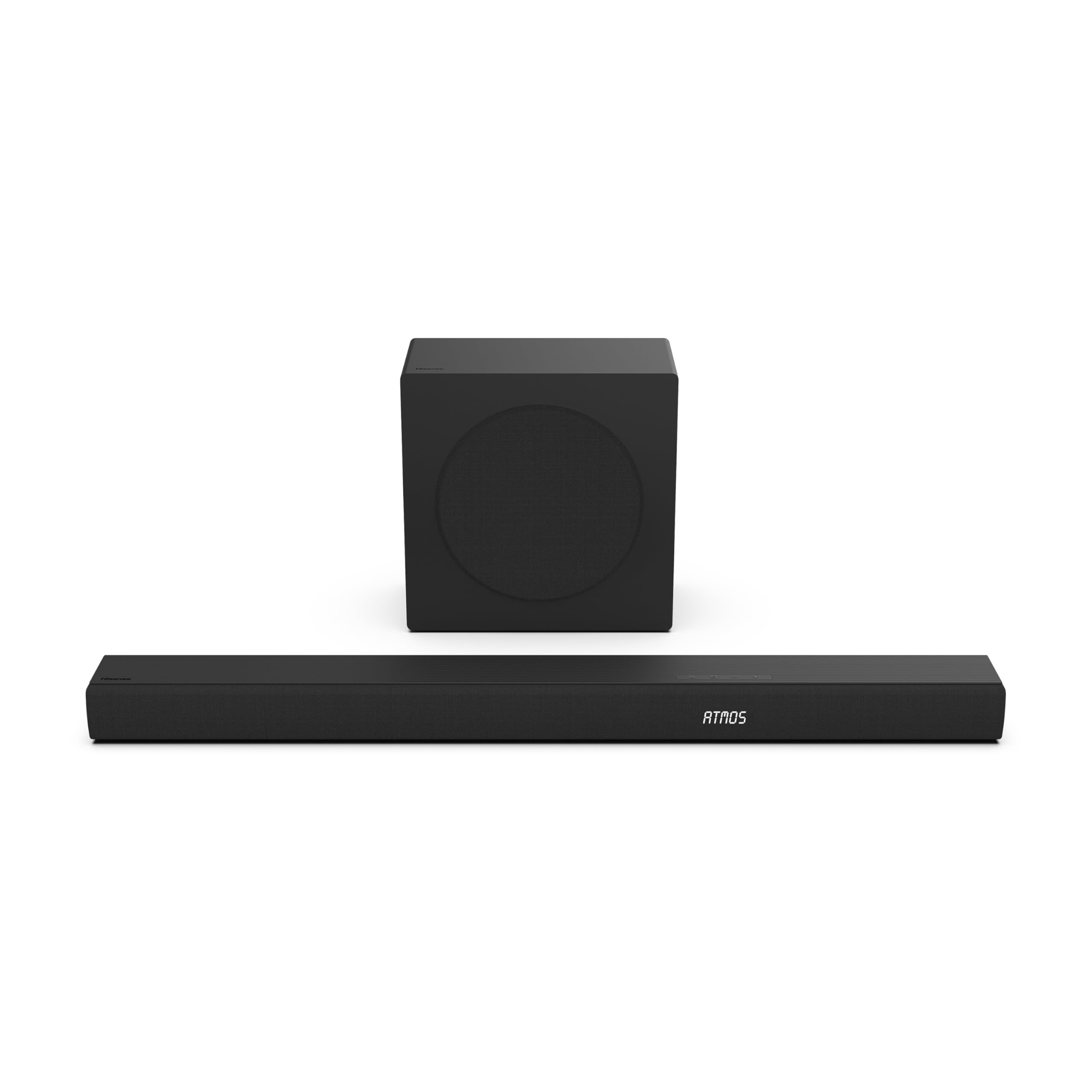
The Hisense AX3100Q is a 3.1-channel soundbar with a 6.5-inch wireless subwoofer that serves as the entry-level gateway into Dolby Atmos and DTS:X. It decodes both object-based formats, though the 3.1 layout means it relies on virtual processing to create the height layer rather than physical up-firing drivers. The result is a wider, more spacious sound than a standard 2.1 bar, with convincing overhead cues in content with strong Atmos mixing — but not the pinpoint height localization of a 3.1.2 system.
Seven EQ modes — AI, Music, Night, Game, Movie, News, and Sport — allow quick access to scene-appropriate tuning. The EzPlay feature brings the soundbar’s settings onto the TV screen when connected to a Hisense or Roku TV, reducing the need to juggle remotes. Bluetooth 5.3 ensures stable streaming from a phone or tablet, and the subwoofer pairs automatically with the soundbar. Setup is genuinely straightforward: HDMI eARC or optical connection, power on, and the system is operational in minutes.
The 6.5-inch subwoofer provides deep bass for its size, though it can occasionally overpower the main bar’s mids and highs at higher volumes. Roku TV users will appreciate the native integration, but those with other TV brands lose the EzPlay visual menu advantage. For buyers who want Dolby Atmos and DTS:X decoding at the absolute lowest investment, this is the most cost-effective option, provided expectations are set correctly regarding virtual height processing versus dedicated up-firing hardware.
Why it’s great
- Dolby Atmos and DTS:X decoding at the lowest price point
- 7 EQ modes including AI scene detection
- EzPlay TV-screen integration with Hisense/Roku TVs
- Simple HDMI eARC or optical setup
Good to know
- Virtual height processing — no physical up-firing drivers
- Subwoofer can overwhelm mids at high volume
- EzPlay only works with Hisense or Roku TVs
FAQ
Do I need a 3.1.2 soundbar for true Dolby Atmos or will a 3.1 bar suffice?
What is the difference between Dolby Atmos and Dolby Atmos with DTS:X support?
Will any soundbar with the Dolby Atmos logo produce overhead sound?
Is HDMI eARC worth the extra cost over standard HDMI ARC for Atmos?
Can I add rear speakers to my budget Atmos soundbar later?
Final Thoughts: The Verdict
For most users, the best budget atmos soundbar winner is the ULTIMEA Skywave F30 Boom because its true 3.1.2 channel layout with neodymium-core up-firing drivers, HDMI eARC for lossless audio, and a 38 Hz subwoofer deliver overhead effects that genuinely impress at the price. If you want Dolby Atmos and DTS:X support with dual-format flexibility, grab the Hisense AX3120Q. And for a Fire TV ecosystem-first experience with real two-way speaker engineering, nothing beats the Amazon Fire TV Soundbar Plus with Subwoofer.

Mo Maruf
I created WellFizz to bridge the gap between vague wellness advice and actionable solutions. My mission is simple: to decode the research and give you practical tools you can actually use.
Beyond the data, I am a passionate traveler. I believe that stepping away from the screen to explore new environments is essential for mental clarity and physical vitality.