Our readers keep the lights on and my smoothie glass nicely filled. As an Amazon Associate, I earn from qualifying purchases.
Finding a headphone amplifier under the price of a basic dinner out is surprisingly possible, but sorting the genuinely clean-sounding units from the noisy ones requires looking past the marketing hype at the actual output transistors and circuit design. The real challenge isn’t just volume — it’s getting a black background, proper channel separation, and enough current to make a hungry set of 250Ω or 600Ω headphones sing without clipping or distortion.
I’m Mohammad Maruf — the founder and writer behind WellFizz. I’ve spent countless hours cross-referencing datasheets, customer testing reports, and measured specs to identify which sub- amplifiers actually deliver measurable performance instead of just loudness.
Whether you need a desktop Class-A unit for critical listening or a portable dongle for commuting, the right budget amp for headphones will transform your listening experience by providing clean power that your phone or laptop jack simply cannot supply.
How To Choose The Best Budget Amp For Headphones
The temptation is to sort by wattage alone, but a budget amp that can drive your specific headphones without introducing hiss or distorting the signal is the real goal. Focus on output impedance, gain structure, and connectivity that matches your listening setup — not just the loudest box on the shelf.
Output Power and Impedance Matching
Amp output is measured in milliwatts (mW) at a given impedance, typically 32Ω or 300Ω. A 32Ω-rated power figure means little if you own 300Ω Sennheiser HD 600s — the delivered power drops significantly as impedance rises. Look for an amp that lists power at both low and high impedance so you can estimate real-world loudness. As a rule, 100mW at 300Ω is a strong baseline for full-size dynamic headphones.
Output Impedance and Damping Factor
Output impedance should be as low as possible — ideally under 1Ω — to avoid altering the frequency response of multi-driver or balanced-armature earphones. A high output impedance (over 10Ω) can introduce a bass bump or treble roll-off, especially with multi-driver IEMs. For single-driver dynamics, this effect is less audible but still measurable.
Noise Floor and Distortion Specs
The noise floor, often given as SNR (signal-to-noise ratio) or residual noise in microvolts (µV), determines how silent the amp is between tracks. A noisy amp reveals itself as a faint hiss with quiet passages or sensitive IEMs. Look for SNR above 100dB and noise floor under 10µV for a black background. THD+N below 0.01% is transparent; below 0.001% is excellent for the budget segment.
Quick Comparison
On smaller screens, swipe sideways to see the full table.
| Model | Category | Best For | Key Spec | Amazon |
|---|---|---|---|---|
| Douk Audio U3 | Class-A Desktop | High-impedance cans on a desk | 1300mW output 26V rail | Amazon |
| Douk Audio U10 Tube | Tube Buffer | Warmth and tube-rolling fun | 1100mW per channel | Amazon |
| Fosi Audio DS2 USB-C | Portable DAC/Amp | Mobile high-res listening | 170mW per ch. 4.4mm | Amazon |
| MOONDROP Dawn PRO 2 | Portable DAC/Amp | IEM tuning via app EQ | 124mW 4.4mm output | Amazon |
| Donner EM1 | Belt-Pack Monitor | Live in-ear monitoring | 12-hour battery life | Amazon |
| Fosi Audio PH05 | Multi-Channel Splitter | Studio sharing or podcasting | 310mW per ch. 5-channel | Amazon |
| LZSIG 6-Channel Amp | Multi-Headphone Splitter | Classroom or band rehearsal | 6 independent volumes | Amazon |
In‑Depth Reviews
1. Douk Audio U3 Headphone Amplifier

The Douk Audio U3 is the benchmark for entry-level Class-A amplification, running its output transistors at a constant high bias to eliminate crossover distortion. The internal 26V voltage rail (stepped up from DC 5-20V input) provides the headroom needed to drive 300Ω Sennheiser HD 600-class headphones to satisfying levels without strain. The socketed TI-NE5532 op-amp invites users to roll different op-amps for sonic voicing, a feature typically reserved for much pricier gear.
The stepped attenuator volume control offers indexed steps with a tactile click, ensuring channel balance remains stable across the volume range — a common weak point in budget pots. Build quality is dense and metallic, with a satisfying solidness that belies its compact dimensions. The lack of a dedicated power supply in the box and the overly bright blue power LED are the primary physical complaints, though neither affects the audio performance itself.
Owners report excellent results with classic high-impedance loads like the HD 650, DT 880, and K701, noting that the amp reveals recording quality and source chain defects with unsparing detail. The sound is described as warm and smooth after a brief burn-in period, with a notably low noise floor that makes it usable with moderately sensitive IEMs.
Why it’s great
- True Class-A bias for ultra-low distortion
- Pluggable op-amp socket for DIY modding
- Steps up to 26V rail for high-impedance drive
Good to know
- Requires quality USB or DC power supply (not included)
- Stepped volume knob has coarse 1-2dB steps
- L/R channel imbalance at very low volume levels
2. Douk Audio U10 Mini Tube Headphone Amplifier

The Douk Audio U10 introduces a genuine tube buffer stage using two 6A2 pentode tubes wired to add harmonic richness and a slight compression that many listeners find more musical than the sterile precision of pure solid-state circuits. The hybrid design applies its voltage boost circuit to achieve a 24V internal rail from a 5V USB supply, enabling it to drive headphones up to 600Ω — including the famously hungry Beyerdynamic DT 880 or Sennheiser HD 800 series — with 1100mW on tap.
Both the tubes and the op-amp are socketed, allowing tube rolling and op-amp upgrades that can shift the sound from warm and syrupy to more detailed and extended. The all-metal enclosure provides effective shielding, and the inclusion of both 3.5mm and 6.35mm jacks makes it versatile for home and desktop use. The unit can also function as a stereo preamp for powered monitors, adding tube warmth before the speakers.
Quality control is a notable concern: several reports describe the front jacks failing or the device dying after a short period, and the tubes can run hot enough that touching them during operation is inadvisable. When the unit works, the sound is described as significantly improving the perceived quality of lossy and lossless sources alike, adding a roundness and pleasant fuzz that reduces listening fatigue.
Why it’s great
- Two 6A2 tubes for warm harmonic coloration
- Drives headphones up to 600Ω impedance
- Pluggable tubes and op-amp for custom tuning
Good to know
- Quality control issues reported (dead units, jacks)
- Tubes run hot to the touch
- No power supply included; requires DC5V/≥2A adapter
3. Fosi Audio DS2 USB-C to AUX Headphone Amp DAC Dongle

The Fosi Audio DS2 is a dual-Cirrus Logic CS43131 DAC and amplifier combined into a compact USB-C dongle, supporting PCM 32-bit/384kHz and DSD256 natively via both 3.5mm single-ended and 4.4mm balanced outputs. The balanced output delivers 170mW per channel into 32Ω, providing ample power for most IEMs and some full-size headphones while maintaining a noise floor of only 1µV — effectively silent even with sensitive multi-BA earphones.
Independent 60-step volume control buttons on the housing allow precise level setting without relying on the source device’s coarse digital volume, supporting volume memory across connections. The aluminum CNC-machined shell dissipates heat effectively during extended listening sessions. Compatibility spans iPhone 15 series, Android phones, iPads, Windows, and macOS, making it a universal upgrade for any device with a USB-C port.
Users consistently praise the transparent, detailed presentation that makes streaming services sound nearly indistinguishable from high-bitrate local files. The power draw from the phone is noticeable — roughly 8% per hour — but the sonic improvement over any built-in headphone output is dramatic. The included USB-C cable is thin and prone to failure, easily replaced with a higher-quality braided cable.
Why it’s great
- Dual CS43131 DAC chips for high-resolution playback
- Ultra-low 1µV noise floor for black background
- 4.4mm balanced output with 170mW per channel
Good to know
- Battery drain is significant on mobile devices
- Included USB-C cable is low quality
- No in-line microphone support
4. MOONDROP Dawn PRO 2 Decoder Headphone Amplifier
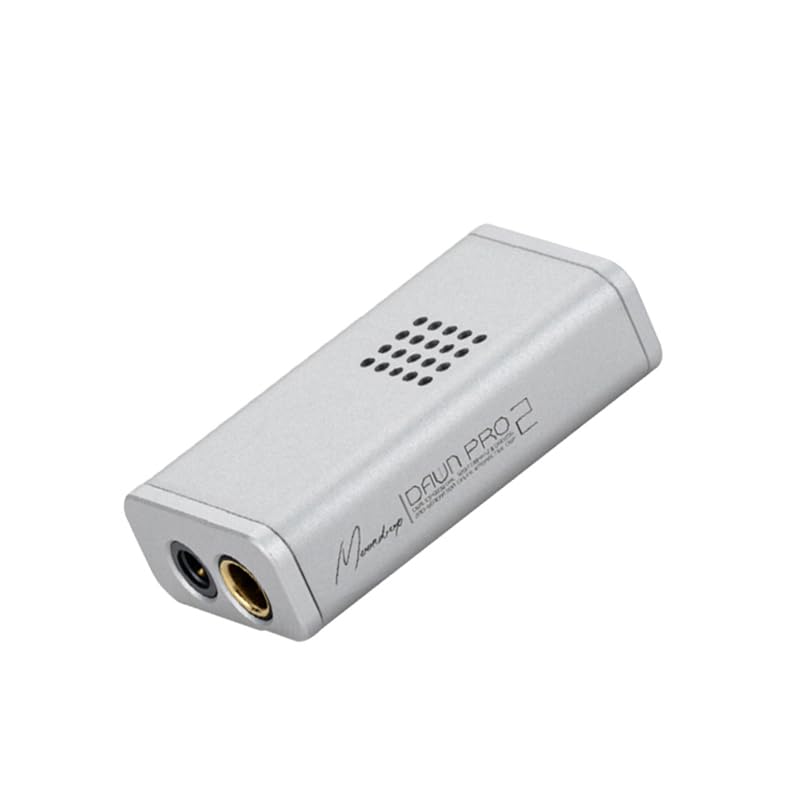
The Moondrop Dawn PRO 2 leverages dual Cirrus Logic CS43198 DAC chips — a step up from the CS43131 — paired with three independent LDO regulators to isolate digital and analog power rails, reducing intermodulation distortion. The output stage provides 124mW per channel at 32Ω via the 4.4mm balanced connection, with a 4Vrms output voltage that gives it surprising headroom for a pocket-sized device.
One of the most distinctive features is the companion Moondrop Link app, which enables a full parametric EQ with adjustable filter type, frequency, gain, and Q factor. Users can load community-shared EQ profiles tailored to specific headphone models, effectively reshaping the frequency response to personal taste. The 100-level lossless volume control separates level management from the phone’s system volume, avoiding digital bit-depth reduction.
The aviation-grade aluminum alloy housing with CNC venting channels keeps the device cool during extended use. The 4.4mm balanced output delivers noticeably more power and channel separation than the 3.5mm single-ended output, making it the recommended connection for power-hungry IEMs like the Moondrop Variations or Sennheiser IE 900. Some units exhibit fitment issues with certain 4.4mm plugs requiring partial insertion for proper contact.
Why it’s great
- Dual CS43198 DAC with separate LDO power regulation
- Full parametric EQ via Moondrop Link app
- 100-level lossless volume control
Good to know
- EQ resets when unplugged from source
- 4.4mm jack can have intermittent connection issues
- Treble can sound slightly etched with bright headphones
5. Donner EM1 Portable Analog Headphone Amplifier
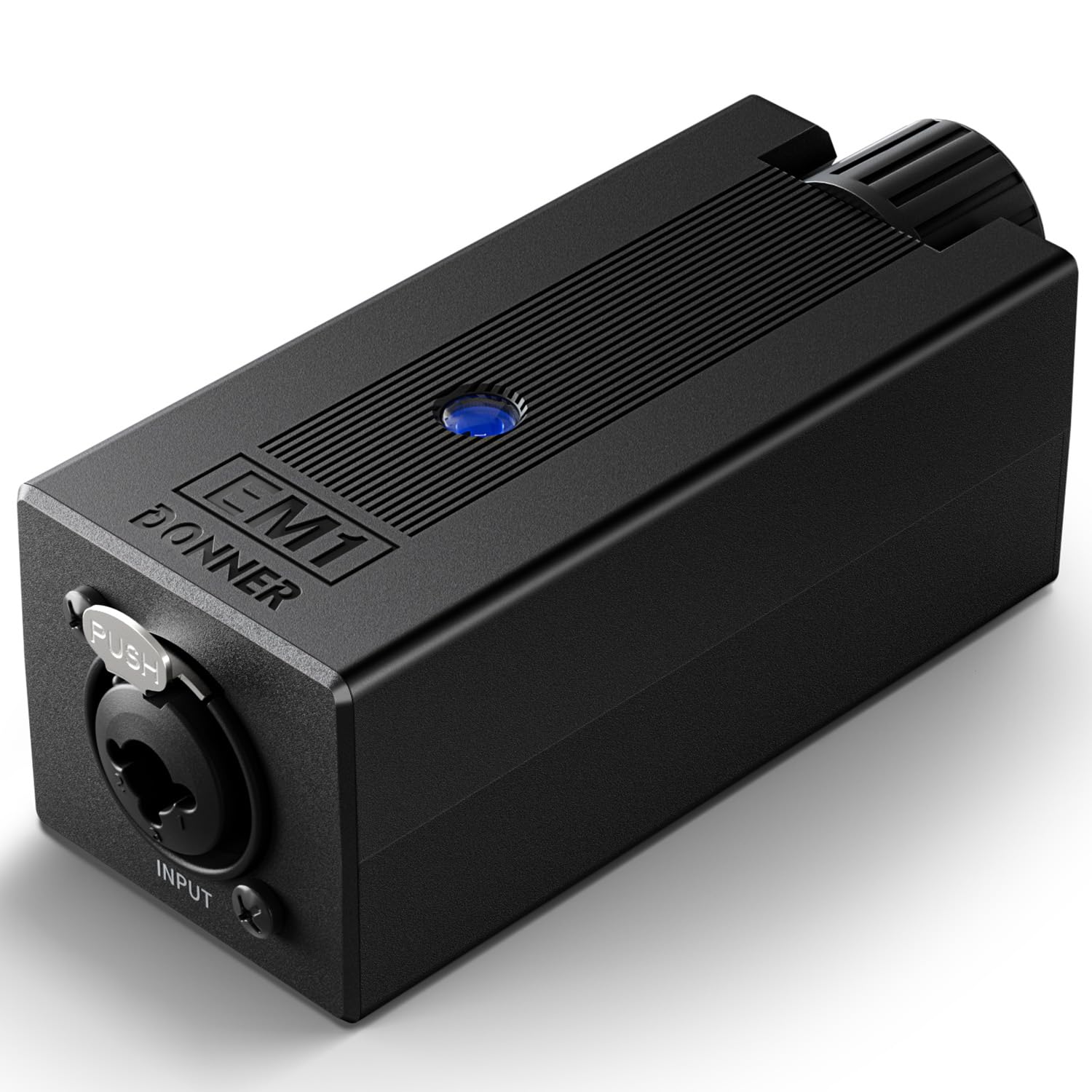
The Donner EM1 is built as a belt-pack monitor amplifier for live performance, designed to provide sufficient gain from a mixer’s aux or monitor send via its locking XLR and TRS inputs. The internal lithium-ion battery delivers up to 12 hours of continuous operation on a single charge, making it ideal for long rehearsal sessions or gigs where power outlets are not available near the performer.
The stereo/mono switch ensures compatibility with both balanced TRS (stereo) and unbalanced TS (mono) sources — a critical distinction for musicians using a single earpiece. The 3.5mm output jack delivers clean gain suitable for both in-ear monitors and on-ear headphones up to moderate impedance levels. Users report the noise floor is low enough that white noise is not distracting during quiet passages.
Volume is controlled via a single knob on the top edge, which is occasionally bumped during movement but is otherwise intuitive. The belt clip is sturdy and fits securely on guitar straps or waistbands. The charger uses a proprietary USB-A to USB-C cable — a standard USB-C to USB-C cable will not charge the device, which is a notable inconvenience for those already invested in USB-C.
Why it’s great
- 12-hour rechargeable battery for live use
- Locking XLR and TRS input connectors
- Stereo/mono switch for one-ear monitoring
Good to know
- Requires proprietary USB-A to C cable for charging
- Volume knob can be bumped accidentally
- Single-ended 3.5mm output only, no balanced
6. Fosi Audio PH05 5-Channel Headphone Splitter Amplifier

The Fosi Audio PH05 is a one-input-to-five-output stereo headphone amplifier designed for collaborative listening in studio, podcast, or classroom settings. Each of the five channels is independently amplified, delivering 310mW at 32Ω per channel, with its own level control knob so each listener can set their preferred volume without affecting others. The all-aluminum alloy chassis is solid and well-damped against vibration.
At the core, the amplifier board uses carefully selected low-noise op-amps to achieve a measured SNR of 105dB and THD+N of just 0.001%, figures that match many dedicated single-headphone amplifiers at twice the price. The noise floor is specified at 25µV, which is quiet enough for sensitive IEMs when volume is not maxed. A large-diameter master volume control and a mute button provide quick control over all outputs simultaneously.
Users testing the PH05 report that it drives full-size planars like the Hifiman Edition XS to satisfying levels without audible distortion, and that the sound character is neutral — adding no coloration and preserving the tonal balance of the source. The lone downside is that the LED indicators for mute status (orange vs. blue) are non-intuitive and can be confusing during quick on-stage or in-studio adjustments.
Why it’s great
- 5 independent channels with 310mW per channel
- 0.001% THD+N and 105dB SNR
- Master volume and mute button included
Good to know
- LED mute indicators are non-intuitive
- Slight noise floor audible at maximum volume
- No balanced input or output option
7. LZSIG 6 Channel Metal Stereo Headphone Amplifier

The LZSIG 6-channel amplifier serves as both a distribution amplifier and a basic mixing tool, accepting one or two stereo inputs and feeding up to six stereo headphone outputs, each with its own volume knob. The internal board is populated with nine ROHM low-noise op-amps, providing enough current to drive headphones in the 32-100Ω range with minimal crosstalk — measured as less than -70dB between adjacent channels.
A dedicated bass boost switch engages a filter that elevates the 400-600Hz and 3000-7200Hz ranges, effectively enhancing vocal presence and low-frequency punch for monitoring applications. The stereo/mono switch makes it compatible with both consumer-stereo and monitoring-mono sources. The metal enclosure includes a standard 12V DC barrel jack for power, and an adapter is included in the box — a welcome inclusion.
The amplifier is well-suited for music classrooms, podcast teams, or rehearsal spaces where multiple listeners need to monitor the same feed. The unit can also function as a high-gain line distributor. Note that the gain is very high — volume should be started low and increased gradually — and the bass boost can sound aggressive with bright headphones. The on/off switch on some units may be unreliable, but support is reportedly responsive.
Why it’s great
- Six independent headphone outputs with separate volume
- Bass boost switch for vocal and low-end emphasis
- Stereo/mono switch for flexible source matching
Good to know
- Very high gain; volume must be set cautiously
- Bass boost can sound harsh on some headphones
- Occasional on/off switch defects reported
FAQ
What output impedance is acceptable for a budget headphone amp?
Can a budget amp drive 300Ω headphones like the Sennheiser HD 600?
What is the difference between a DAC/Amp dongle and a standalone analog amp?
Final Thoughts: The Verdict
For most users, the budget amp for headphones winner is the Douk Audio U3 because its Class-A circuit architecture and 26V voltage rail provide clean, high-current power for demanding high-impedance headphones at an unbeatable price. If you want portable high-resolution playback on the go, grab the Fosi Audio DS2. And for a collaborative studio or classroom setup where multiple listeners need their own volume, nothing beats the Fosi Audio PH05.

Mo Maruf
I created WellFizz to bridge the gap between vague wellness advice and actionable solutions. My mission is simple: to decode the research and give you practical tools you can actually use.
Beyond the data, I am a passionate traveler. I believe that stepping away from the screen to explore new environments is essential for mental clarity and physical vitality.