Our readers keep the lights on and my smoothie glass nicely filled. As an Amazon Associate, I earn from qualifying purchases.
A 55-inch television is the most contested real estate in the consumer electronics aisle—large enough for an immersive living room experience, yet compact enough to fit into apartments and secondary viewing spaces. The challenge for budget-focused buyers is finding a panel that delivers genuine 4K resolution, vibrant HDR color, and responsive smart features without the premium price tag that often accompanies these specs.
I’m Mohammad Maruf — the founder and writer behind WellFizz. I spend my time dissecting display technologies, analyzing real-world performance data, and comparing smart TV operating systems across hundreds of models to find where manufacturers cut corners and where they actually deliver value.
After evaluating nine televisions that balance cost and capability, the data points toward clear winners: the best budget 55 inch tv winner combines QLED color, Dolby Vision HDR, and a responsive smart platform at a price that leaves room for a soundbar.
How To Choose The Best Budget 55 Inch TV
When your budget is the primary constraint, every spec decision becomes a trade-off. The goal is to prioritize the features that have the largest impact on your viewing experience while avoiding flashy marketing terms that don’t translate to real-world performance.
Panel Technology: QLED vs. Mini-LED vs. Standard LED
Standard LED panels use a single backlight that can’t dim specific parts of the screen, resulting in washed-out blacks in dark scenes. QLED uses a quantum dot layer to boost color volume and brightness, making HDR content pop. Mini-LED takes this further by dividing the backlight into hundreds of zones, allowing deep blacks and bright highlights simultaneously. In the budget tier, QLED is the baseline for acceptable HDR performance; Mini-LED is a significant upgrade that elevates picture quality closer to premium OLED territory.
Refresh Rate and Gaming Features
A standard 60Hz panel is fine for casual TV watching and streaming, but if you play console or PC games, native 120Hz or 144Hz support with Variable Refresh Rate (VRR) and Auto Low Latency Mode (ALLM) eliminates screen tearing and delivers fluid motion. HDMI 2.1 ports are required to pass 4K signals at these higher refresh rates, so check the port specifications if gaming is a priority.
Smart TV Operating System
The operating system defines your daily experience. Roku OS is the gold standard for simplicity and speed, with a clean interface and fast app launches. Google TV offers deeper integration with the Google ecosystem and Chromecast built-in, but can feel sluggish on lower-end hardware. Fire TV provides Alexa integration but suffers from a cluttered home screen and slower navigation. Choose the OS that matches your streaming habits and tolerance for interface quirks.
HDR Format Compatibility
Dolby Vision is the most advanced HDR format, offering dynamic metadata that adjusts brightness and contrast scene-by-scene. HDR10+ is an open alternative used by some streaming services. HDR10 is a static format that applies the same settings to the entire movie. For the best picture quality, look for a TV that supports at least Dolby Vision and HDR10, as most streaming content uses one of these formats.
Quick Comparison
On smaller screens, swipe sideways to see the full table.
| Model | Category | Best For | Key Spec | Amazon |
|---|---|---|---|---|
| Roku Plus Series (Mini-LED) | Premium | Best all-around picture quality | Mini-LED backlight + QLED | Amazon |
| iFFALCON 55U85 | Premium | High-refresh gaming | 144Hz VRR + Mini-LED | Amazon |
| TCL T7 Series (Q7) | Mid-Range | High-refresh with QLED color | 120Hz native panel | Amazon |
| Samsung S90F | Premium | Best color accuracy and contrast | QD-OLED panel | Amazon |
| TCL Q65 QLED | Mid-Range | Balanced value with QLED | QLED Pro + Dolby Vision | Amazon |
| Hisense 55E6QF | Mid-Range | Budget-friendly QLED with Fire TV | Hi-QLED + Dolby Vision | Amazon |
| Roku Select Series | Mid-Range | Easiest smart TV experience | QLED + Roku OS | Amazon |
| Westinghouse Xumo TV | Budget | Entry-level 4K with Dolby Vision | 4K UHD + Dolby Vision | Amazon |
| Vizio V4K55M | Budget | Lowest cost 4K with gaming features | 4K UHD + ALLM | Amazon |
In‑Depth Reviews
1. Roku Plus Series (Mini-LED) — 55-Inch
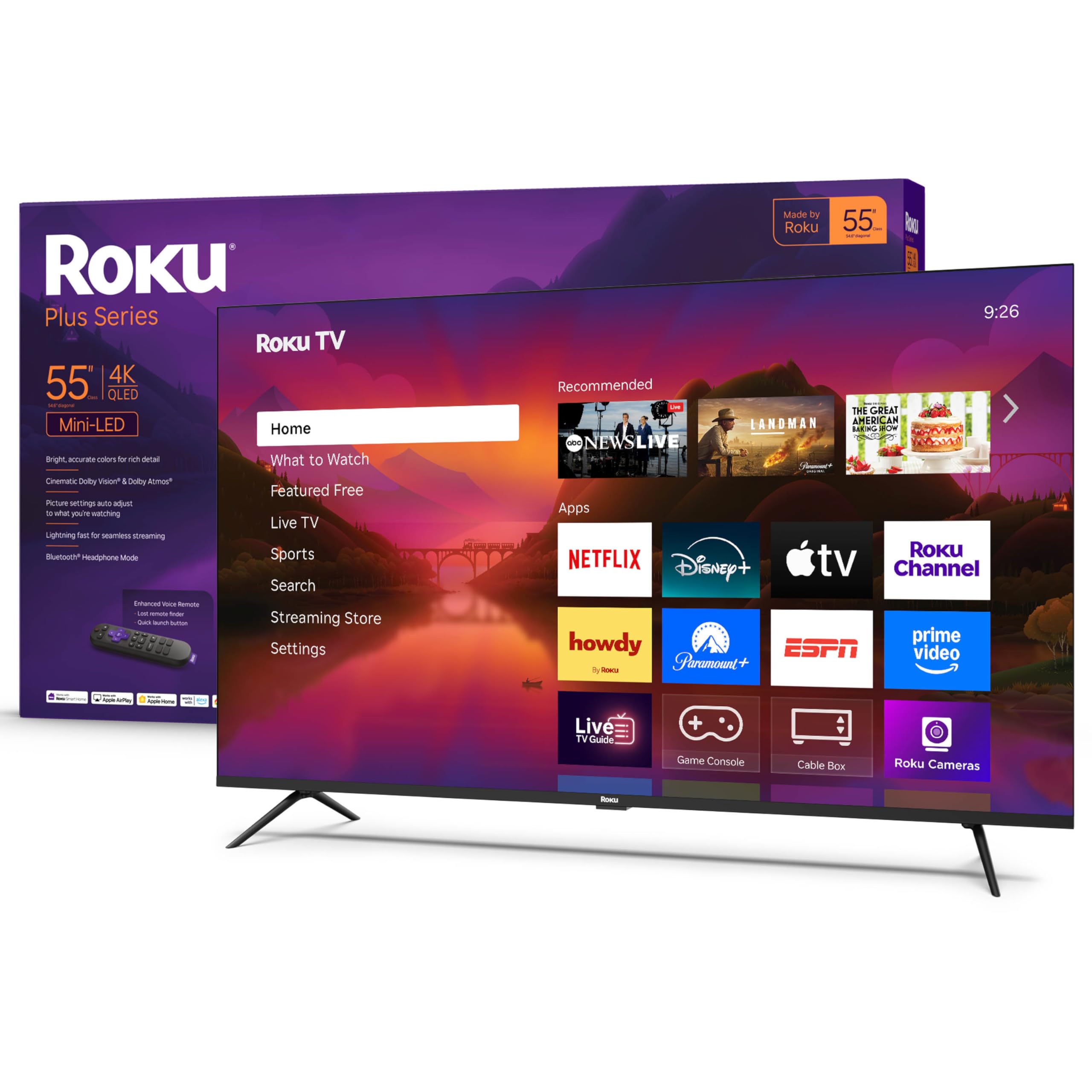
The Roku Plus Series is the TV that proves advanced backlighting doesn’t have to break the bank. Its Mini-LED array provides exceptional contrast for this price range, with deep blacks that make dark movie scenes watchable and highlight peaks that give sunlight and explosions real punch. The QLED quantum dot layer ensures color volume stays high even during bright HDR content, so you see vibrant reds and greens without the washed-out look typical of standard LED panels.
Roku’s Smart Picture Max uses AI to optimize incoming signals, which is particularly useful for lower-resolution cable or streaming content. The built-in Dolby Atmos sound system includes a dedicated subwoofer that delivers surprising bass depth, so dialogue remains clear during action sequences and the low end doesn’t distort at normal listening volumes. The Enhanced Voice Remote includes a lost remote finder and programmable shortcuts for instant app access.
The interface remains the gold standard for smart TV usability: fast app launches, a clean home screen without sponsored clutter, and automatic software updates that add features over time. Bluetooth headphone mode lets you listen to late-night shows without disturbing others, and Apple AirPlay 2 support makes sharing content from Apple devices seamless. The 60Hz panel is the main limitation if you’re a competitive gamer, but for standard console gaming and streaming, this TV delivers the best picture quality and user experience in the entire category.
Why it’s great
- Mini-LED backlight provides excellent contrast and deep blacks
- Roku OS is the fastest and easiest smart TV platform
- Built-in subwoofer delivers surprisingly good bass
- Lost remote finder and Bluetooth headphone mode
Good to know
- 60Hz panel limits gaming to standard refresh rates
- USB port retains power for bias lights up to 10 minutes after shutdown
- Basic settings menu compared to Google TV equivalents
2. iFFALCON 55U85 Mini-LED TV
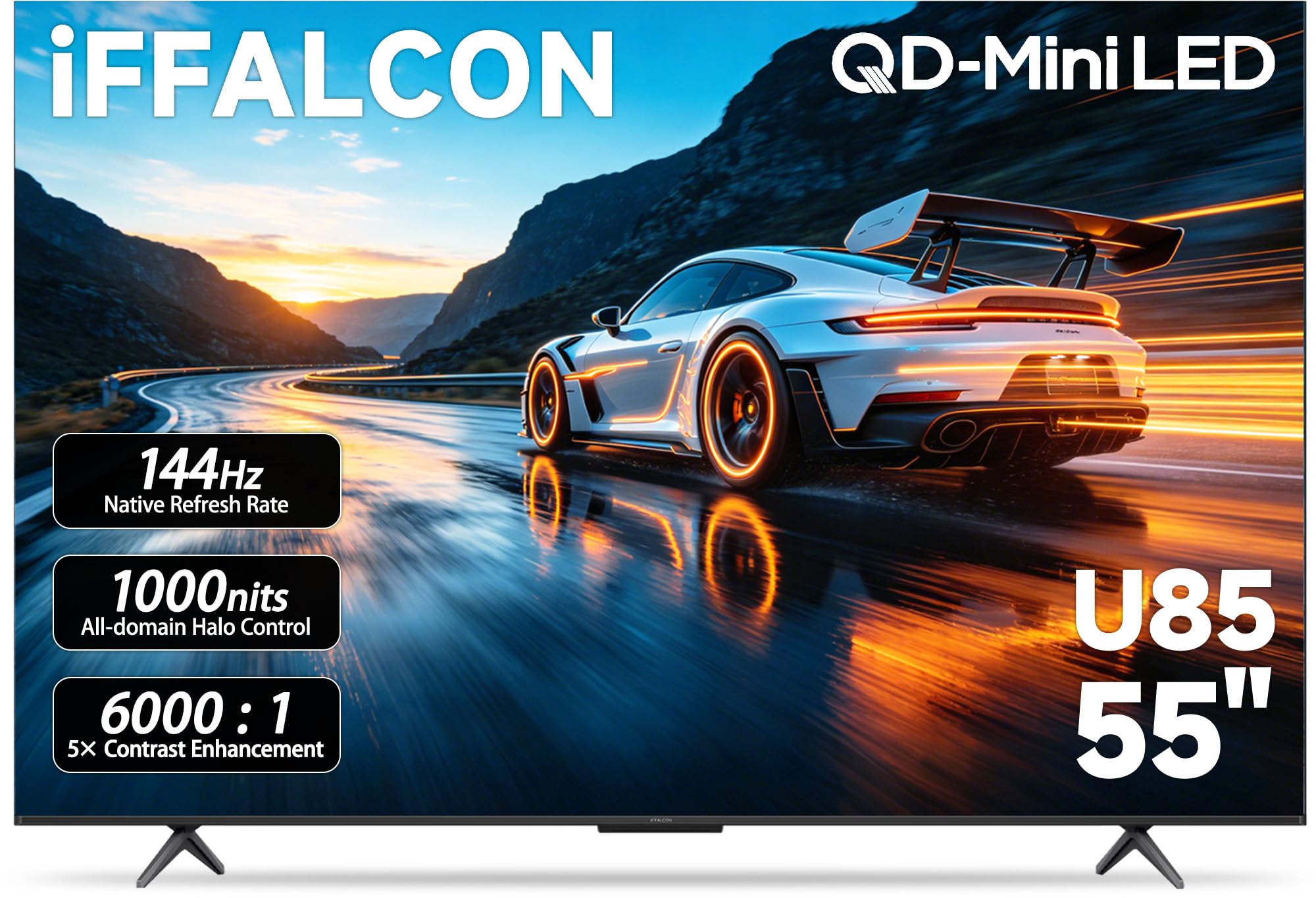
The iFFALCON 55U85 is a gaming-first television that brings Mini-LED backlighting and a 144Hz native panel to a price point where such specs are rare. The local dimming zones produce a 6,000:1 contrast ratio that makes dark game environments feel atmospheric while keeping bright HUD elements and muzzle flashes vivid. Peak brightness reaches 1000 nits, which is high enough to make Dolby Vision Gaming and HDR10+ content look genuinely impressive rather than just “good for the price.”
Four HDMI 2.1 ports are a standout feature—two of them handle 4K at 144Hz, perfect for a PS5, Xbox Series X, and a gaming PC all connected simultaneously. Auto Low Latency Mode kicks in the moment a console is detected, and FreeSync Premium Pro eliminates screen tearing during fast-paced shooters and racing games. The 50W 2.1-channel audio system includes a dedicated 20W woofer, providing enough bass for immersive gameplay without requiring an external soundbar for most rooms.
Google TV with far-field voice control handles streaming duties, and the interface is surprisingly responsive for a budget-tier implementation. The TV’s thicker chassis is a trade-off for the Mini-LED hardware inside, but it includes features rarely seen in this segment: hotel mode for property management, IR blaster and IP control for commercial installations, and 4K@288Hz overshoot capability for PC gaming. The build quality is not as refined as premium brands, but the performance-to-price ratio is exceptional for anyone who prioritizes gaming fluidity over aesthetics.
Why it’s great
- Native 144Hz panel with VRR up to 288Hz for tear-free gaming
- Four HDMI 2.1 ports allow simultaneous console and PC connections
- Mini-LED backlight delivers excellent contrast and 1000-nit peak brightness
- 50W audio system with dedicated woofer
Good to know
- Thicker chassis than ultra-slim competitors
- Reported flickering issue on some units (check return policy)
- Google TV interface can feel less polished than Roku OS
3. TCL T7 Series (55T7) — Amazon Exclusive
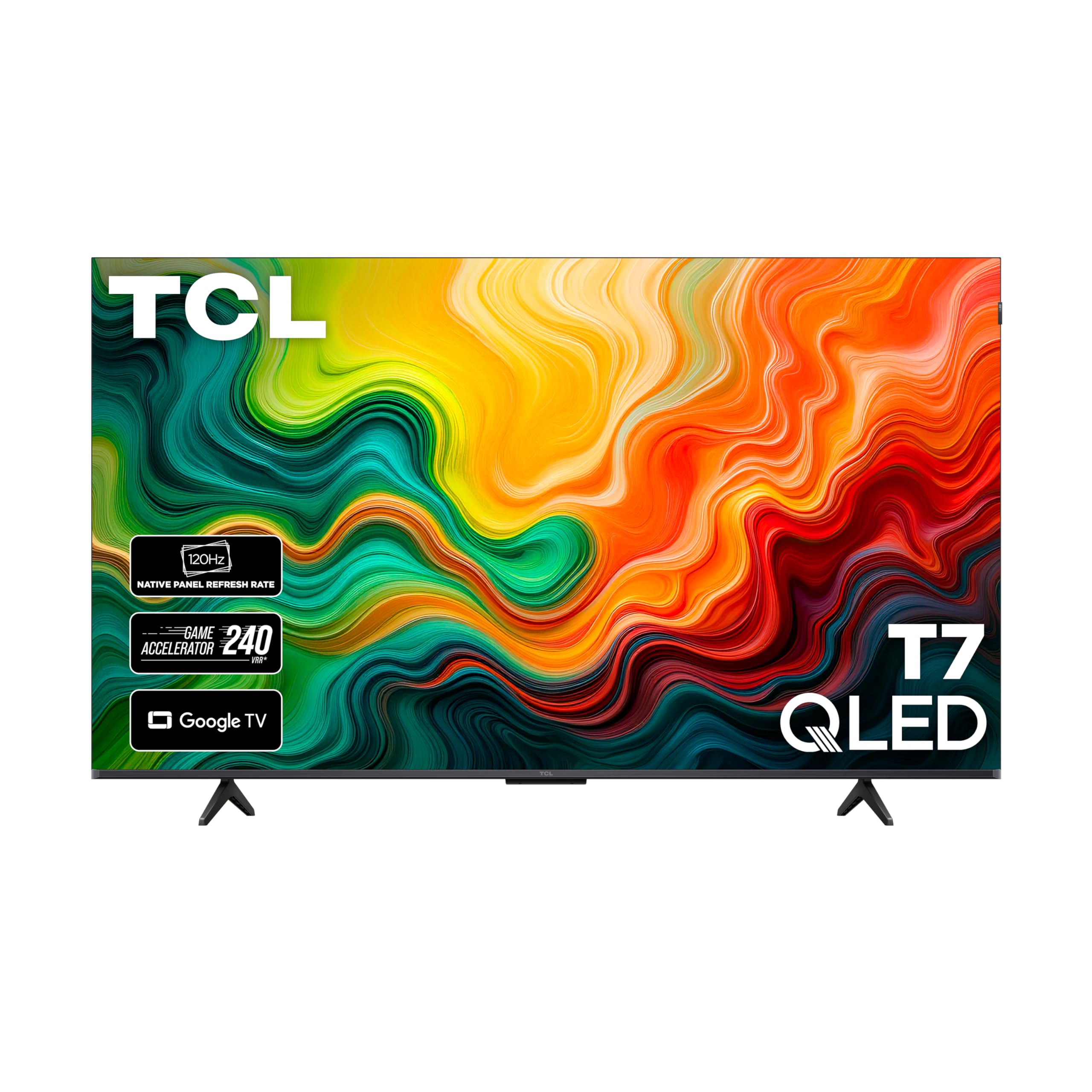
The TCL T7 Series strikes a compelling balance between high-refresh gaming and QLED color accuracy. Its 120Hz native panel with Motion Rate 480 uses MEMC frame insertion to keep fast-moving sports and action films perfectly smooth without the judder or blur that plagues 60Hz screens. The AIPQ Pro processor intelligently upscales 1080p and 1440p content to 4K, reducing the visible artifacts that cheaper scalers introduce with compressed streaming feeds.
Color coverage reaches nearly the entire DCI-P3 color space, which means HDR content from Dolby Vision, HDR10+, and HDR10 sources all look vibrant and natural. The four HDMI inputs include one with eARC, so connecting a Dolby Atmos soundbar or AV receiver is straightforward. The 2025 Google TV interface is responsive and integrates well with Chromecast built-in and Apple AirPlay 2, making it easy to cast from any device in your home.
For PC users, the TV supports 4K at 120Hz via HDMI, and can downscale to 1080p for 144–240Hz operation, depending on the game. The built-in speakers are adequate for dialogue but lack the low-end punch for immersive movie watching, so pairing with a soundbar is recommended. The bezel-less design keeps the focus on the screen, and the TV’s relatively light weight makes wall-mounting a one-person job on most standard mounts.
Why it’s great
- 120Hz native panel with MEMC for smooth motion in sports and gaming
- QLED color covers nearly full DCI-P3 color space
- AIPQ Pro processor provides clean upscaling of lower-resolution content
- Includes both Chromecast and Apple AirPlay 2 support
Good to know
- Built-in speakers lack bass for immersive audio
- Requires internet and Google account setup before HDMI ports work
- PC HDMI connection may have power-save wake issues
4. Samsung S90F (55S90F) — 2025 OLED

The Samsung S90F represents a category jump: it uses a QD-OLED panel that combines the infinite black levels of OLED with the high color volume of quantum dots. This means you get pixel-level contrast where lights in a dark scene appear to float in pure black space, and highlights reach brightness levels that rival premium QLED televisions. The NQ4 AI Gen3 processor uses 128 neural networks to upscale content to 4K, making even older streaming shows look sharp and detailed.
For gamers, Motion Xcelerator supports 4K at 144Hz VRR, which pairs perfectly with both PS5 and high-end PC builds. The AI processor also smooths fast-moving elements like sports balls and scrolling text without introducing soap-opera effect artifacts. The anti-reflective coating reduces glare in brightly lit rooms, but the panel is not as bright as Mini-LED alternatives for direct sunlight scenarios. Samsung’s Tizen OS has improved in navigation speed, but still lags behind Roku in simplicity.
The S90F’s thin profile and near-invisible bezels make it an excellent choice for wall mounting, though the low-positioned mounting holes and fragile top edge require careful installation. Q-Symphony compatibility lets the TV speakers work in tandem with a Samsung soundbar for expanded soundstage. The included SolarCell remote charges via ambient light, eliminating battery replacements. This is the best picture quality on the list, but you are paying a premium for OLED technology that exceeds the strict budget definition.
Why it’s great
- QD-OLED delivers perfect black levels and vibrant quantum dot color
- 144Hz VRR support for high-end console and PC gaming
- NQ4 AI processor provides excellent 4K upscaling
- Thin, bezel-less design ideal for wall mounting
Good to know
- Anti-reflective coating is delicate and can be removed during cleaning
- Not as bright as Mini-LED in very bright rooms
- Tizen OS is less intuitive than Roku or Google TV
5. TCL Q65 QLED (55Q651G) — 2024 Model

The TCL Q65 QLED is the sensible choice for viewers who want rich color and HDR support without spending extra on high-refresh features they won’t use. QLED Pro technology covers nearly the entire DCI-P3 color space, so streaming shows and movies from Dolby Vision and HDR10+ sources look vibrant and detailed. The High Brightness+ LED backlight provides enough luminance to make HDR highlights stand out in moderately lit rooms, though it can’t match the zone-level precision of Mini-LED panels.
The AIPQ processor optimizes color, contrast, and clarity in real time, which is especially helpful for lower-bitrate streaming content. Auto Game Mode with ALLM detects consoles and drops input lag to competitive levels, making it suitable for casual to moderate gaming. Motion Rate 240 with MEMC keeps action scenes smooth, though it’s not a true 120Hz panel—this is a 60Hz panel with frame interpolation. For most TV viewing, this is perfectly adequate.
Google TV provides the same app ecosystem as other Google-based smart TVs, including Chromecast built-in and Google Assistant voice control. Some users report that the interface can feel slower than dedicated streaming sticks, and the remote requires a Google account for full functionality. The bezel-less design looks clean, and the TV’s simple setup process means you can go from unboxing to streaming in under 15 minutes. For buyers who want QLED color at the lowest possible entry point, this is a strong candidate.
Why it’s great
- QLED Pro delivers vibrant color coverage in the DCI-P3 space
- Dolby Vision and HDR10+ support for premium HDR content
- Auto Game Mode with ALLM for low-lag console gaming
- Bezel-less design at an entry-level price
Good to know
- 60Hz panel with MEMC, not native high-refresh
- Google TV interface may feel sluggish over time
- Viewing angles are limited; color shifts off-center
6. Hisense 55E6QF Cinema Series
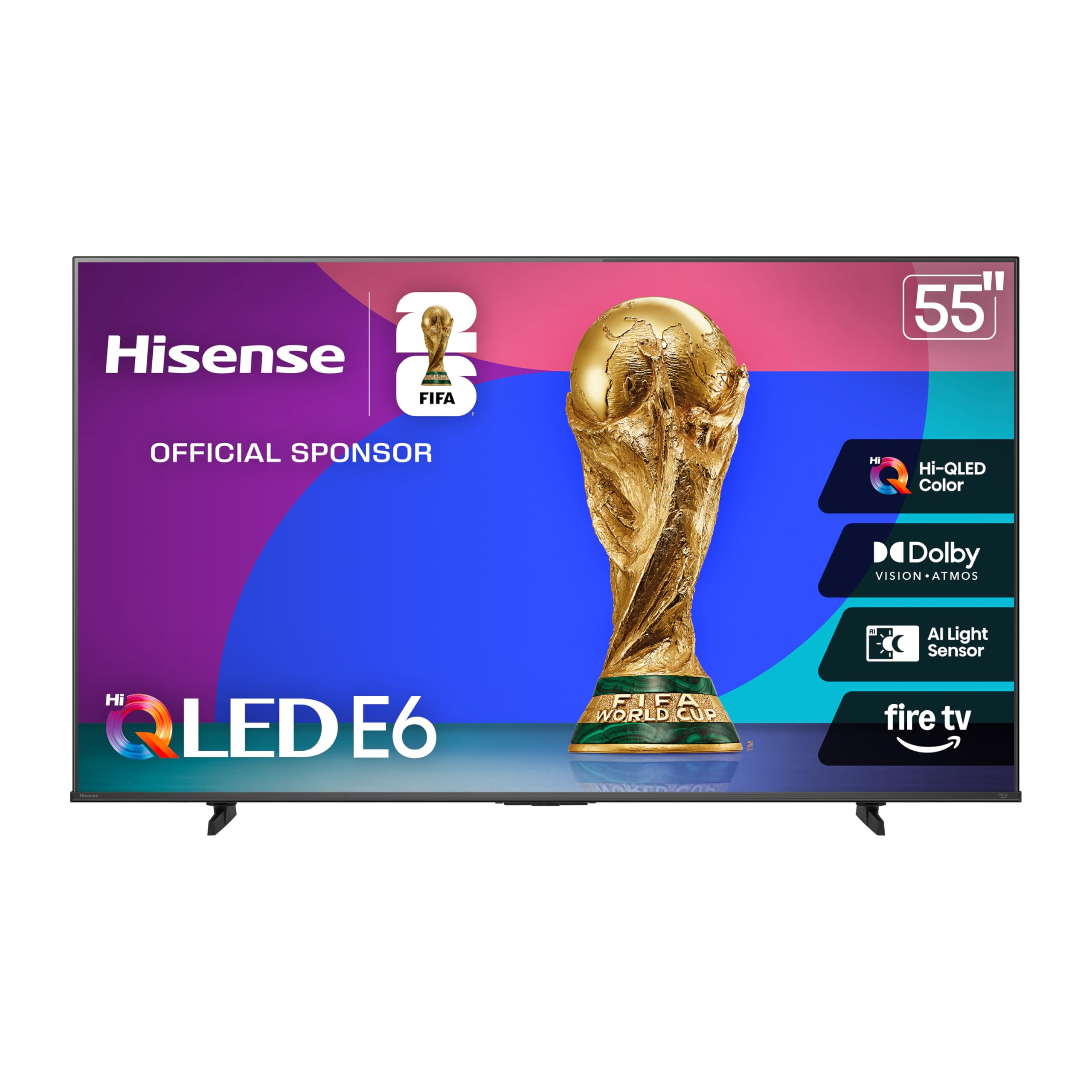
The Hisense 55E6QF Cinema Series brings Hi-QLED color technology—Hisense’s branding for quantum dot panels—to a price point that undercuts competitors with similar specs. The total HDR solution includes support for Dolby Vision, HDR10+ Adaptive, HDR10, and HLG, which means it will properly display HDR content from any streaming service or disc format. The AI Light Sensor adjusts brightness based on room lighting, which helps maintain accurate black levels during daytime viewing and prevents eye strain during dark room sessions.
Fire TV built-in provides tight integration with Alexa, so you can control playback, check the weather, and control smart home devices using just your voice. The home screen aggregates live channels and streaming apps, though it is more advertisement-dense than Roku’s interface. Motion Rate 120 with frame interpolation makes sports and action movies look smooth, but it’s a 60Hz panel, so fluidity is achieved through processing rather than native hardware. Game Mode Plus reduces input lag to acceptable levels for casual gaming.
Initial setup can take longer than expected due to Fire OS account creation and software updates. Some users report that the interface takes 30–60 seconds to become fully responsive after power-on, which is slower than Roku’s instant-on experience. However, once the TV is running, app navigation is generally smooth. The sound is adequate for a bedroom or secondary viewing space, but the lack of a dedicated subwoofer means action sequences lack the bass impact that home theater enthusiasts prefer.
Why it’s great
- Hi-QLED quantum dot panel provides vibrant color reproduction
- Supports all major HDR formats including Dolby Vision and HDR10+
- Fire TV with Alexa integration for hands-free voice control
- AI Light Sensor automatically adjusts picture for room lighting
Good to know
- Fire OS is slower than Roku at startup and app launches
- 60Hz panel with simulated motion processing
- Interface contains more advertisements than competing platforms
7. Roku Select Series — 55-Inch QLED
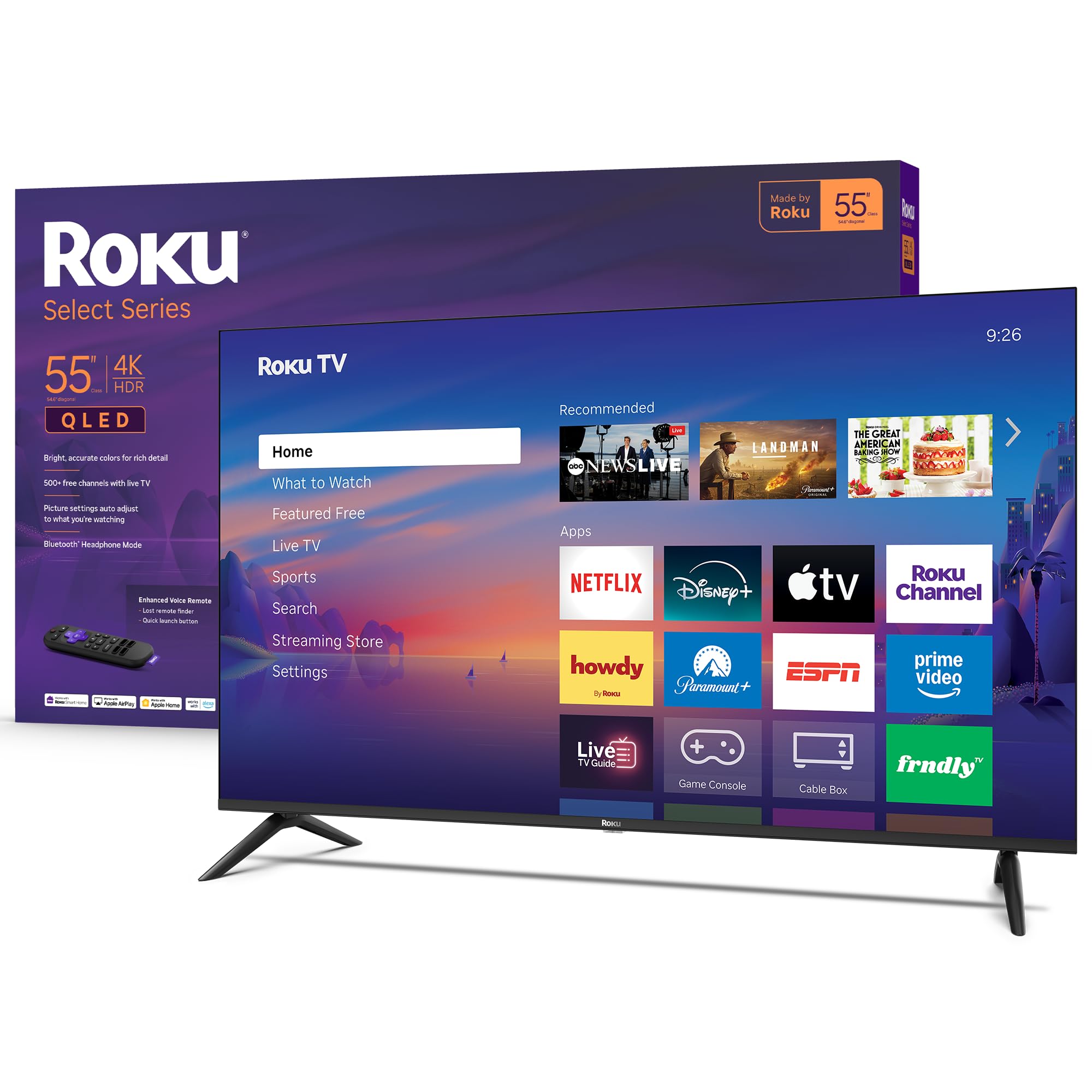
The Roku Select Series is built around the idea that the smart TV experience matters as much as the display itself. Its QLED panel and HDR10 support produce bright, accurate colors for streaming content, and the Roku Smart Picture system automatically optimizes incoming signals for the correct picture mode. The result is a no-fuss experience where you don’t have to dig through menus to make your shows look good—the TV handles it in the background.
Roku’s interface is the fastest in this comparison: apps launch in under a second, and the home screen is clean and customizable without sponsored blocks. Select Series TVs are designed for clear speech and louder sound compared to previous Roku models, so dialogue in quiet movies remains intelligible without cranking the volume. Bluetooth Headphone Mode is particularly useful for late-night viewers who don’t want to disturb sleeping family members.
The Enhanced Voice Remote includes a lost remote finder and programmable shortcut buttons for your most-used streaming apps. Apple AirPlay and Chromecast support make it easy to share content from phones and tablets. The 60Hz panel is a limitation for sports enthusiasts who notice motion blur during fast camera pans, but for the vast majority of streaming users—the target audience for this TV—the combination of a bright QLED panel and Roku’s best-in-class software makes this a compelling choice for those who prioritize ease of use.
Why it’s great
- Roku OS is the fastest and most intuitive smart TV platform
- QLED panel with HDR10 provides vibrant colors for streaming
- Bluetooth Headphone Mode for private late-night listening
- Lost remote finder and programmable shortcut buttons
Good to know
- 60Hz panel only—no high-refresh support for gaming
- Lacks Dolby Vision HDR support
- No variable refresh rate for console gaming
8. Westinghouse 55-Inch Xumo TV
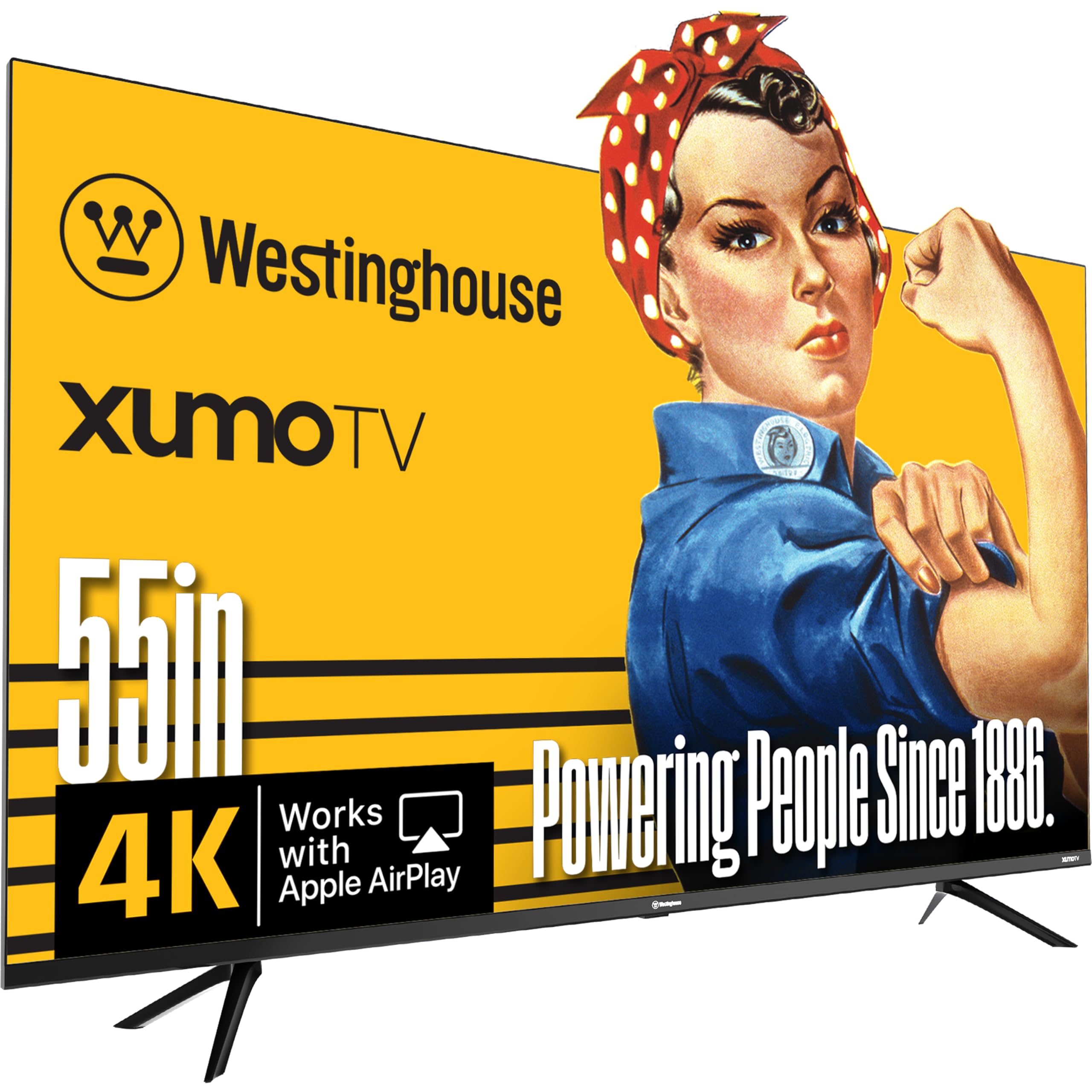
The Westinghouse Xumo TV is the budget-tier option that still includes Dolby Vision and Dolby Atmos support, which is rare at this price level. The 4K UHD panel with HDR10+ provides detailed visuals with enhanced contrast, and the edgeless design keeps the bezels thin for a modern look. Apple AirPlay 2 support lets iPhone and iPad users wirelessly stream content to the big screen without extra hardware.
The Xumo operating system is the primary differentiator—it’s a smart platform developed by Comcast that focuses on free, ad-supported content integrated into the home screen. It includes over 350 free live channels via the Xumo Play app, which is useful for cord-cutters who don’t want to pay for streaming subscriptions. The voice remote with universal search works across installed apps, so you don’t have to app-hop to find specific shows or movies.
The built-in stereo speakers are surprisingly capable for a budget TV, with clear dialogue reproduction and adequate volume for medium-sized rooms. However, the Xumo OS is less mature than Roku or Google TV: app selection is narrower, the interface can feel sluggish after extended use, and there are concerns about long-term support and app updates. Several users report occasional screen blackouts during streaming sessions, which may be related to software stability. For buyers who primarily use external streaming sticks and just need a panel with good HDR support, this TV delivers the core hardware features at a competitive price.
Why it’s great
- Dolby Vision and Dolby Atmos support at an entry-level price
- 350+ free live channels with no subscription required
- Apple AirPlay 2 for easy wireless streaming from iOS devices
- Edgeless design with thin bezels
Good to know
- Xumo OS has fewer apps and feels slower than competitors
- Some units may have been opened or returned before delivery
- Reported screen blackout issues during streaming sessions
9. Vizio V4K55M 55-Inch 4K TV
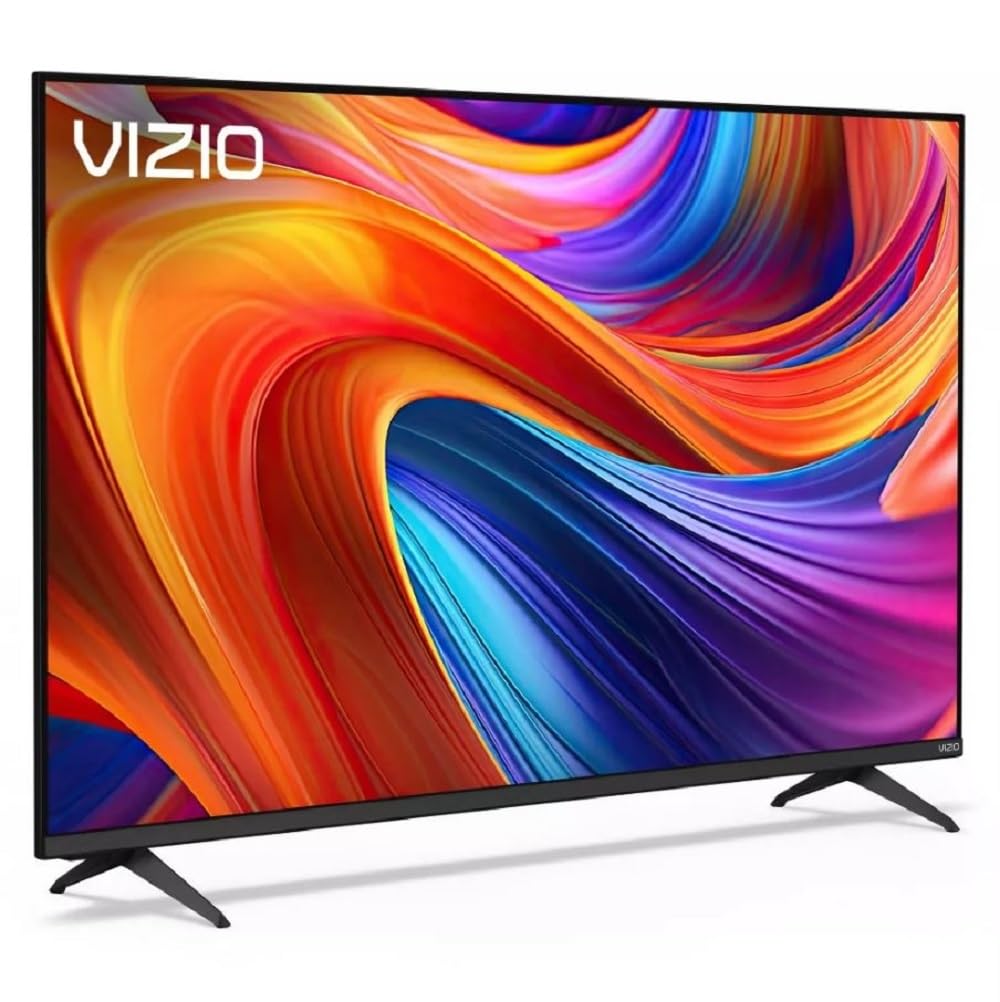
The Vizio V4K55M is the entry point for this category, offering 4K resolution and Dolby Vision HDR at a price that undercuts most competitors. Dolby Vision Bright+ collaborates with Vizio to deliver a version of the HDR format optimized for their hardware, and the panel supports HDR10+, HDR10, and HLG across the full format range. Wi-Fi 6 compatibility is an unexpected bonus at this price, providing faster and more stable streaming performance in homes with multiple connected devices.
Gaming features include Auto Low Latency Mode that activates when a console is detected, an integrated gaming menu for adjusting settings mid-game, and Dolby Vision HDR Gaming for enhanced in-game color depth. The spatial audio system uses Dolby Audio and DTS:X with DTS Virtual:X to create a simulated surround sound experience from the TV’s speakers. Bluetooth headphone pairing allows private listening without a separate transmitter.
The primary concern with this television relates to its packaging: many units sold through third-party channels arrive as opened or refurbished sets, often missing essential components like power cords, remote batteries, and stand screws. While the panel itself performs well for the price, the inconsistency of the purchasing experience means you may need to spend extra time sourcing missing parts. If you can verify that you are receiving a factory-sealed unit, this TV offers the most raw hardware specification for the lowest investment in the entire category.
Why it’s great
- Lowest entry price for 4K with Dolby Vision HDR
- Wi-Fi 6 support for stable streaming in crowded networks
- Auto Low Latency Mode and gaming menu for console play
- DTS Virtual:X for simulated surround sound
Good to know
- Many units ship as opened or refurbished without essential parts
- App and interface updates may be less frequent over time
- Stand and remote feel less premium than mid-range competitors
FAQ
Is a 60Hz panel good enough for watching sports and movies?
Can I use a budget 55-inch TV as a PC monitor?
Final Thoughts: The Verdict
For most users, the best budget 55 inch tv winner is the Roku Plus Series Mini-LED because it delivers Mini-LED contrast and QLED color that surpass typical budget expectations, combined with the fastest and most user-friendly smart TV platform available. If you want high-refresh gaming with PC and console support, grab the iFFALCON 55U85. And for the absolute lowest entry point into 4K HDR viewing, nothing beats the Vizio V4K55M when you can find a factory-sealed unit.

Mo Maruf
I created WellFizz to bridge the gap between vague wellness advice and actionable solutions. My mission is simple: to decode the research and give you practical tools you can actually use.
Beyond the data, I am a passionate traveler. I believe that stepping away from the screen to explore new environments is essential for mental clarity and physical vitality.