Our readers keep the lights on and my smoothie glass nicely filled. As an Amazon Associate, I earn from qualifying purchases.
Three-dimensional scanning has moved out of industrial labs and into workshops, garages, and home studios, but the assumption that high accuracy demands a five-figure budget keeps many makers on the sidelines. A capable entry-level or mid-range scanner now delivers sub-millimeter precision, real-time color capture, and the ability to handle dark or reflective surfaces — all while fitting a sensible budget for hobbyists, small repair shops, and prototyping enthusiasts.
I’m Mohammad Maruf — the founder and writer behind WellFizz. I’ve spent years analyzing the hardware specifications, real-world customer feedback, and performance benchmarks of 3D scanning hardware to identify which models genuinely deliver on their promises without forcing buyers into hidden upgrade cycles.
Whether you need to reverse-engineer an automotive part, capture small objects for 3D printing, or digitize a human form for digital archiving, choosing the right budget 3d scanner requires understanding light source types, tracking methods, and the real-world accuracy figures that matter.
How To Choose The Best Budget 3D Scanner
Not all sub- scanners are created equal. The cheapest models use single infrared projectors that fail on dark or shiny surfaces, while value-minded mid-range units borrow blue laser or structured-light technology from industrial gear. Focus on three decision points to avoid wasted time and rescanned projects.
Light Source: Blue Laser vs Infrared Structured Light
Blue laser (400–500 nm wavelength) penetrates glossy and dark surfaces better than infrared because the shorter wavelength projects a finer pattern with higher contrast. Infrared structured light works well on matte, light-colored objects but struggles with metal, carbon fiber, or dark plastics unless you apply scanning spray. If you plan to scan automotive parts or tools regularly, favor blue laser or a hybrid scanner with multi-line laser modes.
Tracking Stability and Anti-Shake
Handheld scanning introduces inevitable micro-movements. Models with dedicated anti-shake algorithms or multi-camera stereo depth arrays maintain point cloud alignment even when your hands are not perfectly steady. The alternative — marker-based tracking — forces you to place adhesive dots on the object and may miss fine geometry. Look for “anti-shake” or “feature tracking” in the spec list if you need to scan without a tripod.
Accuracy vs Precision: Read the Fine Print
Many budget scanners advertise “0.02 mm accuracy,” but this figure is often single-frame precision measured under lab conditions on ideal surfaces. Real-world accuracy for the full merged model is typically 2–5 times higher. A scanner claiming 0.05 mm single-shot precision will often deliver 0.15–0.3 mm on a complex, multi-surface object. For reverse engineering of mechanical parts, 0.1 mm point distance is acceptable; for jewelry or dental models, you need 0.03 mm or better.
Quick Comparison
On smaller screens, swipe sideways to see the full table.
| Model | Category | Best For | Key Spec | Amazon |
|---|---|---|---|---|
| Creality CR-Ferret SE | Handheld | Outdoor + dark objects | Anti-shake 24-bit color | Amazon |
| 3DMakerpro Seal Lite | Desktop | Small-format detail | 0.02 mm blue LED | Amazon |
| Revopoint INSPIRE 2 | Hybrid | Wireless + challenging surfaces | 0.03 mm precision | Amazon |
| Shining 3D Einstar | Handheld | Hair + body scanning | 14 FPS infrared | Amazon |
| Revopoint MetroX Pro | Industrial | Precision reverse engineering | 0.01 mm blue laser | Amazon |
| Revopoint MIRACO Plus | All-in-One | On-device processing | 32 GB RAM + 48 MP | Amazon |
| Creality Sermoon S1 | Pro | Large objects + deep holes | 0.02 mm, 90 FPS | Amazon |
| XTOOL D6S | OBD2 | Vehicle diagnostics | CAN FD + 30 resets | Amazon |
In‑Depth Reviews
1. Creality CR-Ferret SE 3D Scanner

The Creality CR-Ferret SE brings anti-shake compensation and 24-bit color capture into the sub- price band — a combination that was rare even in the category a year ago. Its Wi-Fi 6 wireless bridge lets you scan without a USB tether, and the onboard 2 MP RGB camera automatically synchronises colour data with the 3D geometry, producing lifelike models straight out of the software.
Scanning black or metallic items without spray is a genuine time-saver. The Ferret SE uses a one-shot structured-light approach that maintains tracking on car parts, tires, and dark plastics. Weighing just 105 g, it is comfortable for prolonged handheld use, and the outdoor-friendly algorithm handles changing ambient light better than most near-infrared scanners.
Customer experiences highlight a real learning curve with the software environment — some users reported the phone app as buggy and had to rely on the PC client. Tracking can also drift on low-texture objects unless you add a few markers. Once dialled in, the mesh quality rivals scanners costing twice as much, making it a strong choice for hobbyists stepping up from phone-based photogrammetry.
Why it’s great
- Anti-shake allows stable handheld scanning without a tripod
- Full 24-bit color capture with automatic texture mapping
- Scan black/metallic objects without spray
Good to know
- Phone app is underdeveloped compared to the PC software
- Requires a Gen-8 i5 or better CPU for smooth operation
2. 3DMakerpro Seal Lite 3D Scanner
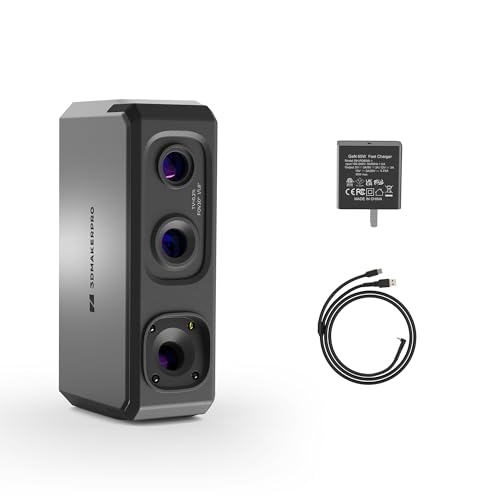
The Seal Lite uses a blue LED light source with a 400–500 nm wavelength to capture fine surface detail at 0.02 mm single-frame accuracy. Its recommended working distance of 180–280 mm and small-format orientation (10–300 mm object size) make it ideal for jewellery, dental models, and small mechanical parts where micron-level fidelity matters more than scanning speed.
Unlike infrared scanners that often require spray on glossy or translucent items, the blue LED pattern projects with enough contrast to handle most matte objects straight out of the box. The scan-back and anti-shake features help recover tracking when you briefly lose line of sight, reducing the frustration of restarting a scan halfway through.
Reviews consistently mention that the Seal Lite demands a powerful PC — a weak GPU or insufficient RAM leads to frame drops and alignment errors. The documentation is minimal, and the plastic build feels less premium than some competitors. For users willing to invest time in the learning curve, the resulting mesh density and edge definition are outstanding for the price bracket.
Why it’s great
- Blue LED achieves 0.02 mm accuracy on small objects
- Scan-back and anti-shake reduce failed scans
- Lifetime free JMStudio software with multiple export formats
Good to know
- Struggles with reflective or black surfaces without spray
- Requires a high-end PC for smooth 10 FPS scanning
3. Revopoint INSPIRE 2 3D Scanner
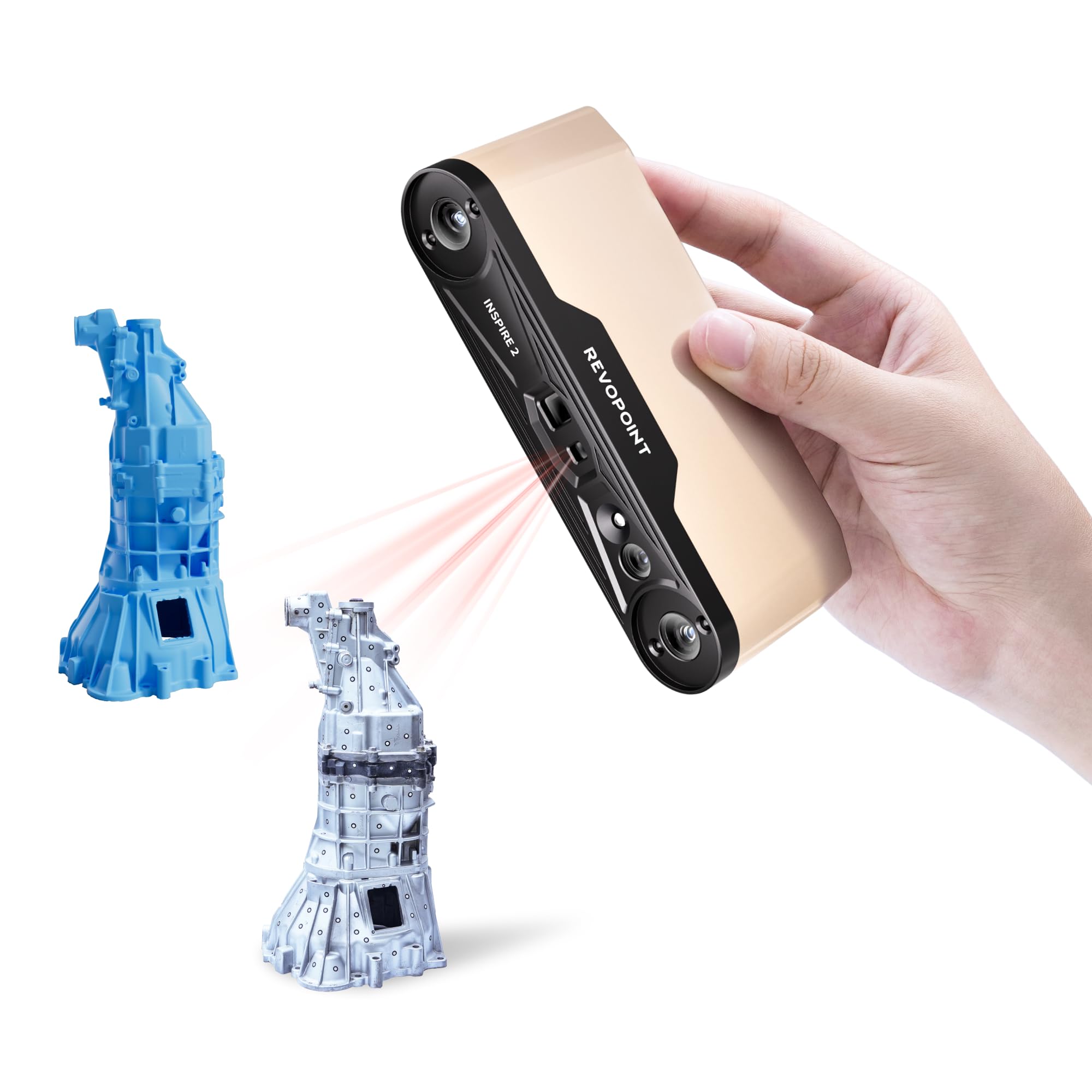
The INSPIRE 2 bridges the gap between entry-level structured light and mid-range laser scanning by offering both infrared structured light and 11-line infrared laser modes in a single handheld unit. Switching between modules lets you tackle matte, feature-rich objects with the fast structured-light mode and then flip to laser mode for dark or reflective surfaces — all without changing hardware.
Its built-in Wi-Fi 6 enables cable-free scanning on mobile devices (iOS, Android, Windows, macOS) and real-time PC-to-mobile streaming via the Revo Mirror app. Calibration is simplified by a high-precision board that the company claims boosts point cloud accuracy by 75 %. The adjustable optical zoom (1.5× and 2×) helps capture mixed-geometry surfaces like engine blocks or sculptures.
Some users reported that the included calibration dots have poor adhesion, and the scanner may require several calibration passes before delivering stable data on day one. Customer service from Revopoint is generally responsive, and once the workflow is optimised, the mesh quality is on par with units costing twice as much. The 190 g weight makes it genuinely pocketable for field work.
Why it’s great
- Dual structured-light and laser modes for varied surfaces
- Full wireless scanning with Wi-Fi 6 and mobile app compatibility
- Adjustable optical zoom captures fine and large details
Good to know
- Calibration dots may need replacement with stronger adhesive
- Requires a high-spec PC (i7-13th Gen or M1 Pro) for smooth performance
4. Revopoint MetroX Pro 3D Scanner
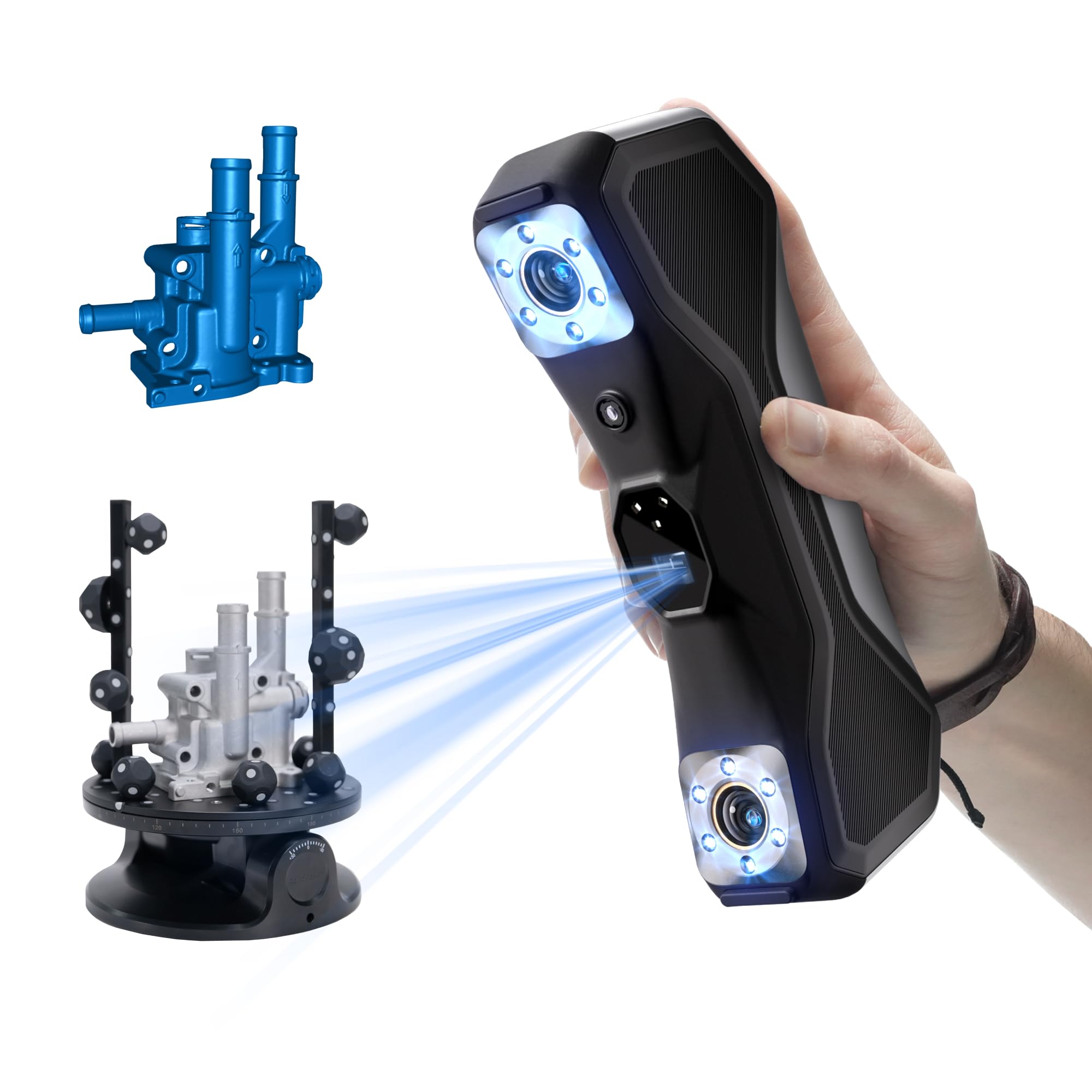
The MetroX Pro pushes into industrial-grade territory with single-frame precision of 0.01 mm and volumetric accuracy of 0.02 mm + 0.04 mm × L(m). Its blue laser array offers four scanning modes: 30 cross-line lasers for flat shiny surfaces, 15 parallel lines for fine edges and corners, a 62-line full-field blue structured light for marker-free scans at 7 million points per second, and an automatic turntable mode.
No scanning spray is required when using the cross-line or parallel-line modes on dark or reflective surfaces. The PC-to-mobile real-time streaming via Revo Mirror lets you monitor the scan on a tablet while moving freely around large objects. The included carrying case, calibration board, and UV lens filters make it a complete kit for field work or shop-floor use.
A handful of users noted Thunderbolt Type-C incompatibility on certain ports, and the color scanning function required careful distance and lighting adjustments to produce clean textures. The MetroX Pro is heavier than handheld competitors (14.8 lb shipping weight with accessories) and is best suited for users who need measurable accuracy for reverse engineering, not casual hobby scanning.
Why it’s great
- Industrial 0.01 mm single-frame precision with blue laser
- Four scanning modes adapt to every surface type
- No spray needed on shiny or dark materials in laser mode
Good to know
- Some Thunderbolt Type-C ports cause connection issues
- Color texture capture requires practice and specific lighting
5. Shining 3D Einstar Handheld 3D Scanner
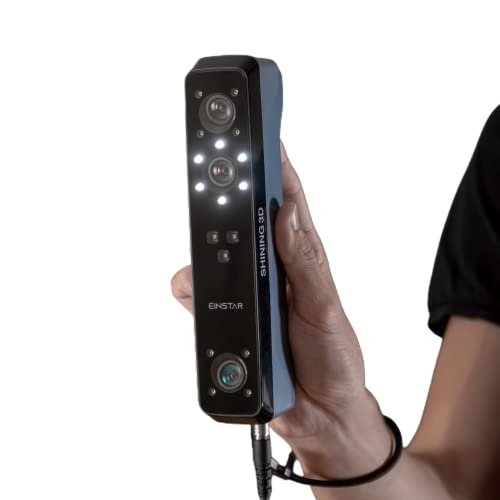
The Einstar uses three infrared VCSEL projectors and two stereo depth cameras to maintain stable tracking even in outdoor lighting up to 20,000 lux. Its “Hair Mode” is a standout feature for digitising human subjects with fine hair details — a challenge that baffles most structured-light scanners. The built-in RGB camera captures colour data synchronised with the depth stream.
Scanning speed reaches 14 FPS, which is competitive with mid-range units, and the data quality indicator guides you to adjust distance and angle before moving on. The EXstar software supports automatic alignment and exports to OBJ, STL, PLY, ASC, 3MF, and P3 formats. Users report that tracking is notably stable on dark car interiors and reflective bumpers, outperforming several competitors at the same price point.
Downsides include poor ergonomics — the cable routing and hand position feel awkward during long scans — and a steep learning curve for the software, which lacks a built-in tutorial. A few units arrived with defective cooling fans, and the scanner can lose tracking on uniformly coloured flat surfaces without markers. Despite these quirks, the Einstar delivers professional-level results on organic forms.
Why it’s great
- Hair Mode captures fine strands for full-body scans
- Stable outdoor performance up to 20,000 lux
- 14 FPS speed with built-in data quality feedback
Good to know
- Awkward hand position and cable management
- Software lacks a step-by-step tutorial for new users
6. Revopoint MIRACO Plus 3D Scanner

The MIRACO Plus is a standalone scanner with an integrated 8-core 2.4 GHz processor, 32 GB RAM, and a 256 GB hard drive — no laptop required. Its quad depth camera system switches between Near mode for small screws and Far mode for large machinery, while the 48 MP RGB camera with flash LEDs captures colour data in low-light conditions. The 6-inch 2K AMOLED 180° flip screen provides a real-time view from any angle.
Photogrammetric metrology is built into the hardware via a photogrammetry kit (four carbon-fibre scale bars and 416 coded targets), achieving length accuracy of 0.02 mm + 0.05 mm × L(m). Dual scanning modes (single-shot for high accuracy, continuous at 20 FPS for speed) let you balance precision and throughput without changing settings. The battery offers up to two hours of continuous scanning with 65 W fast charging reaching 80 % in 35 minutes.
Users on macOS reported USB connection bugs that required forum workarounds, and the actual battery life under heavy use was closer to 30 minutes when running the onboard lights and display simultaneously. Dark or shiny objects still need spray or markers, and Revo Design CAD conversion software is sold separately. For a truly all-in-one workflow without a tethered PC, MIRACO Plus is exceptional — but it is priced accordingly.
Why it’s great
- Standalone scanning with 32 GB RAM, no PC required
- Integrated photogrammetry for large-object accuracy
- 48 MP colour capture with flash LEDs for even lighting
Good to know
- Battery drains quickly with screen and lights active
- Mac USB connectivity issues reported; workaround needed
7. Creality Sermoon S1 3D Scanner
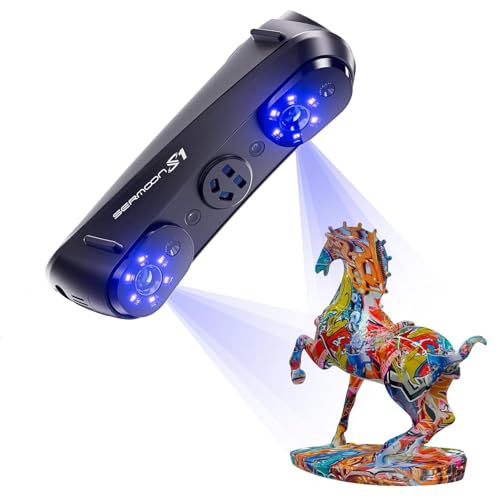
The Sermoon S1 is built for scale: a scanning range from 5 mm to 4,000 mm means you can digitise a tiny gear tooth one minute and a full car bumper the next. Its triple-mode blue laser system switches between 34 crossed lines for fast large-object capture, 7 parallel lines for fine detail, and a single-line mode for deep holes, edges, and grooves that other scanners miss. The 0.02 mm accuracy with 0.08 mm/m volumetric precision holds up across the entire range.
At 90 FPS, data acquisition is notably faster than the 10–14 FPS typical of LED-based scanners, reducing total scan time for large projects. The 4-lens stereo vision system supports marker-free tracking on textured surfaces, and AI-assisted processing in the included software handles alignment and mesh cleanup automatically. The result is a workflow that feels more like cinematography than medical imaging.
Some users noted that the software occasionally adds bumps from reflective surfaces unless the “remove noise” filter is manually tuned, and the recommended PC spec (i7-10th Gen, 32 GB RAM) is steep for a home setup. The Sermoon S1 is a professional tool and carries a commensurate investment, but for users scanning everything from jewellery to architectural elements, it eliminates the need for multiple devices.
Why it’s great
- Ultra-wide scan range from 5 mm to 4,000 mm
- 90 FPS capture reduces scan time for large objects
- Triple blue laser modes handle deep holes and fine edges
Good to know
- High PC requirements (i7-10th Gen, 32 GB RAM recommended)
- Reflective surfaces may produce artifacts without careful tuning
8. XTOOL D6S OBD2 Scanner Diagnostic Tool

While not a spatial 3D scanner, the XTOOL D6S earns a place in this guide because it is the tool that many budget-conscious mechanics and DIYers actually need: it “scans” a vehicle’s electronic systems rather than its geometry. Its OE-level full-system diagnostics cover engine, ABS, SRS, transmission, EPB, AC, and more, reading and clearing DTCs with live data graphing across four PIDs simultaneously.
Thirty maintenance resets — including ABS bleed, crank sensor relearn, injector coding, TPMS reset, and transmission adaptation — cover 99 % of common shop-level tasks. The 5.45-inch HD touchscreen with AutoVIN detection identifies the vehicle automatically, and the Linux-based interface is responsive even after extended use. Free lifetime Wi-Fi updates keep the vehicle coverage expanding without subscription fees.
Several users noted that the cam/crank sensor relearn function only works on certain model years (post-2005 mostly), and the lack of bi-directional controls limits advanced diagnostic capability. The textured silicone grip and 32 GB internal storage with microSD expansion make it rugged enough for a workshop environment. For its price, it delivers dealership-level diagnostic depth without any ongoing costs.
Why it’s great
- OE-level full-system diagnostics on 90+ brands
- 30 maintenance functions save hundreds in shop fees
- Free lifetime Wi-Fi updates with no subscription
Good to know
- Pre-2005 vehicle support is limited
- No bi-directional control for advanced diagnostics
FAQ
Can a budget 3D scanner capture black or shiny objects?
Do I need a powerful computer to run these scanners?
What is the real-world accuracy I can expect from a sub- scanner?
Final Thoughts: The Verdict
For most users, the budget 3d scanner winner is the Creality CR-Ferret SE because it combines anti-shake handheld stability, full-color capture, and spray-free dark-object scanning at a price that leaves room for a turntable and software subscriptions. If you need micron-level detail on small objects, grab the 3DMakerpro Seal Lite. And for a completely tether-free experience with onboard processing, nothing beats the Revopoint MIRACO Plus.

Mo Maruf
I created WellFizz to bridge the gap between vague wellness advice and actionable solutions. My mission is simple: to decode the research and give you practical tools you can actually use.
Beyond the data, I am a passionate traveler. I believe that stepping away from the screen to explore new environments is essential for mental clarity and physical vitality.