Our readers keep the lights on and my smoothie glass nicely filled. As an Amazon Associate, I earn from qualifying purchases.
Cream contour formulas promise a sculpted, lifted look, but they can quickly turn patchy and streaky if applied with the wrong brush. The fluffy domed brush you use for powder foundation won’t cut it—you need a dense, flat-topped or precisely angled head that packs product onto the skin and buffs it out without disrupting your base layer.
I’m Mohammad Maruf — the founder and writer behind WellFizz. I spend my time analyzing the specific bristle density, head geometry, and fiber firmness that determine whether a cream or liquid contour product delivers a natural finish or a muddy mess.
After combing through hundreds of customer reports and technical specs for the best brushes on the market, I’ve narrowed the field to five tools that solve the real problem: streak-free, diffused definition. Whether you are a beginner or a seasoned artist, the brush for cream contour you choose dictates how easily your product blends into a seamless shadow.
How To Choose The Best Brush For Cream Contour
Choosing the wrong brush for cream contour is the fastest way to ruin your makeup routine. A poor tool will lift your foundation, deposit contour in uneven streaks, or leave harsh lines that refuse to blend. Focus on three non-negotiable specs before you click “add to cart.”
Bristle Density: The “Packing” Factor
Cream products are thicker and heavier than powders. A brush with loose, wispy bristles cannot pick up enough product from the pan and will struggle to lay down an even stripe along your cheekbone. Look for a brush that is noticeably dense—squeeze the bristles between your fingers and they should resist compression. The Real Techniques Snatch + Sculpt achieves this with a patent-pending oval head that is packed tightly enough to deposit cream and then buff it out without absorbing too much formula into the ferrule.
Head Shape: Flat Top vs. Angled vs. Domed
Flat-top heads (like the Palladio Flat Kabuki) excel at stippling and buffing—you tap the product on, then swirl in circular motions to burnish away edges. Angled heads (like the Albeaut 201 contoured foundation brush) follow the natural planes of your face and allow more sculpted precision under the cheekbones. Domed heads (like the Jessup F04 foundation brush side) are better suited for general blending after the contour is placed. If you contour daily, an angled or flat-top brush will shave thirty seconds off your routine while delivering sharper definition.
Synthetic Fiber Quality: No Shedding, Quick Drying
Cream contour brushes need to be washed often—once a week minimum—because product residue builds up in the dense core and can breed bacteria. Poor-quality synthetic fibers will start shedding within five washes, leaving tiny black hairs on your face. All five brushes reviewed here use synthetic bristles, but the construction matters: the reinforced ferrules on the DUcare dual-ended brushes prevent the glue from breaking down, while the three-brush Albeaut set held its shape after multiple washes according to customer review feedback. Prioritize brushes that promise no shedding and dry quickly so you can rotate them into your morning routine.
Quick Comparison
On smaller screens, swipe sideways to see the full table.
| Model | Category | Best For | Key Spec | Amazon |
|---|---|---|---|---|
| Real Techniques Snatch + Sculpt | Single Brush | Precise contour + buffing | Patent-pending elongated oval head | Amazon |
| Albeaut 3-Piece Set | 3-Piece Set | Full face routine | Contoured angled foundation brush | Amazon |
| Jessup 3-Piece Double Ended Set | 6-in-3 Set | Precision contouring + travel | Double-ended precision angled brush | Amazon |
| DUcare 2-Piece Dual Ended Set | 4-in-2 Set | Space-saving travel | Dual-ended contour/blending head | Amazon |
| Palladio Flat Kabuki | Single Brush | Buffing and stippling | Super-soft flat-top synthetic kabuki | Amazon |
In‑Depth Reviews
1. Real Techniques Snatch + Sculpt Contour Brush

The Real Techniques Snatch + Sculpt earns the top spot because of its patent-pending elongated oval head—a shape that mimics the exact path of a contour swipe. While most flat-top brushes are perfectly round, this brush’s 1.18-inch width and domed profile let you lay down a stripe of cream contour under the cheekbone in one clean motion, then flip to the flat side to buff without lifting your foundation. Dense synthetic bristles pack the product on without absorbing it, and the 1.41-ounce weight gives a balanced feel that doesn’t tip over on your vanity.
Customer reviews consistently call out the brush’s exceptional durability. After daily washing, the bristles show no shedding and the ferrule remains tight—a rare trait at this price point. The wedge-shaped head also fits the hollows of your cheeks and the temples of your forehead without needing to angle the handle awkwardly, which cuts blending time by roughly a third compared to a standard round kabuki.
This brush works equally well with liquid bronzers and cream contour sticks. The dense fiber pack picks up product from stick formulas without scraping the surface, and the flat face buffs out edges into a soft, diffused shadow rather than a hard line. It is the one-brush solution for anyone who contours at least twice a week and wants professional-level precision without a professional-level budget.
Why it’s great
- Patent-pending oval shape matches contour planes perfectly.
- Dense bristles pack cream products with zero absorption.
- Zero shedding reported after repeated cleaning.
Good to know
- Not ideal for powder contour—the dense head picks up too much product.
- Single-function brush; no double-ended versatility for travel.
2. Albeaut 3-Piece Makeup Brush Set
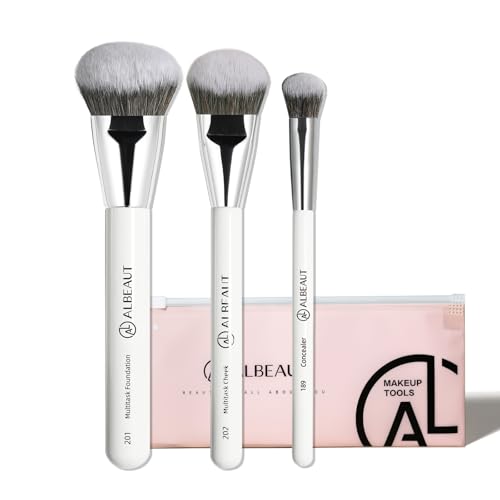
The Albeaut three-piece set is built around a 3-step face routine: the 189 kitten paw concealer brush, the 201 contoured foundation brush, and the 202 multitask cheek brush. The star for cream contour is the 201, which features an angled head that mirrors the natural line of the jaw and cheekbone. Unlike a flat top, this shape lets you apply product precisely to the hollow of the cheek and then use the broader side to blend outward without redepositing pigment onto the apples of your cheeks.
Customer reviews frequently compare these brushes to the popular BK Beauty brand but note that the bristles here are firm-dense rather than ultra-fluffy. This firmness is actually an advantage for cream formulas: it pushes the product into the skin rather than letting it sit on top, resulting in a sculpted look that reads as natural shadow rather than obvious makeup. The synthetic fibers are velvet-soft enough for mature or sensitive skin, and multiple reviewers confirmed no shedding after several washes.
The set also includes a kitten paw concealer brush that is shaped to hug the under-eye curve, making it useful for correcting contour mistakes at the outer corner of the eye. At a mid-range price point for the three-brush bundle, this is the strongest option for someone building a complete cream contour routine from scratch without buying individual tools.
Why it’s great
- Angled foundation brush follows face planes for streak-free contour.
- Firm bristles push cream product into skin for a natural shadow effect.
- Three brushes cover concealer, foundation, and blush/contour in one set.
Good to know
- Wooden handles require careful drying to prevent cracking.
- The cheek brush is less dense than the angled brush—not ideal for heavy contour sticks.
3. Jessup 3-Piece Double Ended Brush Set

The Jessup double-ended set turns six brush heads into three compact handles, making it the most space-efficient option for travel or a minimalist kit. The F05 brush is the dedicated contour tool: one end has a small, precise head that fits perfectly into the hollow of the cheek and the sides of the nose, while the larger rounded side blends out the edges. The F06 brush adds an even smaller angled tip that is ideal for nose contouring and blending cream product into the crease of the eyelid without a separate brush.
Reviewers report that the bristles are soft yet firm—soft enough not to irritate, but firm enough to deposit cream contour onto the skin rather than letting it slide around. The double-ended design means you can place your contour with the small precision side and buff with the larger side without switching tools mid-routine. The brush handles are 2.36 inches wide and fit into any makeup bag compartment without bending the bristles.
Crucially, the Jessup set held up through 14 months of monthly cleaning according to one long-term reviewer, with no shedding and no loosening of the ferrule. The peach dust color is also a nice visual break from the standard all-black brush. If your priority is a portable toolkit that handles cream contour, blush, and bronzer without taking up seven slots in your bag, this is the strongest contender.
Why it’s great
- Double-ended design replaces four brushes with two compact handles.
- Precision angled tip contours the nose and inner corners with ease.
- Soft-firm bristle balance picks up cream without dragging.
Good to know
- The larger brush head is not dense enough for thick cream contour sticks—better for lighter liquids.
- Some users found the handles slightly shorter than standard, taking a few tries to get used to.
4. DUcare 2-Piece Dual Ended Brush Set

The DUcare set offers four brush functions in two dual-ended handles—one end for foundation and powder buffing, the other for contour and blending. This is the most streamlined set on the list for someone who wants a full-face brush collection in the smallest possible footprint. The contour end features a slightly tapered head that works well for placing product along the jawline, and the flatter blending side diffuses the cream into the skin without creating harsh edges.
Customer reviews highlight the ultra-soft texture of the synthetic bristles. Some users note that the extreme softness means the brush does not pick up as much product per swipe as a denser brush like the Real Techniques or Albeaut, which can be a positive for beginners who tend to over-apply contour. The dual-ended design also saves space in a travel bag, and the reinforced ferrules prevent the bristles from shedding even after multiple washes.
This brush set works best with liquid and cream formulas that have a thinner consistency—thicker stick-like contour creams may not deposit evenly on the ultra-soft fibers. For anyone who prefers a more diffused, natural look or who is still learning how much product to load, the DUcare set provides a forgiving application that is hard to mess up.
Why it’s great
- Ultra-soft bristles prevent harsh lines—ideal for beginners.
- Dual-ended design reduces brush count to two tools.
- Reinforced ferrules prevent shedding after repeated cleaning.
Good to know
- Soft bristles pick up less product than denser alternatives.
- Not suitable for thick cream contour sticks—better for liquid formulas.
5. Palladio Flat Kabuki Brush

The Palladio Flat Kabuki is the most traditional brush shape on this list: a wide, flat-top dome of super-soft synthetic bristles designed for buffing and stippling. Unlike the elongated oval of the Real Techniques brush or the angled shape of the Albeaut, this kabuki head is perfectly round and measures about 1.5 inches across. It is not designed for precise contour placement—instead, it excels at the blending step, turning a previously applied stripe of cream contour into a soft, diffused shadow through gentle circular motions.
The 7.13-inch handle is longer than most flat kabukis, giving you more leverage and control during buffing. The bristles are noticeably feathery compared to the denser brushes on this list, which means you can stipple cream product onto the skin without feeling any scratchiness. Palladio markets it as a foundation and blush brush, but it works well as a final blending tool after you have already placed your contour with a more precise brush.
If you already own a precision contour brush and need a secondary tool to soften edges quickly, the Palladio Flat Kabuki is a budget-friendly addition. However, as a standalone brush for cream contour, it lacks the head shape to create a defined line under the cheekbone—you would need to use the side of the dome, which is less intuitive than an angled or oval head.
Why it’s great
- Feathery soft bristles buff cream contour edges into a natural finish.
- Extra-long handle provides better leverage for stippling motions.
- Versatile enough for foundation, blush, and setting powder.
Good to know
- Flat round head struggles to place precise contour lines.
- Best used as a secondary blending brush rather than a primary contour applicator.
FAQ
Can I use a powder contour brush for cream contour?
How often should I wash a cream contour brush?
Are synthetic bristles better than natural for cream contour?
Final Thoughts: The Verdict
For most users, the brush for cream contour winner is the Real Techniques Snatch + Sculpt because its patent-pending oval head precisely mimics the contour line of your face, and the dense synthetic bristles deliver streak-free blending without absorbing product. If you want a complete routine in one bundle, grab the Albeaut 3-Piece Set, which adds a precision concealer brush and a multitask cheek brush to your kit. And for a travel-friendly option that packs six brush heads into three compact handles, nothing beats the Jessup Double-Ended Set.

Mo Maruf
I created WellFizz to bridge the gap between vague wellness advice and actionable solutions. My mission is simple: to decode the research and give you practical tools you can actually use.
Beyond the data, I am a passionate traveler. I believe that stepping away from the screen to explore new environments is essential for mental clarity and physical vitality.