Our readers keep the lights on and my smoothie glass nicely filled. As an Amazon Associate, I earn from qualifying purchases.
Uneven grass, wasted seed, and that telltale stripe of over-fertilized green are the hallmarks of a poorly chosen broadcast spreader. The right unit distributes material in a consistent fan pattern, saving time and preventing lawn damage, while a bad one turns a chore into a guessing game of calibration and clogs.
I’m Mohammad Maruf — the founder and writer behind WellFizz. Over the last 15 years, I’ve analyzed hundreds of lawn spreaders, comparing hopper capacities, gearbox durability, tire types, and spread patterns to separate the precision tools from the plastic toys.
This guide breaks down the top performers by build quality, handling, and accuracy so you can confidently choose the best broadcast spreader for lawns that matches your property size and terrain.
How To Choose The Best Broadcast Spreader For Lawns
Matching the spreader to your lot size and terrain is the single most important decision. A unit that glides over flat St. Augustine may struggle on a bumpy hillside, and a 185-pound hopper is pure overkill for a quarter-acre lot. Focus on three core factors before looking at brand names.
Hopper Capacity & Material Type
A 50-pound poly hopper handles most suburban lawns in one pass, but if you’re covering an acre or more, the 130-pound and 185-pound models save refill trips. Rustproof polypropylene resists corrosion from fertilizer salts and won’t dent like metal, but the gearbox and frame materials matter more for longevity than the hopper itself.
Tire Size & Pneumatic Design
Solid polymer tires bounce on rough ground and can leave uneven patterns. Pneumatic tires from 10 to 14 inches absorb terrain bumps and maintain traction, especially on slopes. Studded or turf-tread options provide grip without tearing sod — a critical detail for wet-morning application or hilly properties.
Spread Width & Calibration Control
Twelve-foot spread patterns cover ground quickly, but a side deflector is essential for flower beds and driveways. Look for a fully enclosed gearbox that seals out moisture and grass clippings, and a gate control that lets you fine-tune flow without guesswork. A clear calibration chart saves hours of trial-and-error.
Quick Comparison
On smaller screens, swipe sideways to see the full table.
| Model | Category | Best For | Key Spec | Amazon |
|---|---|---|---|---|
| Agri-Fab 130 lb Push | Push Spreader | Large suburban lawns | 13″ x 4″ pneumatic tires | Amazon |
| EarthWay 2050P 80 lb | Push Spreader | Medium lawns, pre-assembled ease | 80 lb poly hopper | Amazon |
| EarthWay 2150 Commercial 50 lb | Push Spreader | Rough, uneven terrain | 13″ pneumatic stud tires | Amazon |
| Brinly P20-500BHDF-A | Push Spreader | Precision edging with deflector | 12″ x 3″ pneumatic tires | Amazon |
| Titan Attachments 70 lb | Push Spreader | Budget-friendly durability | 70 lb capacity drum | Amazon |
| Agri-Fab 185 lb Tow Behind | Tow-Behind | One-plus acre properties | 185 lb hopper, 12 ft width | Amazon |
| Chapin 8622B Tow Behind | Tow-Behind | Rugged farm/ATV use | Auto-stop dual impeller | Amazon |
In-depth Reviews
1. Agri-Fab 45-0614 130 lb Push Lawn & Garden Broadcast Spreader

This walk-behind unit from Agri-Fab hits the sweet spot for owners of half-acre to full-acre lawns. The 130-pound poly hopper swallows entire bags of fertilizer without needing a mid-lawn refill, and the 10 to 12-foot spread width covers ground efficiently. The direct rod control provides a simple mechanical connection between your hand and the gate, giving you immediate feedback on flow rate adjustments. Taller users will appreciate the adult-sized handle height that reduces back strain during extended sessions.
The 13 by 4-inch pneumatic tires roll smoothly over uneven terrain and maintain traction on damp grass without leaving ruts. The alloy steel frame with rust-resistant coating adds rigidity that prevents the twisting motion cheaper spreaders develop over time. Assembly takes about an hour, and while the hardware comes unlabeled, the build quality is immediately apparent once the unit is together.
One recurring note from users involves the gate rod occasionally needing a slight straightening to close fully — a quick fix with pliers. The unit is heavy when fully loaded, so partially filling the hopper on sloped properties makes pushing much easier. For a premium push spreader that balances capacity with maneuverability, this is the top contender.
Why it’s great
- Large 130 lb capacity reduces refill stops
- Adult-sized handle and 13-inch tires for comfort on all terrains
- Sturdy alloy steel frame resists flexing
Good to know
- Assembly instructions lack part labels; plan for one hour build time
- Gate rod may need manual straightening for a complete seal
- Very heavy to push on hills when hopper is full
2. EarthWay 2050P 80 lb Broadcast Spreader

EarthWay’s 2050P arrives fully assembled — a rare convenience that eliminates the most common frustration with this category. The 80-pound rustproof poly hopper handles 40-pound bags of fertilizer or seed with room to spare, making it ideal for medium-sized lawns up to 1.5 acres. The 10-inch pneumatic tires glide over bumpy ground without tearing the turf, and the side spread control allows feathered edging near flower beds without manual deflection.
The fully enclosed gearbox protects against moisture and debris, which is critical when spreading lime or damp granular products that would gum up an open system. The positive shut-off stops material flow immediately when you release the handle, preventing waste at turnarounds. Users consistently report consistent spread patterns even with dense materials like pelletized lime.
One downside is the rear kickstand can drag in thick St. Augustine grass, and the flow setting chart is not included for specific branded chemicals, so expect some initial calibration testing. The agitator pin is a potential wear point, but overall durability is strong, with many owners reporting years of trouble-free service. For a “ready to roll” option, this is hard to beat.
Why it’s great
- Arrives pre-assembled, saving 1-2 hours of build time
- Rustproof poly hopper and enclosed gearbox for longevity
- Consistent spread pattern with positive shut-off
Good to know
- No calibration chart for specific branded fertilizers
- Rear kickstand can drag in tall, thick grass
- Agitator pin may wear faster than the rest of the unit
3. EarthWay 2150 Commercial 50 lb Broadcast Fertilizer Spreader

When your lawn is less golf green and more all-terrain challenge, the EarthWay 2150 brings purpose-built traction. The 13-inch high-flotation pneumatic stud tires with rustproof poly rims roll over ruts, roots, and wet slopes without bogging down or bouncing. This is the unit for homeowners with uneven acreage who need consistent coverage without fighting the machine every step.
The 50-pound hopper is smaller than the 80-pound or 130-pound alternatives, but this is a deliberate trade-off for maneuverability. The three-hole drop system with side-spread control creates a feathered edge pattern that reduces striping, and the clog-free grate breaks up caked material before it reaches the impeller. The fully enclosed gearbox is sealed against moisture, which is critical when working with damp lime or iron-rich fertilizers that corrode exposed gears.
Assembly requires mechanical patience — the instruction drawings are sparse, and even experienced users report a two-hour build time. The flip-switch flow control is a welcome design choice that eliminates the need to hold a spring handle continuously. The spreader delivers an even, wide pattern, though the adjuster setting is a guessing game without a reference chart.
Why it’s great
- 13-inch stud tires provide unmatched traction on rough terrain
- Clog-free grate prevents material bridging in damp conditions
- 5-year limited warranty indicates commercial-grade confidence
Good to know
- 50 lb capacity requires more frequent refills on large lawns
- Assembly instructions are very poor; plan for two-hour build
- No built-in calibration guide for specific products
4. Brinly P20-500BHDF-A Push Spreader with Side Deflector Kit

Brinly’s P20-500BHDF-A stands out because it includes a side deflector kit as standard equipment — a feature often sold separately or absent entirely on competitor units. The deflector flips down to control material distribution near sidewalks, driveways, and garden beds, then stores out of the way when you need a full 10-to-12-foot spread. For precision-focused homeowners who want clean edges without wasting product, this is a compelling package.
The 50-pound rustproof poly hopper is paired with large 12 by 3-inch pneumatic turf-tread tires that push easily across bumpy terrain. The fully enclosed rust-resistant gearbox uses stainless steel for the shaft and agitator, reducing the risk of corrosion from fertilizer salts. Assembly is notably straightforward compared to other premium units — roughly 20 minutes with the included instructions and online video support.
The clear hopper cover and grate are included, and the spreader setting chart covers multiple material types. One minor irritation is that the control lever requires a slightly tricky angle during assembly, and some back-spray may hit your ankles at high flow rates. The unit does not fold for storage, so you’ll need floor space in the shed.
Why it’s great
- Side deflector kit included for accurate edging
- Stainless steel hardware resists fertilizer corrosion
- Quick 20-minute assembly with clear instructions
Good to know
- Does not fold for compact storage
- Minor back-spray on ankles at higher flow rates
- 50 lb capacity may be limiting for larger properties
5. Titan Attachments 70 lb Professional Fertilizer Push Broadcast Spreader
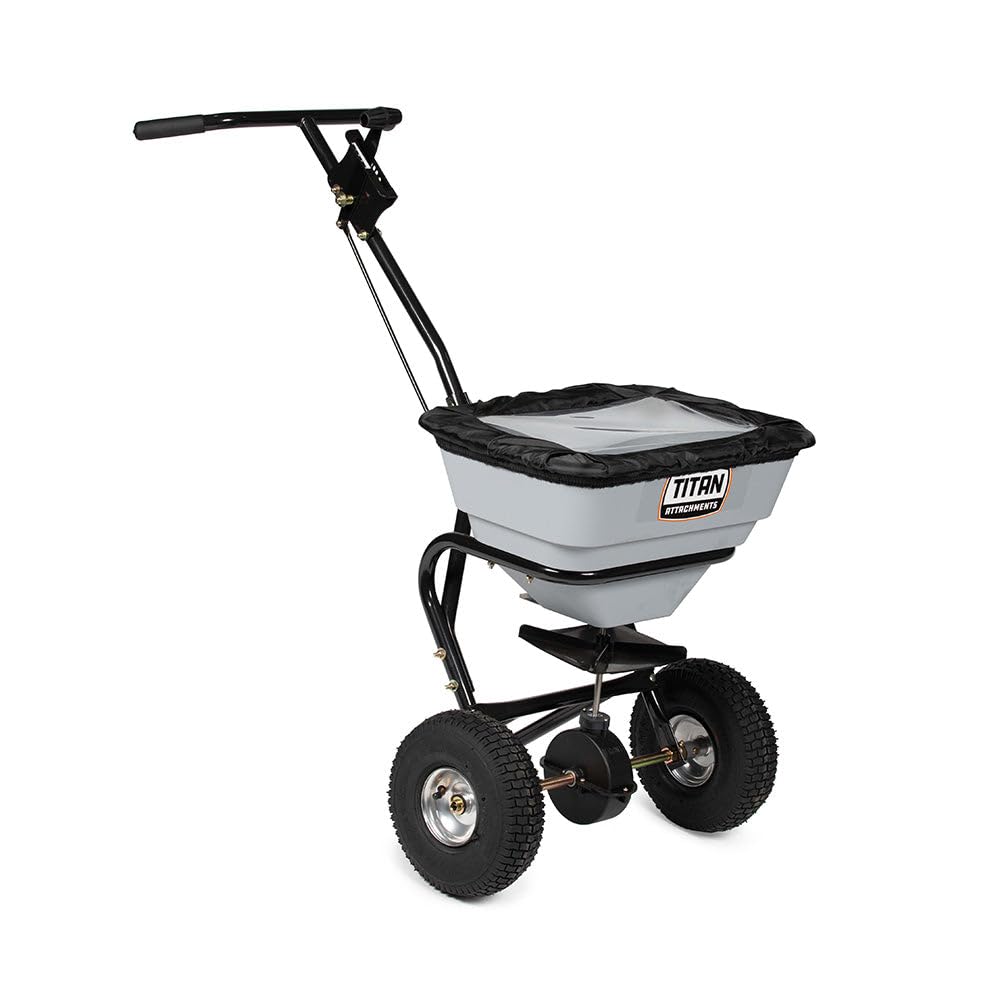
Titan’s 70-pound drum spreader occupies the entry-level premium space, offering a sturdy axle and stainless steel flow control plate at a price point below the main competition. The 70-pound capacity is sufficient for quarter-acre to half-acre lawns, and the four flow settings provide basic adjustability for seed, fertilizer, and ice melt. The tires and axle are built with thicker material than the budget Scotts models, giving it a noticeably more solid feel during operation.
The catch is assembly — the instructions are widely described as terrible, with missing steps and unclear diagrams. Many users spend four hours or more putting this spreader together, often relying on YouTube videos to decode the process. Once assembled, the unit works well, but the upfront time investment is significant. The spreader is effective on turf and sod without damaging grass, and the polymer drum resists rust.
Some units arrive with missing or wrong hardware, and the wing nut on the control lever has been reported to shear off under heavy use. Titan’s customer service is responsive for replacements, but the overall fit and finish varies. For the mechanically inclined who don’t mind a project, this spreader offers good durability at a lower entry cost.
Why it’s great
- Sturdy axle and stainless steel flow control plate
- 70 lb capacity suits medium-sized lawns
- Durable polymer drum won’t rust
Good to know
- Assembly instructions are extremely poor; plan for 4+ hours
- Some units arrive with missing or wrong parts
- Control lever wing nut may shear off under heavy use
6. Agri-Fab 185 lb Tow Behind Broadcast Spreader

For properties exceeding one acre, a tow-behind spreader eliminates the physical effort of pushing a heavy load. Agri-Fab’s 185-pound unit covers up to 40,000 square feet with a 12-foot spread width, drastically reducing the number of passes needed. The rustproof poly hopper and heat-treated steel gears are designed for long-term outdoor storage, and the on-and-off flow control is reachable from the riding mower seat.
The 13-inch turf tread pneumatic tires provide stable transport across uneven lawn and garden terrain without bouncing or skidding. Assembly is straightforward, and the 3-year limited warranty adds peace of mind. Many users report consistent spread patterns with seed, fertilizer, and ice melt when the gate is properly calibrated.
The weakest point is the hardware quality — cotter pins have sheared during use, and the trap door design sometimes allows material to pour out when closed. The spreader plate on some units arrives bent or missing, though customer service handles replacements promptly. For smooth, maintained acreage, this unit performs well, but bumpy fields can cause premature wear on the frame and pins.
Why it’s great
- 185 lb capacity handles large acreage with fewer refills
- 12 ft spread width speeds up coverage
- Seat-mounted flow control for convenient operation
Good to know
- Cotter pins and hardware can shear on bumpy terrain
- Gate may not seal completely, allowing material leakage
- Not built for rough, off-lawn field use
7. Chapin 8622B Tow & Pull Behind Broadcast Spreader

Chapin’s 8622B targets the serious acreage owner with a 2.2 cubic-foot hopper and a dual-auger system that handles seed, fertilizer, and granular products without bridging or clogging. The defining feature is the auto-stop dual impeller — material flow halts the instant you stop moving, preventing burned patches and waste during turnarounds. This is a genuine time-saver for those covering several acres with a ZTR mower or ATV.
The powder-coated steel frame supports 14-inch wide-tread pneumatic tires that provide stable traction across pasture and lawn alike. Enclosed Delrin bearings add weather resistance and eliminate the need for constant greasing. Eleven gate settings give fine control over flow rate, and the automatic gate opening eliminates manual lever adjustments during operation.
The build quality is farm-grade with cast metal gears and a grease nipple for lubrication, but assembly can still be frustrating due to poor instructions. The unit ships mostly pre-assembled, but some hardware doesn’t match the manual. The rain cover does not fit the hopper shape well, and the auger design can cause flow issues with damp material. For dedicated acreage owners who want automatic shut-off and rugged construction, this is a top-tier choice.
Why it’s great
- Auto-stop impeller prevents waste and lawn burn
- Cast metal gears and grease nipple for long service life
- 14-inch tires and powder-coated steel frame for rough terrain
Good to know
- Assembly instructions are poor and sometimes inaccurate
- Rain cover does not fit the hopper shape securely
- Not recommended for rock salt, sand, or lime products
FAQ
How do I calibrate my broadcast spreader for accurate application?
Are pneumatic tires worth the extra cost on a push spreader?
What is the difference between a drop spreader and a broadcast spreader?
Final Thoughts: The Verdict
For most users, the best broadcast spreader for lawns winner is the Agri-Fab 45-0614 because its 130-pound capacity, 13-inch pneumatic tires, and direct rod control offer the best balance of coverage and maneuverability for half-acre to full-acre properties. If you want a pre-assembled unit with solid performance for medium lawns, grab the EarthWay 2050P. And for rough, uneven terrain where traction determines consistency, nothing beats the EarthWay 2150 Commercial with its studded 13-inch tires and clog-free grate.

Mo Maruf
I created WellFizz to bridge the gap between vague wellness advice and actionable solutions. My mission is simple: to decode the research and give you practical tools you can actually use.
Beyond the data, I am a passionate traveler. I believe that stepping away from the screen to explore new environments is essential for mental clarity and physical vitality.