Our readers keep the lights on and my smoothie glass nicely filled. As an Amazon Associate, I earn from qualifying purchases.
The moment you spot a bald eagle perched across a lake or your kid scores a goal from the far sideline, a smartphone screen just can’t bridge the distance. A bridge camera puts that reach in your hands with a fixed superzoom lens built around a single, purpose-built body — no lens swapping, no complicated rigs. It’s the perfect tool for beginners who want to explore wildlife, travel, and action photography without the weight and cost of a full interchangeable-lens system.
I’m Mohammad Maruf — the founder and writer behind WellFizz. I’ve spent countless hours analyzing the optical reach, sensor performance, stabilization systems, and menu logic of the most popular bridge cameras to help new shooters find the model that best matches their curiosity and budget.
This guide breaks down nine top contenders so you can confidently choose the very best bridge camera for beginners that matches your passion and budget.
How To Choose The Best Bridge Camera For Beginners
A bridge camera is defined by its built-in zoom lens — a single optic that spans from wide-angle to extreme telephoto. For a beginner, the right choice balances reach with ease of use. Here are the core specs to weigh before buying.
Optical Zoom Range
This is the headline number, but bigger isn’t always better. A 25x zoom (24–600mm equivalent) covers family events and casual landscapes. A 60x or 83x zoom (20–1200mm or 24–2000mm) opens up wildlife and moon photography. The trade-off: longer zoom ranges often require higher shutter speeds or a tripod to avoid blur, even with stabilization.
Image Stabilization
At full telephoto, any hand tremor magnifies into visible shake. Optical Image Stabilization (OIS) shifts lens elements to compensate. Without it, your sharp eagle shot becomes a smudge. Look for cameras with built-in OIS or POWER O.I.S. — mechanical stabilization is far more effective than digital-only corrections.
Sensor Size and Resolution
Most bridge cameras use a 1/2.3-inch sensor — small by DSLR standards but compact enough to cram a superzoom lens into a single barrel. Resolution ranges from 16MP to 20MP. More pixels don’t guarantee better quality; larger individual pixels (lower megapixel count on the same sensor size) often produce cleaner low-light images. For beginners, 16–18MP is plenty.
Ease of Use and Scene Modes
Bridge cameras serve as learning platforms. The best beginner models include Auto mode, scene presets (Portrait, Landscape, Sports, Moon), and guided menus. Some even offer dedicated Bird or Moon modes that automatically set focus, exposure, and shutter speed for those specific subjects. A tilt or articulating LCD screen also helps frame low-angle or overhead shots without lying on the ground.
Quick Comparison
On smaller screens, swipe sideways to see the full table.
| Model | Category | Best For | Key Spec | Amazon |
|---|---|---|---|---|
| Panasonic LUMIX FZ80D | Mid-Range Premium | Versatile zoom & 4K video | 60x optical zoom (20-1200mm) | Amazon |
| Nikon COOLPIX P950 | Premium | Extreme reach for wildlife | 83x optical zoom (24-2000mm) | Amazon |
| Nikon COOLPIX P1000 | Premium | Maximum telephoto power | 125x optical zoom (24-3000mm) | Amazon |
| Canon PowerShot SX70 HS | Premium | Compact premium travel zoom | 65x optical zoom (3.8-247mm) | Amazon |
| Minolta Pro Shot 20MP | Mid-Range | Long zoom with Wi-Fi sharing | 67x optical zoom, articulating screen | Amazon |
| Canon EOS R100 | Premium | Mirrorless upgrade path | 24.1MP APS-C sensor, 4K | Amazon |
| Canon EOS Rebel T7 | Premium | DSLR learning platform | 24.1MP APS-C, Wi-Fi/NFC | Amazon |
| Kodak PIXPRO AZ425 | Budget-Friendly | Affordable all-in-one bundle | 20MP sensor, 3-inch LCD | Amazon |
| Kodak PIXPRO AZ255 | Budget-Friendly | Entry-level zoom on a tight budget | 25x optical zoom (24-600mm) | Amazon |
In‑Depth Reviews
1. Panasonic LUMIX FZ80D
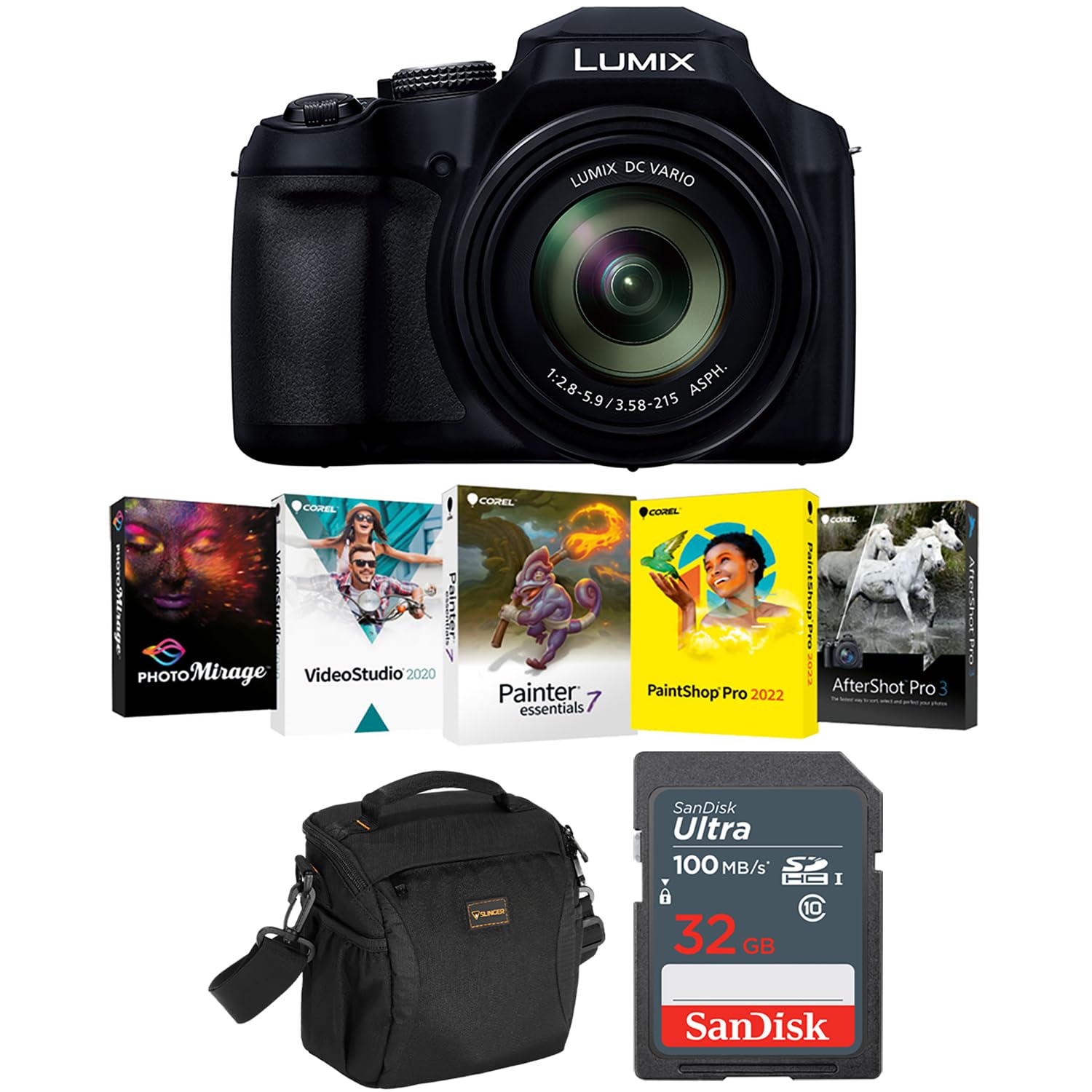
The Panasonic LUMIX FZ80D strikes the ideal balance between reach and usability for a beginner. Its 60x optical zoom (20-1200mm equivalent) covers everything from sweeping landscapes to distant wildlife, and the POWER O.I.S. stabilization keeps handheld shots sharp even at the long end. The 18.1MP 1/2.3-inch sensor produces vibrant colors straight out of camera, and 4K UHD video at 30p adds versatility for family memories or vlogging.
What sets the FZ80D apart for newcomers is the bundled accessory kit — a 32GB SD card, shoulder bag, and software suite — so you can start shooting immediately. The 2.36m-dot OLED electronic viewfinder provides a clear, lag-free preview even in bright sunlight, and the 3-inch 1.84m-dot LCD tilts for unusual angles. The aperture range (f/2.8 at wide-angle to f/5.9 at telephoto) allows decent separation of subject from background when zoomed in.
Wi-Fi connectivity is included but requires downloading the Panasonic app, which some users found clunky. There’s no Bluetooth, so transferring images to a phone isn’t as seamless as with higher-end models. The manual is thin, so expect to download the 250+ page full guide online. Battery life is adequate for a full day of casual shooting, but buy a spare if you plan to shoot 4K video extensively.
Why it’s great
- Excellent 60x zoom range with effective POWER O.I.S. stabilization
- 4K video at 30p plus high-speed 10 fps continuous shooting
- Bright OLED EVF and articulating LCD for flexible composition
- Great value bundle with SD card and bag included
Good to know
- Wi-Fi app setup can be frustrating for some users
- No Bluetooth for constant connection
- Detailed manual only available online
2. Nikon COOLPIX P950

The Nikon COOLPIX P950 is the bridge camera for the beginner obsessed with getting closer. Its 83x optical zoom (24-2000mm equivalent) reaches further than almost any fixed-lens camera on the market, yet it remains relatively compact for the power it delivers. The 16MP sensor is modest by modern standards, but in good light the P950 produces clean, detailed images that are more than adequate for social media, small prints, and species identification — which is exactly what wildlife newcomers need.
Nikon includes dedicated Bird and Moon scene modes that automatically set focus, exposure, and shutter speed for these specific subjects — a huge advantage for beginners who don’t yet know how to manually dial in settings for a fast-moving bird or a low-contrast lunar surface. The built-in image stabilization is excellent; many users report sharp handheld shots even at full 83x zoom, though a tripod becomes advisable beyond 1500mm. The rotating LCD screen and electronic viewfinder make framing easier at odd angles.
The autofocus can hunt when tracking small birds against busy backgrounds, especially at maximum zoom. Manual focus via the lens ring provides a workaround, but it takes practice. Battery life is decent for a day of mixed shooting, but heavy use of the EVF drains it faster. The included strap and USB cable are basic, and you’ll want to buy a fast SD card immediately since none is included in the box.
Why it’s great
- 83x optical zoom with excellent image stabilization
- Dedicated Bird and Moon modes simplify wildlife shooting
- Rotating LCD and clear EVF for flexible framing
- Built-in Wi-Fi for basic image transfer
Good to know
- Autofocus can struggle with fast-moving or distant subjects
- Small sensor limits low-light performance
- No SD card included in the package
3. Nikon COOLPIX P1000
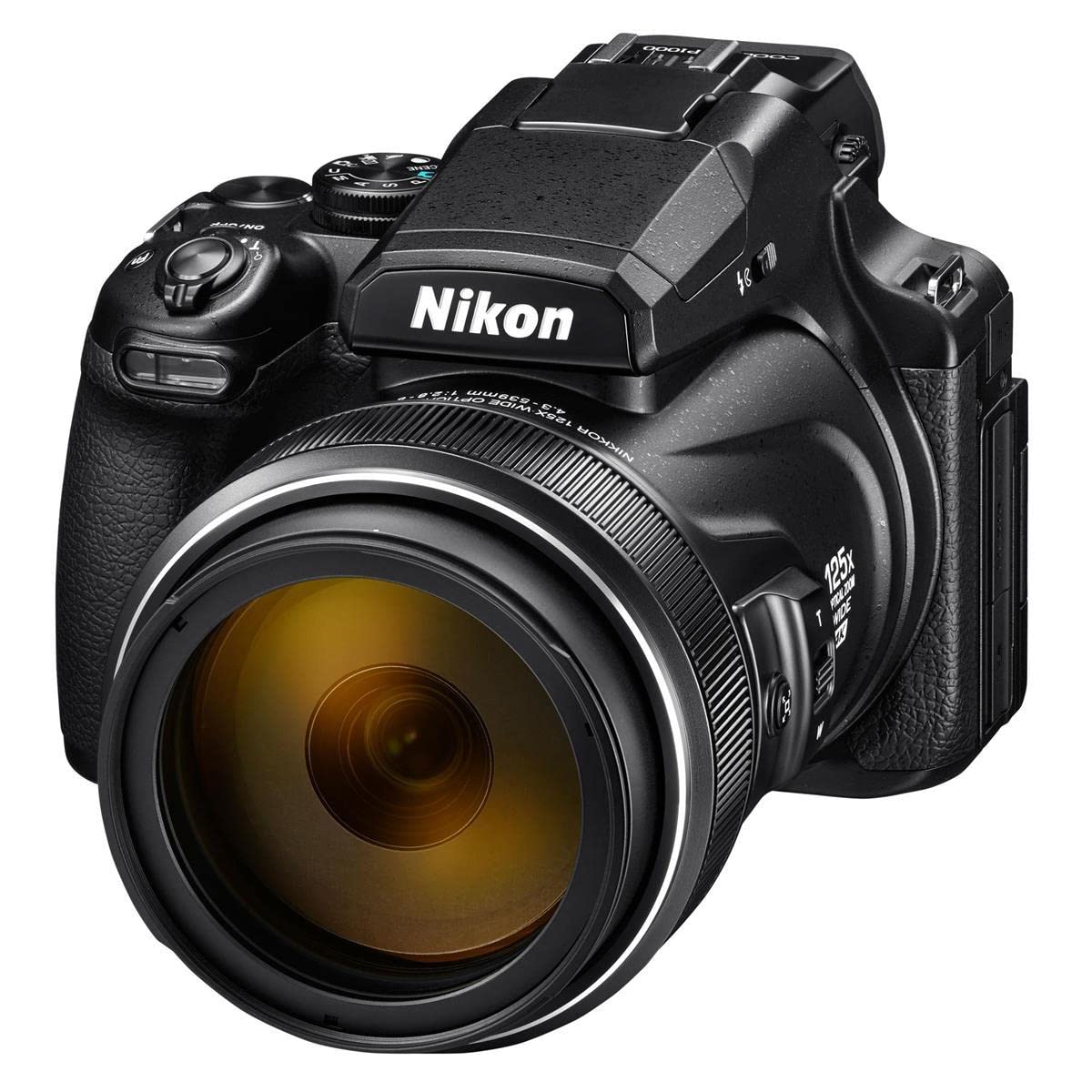
The Nikon COOLPIX P1000 holds the crown for the most extreme optical zoom ever put on a consumer camera: 125x optical reach, equivalent to 24-3000mm. At full extension, you can read a street sign from two miles away or capture the craters on the moon in stunning detail. For a beginner who dreams of documenting distant wildlife, aviation, or celestial events, the P1000 delivers images that were previously impossible without a telescope and a separate camera rig.
Despite its massive zoom, the P1000 offers full manual controls (P, A, S, M), RAW shooting, and a dedicated hotshoe for an external flash or microphone. The 4K UHD video is solid, and the dual-detect image stabilization helps keep shots steady even at extreme focal lengths — though a tripod is strongly recommended past 1500mm. The 3.2-inch vari-angle LCD and high-resolution OLED EVF make composition comfortable whether you’re shooting above a crowd or low to the ground.
The trade-offs are unavoidable: the P1000 is large and heavy, weighing nearly 3 pounds with battery. The small 1/2.3-inch sensor struggles in low light, so nighttime handheld shots will be noisy. Autofocus can hunt at max zoom, especially on fast-moving subjects like birds in flight. Battery life is about 250 shots per charge, and the camera demands a sturdy tripod for its longest reaches. This is a specialist tool for the beginner who values reach above all else.
Why it’s great
- Unmatched 125x optical zoom (24-3000mm) for extreme reach
- RAW shooting and full manual controls for learning
- 4K video with hotshoe for external accessories
- Excellent moon and wildlife detail in good light
Good to know
- Heavy and bulky — requires planning to carry all day
- Small sensor struggles dramatically in low light
- Autofocus can hunt at max zoom on moving subjects
- Short battery life; multiple spares are essential
4. Canon PowerShot SX70 HS

The Canon PowerShot SX70 HS fits a 65x optical zoom into a body that’s noticeably smaller and lighter than the Nikon P950 or P1000. With an equivalent focal range of 21-1365mm, it’s wide enough for sweeping landscapes and long enough for wildlife and sports action. The 20.3MP CMOS sensor delivers Canon’s characteristically pleasing color science, and the DIGIC 8 processor ensures snappy performance for a beginner learning the ropes.
Built-in Wi-Fi and Bluetooth make image transfer to a smartphone almost effortless, allowing you to share shots on social media within seconds of capture. The 3-inch vari-angle touchscreen LCD is responsive and intuitive for menu navigation. The electronic viewfinder is adequate but not as sharp as the Panasonic FZ80D’s OLED unit. Auto mode does a solid job in most daylight conditions, while the Scene modes (such as Portrait and Sports) help new users understand exposure without diving into manual controls.
The SX70 HS uses a proprietary battery that must be removed to charge — a minor inconvenience. Some users report the manual is thin and requires downloading the full guide online. The lens cap on early units was known to pop off easily, though later batches seem improved. Battery life sits at about 325 shots per charge, which is decent but not class-leading. For travel beginners who want a compact superzoom with fast connectivity, the SX70 HS is a refined pick.
Why it’s great
- Compact and lightweight body for easy travel
- 65x zoom with excellent Canon color science
- Wi-Fi and Bluetooth for seamless image sharing
- Responsive vari-angle touchscreen LCD
Good to know
- Battery must be removed to charge; no external charger included
- EVF image quality is adequate but not OLED-sharp
- Detailed manual only available online
5. Minolta Pro Shot 20MP

The Minolta Pro Shot 20MP delivers a 67x optical zoom range for a mid-range price, making it an attractive option for beginners who want serious telephoto power without jumping to the premium tier. The 20-67x lens covers wide-angle to extreme telephoto effectively, and optical image stabilization helps keep shots sharp at the long end. The 20MP sensor captures enough detail for large prints and heavy cropping.
The articulating 3-inch LCD screen is a highlight, allowing you to frame shots from high or low angles without contorting your body. Built-in Wi-Fi and an accompanying app enable wireless image transfer and remote camera control from your smartphone — a useful feature for group photos or shy wildlife. The 27 scene modes include presets for fireworks, snow, beach, and night portrait, which help beginners achieve good results without needing to understand exposure triangle principles.
Some users report that the menu system is non-intuitive, requiring a learning curve to locate features like RAW shooting (which is buried in the “A” mode settings). Build quality feels solid, but a few units have experienced quality control issues, particularly with the card reader and battery charging. Battery life is average — expect to recharge after a full day of mixed shooting. For the zoom range offered at this price point, the Minolta Pro Shot remains a compelling budget-friendly option for aspiring wildlife photographers.
Why it’s great
- Excellent 67x optical zoom for distant subjects
- Articulating LCD and built-in Wi-Fi for flexible shooting
- 27 scene modes ideal for beginners exploring different conditions
- Included 16GB SD card and accessories in box
Good to know
- Menu system can be non-intuitive for new users
- Some reports of quality control issues
- Average battery life; plan for midday recharging
6. Canon EOS R100

Strictly speaking, the Canon EOS R100 is a mirrorless camera with an interchangeable lens, but its RF-S18-45mm kit lens gives it the fixed-zoom feel of a bridge camera while offering a future upgrade path. The 24.1MP APS-C sensor is dramatically larger than the 1/2.3-inch sensors in traditional bridge cameras, delivering superior low-light performance, shallower depth of field for portraits, and significantly more detail in every frame.
For a beginner, the R100’s Dual Pixel CMOS AF with face and eye detection makes focusing effortless — it locks onto subjects instantly and tracks them reliably, even in moderate motion. The 4K video at 24 fps and Full HD at 60 fps provide flexibility for vlogging and event recording. The camera body is remarkably light and compact, making it easy to carry every day. The guidance interface overlays helpful explanations on the screen, teaching you the impact of aperture, shutter speed, and ISO as you adjust them.
The kit lens has a modest 18-45mm zoom range (roughly 29-72mm equivalent) — nothing close to the 60x or 83x reach of dedicated bridge cameras. To get that level of zoom, you would need to purchase additional telephoto lenses, which adds cost and weight. The R100 lacks in-body stabilization, relying on the lens for shake reduction. The LCD is fixed (not articulating), and the EVF is small but functional. For beginners who want superb image quality and a future-proof system, the R100 is a brilliant first step.
Why it’s great
- Large APS-C sensor for excellent image quality and low light
- Reliable Dual Pixel AF with face/eye detection
- Compact and lightweight for everyday carry
- Educational interface helps beginners learn manual controls
Good to know
- Kit lens zoom range is limited compared to dedicated bridge cameras
- No in-body stabilization; relies on lens stabilization
- Fixed LCD screen — no articulation for creative angles
7. Canon EOS Rebel T7
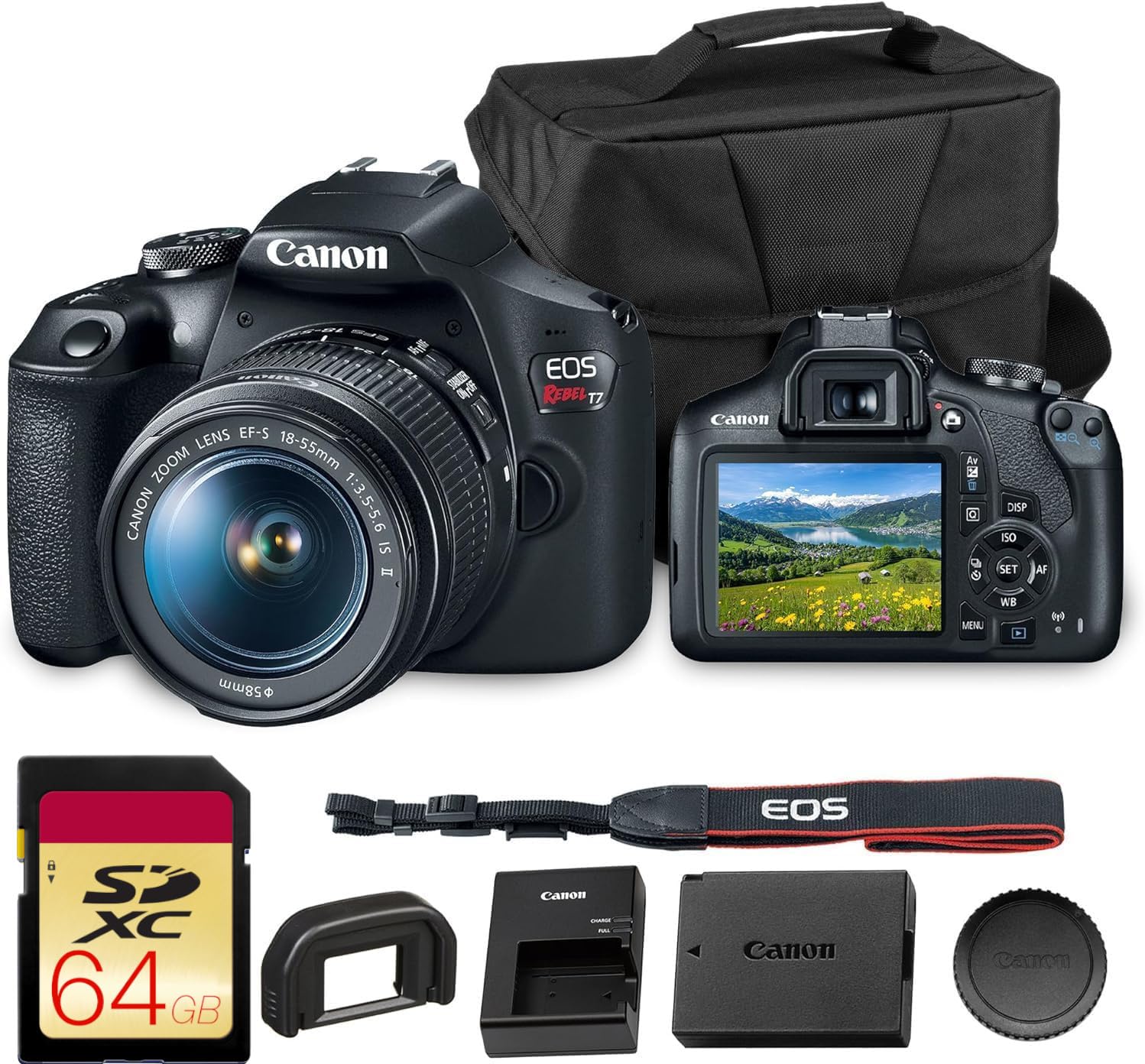
The Canon EOS Rebel T7 is a classic entry-level DSLR that, when bundled with its 18-55mm kit lens, functions much like a bridge camera — a single, versatile zoom that covers wide-angle to moderate telephoto. The 24.1MP APS-C sensor is the same class as the R100’s, providing excellent image quality, solid dynamic range, and the ability to produce beautiful background blur (bokeh) when paired with the kit lens at the portrait end.
What makes the T7 particularly beginner-friendly is the optical viewfinder: a true through-the-lens view with zero lag, which many new photographers find more natural than an electronic viewfinder. The DIGIC 4+ processor is older but proven, delivering reliable autofocus and smooth operation for stills. Built-in Wi-Fi and NFC allow quick image transfer to a smartphone for sharing — a feature that beginners appreciate more than any other. The included bundle adds a shoulder bag and 64GB SD card, so you’re ready to shoot immediately.
The T7 has a 9-point autofocus system that feels dated compared to the R100’s 143-point system, particularly when tracking moving subjects. Video is limited to 1080p at 30 fps — no 4K. The camera is bulkier than mirrorless options, and the kit lens (18-55mm, 29-88mm equivalent) cannot match the zoom reach of a true bridge camera. For a beginner who prioritizes image quality, upgradeability, and a traditional DSLR experience, the Rebel T7 is a proven, affordable choice.
Why it’s great
- Large APS-C sensor for superior image quality and bokeh
- Optical viewfinder provides a natural, lag-free shooting experience
- Wi-Fi and NFC for easy image sharing
- Great bundle with bag and 64GB SD card included
Good to know
- Kit lens zoom range limited compared to true bridge cameras
- 9-point AF system struggles with fast-moving subjects
- No 4K video; 1080p only
- Bulky body may deter some users from daily carry
8. Kodak PIXPRO AZ425

The Kodak PIXPRO AZ425 is a budget-friendly bridge camera that prioritizes simplicity and value. The 20MP sensor captures adequate detail for daylight shooting, and optical image stabilization helps reduce blur at moderate zoom ranges. The 42x optical zoom (24-1008mm equivalent) provides enough reach for family events, school plays, and accessible wildlife — you won’t be shooting distant eagles, but you can fill the frame with a deer at the edge of a field.
This bundle includes a 32GB SD card, a rechargeable battery and charger kit, and a camera case — everything a beginner needs to start shooting without additional purchases. The 3-inch LCD display is straightforward for composing and reviewing images. The AZ425 features Auto scene detection, object tracking, and post-editing filters, so new users can get pleasing results without diving into manual settings. The white color option is a nice aesthetic touch.
The autofocus system uses contrast detection with only 3 AF points, which is slow and can struggle in low light or with moving subjects. Image quality suffers noticeably above ISO 800, producing visible noise and reduced detail. The camera does not shoot RAW, so all post-processing flexibility is lost. The bundled accessories (bag, spare battery) offset these limitations for a beginner who just wants a capable, inexpensive camera to learn the basics of zoom photography.
Why it’s great
- Great value bundle includes SD card, case, and spare battery
- 42x zoom provides useful reach for family and casual subjects
- Auto scene detection simplifies shooting for total beginners
- Optical image stabilization aids handheld sharpness
Good to know
- Slow 3-point AF system struggles with motion and low light
- Image quality degrades quickly at higher ISOs
- No RAW shooting capability for post-processing
9. Kodak PIXPRO AZ255

The Kodak PIXPRO AZ255 is the true entry-level bridge camera, offering a 25x optical zoom (24-600mm equivalent) at a price that’s accessible to anyone. The 16MP CMOS sensor is modest, but in good lighting the AZ255 delivers images that are sharp enough for social media, small prints, and family albums. The 25x zoom covers typical family scenarios — group portraits, birthday parties, school sports from the bleachers — without overwhelming a new user with features they won’t use.
One distinct feature is the use of AA batteries: the camera ships with four starter alkalines, and you can switch to high-capacity lithium AAs or rechargeable NiMH cells for extended life. This means no proprietary battery to hunt for, and you can find replacements anywhere in the world — a real advantage for travel. Optical image stabilization helps keep handheld shots sharp throughout the zoom range. The macro mode is surprisingly effective for close-up flower or food shots.
The AZ255 has a basic 9-point contrast-detection autofocus system that works well in good light but hunts in dim conditions. The LCD screen is fixed (no articulation), making low-angle and overhead shots more difficult. Video is limited to 1080p Full HD at 30 fps — adequate but not class-leading. The plastic body feels light but also less durable than metal-framed competitors. For the absolute minimum budget, the AZ255 provides a functional introduction to bridge photography without any financial risk.
Why it’s great
- Extremely affordable entry point into bridge photography
- AA battery system is universally replaceable and travel-friendly
- 25x zoom covers most beginner use cases (family, travel, casual wildlife)
- Optical image stabilization helps reduce blur at full zoom
Good to know
- Plastic build feels less durable than mid-range alternatives
- Fixed LCD limits creative framing angles
- Autofocus hunts in low-light conditions
FAQ
Are bridge cameras good for beginners who have never used a camera before?
What is the difference between optical zoom and digital zoom?
Do I need a tripod for a bridge camera with 60x or higher zoom?
How important is the electronic viewfinder (EVF) on a bridge camera?
Final Thoughts: The Verdict
For most users, the bridge camera for beginners winner is the Panasonic LUMIX FZ80D because it offers a balanced 60x zoom range, effective POWER O.I.S. stabilization, 4K video, and a clear OLED EVF at a price that leaves room for accessories. If you want extreme telephoto reach for wildlife photography, grab the Nikon COOLPIX P950 with its dedicated Bird mode and 83x optical zoom. And for budget-conscious beginners who just want to dip their toes into bridge photography, nothing beats the straightforward, AA-powered simplicity of the Kodak PIXPRO AZ255.

Mo Maruf
I created WellFizz to bridge the gap between vague wellness advice and actionable solutions. My mission is simple: to decode the research and give you practical tools you can actually use.
Beyond the data, I am a passionate traveler. I believe that stepping away from the screen to explore new environments is essential for mental clarity and physical vitality.