Our readers keep the lights on and my smoothie glass nicely filled. As an Amazon Associate, I earn from qualifying purchases.
Nothing sabotages a weekend bake faster than a stand mixer that labors, overheats, and eventually stalls the moment a stiff sourdough hits the hook. You need a machine that maintains torque through the final stretch of gluten development without walking across the counter. This guide breaks down the models that deliver consistent power, real capacity, and a build that lasts through years of weekly bakes.
I’m Mohammad Maruf — the founder and writer behind WellFizz. I’ve spent months analyzing motor specs, gear materials, bowl capacities, and real-user longevity reports to separate the machines that handle dense doughs from those that simply look the part.
After sorting through dozens of contenders by motor type, alloy construction, and kneading geometry, I’ve landed on the definitive list of machines that qualify as the true best bread mixer investments for home bakers who refuse to compromise on dough quality.
How To Choose The Best Bread Mixer
A great bread mixer must handle long knead cycles without bogging down or overheating. You need to consider motor power, mixing action, and the overall build quality. Not every shiny stand mixer can handle the continuous torque required for stiff dough; many are designed primarily for cake batter and light whipping.
Motor Type and Torque Delivery
DC motors deliver more consistent torque at lower speeds and run quieter than their AC counterparts. For bread mixing, a motor that maintains its speed under load is essential. Machines with DC motors typically run cooler and last through repeated heavy kneading cycles without the motor burning out or tripping a thermal breaker.
Mixing Action: Planetary vs. Spiral
Planetary mixing, where the attachment orbits the bowl while spinning, is common in tilt-head machines and works well for moderate doughs. Spiral mixing uses a rotating bowl and a stationary spiral hook that develops gluten more efficiently and with less heat buildup, making it the preferred geometry for serious bread bakers. Spiral mixers also produce less strain on the motor during stiff dough cycles.
Bowl Capacity and Batch Size
A 5-quart bowl can handle a single loaf or a batch of 12 dinner rolls. For bakers making two to four loaves at a time, a 6.5-quart or larger bowl is recommended. Pay attention to the recommended flour weight rather than just quart volume. A machine that states a max flour weight of 3 kg will handle heavier whole-grain and high-hydration doughs far better than one that only lists quart capacity.
Quick Comparison
On smaller screens, swipe sideways to see the full table.
| Model | Category | Best For | Key Spec | Amazon |
|---|---|---|---|---|
| ZACME 8.4QT Commercial | Premium | Heavy batch bread and pizza dough | 800W DC motor, 8.4 qt bowl | Amazon |
| Kraftsman All Metal | Premium | Quiet operation, all-metal build | DC motor, 24.9 lb die-cast body | Amazon |
| NutriMill Artiste | Premium | Large batch mixing with bottom drive | 500W motor, 6.5 qt bowl | Amazon |
| Hamilton Beach Pro | Mid-Range | Planetary action with power hub | 450W motor, 5 qt bowl | Amazon |
| CEBORY 3-IN-1 | Mid-Range | Budget-friendly stand mixer with DC motor | 660W DC motor, 6.5 qt bowl | Amazon |
| Acekool MC1 | Mid-Range | Entry-level tilt-head for frequent bakers | 660W motor, 7.5 qt bowl | Amazon |
| Joydeem HMJ-A501 | Budget | Dough-only machine with fermentation | 180W motor, 5.3 qt bowl | Amazon |
| Joydeem JD-HMJ7L | Budget | Large capacity dough maker with proofing | 250W motor, 7.4 qt bowl | Amazon |
| Ooni Halo Pro Spiral | Premium | Pro-level spiral mixing for artisan bakers | Spiral mixing, 7.3 qt, 58 speeds | Amazon |
In‑Depth Reviews
1. ZACME 8.4QT Commercial Stand Mixer
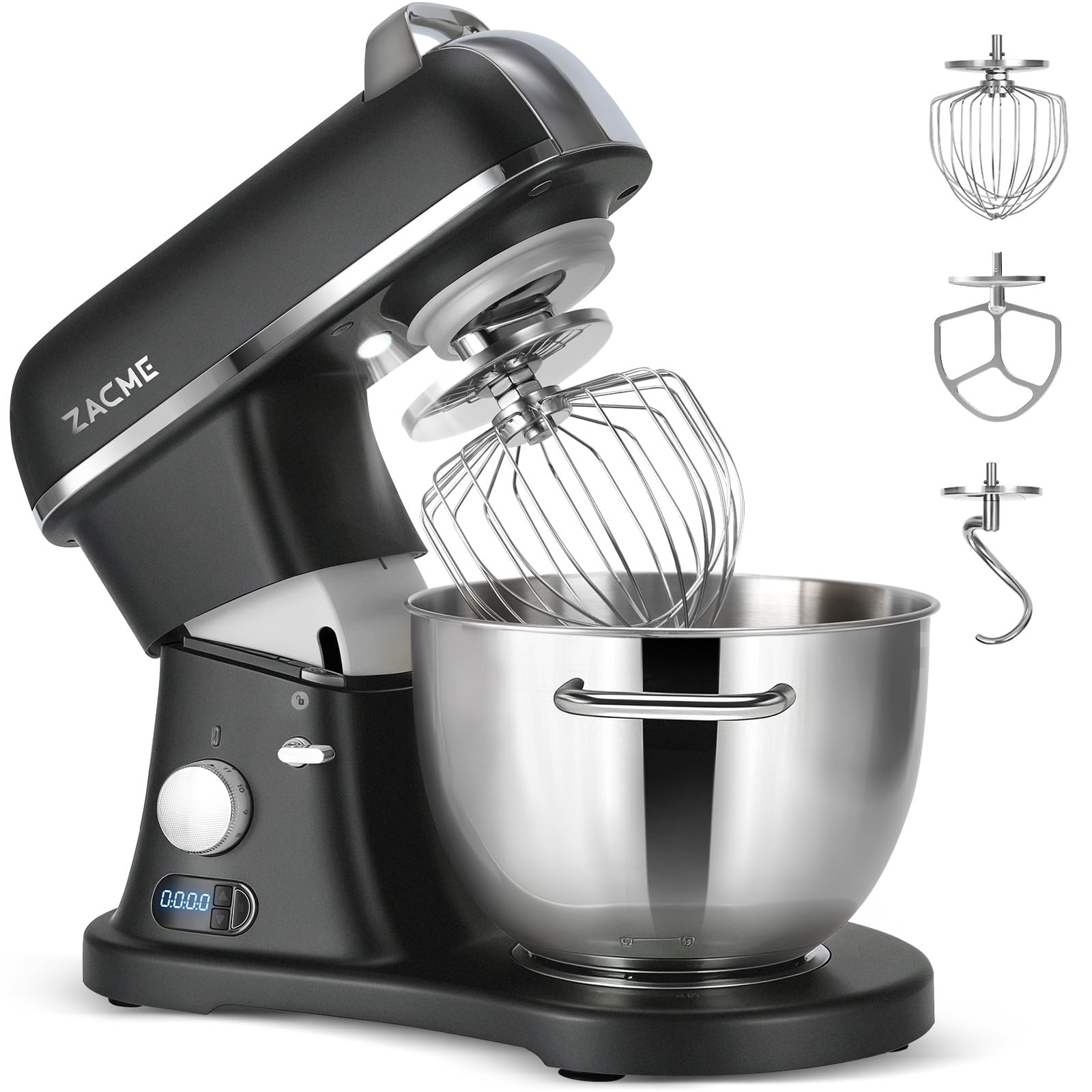
The ZACME 8.4QT is the closest thing to a commercial spiral mixer without the 6-digit price tag. Its 800W DC motor powers through 3 kg of stiff dough without breaking a sweat, and the aluminum die-cast housing keeps vibration to a minimum. The planetary action with a stainless steel bowl this large means you can mix enough dough for four large loaves in a single batch, saving real time on bake days. The LCD timer display is a practical addition for tracking knead times consistently.
Noise levels are genuinely low — the first gear registers under 48 dBA, making early-morning mixing sessions neighbor-friendly. The machine meets NSF/ANSI 8-2023 standards, which is rare at this price point and signals commercial-grade durability. The tilt-head design remains easy to operate despite the heavy bowl.
Some users note the plastic accessory cover feels less premium than the rest of the build, and the machine is heavy to move around the counter. That weight, however, is exactly what keeps it planted during heavy mixing. Overall, this is the most capable all-rounder for bakers who want commercial performance without a commercial budget.
Why it’s great
- Powerful 800W DC motor handles the heaviest doughs without stalling
- Large 8.4-quart bowl fits multiple loaf batches
- Very quiet operation under load
Good to know
- Very heavy unit, difficult to move frequently
- Plastic accessory cover feels cheaper than the rest of the machine
2. Kraftsman All Metal Stand Mixer

The Kraftsman stands out for its all-metal, die-cast construction weighing 24.9 pounds. That mass provides exceptional stability when mixing dense whole-wheat or rye doughs. The DC motor runs quieter and cooler than comparable AC units, and the built-in timer with second-level precision helps you replicate consistent results batch after batch. The flexible edge beater scrapes the bowl sides automatically, reducing the need to stop and scrape.
Four stainless steel attachments, including a dough hook and whisk, cover a wide range of baking tasks. The universal power hub expands functionality for pasta rollers and meat grinders if you ever need those extras. The tilt-head design with a removable splash guard makes adding flour mid-mix straightforward.
Customer reports mention that the mixer occasionally climbs the dough on the hook, requiring a quick pause to scrape. The brand is relatively new, and some users note the machine is built by a Chinese OEM also used by other brands, which raises warranty concerns if the company changes its support structure. Still, the raw build quality and quiet operation make it a strong mid-premium option.
Why it’s great
- Heavy die-cast metal body prevents counter-walking
- DC motor delivers quiet, consistent torque
- Built-in timer improves repeatability
Good to know
- Dough can climb the hook during kneading
- Brand warranty may be uncertain long-term
3. NutriMill Artiste Kitchen Stand Mixer

The NutriMill Artiste uses a bottom-drive design that delivers power directly to the bowl rather than through a tilting head. This geometry allows it to handle up to 8 pounds of dough without straining, and the 6.5-quart bowl can accommodate four loaves or a triple batch of cookie dough. The suction cup feet keep it anchored at higher speeds, a feature essential for bottom-drive machines that experience more torque on the bowl.
The clear lid with a center opening lets you add flour or water mid-cycle without splatter. The extended-length dough hook reaches deeper into the bowl than standard designs, improving gluten development in stiff doughs. The wire whips handle lighter mixing tasks well, and the included recipe book helps new owners get started quickly.
Some users report wobbling at speed settings above 3, and the plastic bowl, while sturdy for its purpose, scratches over time with heavy use. The machine is also slightly taller than tilt-head mixers, which may affect under-cabinet storage. For bakers who mix large batches regularly, the Artiste’s capacity and motor reliability outweigh these storage concerns.
Why it’s great
- Bottom-drive design handles heavy batches without strain
- Large 6.5-quart bowl fits substantial dough weights
- Clear lid with opening prevents mess when adding ingredients
Good to know
- Wobbles slightly at higher speeds
- Plastic bowl scratches over time
4. Hamilton Beach Professional All-Metal Stand Mixer

Hamilton Beach’s Professional mixer offers solid 450W of power and a planetary mixing action that covers the entire bowl surface, ensuring no dry flour pockets remain. The all-metal construction provides a stable base, and the 5-quart bowl is well-suited for bakers making one to two loaves at a time. The specialty attachment power hub is a welcome addition for those who want to expand into pasta making or meat grinding without buying a separate machine.
The spiral dough hook handles moderate bread doughs effectively, and the 12 speed settings give you precise control over mixing intensity. The splash guard with a pour chute is a practical feature that keeps flour off the counter. Suction cup feet keep the machine planted at higher speeds, even during stiff dough kneading.
A few users note that the whisk attachment is made of stainless steel while the flat beater and dough hook use coated metal, which may chip over extended use. The bowl size, while adequate for small batches, may feel restrictive for bakers who regularly make three or more loaves. Overall, this is a reliable workhorse at a reasonable price point.
Why it’s great
- Planetary action ensures complete bowl coverage
- Power hub accepts multiple specialty attachments
- Suction cup feet maintain stability
Good to know
- Bowl size is small for high-volume bakers
- Some attachments use coated metal, not all stainless
5. CEBORY 3-IN-1 Electric Stand Mixer

The CEBORY 3-IN-1 brings a 660W DC motor and a 6.5-quart bowl at a very accessible price. The DC motor provides efficient torque while keeping noise levels lower than many AC alternatives in this bracket. The tilt-head design with 10 speeds plus a pulse function gives you fine-grained control over mixing stages, from gentle folding to high-speed whipping.
The included stainless steel bowl and dishwasher-safe attachments make cleanup easy. The suction cup feet hold the machine steady during kneading, and the green color option adds a visually distinct look to the counter. It handles bread dough, cookie batter, and meringue tasks without difficulty.
Some users report that the tall bowl design can make it difficult to scrape the sides or add ingredients, and the attachments do not always reach the very bottom of the bowl, leaving small unmixed pockets. The green paint may scratch over time with heavy use. For bakers on a budget who still want DC motor benefits, this is a capable entry point.
Why it’s great
- DC motor delivers quiet, efficient kneading
- Large 6.5-quart bowl at a budget-friendly price
- Dishwasher-safe attachments simplify cleanup
Good to know
- Attachments may leave bottom unmixed pockets
- Tall bowl limits easy ingredient access
6. Acekool MC1 Stand Mixer

The Acekool MC1 defends its position as a durable, daily-use mixer that has survived commercial use in a biergarten for two consecutive years. The 660W motor combined with a 7.5-quart bowl is generous for a machine at this price level, allowing you to mix large batches of bread or pizza dough in one go. The tilt-head design and six anti-slip silicone suction cups keep the machine stable, even during prolonged kneading.
The stainless steel bowl includes a handle for easier handling, and the included dough hook, flat beater, and whisk cover the essential baking tasks. The 10-speed range with suggested speed modes for different dough types simplifies the learning curve. The splash guard catches flour during initial mixing, reducing counter mess.
Some users note that the first speed is faster than ideal for delicate doughs, and the attachments do not always scrape the very bottom of the bowl, requiring a pause to fold. The machine lasted a reviewer three years of frequent use before showing wear, which represents solid value. For bakers who want a large bowl and reliable motor without a premium price, this is a smart choice.
Why it’s great
- Proven durability with long-term daily use
- Very large 7.5-quart bowl for big batches
- Multiple suction cups keep it stable
Good to know
- First speed is not slow enough for delicate mixing
- Bottom of bowl may have unmixed pockets
7. Joydeem HMJ-A501 Electric Dough Maker
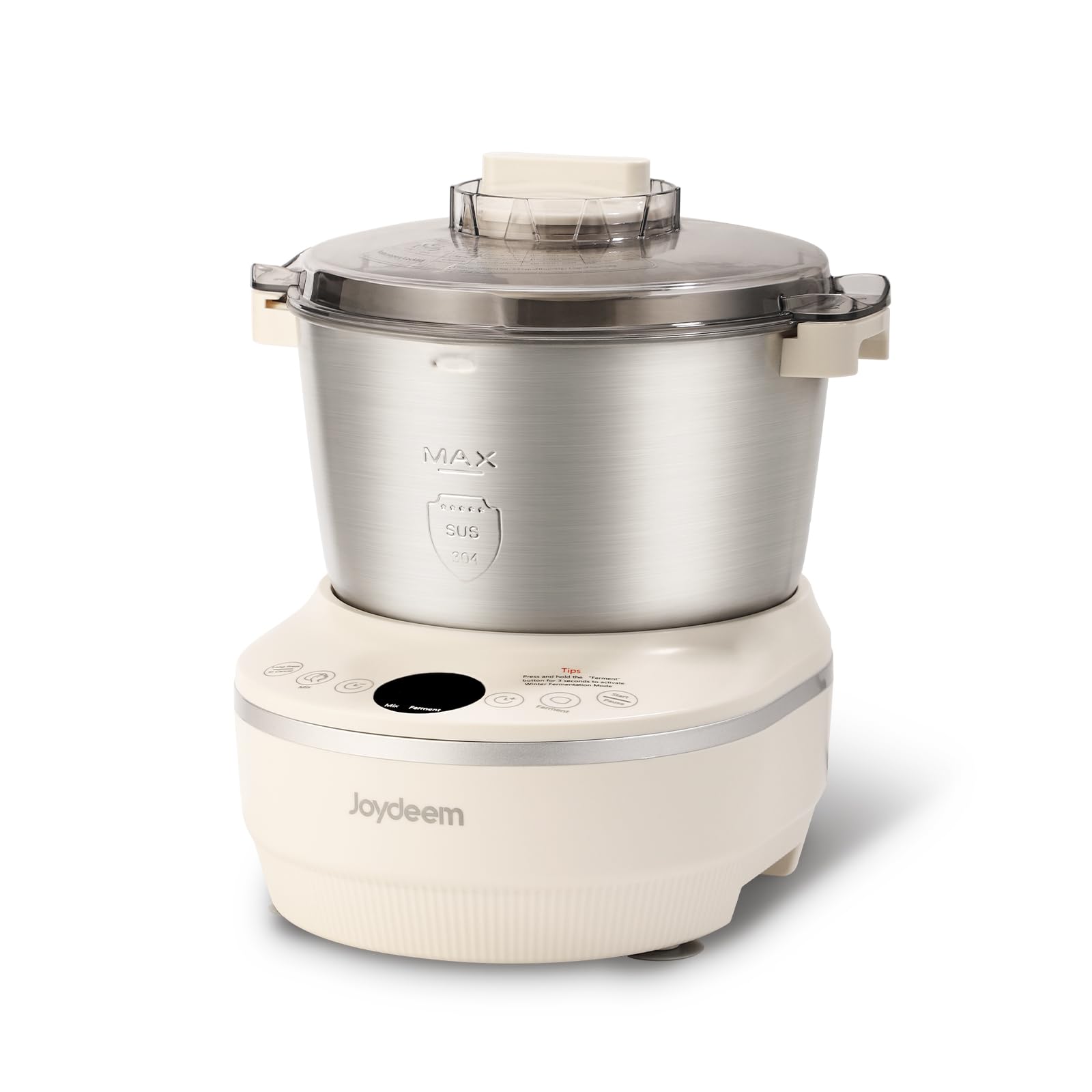
The Joydeem HMJ-A501 is a dedicated dough maker designed for users who primarily need a machine for kneading and fermenting — not for whipping cream or beating eggs. The 180W motor operates in automatic intervals that mimic hand-kneading, with a pause between rotations to allow gluten to relax before the next stretch. This process is particularly good for sticky sourdough and high-hydration doughs that stress traditional stand mixers.
The built-in fermentation heater maintains a range between 77-100°F, which is ideal for proofing dough in colder kitchens. The 5.3-quart bowl handles up to 1600g of flour, enough for three loaves. The 304 stainless steel bowl and blade resist corrosion and are easy to hand wash. The vertical design with a small top window allows you to check dough progress without lifting the lid.
Users report that the machine is arthritis-friendly due to the minimal physical effort required. The automatic mix-pause-rest cycles can run up to 120 minutes for long-fermentation doughs. The machine is not dishwasher safe, and the timer cannot be adjusted mid-cycle without unplugging it. This is a purpose-built tool for dough enthusiasts rather than a general-purpose kitchen mixer.
Why it’s great
- Automatic kneading cycles mimic professional hand techniques
- Built-in fermentation heater works well in cold kitchens
- Great option for arthritis sufferers who struggle with kneading
Good to know
- Not dishwasher safe — hand wash only
- Cannot adjust timer mid-cycle without unplugging
8. Joydeem JD-HMJ7L Dough Maker

The Joydeem JD-HMJ7L expands on the dough-maker concept with a 7.4-quart capacity and a 250W motor, making it suitable for families who bake multiple loaves at once. The microcomputer-controlled programs automatically manage mixing and fermentation times, and you can preset the machine to finish kneading in 15 minutes or complete a full mix-and-proof cycle in 45 minutes with an audible alert.
The face-up touch panel saves counter space, and the vertical design has suction cup feet that keep it stable during operation. The 304 stainless steel bowl and blade are dishwasher safe, which is a notable improvement over the smaller HMJ-A501. The machine simulates natural hand-kneading with a start-stop blade motion, reducing the stress on the motor and improving dough quality.
Some users report that the fermentation mode can get too warm in one spot, causing the dough on the bottom to start baking slightly. Those who notice this simply disable the fermentation function and let the dough rise naturally. The touch buttons are less rugged than mechanical controls, so careful handling is recommended. For the price, this is a highly capable dough-specific machine with generous capacity.
Why it’s great
- Large 7.4-quart bowl handles family-sized dough batches
- Microcomputer programs manage mixing and proofing automatically
- Dishwasher-safe bowl and blade simplify cleanup
Good to know
- Fermentation heater may overheat in one spot
- Touch buttons are less durable than mechanical switches
9. Ooni Halo Pro Spiral Mixer

The Ooni Halo Pro Spiral Mixer is a genuine spiral mixer engineered for home bakers who want professional gluten development. Unlike planetary mixers, this machine rotates the bowl while the spiral hook stays fixed, developing gluten networks faster and with less heat generation. The 58 speed settings range from 60 RPM to over 1,000 RPM, giving you the precision to handle anything from delicate croissant dough to stiff bagel dough.
The patented removable breaker bar works alongside the spiral hook to aerate and strengthen dough, which is visible in the final crumb structure of the bread. The 7.3-quart stainless steel bowl is removable and dishwasher safe, and the die-cast aluminum body keeps the machine stable during high-torque cycles. The included attachments — spiral dough hook, flexible beater, geared whisk, and breaker bar — allow it to double as a general mixer for cakes and cookies.
The capacitive controls with a rotary dial are intuitive, and the LED lights illuminate the bowl during mixing. The machine is quieter than a KitchenAid under load and requires significantly less kneading time for equivalent gluten development. The only weak point reported is the whisk attachment, which struggles with heavy batters. This is a serious investment for the committed artisan baker who values dough structure above all else.
Why it’s great
- Spiral mixing action develops gluten faster and with less heat
- 58 speed settings give exceptional control
- Removable breaker bar improves dough aeration
Good to know
- Whisk attachment is weaker than the rest of the package
- Capacitive controls may be sensitive during cleanup
FAQ
Can a bread mixer handle high-hydration sourdough without overheating?
What is the minimum motor wattage for reliable bread kneading?
How large of a bowl do I need for two loaves of bread?
Final Thoughts: The Verdict
For most users, the best bread mixer winner is the ZACME 8.4QT Commercial because it combines 800W of DC motor power, a large 8.4-quart bowl, and NSF-rated commercial durability at a price that undercuts traditional premium brands. If you prioritize whisper-quiet operation and an all-metal build, grab the Kraftsman All Metal Mixer. And for serious artisan bakers who want true spiral mixing technology, nothing beats the Ooni Halo Pro Spiral Mixer.

Mo Maruf
I created WellFizz to bridge the gap between vague wellness advice and actionable solutions. My mission is simple: to decode the research and give you practical tools you can actually use.
Beyond the data, I am a passionate traveler. I believe that stepping away from the screen to explore new environments is essential for mental clarity and physical vitality.