Our readers keep the lights on and my smoothie glass nicely filled. As an Amazon Associate, I earn from qualifying purchases.
Recovering from a Posterior Cruciate Ligament injury introduces a unique challenge: preventing the tibia from slipping backward while the graft heals. A standard ACL brace won’t provide the posterior tibial support your knee demands.
I’m Mohammad Maruf — the founder and writer behind WellFizz. I spent months cross-referencing medical specifications, hinge mechanics, and patient feedback to isolate exactly what separates a real PCL support system from a general-purpose knee cage.
Whether you’re facing post-op immobilization or a conservative rehab protocol, choosing a proper brace for pcl injury hinges on understanding hinge lockout angles and the force distribution of the frame.
How To Choose The Best Brace For PCL Injury
A PCL injury brace must prevent the shinbone from sliding backward behind the femur — a demand that calls for a rigid frame and a reliable extension stop. Without these, the posterior cruciate ligament remains vulnerable during every flexed-knee movement.
The Hinge Lock Matters More Than Price
You need a brace with a genuine range-of-motion (ROM) lock that can be set to 0 degrees of extension for immediate post-op use, then gradually opened in 10- or 15-degree increments as rehab progresses. Look for dials that physically block the hinge from moving beyond your chosen angle — friction-based straps do not offer this precision.
Frame Rigidity and Weight Distribution
A PCL brace must be stiff enough to resist the backward force of the tibia. Aluminum-alloy frames paired with polycentric hinges deliver the highest torsional rigidity. Heavy braces feel secure but can cause compliance issues — balance frame strength with non-slip padding that prevents migration.
Size Accuracy and Adjustability
Measure your thigh circumference at the midpoint and your calf at the widest point using a cloth tape. A brace that is too long can migrate and lose its posterior shelf alignment. Models with telescoping frame bars allow you to match the brace length to your leg length precisely.
Quick Comparison
On smaller screens, swipe sideways to see the full table.
| Model | Category | Best For | Key Spec | Amazon |
|---|---|---|---|---|
| DonJoy Performance BIONIC FULLSTOP | Premium Sports | Active sports & hyperextension prevention | Four-point leverage system | Amazon |
| Komzer Professional ACL Knee Brace | High-End | Professional rehab & gym training | Stainless steel polycentric gear hinges | Amazon |
| Brace Direct T Scope Premier | Premium | Post-op recovery & adjustable fit | Telescoping frame (17″-27″) | Amazon |
| KD ROM Knee Brace | Mid-Range | Everyday PCL support with fast application | Fast-Clip buckles, 0°-120° ROM | Amazon |
| DOUKOM Hinged Knee Brace | Mid-Range | Versatile post-op & ligament injury rehab | ROM -10° to 110° flexion | Amazon |
| BraceAbility Torn Meniscus ROM Knee Brace | Value | Affordable immobilization & meniscus combined injuries | Polycentric ROM hinges | Amazon |
| kefit Hinged Knee Brace Rom | Entry-Level | Budget-conscious post-op stabilization | Adjustable locking dial -10° to 120° | Amazon |
In‑Depth Reviews
1. DonJoy Performance BIONIC FULLSTOP Knee Brace

DonJoy’s BIONIC FULLSTOP uses a four-point leverage system that dampens the knee through its extension arc, training the user to avoid the at-risk posterior position. This is not a simple immobilizer — its silicone frame liners and breathable compression sleeve provide thermal regulation while delivering targeted support for ACL, PCL, LCL, and MCL injuries.
The polycentric hinge architecture allows natural knee roll, and the adjustable straps enable a very custom fit without resorting to a full custom mold. At 2.5 pounds, it is noticeably lighter than many full-metal braces, yet the frame feels dense enough to stop hyperextension cold. Reflectivity on the sleeve adds a practical touch for low-light training.
Users report it holds up through football, soccer, and skiing sessions. The most common long-term concern is strap stitching — some units show wear near the buckle after extended use and a small percentage of users experience side itching from the lining. If you need a premium brace for high-impact activities, this is the benchmark.
Why it’s great
- Four-point leverage system actively trains user away from hyperextension
- Breathable, moisture-wicking compression sleeve reduces heat buildup
- Anti-migration silicone grip keeps brace in place during sport
Good to know
- Strap stitching may degrade faster than expected at this tier
- Does not fully stop hyperextension for users with -35° joint laxity
2. Komzer Professional ACL Knee Brace

Komzer builds this brace around high-strength stainless steel polycentric gear hinges — a feature normally reserved for medical devices. The numbered straps with foam cushion pads allow micro-adjustments, and the extra-thick silicone-coated neoprene frame liners practically lock the brace onto your thigh and calf, eliminating the need for constant readjustment during squats or gym sessions.
The frame uses aluminum alloy to keep overall weight manageable while maintaining the stiffness needed for posterior tibial support. A ROM adjustment tool kit with extension/flexion pins lets you set precise stop angles for each phase of PCL recovery. It comes in four size variations, which means less migration compared to one-size-fits-all designs.
Real buyers consistently note it works as well as orthopedist braces. The silicone grip liners can irritate bare skin — users with sensitive legs should wear a thin sleeve underneath. A learning curve exists for the initial hinge setup, but the durability and return-to-sport reviews make this a serious contender for active rehab.
Why it’s great
- Stainless steel polycentric gear hinges provide industry-leading lock precision
- Silicone-coated neoprene liners prevent slipping during dynamic movement
- Aluminum frame delivers stiffness without excessive weight
Good to know
- Grip lining can irritate skin; a thin base layer is recommended
- ROM pin setup has an initial learning curve
3. Brace Direct T Scope Premier Post Op Knee Brace
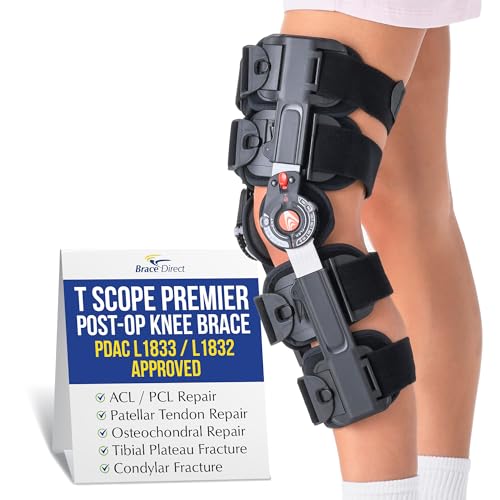
The T Scope Premier differentiates itself with a telescoping frame that extends from 17 to 27 inches, accommodating a wide range of leg lengths and thigh circumferences up to 30.5 inches. This adjustability is critical for PCL braces because a frame that is either too short or too long will lose its posterior shelf alignment, leaving the knee unprotected during early weight-bearing.
Brace Direct includes a free video fitting appointment with a certified professional — a service that bridges the gap between mail-order and custom orthotics. Quick-clip buckles make application fast, which matters when you are tender from post-surgery manipulation. The neoprene material body offers good padding, though it can feel warm during all-day wear.
Customer feedback highlights its role in post-TKR and revision recovery, where preventing falls from unstable knees was the primary goal. The brace fits comfortably over sweatpants and leggings, and users report it provides walking confidence immediately. The adjustability clasp pieces are functional but not as refined as premium DonJoy hardware.
Why it’s great
- Telescoping frame adjusts from 17″-27″ for precise leg-length matching
- Free professional video fitting session included
- Quick-clip buckles allow easy one-handed application
Good to know
- Clasp pieces for length adjustment feel less refined than hinge hardware
- Heavier than sport-focused braces for long walks
4. KD ROM Knee Brace

KD’s ROM brace focuses on comfort without sacrificing the mechanical lock needed for a PCL protocol. The soft inner lining and adjustable straps reduce pressure points for extended wear, which is essential when the brace must stay on for eight-plus hours a day. The robust hinge mechanism provides a solid 0-to-120-degree adjustment range with clear stop settings.
Fast-Clip technology enables quick application and removal — a real asset during early rehab when bending to fasten straps is painful. The adjustable-length design accommodates thigh measurements up to 35 inches, and the included shoulder strap reduces brace weight and prevents migration. At this tier, the build quality feels on par with what a surgeon’s office might provide for a fraction of the cost.
Some users encountered squeaky hinges after a week of use, and the design places bolts for the shoulder strap on the inner thigh, where they can dig into the skin. For those who skip the shoulder attachment, this isn’t an issue. Overall, it’s a solid mid-range choice for users who prioritize quick daily application and wide size accommodation.
Why it’s great
- Fast-Clip buckles enable easy one-handed on/off
- Soft inner lining reduces irritation for all-day compliance
- Fits thighs up to 35 inches for broader size inclusion
Good to know
- Hinges may develop squeaking sounds after several days
- Shoulder strap bolts on inner thigh can cause chafing
5. DOUKOM Hinged Knee Brace

DOUKOM’s hinged brace covers the full PCL rehab spectrum with a -10-to-110-degree flexion range and -10-to-90-degree extension settings, allowing very fine control over hyperextension prevention. The frame uses lightweight aluminum alloy with durable plastic quick-release buckles, making it simpler to manage than traditional hook-and-loop systems.
A removable shoulder strap helps redistribute weight off the knee and prevents downward slippage, a common complaint with longer braces. The non-slip fabric and breathable inner lining reduce sweating and skin sensitivity during extended wear. This brace is ambidextrous, fitting both left and right legs — a convenience for households sharing recovery gear.
Buyers praise its customer service responsiveness — one user had a lock tab fail after eight months and received a replacement within the week. The frame length can be too long for shorter individuals at the low end of the size range, causing slippage. Stick to the sizing guide closely and consider your inseam before ordering.
Why it’s great
- Broad ROM range (-10° to 110° flexion) for precise rehab control
- Removable shoulder strap reduces brace migration
- Excellent customer support with quick replacement parts
Good to know
- Frame length can be too long for users with shorter legs
- Slightly heavy at 3.15 pounds for all-day wear
6. BraceAbility Torn Meniscus ROM Knee Brace

BraceAbility’s ROM brace uses polycentric hinges with 15-degree adjustment increments, providing enough control for combined meniscus and PCL injuries without the high price tag. The wraparound upper design secures above the kneecap while the neoprene sleeve below delivers thermo-compression to reduce swelling — a dual approach that supports both ligament and cartilage recovery.
Medical-grade fastener straps allow a customized fit, and the open patella design relieves pressure on the kneecap during flexion. A popliteal cutout behind the knee prevents bunching and pinching, which improves comfort during walking and bending. The brace is available in multiple sizes from petite to plus, increasing the odds of a proper fit.
Users with broken patellas and post-op meniscus repairs report excellent pain relief and stability, especially for nighttime wear. The brace is heavy compared to sleeve-style supports, and the 15-degree increments may feel too coarse for precise early-phase rehab. It also requires some initial disassembly of the hinge side plates to access the ROM settings — a step that can confuse first-time users.
Why it’s great
- Polycentric hinges offer good stability for combined PCL/meniscus injuries
- Open patella design reduces kneecap pressure during flexion
- Popliteal cutout prevents fabric bunching behind the knee
Good to know
- 15-degree ROM increments may not offer enough granularity for early rehab
- Heavy frame can feel unstable for users with diminished dexterity
7. kefit Hinged Knee Brace Rom

Kefit’s ROM brace brings an adjustable locking dial with -10-to-120-degree flexion and -10-to-30-degree extension settings to the entry-level price point. The push-button adjustable struts let you modify the frame length for a better match to your leg, and the open design fits both right and left legs. For someone who needs a functional PCL brace without spending for premium branding, this covers the basics.
The fastening straps are fully adjustable and the soft pads provide decent grip to keep the brace in place during daily walking. At 2.1 pounds, it is lighter than some mid-range competitors, which helps with compliance. Users have successfully used it for post-op immobilization, wrestling support, and general pain relief from ligament sprains.
The locking mechanism is the weakest link — several buyers report that the hinge locks fail under active movement, requiring zip ties or tape to reinforce. The top strap can also slide down during extended wear, and the brace is difficult to put on without assistance. If your rehab involves high-intensity motion, the hinge limitation makes this a risk; for basic stabilization, it gets the job done.
Why it’s great
- Locking dial provides ROM control from -10° to 120°
- Push-button adjustable struts for personalized leg-length fit
- Lightweight frame at 2.1 pounds for better daily wear comfort
Good to know
- Locking mechanism may fail under active use, requiring field modifications
- Difficult to apply independently without assistance
FAQ
Can a standard ACL brace be used for a PCL injury?
How many degrees of ROM should I set for early PCL rehab?
Final Thoughts: The Verdict
For most users, the brace for pcl injury winner is the DonJoy Performance BIONIC FULLSTOP because its four-point leverage system actively trains the knee away from hyperextension while offering the ventilation and mobility needed for sport. If you want professional-grade polycentric hinges for gym and rehab, grab the Komzer Professional ACL Knee Brace. And for a telescoping fit with professional support, nothing beats the Brace Direct T Scope Premier.

Mo Maruf
I created WellFizz to bridge the gap between vague wellness advice and actionable solutions. My mission is simple: to decode the research and give you practical tools you can actually use.
Beyond the data, I am a passionate traveler. I believe that stepping away from the screen to explore new environments is essential for mental clarity and physical vitality.