Our readers keep the lights on and my smoothie glass nicely filled. As an Amazon Associate, I earn from qualifying purchases.
An MCL tear doesn’t just hurt—it destabilizes the entire knee, making every lateral step a gamble. Finding a brace that specifically controls that medial-lateral play without restricting your daily movement is the difference between ongoing aggravation and confident recovery.
I’m Mohammad Maruf — the founder and writer behind WellFizz. My work focuses on dissecting medical-grade product specifications, analyzing real-user outcomes for ligament injuries, and identifying the structural design elements that separate a supportive brace from one that just feels like a tight sock.
After combing through hundreds of patient and athlete reviews and comparing hinge mechanisms, stabilizer construction, and compression fabrics, this guide isolates the models that truly stabilize the medial collateral ligament. This is the definitive breakdown for finding the best brace for mcl injury for your specific rehab stage and activity level.
How To Choose The Best Brace For MCL Injury
Selecting a brace for an MCL injury is not about picking the most padded or expensive model. You need a device that actively resists the side-to-side (valgus) force that stresses the medial ligament while still allowing comfortable knee flexion for daily life. Focus on these three areas to find your best fit.
Hinge Integrity and Stabilizer Placement
Not all hinges are created equal. An entry-level sleeve might have soft, flexible stays that do little to block lateral movement. A proper MCL brace uses bilateral polycentric hinges—one on each side of the knee—crafted from either reinforced polymer or lightweight aluminum. These hinges must track the knee’s natural rotation. For pure MCL protection, the hinge stiffness and the frame’s ability to resist a sideways bend at the joint line are the specs that matter most.
Fit, Slippage, and the Wraparound vs. Sleeve Decision
An MCL brace that slides down your leg mid-walk offers zero protection. Sleeve-style braces must be sized precisely—too loose and they migrate, too tight and they cut circulation. Wraparound designs, often with multiple Velcro straps above and below the knee, offer a more customizable fit and are easier to put on during post-injury swelling phases. If you are between sizes, always size up for a sleeve. For a wraparound, follow the thigh circumference measurement more carefully than the calf measurement.
Material Breathability and All-Day Wear
An MCL injury can take weeks to heal, which means you will be wearing this brace for long hours. Neoprene retains heat and can cause sweating and skin irritation. Look for options that use fabric blends like Lycra, mesh weaves, or moisture-wicking materials such as HydraCinn or Drytex. These fabrics improve airflow and reduce the chances of the brace slipping on the skin due to sweat. If you have sensitive skin, hypoallergenic and latex-free constructions are a big plus.
Quick Comparison
On smaller screens, swipe sideways to see the full table.
| Model | Category | Best For | Key Spec | Amazon |
|---|---|---|---|---|
| Shock Doctor 875 | Premium | Maximum lateral stability for active users | Bilateral polycentric steel hinges | Amazon |
| Mueller Hg80 5401 | Premium | Comfortable all-day support with triaxial hinges | Triaxial hinge system, HydraCinn fabric | Amazon |
| BioSkin Wraparound | Premium | Anti-slip stability for post-surgical recovery | Aircraft-grade aluminum hinges | Amazon |
| DonJoy Drytex Sport | Mid-Range | Breathable, lightweight hinged support | Drytex fabric, 6-inch bilateral stays | Amazon |
| GHORTHOUD Hinged ROM | Mid-Range | Adjustable ROM for early rehab stages | Adjustable ROM dials (0-120°) | Amazon |
| Galvaran Professional | Budget | Affordable support with meniscus pads | 4 memory spring stabilizers | Amazon |
| McDavid 5116 | Budget | Lightweight compression for mild MCL sprains | Spring steel stays, gel buttress pad | Amazon |
In‑Depth Reviews
1. Shock Doctor Knee Brace 875

The Shock Doctor 875 is the benchmark for a reason. Its bilateral dual hinges are heavy-duty steel, engineered to resist the exact lateral forces that aggravate an MCL sprain or tear. The four-way stretch Lycra mesh provides a pre-curved anatomical fit that cradles the joint without trapping heat, making it breathable enough for all-day wear during the acute phase of an injury.
Users consistently report that this brace eliminates the feeling of “giving way” that defines MCL instability. The compression wrap supports soft tissue alignment and promotes blood flow to aid tendon healing. Strap tabs with easy-grip ends allow for micro-adjustments, so you can tighten down the medial side without pinching the back of your knee. It fits both left and right legs, simplifying the ordering process.
The one caveat is initial tightness—users often need a few days to break in the neoprene blend. Following the size chart exactly is essential, as an oversized brace will not deliver the required hinged control. For users with a confirmed MCL injury who need to return to light activity, this brace provides the most confidence-inspiring lateral lock-down in the mid-to-premium tier.
Why it’s great
- Heavy-duty bilateral steel hinges offer top-tier medial-lateral resistance
- Breathable Lycra mesh reduces moisture and heat build-up
- Multiple easy-grip straps allow precise compression adjustment
Good to know
- Requires a break-in period of a few days for full comfort
- May be too bulky for wearing under slim-fitting pants
2. Mueller Hg80 Hinged Knee Brace 5401
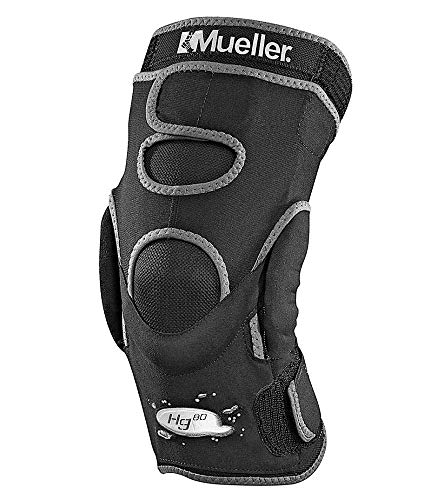
The Mueller Hg80 stands apart because of its triaxial hinge system. Unlike standard bilateral hinges that pivot on one axis, Mueller’s design tracks the knee joint through three points of rotation, producing a more natural gait pattern. This is a critical advantage for MCL recovery, as it prevents the hinge from binding or pinching when you bend your knee during walking or climbing stairs.
The HydraCinn fabric is exceptionally soft against the skin and wicks moisture far better than standard neoprene. Physical therapists have noted that this brace reduces walking pain by such a margin—some report 80% relief—because the combination of targeted compression and hinge tracking offloads the medial ligament effectively. The brace is also surprisingly slim, fitting discretely under looser trousers.
The biggest complaint is sizing: the brace must be slipped over the foot, and users with larger calf muscles often find the XL opening too narrow. Mueller does offer an XXL, but if you are at the upper end of a size bracket, expect a very snug fit. Over long-term daily use, the fabric can stretch and the hinges may loosen, but for a mid-premium brace, its comfort-to-support ratio is unmatched.
Why it’s great
- Triaxial hinges track natural knee motion more accurately than standard hinges
- HydraCinn fabric is breathable, soft, and moisture-wicking
- Provides significant walking pain relief for MCL and meniscus injuries
Good to know
- Pulling it on over the foot is difficult for users with larger calves
- Long-term daily wear may cause the fabric to stretch over two years
3. BioSkin Wraparound Hinged Knee Brace 5133
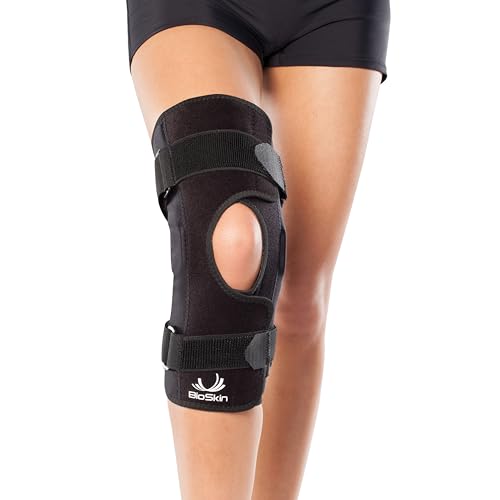
The BioSkin Wraparound solves two persistent problems: getting a brace on during a painful MCL injury, and keeping it from sliding down. The open-back wraparound design lets you position the hinges exactly against your knee’s medial and lateral lines before securing the closure, eliminating the difficult “pull-over-the-foot” struggle. The elastic straps above and below the kneecap are specifically engineered to prevent migration.
Its aircraft-grade aluminum hinges are remarkably lightweight yet rigid enough to resist valgus stress. The fabric is a hypoallergenic nylon/Lycra blend that breathes well and minimizes skin irritation—a frequent problem with neoprene-based braces during long-term use. Many users who were prescribed expensive DonJoy braces from their orthopedic doctor say the BioSkin matches or exceeds that level of stability at a much lower investment.
Some users report that the Velcro contact points on the inner thigh can feel slightly abrasive against bare skin, and the sizing chart runs tight—if your thigh measurement lands near the top of a range, sizing up is recommended. The hinge is non-bulky, making this one of the lowest-profile premium braces on the market, especially valuable for daily wear under clothing.
Why it’s great
- Wraparound design is easy to apply during acute swelling without pulling over the foot
- Lightweight aluminum side hinges offer strong medial-lateral control
- Hypoallergenic, breathable fabric minimizes skin irritation
Good to know
- Sizing chart runs small; order up if you are at the top end of a range
- Inner-thigh Velcro can feel rough against bare skin for some users
4. DonJoy Drytex Sport Hinged Knee Brace
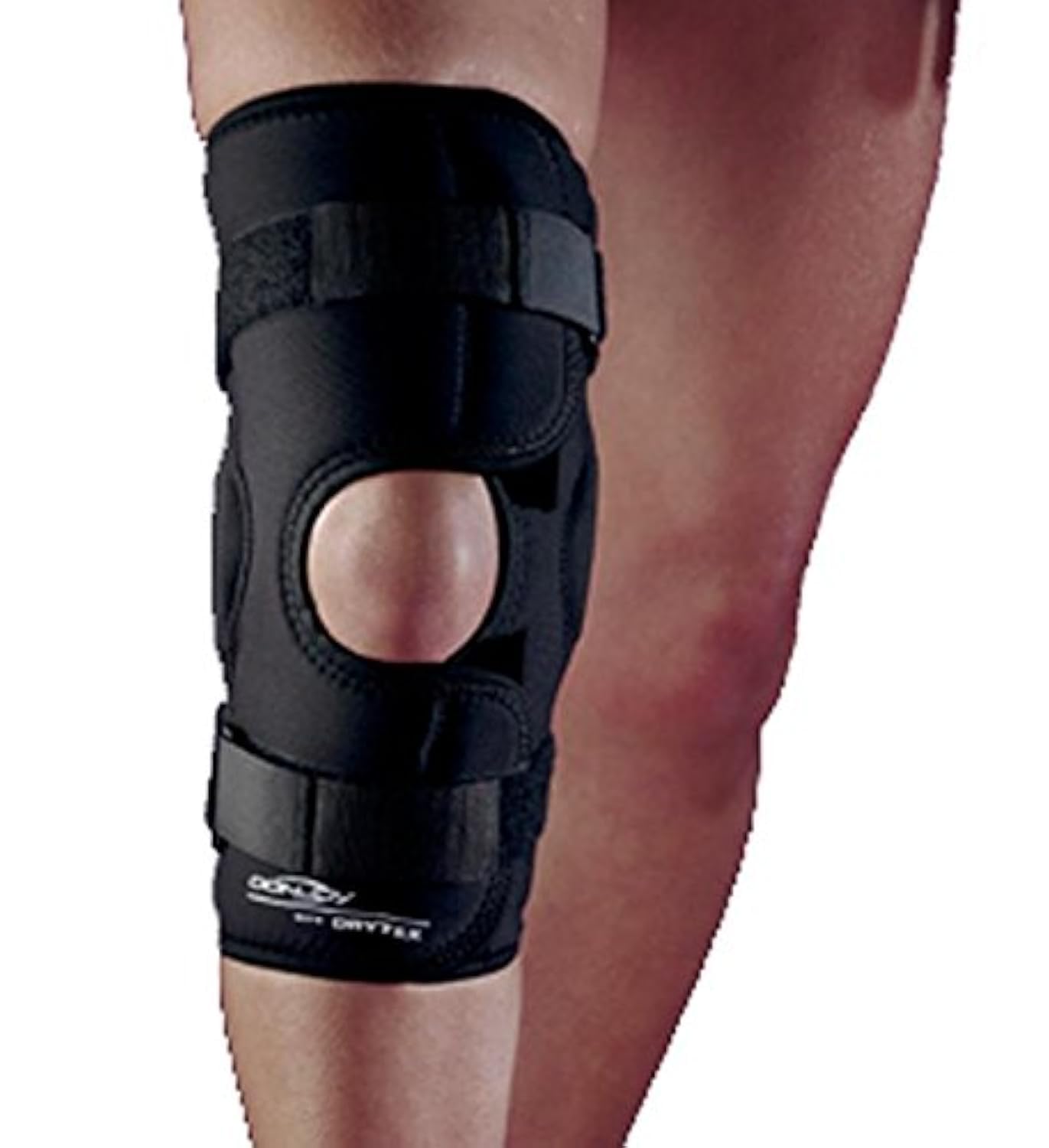
DonJoy is a name frequently recommended by orthopedic surgeons, and the Drytex Sport model distills their clinical expertise into a mid-range option. The six-inch bilateral stays provide a solid wall against medial-lateral movement without the weight of a full-hinge system. The Drytex fabric is a standout feature—it is one of the most breathable, quick-drying materials found on a hinged brace, reducing sweat accumulation during activity.
Users who need a brace for returning to sports after a sprain appreciate how easy it is to slide on and off. The compressive fit supports proprioception, helping your brain sense where your knee is in space, which is vital for early-stage rehab. The brace offers a good balance of stability and flexibility for walking, jogging, and gym work.
A minor but common complaint involves the seam near the popliteal (back of knee) cutout, which can rub on bare skin during deep flexion. Wearing a thin moisture-wicking liner underneath solves this. Also, the sizing is done by measuring the thigh six inches above the kneecap, not the knee itself—skipping this measurement step leads to fit issues.
Why it’s great
- Drytex material is highly breathable and quick-drying for active use
- Six-inch bilateral stays provide reliable medial-lateral support
- Easy to put on and remove, ideal for post-sprain rehab
Good to know
- Seam behind the knee may rub on bare skin during deep bends
- Sizing relies on precise thigh measurement six inches above the kneecap
5. GHORTHOUD Hinged ROM Knee Brace
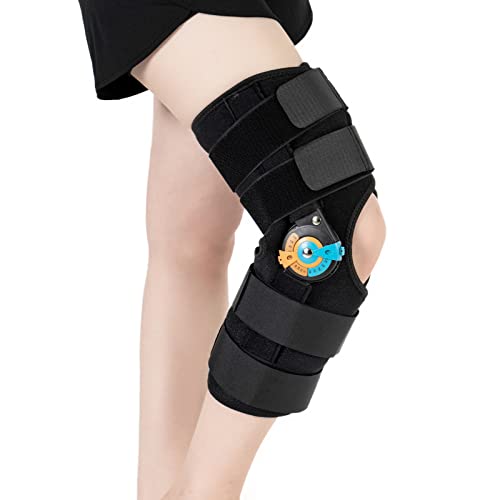
This brace is designed specifically for the graded rehab process. The locking dials allow you to set the range of motion from a fully locked extension (0 degrees) up to 120 degrees of flexion. This is uniquely valuable for MCL injuries treated conservatively—your orthopedic doctor may want to restrict bending beyond 30 degrees in the early weeks, then gradually increase the ROM as the ligament heals. The GHORTHOUD lets you follow that protocol without buying a new brace at each stage.
The hinges are also fully removable. Once the MCL has healed and you are ready to transition to daily activity, you can take the steel stabilizers out, converting the brace into a compression sleeve for lighter support. The open patella design reduces pressure on the kneecap, and the Lycra fabric provides a snug, non-slip fit.
Some users report that the hinges can develop a squeaking noise after a few days of use, which can be fixed with a small application of graphite lubricant. The straps are long, and the Velcro can feel rough if it contacts bare skin directly. Overall, for anyone in active MCL rehab who needs controlled flexion, this is a valuable tool.
Why it’s great
- Adjustable ROM dials allow precise control from 0° to 120° for staged rehab
- Detachable hinges let the brace double as a compression sleeve later
- Open patella design reduces pressure on the kneecap during movement
Good to know
- Hinges may develop a squeak that requires lubrication after a few days
- Velcro contact points can be rough on bare skin without an under-sleeve
6. Galvaran Professional Knee Brace

The Galvaran targets a common comorbidity of MCL injuries: meniscus irritation. It features dedicated EVA pads sewn into the outer meniscus position, which provide localized pressure relief and help reduce swelling alongside the medial-lateral support. The four memory spring stabilizers on each side offer a surprising amount of rigidity for a budget-priced brace, resisting bending on the coronal plane.
The two-way adjustable cross straps give you fine control over the compression level around the joint, and the mesh weave fabric keeps the knee from getting swampy during long wear. Users recovering from combined ACL/MCL and meniscus repairs report that the front wrap design keeps everything aligned without the brace twisting. The open patella design with silicone pads also helps reduce friction over the kneecap.
One sizing issue stands out: some users, particularly women, found the strap length insufficient to wrap fully around a larger thigh, so measuring before purchase is essential. The stabilizers, while springy, do not offer the same mechanical stop as a true polycentric hinge, so this is best suited for low-load activities like walking and everyday wear rather than high-impact sports.
Why it’s great
- Meniscus pads provide targeted relief for concurrent meniscus irritation
- Four memory spring stabilizers offer strong lateral support for the price
- Mesh weave fabric improves breathability and reduces moisture buildup
Good to know
- Strap length may be too short for users with larger thigh circumference
- Spring stabilizers are less rigid than mechanical hinges for high-impact activity
7. McDavid Elastic Compression Knee Sleeve 5116

For a Grade 1 MCL sprain where ligaments are stretched but not fully torn, the McDavid 5116 offers a lightweight alternative to a bulky hinged brace. It uses spring steel stays rather than large hinges, providing targeted lateral support without the weight. The gel buttress pad surrounds the patella to stabilize the kneecap, which can help off-load tension on the medial side during movement.
The four-way stretch elastic material delivers consistent compression without trapping heat, making it comfortable for all-day wear under office clothes or casual pants. Users with mild MCL irritation or arthritis in the same knee find that this sleeve provides enough proprioceptive feedback to prevent the knee from wandering into a vulnerable valgus position during walking and light jogging.
This is not a brace for a Grade 2 or Grade 3 MCL tear. The steel stays offer a gentle guide, not a mechanical block against lateral forces. The top edge of the sleeve can also roll down slightly on some leg shapes, requiring a periodic pull-up. If you need serious, non-negotiable medial protection, you need a heavier brace. But for daily comfort and minor support, this is a top-tier entry-level pick.
Why it’s great
- Spring steel stays provide targeted lateral support without hinge bulk
- Gel buttress pad helps stabilize the patella and reduce medial stress
- Four-way stretch fabric is breathable and comfortable for all-day wear
Good to know
- Not sufficient for Grade 2 or Grade 3 MCL tears requiring rigid support
- Top edge may roll down on some leg shapes during extended use
FAQ
Can I wear a sleeve-style brace for a Grade 2 MCL tear?
How do I stop my MCL brace from sliding down my leg?
Should I sleep with my MCL brace on?
Final Thoughts: The Verdict
For most users, the best brace for mcl injury winner is the Shock Doctor 875 because its polycentric steel hinges provide uncompromising lateral stability for the active rehab phase and beyond. If you value all-day comfort and a more natural gait, grab the Mueller Hg80. And for those in the early, painful stages of recovery who need a brace they can actually put on without agony and that won’t slip, nothing beats the BioSkin Wraparound.

Mo Maruf
I created WellFizz to bridge the gap between vague wellness advice and actionable solutions. My mission is simple: to decode the research and give you practical tools you can actually use.
Beyond the data, I am a passionate traveler. I believe that stepping away from the screen to explore new environments is essential for mental clarity and physical vitality.