Our readers keep the lights on and my smoothie glass nicely filled. As an Amazon Associate, I earn from qualifying purchases.
The wrong brace can interfere with sleep, complicate daily tasks, and slow recovery by allowing micro-movements that disrupt healing.
I’m Mohammad Maruf — the founder and writer behind WellFizz. I’ve spent years analyzing medical support devices, cross-referencing clinical requirements with real-world user reports to separate designs that offer genuine therapeutic value from those that merely look the part.
After evaluating dozens of options across material quality, strap architecture, and user-reported comfort, these seven models represent the most effective choices currently available for anyone searching for the best brace for dislocated shoulder recovery.
How To Choose The Best Brace For Dislocated Shoulder
Shoulder dislocation braces vary widely in strap configuration, abduction angle, and padding density. The wrong choice can lead to neck strain, poor joint alignment, or inadequate immobilization that risks re-injury. Focus on these four factors to find a brace that supports — not complicates — your recovery.
Strap Architecture and Neck Pressure
Traditional slings that loop around the neck concentrate the entire arm’s weight on a single strap, often causing cervical discomfort within hours. Look for braces that use a Y-shaped or figure-eight strap system, or a shoulder ring design, to distribute weight across the torso. Options with a waist belt further offload weight from the shoulder and keep the brace from shifting during movement.
Abduction Angle and Pillow Design
After a dislocation, the humeral head needs to be held in a slight outward position to prevent the joint capsule from being compressed. Braces that include a removable abduction pillow allow you to adjust the angle — typically 15° to 30°. A pillow that is too firm can make sleeping uncomfortable, while one that is too soft fails to maintain the brace’s intended position. Removable or adjustable pillows offer the best balance.
Material Breathability and Skin Contact
Extended wear — sometimes 4 to 6 weeks — means the brace’s fabric directly affects comfort. Cotton and breathable mesh reduce heat buildup and skin irritation, while neoprene blends offer more padding but can trap sweat. Removable, washable covers are a strong advantage for long-term hygiene.
Ease of Adjustment and One-Handed Use
Once the brace is on, adjustments often need to be made with only one functional hand. Braces with wide hook-and-loop panels, pre-routed straps, and buckles that click into place without threading reduce frustration. Models that can be partially donned independently — with a caregiver only needed for final tensioning — are ideal for active recovery phases.
Quick Comparison
On smaller screens, swipe sideways to see the full table.
| Model | Category | Best For | Key Spec | Amazon |
|---|---|---|---|---|
| DonJoy UltraSling PRO | Premium Immobilizer | Optimal neck relief & universal fit | Shoulder ring design, no neck strap | Amazon |
| Velpeau Abduction Sling | Premium Adjustable | Customizable abduction angles & storage | Two removable pillows, 15°-30° angle | Amazon |
| ErgoFoam Shoulder Sling | Premium Athlete | Memory foam comfort & 3-point strap | 100% memory foam abduction pillow | Amazon |
| Cozyhealth Abducted Sling | Mid-Range Versatile | Feature-rich with interior pockets | Aluminum alloy support, removable pillow | Amazon |
| BraceAbility Elbow Immobilizer | Mid-Range Elbow | Elbow immobilization at 90-degree angle | Aluminum stays, foam laminate padding | Amazon |
| Alpha Medical Abducted Immobilizer | Value Abduction | Budget abduction support & exercise ball | 14.39 oz, removable abduction pillow | Amazon |
| WC Shoulder Support Brace | Budget Lightweight | Ultra-light cotton for sleep & desk work | 100% cotton, 5″ wide base strap | Amazon |
In‑Depth Reviews
1. DonJoy Braces UltraSling PRO Shoulder Immobilizer

The DonJoy UltraSling PRO uses a revolutionary shoulder ring design that completely eliminates the neck strap — a critical feature for anyone with a dislocated shoulder who needs to wear a brace for weeks. The ring sits around the good shoulder and routes the support forces across the torso, keeping the cervical spine free from pressure. This is particularly beneficial during sleep and long sitting periods, where traditional slings often cause headaches and referred pain.
The universal size fits both left and right shoulders without requiring measuring. The strap system uses strong hook-and-loop panels and buckles that allow fine-tuned adjustments without tools. Ventilation channels in the padding reduce heat buildup, and the included abduction pillow and therapeutic squeeze ball support phased recovery — from full immobilization to controlled movement as the joint heals.
User reports consistently note that the UltraSling PRO is noticeably more comfortable than hospital-issued slings, especially for larger individuals (up to 275 lbs) who often find braces too short or restrictive. The main drawbacks are the higher cost and a learning curve for one-handed application — some users report needing assistance to achieve the optimal fit on the first try, though once set, the brace stays secure.
Why it’s great
- Shoulder ring design removes all neck pressure
- Universal fit accommodates most body types without sizing
- Included abduction pillow and squeeze ball support phased recovery
- Well-ventilated padding reduces heat discomfort
Good to know
- Higher price point reflects medical-grade engineering
- One-handed application can be tricky; a second person helps initially
- Padding material can feel warm for some users
2. Velpeau Shoulder Abduction Sling
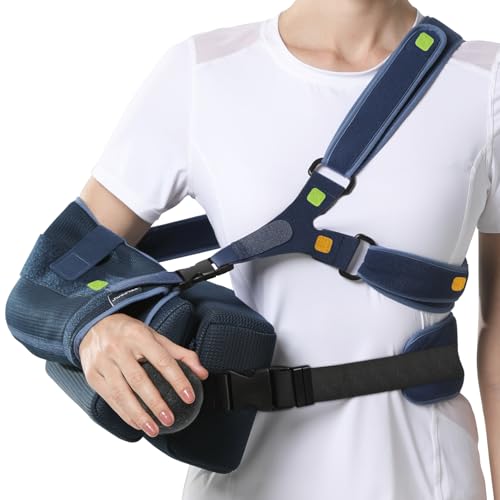
The Velpeau Abduction Sling stands out for its dual-pillow system that allows customizable abduction angles from 15° to 30°. This is a meaningful differentiator for dislocation recovery because the optimal angle varies depending on the nature of the capsular tear and individual anatomy — a one-size-fits-all pillow often over- or under-positions the joint. The included hand sports ball with a support splint stabilizes the wrist and promotes blood circulation while keeping the arm in a fixed abduction position.
The Y-shaped shoulder straps are wide and padded, distributing arm weight across the chest and back rather than the neck. The waist strap accommodates up to 45 inches, and the overall design allows use with or without the pillows — useful during early rehab when the joint needs full support and later when active movement begins. The sling converts between left and right arm by detaching and reinstalling the pillows and ball support in the opposite direction, which adds setup time but ensures a tailored fit for either side.
Users who tried hospital-issued slings or premium brands like Breg and DonJoy consistently rate the Velpeau as more comfortable, especially for sleeping. The breathable mesh panels reduce sweat accumulation, and the interior pocket eliminates the need for a separate bag for small items. The primary complaint concerns the hand ball being stiff for squeezing exercises, but the overall build quality and adjustability make it a compelling premium option.
Why it’s great
- Two pillows offer 15° and 30° abduction options
- Breathable mesh reduces heat and sweat
- Converts between left and right arm use
- Built-in pocket adds daily convenience
Good to know
- Pillow removal and reinstallation for opposite arm requires time
- Hand ball is quite firm, less useful for early rehab squeezing
- Inside material can feel slightly scratchy against bare skin
3. ErgoFoam Shoulder Sling with Abduction Pillow

ErgoFoam brings its orthopedic design expertise — recognized in Forbes and The New York Times — to a shoulder sling built around a 100% memory foam abduction pillow. Unlike cheaper foam that compresses flat after a few hours, the ErgoFoam pillow maintains its shape and firmness, keeping the arm in the prescribed abduction position throughout the night. The 3-point shoulder strap system routes support across the back and under the opposite arm, distributing weight so the injured shoulder isn’t pulling directly on the neck.
The sling is designed for athletes and active individuals who need stability during daily movement. The under-arm component positions the arm slightly forward, which reduces strain on the posterior capsule — a common pain point after a dislocation. The shoulder pad is thick and soft, preventing the soreness that develops after several hours of wear. The entire sling is machine washable, which matters for long recovery periods where hygiene is a concern.
User feedback highlights the elimination of neck pain compared to traditional neck-strap slings, with several users calling it a “game changer” for rotator cuff recovery. The downsides include a firm pillow that some find too hard for sleeping on their side, and the Velcro band that secures the abduction pillow can feel scratchy against the arm if worn without a shirt. The O-ring in the back strap also lacks cushioning, which some users report as uncomfortable in reclining chairs.
Why it’s great
- Memory foam pillow resists compression for consistent abduction
- 3-point strap eliminates neck strain completely
- Machine washable for long-term hygiene
- Trusted by orthopedic practices and professional athletes
Good to know
- Abduction pillow may feel too firm for side sleeping
- Velcro band for pillow can irritate bare skin
- Back O-ring lacks padding, uncomfortable in recliners
4. Cozyhealth Abducted Shoulder Sling Immobilizer

The Cozyhealth immobilizer packs premium features — including an aluminum alloy support frame, a contoured abduction pillow with adjustable angle, and a hand sports ball — into a mid-range price bracket. The aluminum support provides a rigid structure that prevents the arm from rotating outward or moving backward, which is critical after a dislocation where the anterior capsule is often stretched or torn. The abduction pillow sits inside this frame, offering 30° of abduction with a removable foam insert to adjust up to 45°.
The padded shoulder strap uses breathable mesh and sponge filling, reducing pressure on the trapezius. The waist loop prevents the entire brace from shifting upward when the user stands or sits. The two interior pockets are useful for carrying small items without needing a bag, and the design allows the hand, wrist, and elbow to move freely when the arm sling is opened without removing the whole system — a thoughtful feature for early active range-of-motion exercises.
Users coming from hospital-issued slings report that the Cozyhealth feels more comfortable against the ribs and is easier to adjust with one hand. The main critique involves assembly: the straps come long and need to be cut to length and re-attached with Velcro ends. Some users found the sling itself too long for shorter torsos. The hand ball is attached to the aluminum support, which keeps the wrist stable but limits independent ball use for squeezing exercises.
Why it’s great
- Aluminum alloy frame prevents backward rotation of the arm
- Adjustable abduction angle from 30° to 45°
- Pockets provide convenient storage for daily essentials
- Allows hand, wrist, and elbow movement while immobilized
Good to know
- Straps require cutting and re-attaching for proper fit
- Sling length may be excessive for shorter users
- Hand ball is fixed to the support, not free for squeezing
5. BraceAbility Elbow Immobilizer Brace
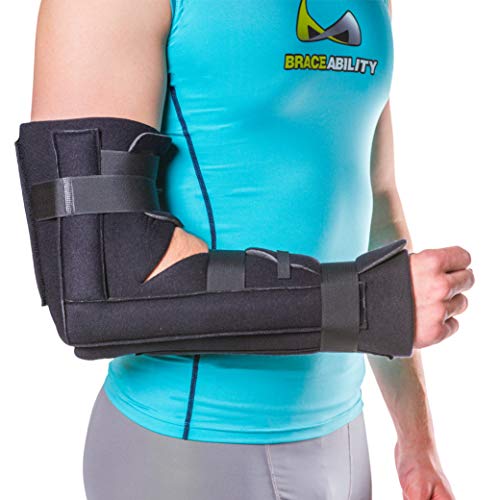
The BraceAbility Elbow Immobilizer serves a specific role — it locks the elbow at a 90-degree angle using aluminum stays embedded in soft foam laminate. While not a dedicated shoulder brace, this is relevant after a dislocation when the elbow must also be stabilized to prevent the arm from rotating and stressing the shoulder joint. The immobilizer is most useful during sleep, when uncontrolled movement can undo the position set during the day.
The brace uses hook-and-loop closures for size adjustment and includes a removable elbow pad for pressure relief. The foam laminate material is soft against the skin, and the aluminum stays are removable for washing. The S/M size accommodates bicep circumferences up to roughly 14 inches, while the L/XL fits larger arms. The design is more compact and portable than full shoulder-immobilizer systems, making it a practical option for desk work or car use where a bulky abduction pillow would be intrusive.
User reviews highlight its effectiveness for elbow immobilization after fractures and bursitis, with comments that it is more comfortable and better-constructed than doctor-prescribed alternatives. The main limitation is that the S/M size may be too large for small-framed women, requiring skillful wrapping to achieve a snug fit. For shoulder-specific dislocation recovery, this brace is best used as a supplementary immobilizer for the elbow rather than a primary shoulder brace.
Why it’s great
- Locked 90-degree position prevents shoulder rotation during sleep
- Removable aluminum stays allow washing
- Compact and portable for travel or desk use
- More comfortable than typical hospital-provided splints
Good to know
- S/M may be too large for petite women, fit is not snug
- Primarily an elbow brace, not a dedicated shoulder immobilizer
- Does not include abduction support or shoulder strap
6. Alpha Medical Abducted Shoulder Immobilizer

The Alpha Medical Abducted Immobilizer offers the core features of a premium abduction sling — removable pillow, rotator cuff support, and an exercise ball — at a significantly lower investment. The pillow positions the arm in abduction to prevent the humerus from slipping out of the joint capsule, and the waist wrap provides lateral stability that keeps the arm from drifting away from the body. The included exercise ball supports grip strengthening during recovery, which is important for restoring full hand and forearm function.
Users report that this sling works well as a replacement for the hospital-provided sling, particularly for post-surgery recovery from rotator cuff repair and shoulder dislocations. The construction is straightforward and easy to put on without help. The pillow is removable, which allows the brace to function as a basic sling during later recovery stages when less abduction is needed. The material is soft but can feel warm against the skin, and the hook-and-loop closures are secure enough for daily wear.
The main compromises are in adjustability and fit. The pillow is fixed at a single abduction angle and cannot be adjusted, which may over-position the shoulder for some users. The sling is relatively bulky and may feel large for smaller-framed individuals, with one user reporting that the pillow was too large and uncomfortable for a 5’2″ frame. The Velcro type used on the strap can snag hair and may feel scratchy against bare skin. These limitations are acceptable given the price point but worth noting for users who need precise abduction control.
Why it’s great
- Affordable entry into abduction-style immobilization
- Removable pillow allows transition to basic sling
- Waist wrap prevents arm drift and adds stability
- Works for both left and right arm
Good to know
- Pillow angle is fixed, not adjustable
- Velcro can snag hair and irritate skin
- Sling may be bulky for smaller body frames
7. WC Shoulder Support Brace Arm Sling
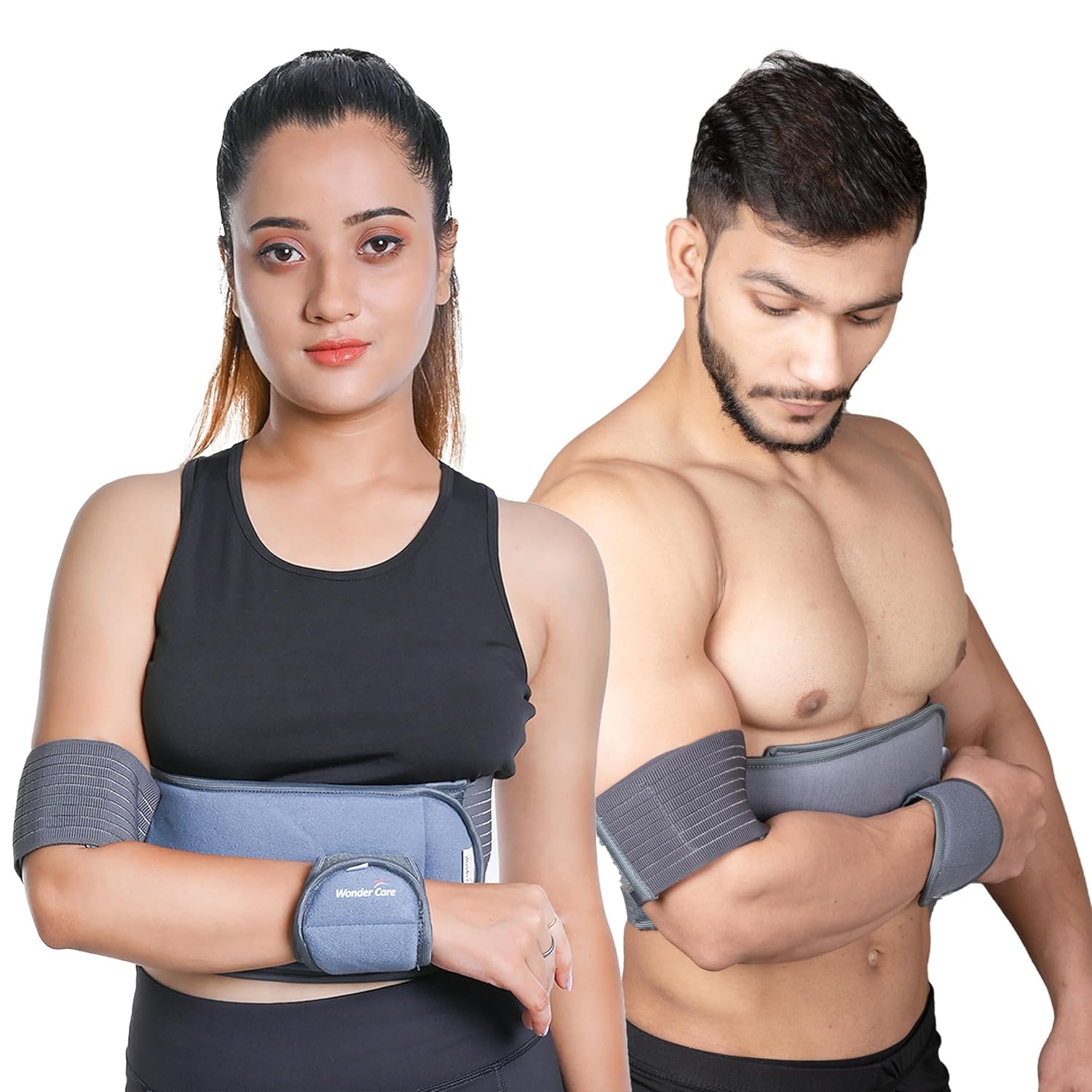
The WC Shoulder Support Brace strips immobilization down to its essentials — a cotton band that wraps the biceps and forearm, holding the arm across the chest without any strap crossing the neck. This design directly addresses the most common complaint with traditional slings by eliminating neck pressure entirely. The 5-inch wide base band distributes support across the upper arm and chest, preventing the brace from digging in during extended wear at a desk or during sleep.
The brace is constructed from 100% cotton, which is breathable and washable — important for users who need to wear it for weeks. The hook-and-loop closure at the front allows one-handed adjustment, and the wrist loop can be slipped out to free the hand for typing or eating while the elbow loop keeps the upper arm fixed at the side. The design is suitable for both left and right arms, and the sizing runs from extra-small to extra-large, with a size chart based on chest circumference.
User reports are largely positive, with specific praise for the comfort during sleep and the ability to maintain shoulder stability during daily activities. The primary issue is that the arm band may be too small for individuals with larger biceps — one user with 17-inch arms reported the band cuts circulation even at maximum extension. The hook-and-loop system, while simple, may not provide enough tension for users who need firm immobilization after a complete dislocation. This brace works best for minor subluxations, post-reduction comfort, or as a supplement to a primary immobilizer.
Why it’s great
- Cotton fabric is breathable and comfortable for sleep
- No neck strap eliminates cervical strain
- Freeing the hand from the wrist loop is quick for daily tasks
- Washable for long-term hygiene
Good to know
- Arm band may be too tight for large biceps over 17 inches
- Hook-and-loop closure may lack tension for full immobilization
- Not suitable for severe dislocations needing rigid abduction
FAQ
How long should I wear a brace after a shoulder dislocation?
Can I sleep with an abduction pillow in my brace?
What is the difference between a sling and an immobilizer for a dislocated shoulder?
Do I need a brace that fits both left and right arms?
Final Thoughts: The Verdict
For most users, the best brace for dislocated shoulder winner is the DonJoy UltraSling PRO because its shoulder ring design completely eliminates neck pressure while providing secure, adjustable immobilization for virtually any body type. If you want the ability to customize your abduction angle and need built-in storage for daily essentials, grab the Velpeau Abduction Sling. And for athletes and active individuals who prioritize memory foam comfort and a 3-point strap system, nothing beats the ErgoFoam Shoulder Sling.

Mo Maruf
I created WellFizz to bridge the gap between vague wellness advice and actionable solutions. My mission is simple: to decode the research and give you practical tools you can actually use.
Beyond the data, I am a passionate traveler. I believe that stepping away from the screen to explore new environments is essential for mental clarity and physical vitality.