Our readers keep the lights on and my smoothie glass nicely filled. As an Amazon Associate, I earn from qualifying purchases.
That moment when your home monitor screams a high reading, you panic, and the doctor’s office confirms you’re fine—that’s a bad BP cuff. An inaccurate device doesn’t just waste time; it causes unnecessary stress and can mask real health trends. The right cuff delivers repeatable, clinically valid numbers so you can manage your health with confidence, not guesswork.
I’m Mohammad Maruf — the founder and writer behind WellFizz. I’ve spent years evaluating home health monitors, parsing clinical validation studies, and mapping oscillometric sensor accuracy against user-reported consistency to separate real quality from marketing noise.
Whether you need a model with Bluetooth tracking for your doctor, a multi-user family hub that stores hundreds of readings, or a simple reliable monitor for daily checks, the best bp cuff combines validated accuracy with a comfortable arm fit and memory that suits your lifestyle.
How To Choose The Best BP Cuff
A home blood pressure monitor is a long-term health tool, not a one-time purchase. The wrong cuff can give you readings that are off by 10-15 mmHg, leading to false alarms or missed warnings. Here are the three factors that matter most.
Arm Circumference & Cuff Fit
This is the single biggest source of user error. A cuff that is too small will read artificially high, and one that is too large will read low. Standard cuffs typically fit 9 to 17 inches, but you need to measure your bare upper arm mid-bicep. If you fall outside that range, look for a model that includes multiple cuffs or an XL option.
Memory Capacity & Multi-User Support
Tracking trends over weeks is more valuable than a single reading. A monitor that stores 60 to 90 readings lets you spot patterns without manual logging. If two people in the household need monitoring, look for dedicated multi-user memory that separates each person’s data by user ID rather than jumbling them together.
Clinical Validation & Connectivity
Not all monitors are created equal. Look for devices that have been independently tested against protocols like ESH, AAMI, or BHS. Bluetooth connectivity is convenient for sharing reports with your doctor, but it should never replace core accuracy. Some apps require subscriptions for PDF exports—check that before committing to a connected model.
Quick Comparison
On smaller screens, swipe sideways to see the full table.
| Model | Category | Best For | Key Spec | Amazon |
|---|---|---|---|---|
| OMRON Gold | Premium | AFib Detection & App Sync | AFib Detection, Bluetooth, 9″-17″ Cuff | Amazon |
| AQESO 3-Cuff Kit | Premium | Family Use with Multiple Arm Sizes | 3 Cuffs (7″-21″), 1500 MEM, 3 User | Amazon |
| Acenis Large Screen | Mid-Range | Seniors & Easy Visibility | Large Color Screen, XL Cuff | Amazon |
| Microlife BPM2 | Mid-Range | Long-Term Reliability | 60 MEM, AA Rated, 8.7″-16.5″ Cuff | Amazon |
| iHealth Track | Mid-Range | Smartphone Logging | Bluetooth, 99 MEM, 8.7″-16.5″ Cuff | Amazon |
| Braun ExactFit 2 | Mid-Range | Gentle Inflation Comfort | Color-Coded, 30 MEM, 8.6″-16.5″ Cuff | Amazon |
| Medline MDS4001 | Budget | Simple No-Fuss Monitoring | 90 MEM, 8.5″-12″ Cuff | Amazon |
In‑Depth Reviews
1. OMRON Gold Blood Pressure Monitor
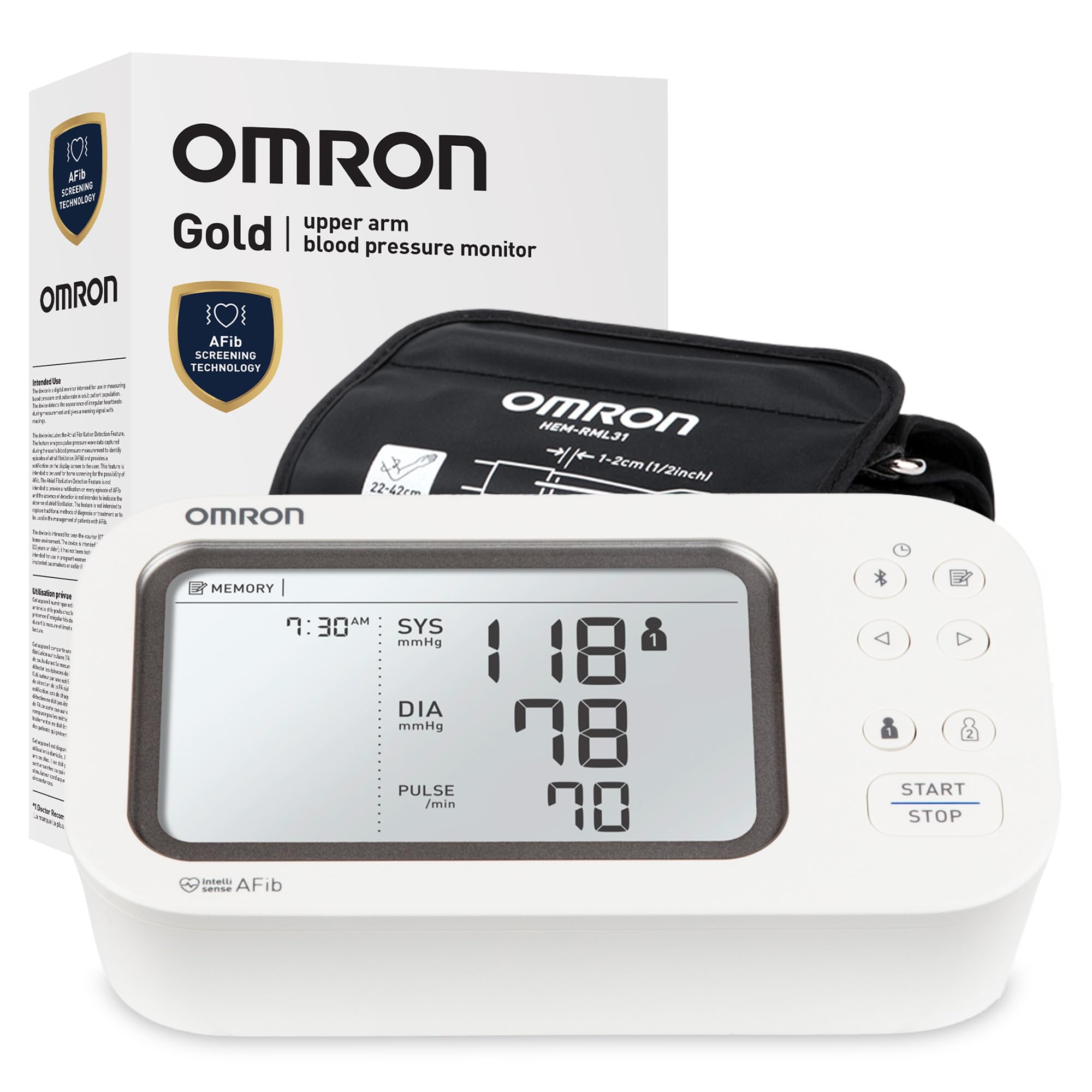
The OMRON Gold is the most advanced upper arm monitor in this lineup, and it earns its premium position with exclusive Atrial Fibrillation (AFib) screening during every reading. This isn’t a generic feature—OMRON’s algorithm detects irregular heart rhythms that can signal stroke risk, making this unit a genuine medical-grade tool for at-home use. The wide-range D-ring cuff accommodates arms from 9 to 17 inches, and the Bluetooth pairing with the OMRON connect app unlocks unlimited storage and trend reports you can share directly with your physician.
The morning average indicator is a standout for anyone at cardiovascular risk. It automatically flags systolic spikes that commonly occur after waking, a pattern many standard monitors ignore. The unit reads systolic, diastolic, and pulse simultaneously, and the app tracks two separate users independently. Keep in mind that the app requires a subscription for PDF report exports—a /month fee that adds up over years—so plan your logging strategy accordingly.
A small subset of users with existing AFib have reported the device refuses to take a reading, displaying an error instead of a number. This is a safety feature, not a flaw: the algorithm cannot guarantee accuracy during arrhythmia. For the vast majority of users without diagnosed rhythm disorders, this is the most trustworthy monitor on the list. The build quality, strap storage case, and four included AA batteries round out a polished package that justifies its status.
Why it’s great
- Clinically validated AFib detection for advanced heart screening
- Bluetooth sync with unlimited trend tracking and doctor reports
- Morning average indicator catches dangerous early spikes
Good to know
- App requires a subscription for PDF export
- Will not read for users with diagnosed AFib (safety lockout)
2. AQESO Blood Pressure Machine with 3 Cuff Sizes

The AQESO solves the single biggest accuracy problem in home BP monitoring: wrong cuff size. By including three separate cuffs—Small (7-9 inches), Medium/Large (9-17 inches), and XL (13-21 inches)—this monitor accommodates everyone from petite adults to larger arms that standard cuffs pinch. The oscillometric sensor delivers readings in under 30 seconds, and the large backlit LCD makes results legible even in dim light or for users with reduced vision.
Memory capacity is extraordinary for the price tier. The unit stores 500 readings per user across three separate user profiles, totaling 1,500 measurements. That means a family of three can track months of daily data without any overwrites. The WHO classification bar color-codes each result as green, yellow, or red, giving immediate context without needing to memorize normal ranges.
A notable design trade-off is the power system. The unit runs on four AAA batteries or a USB-C cable, but it is not rechargeable—using USB-C requires a continuous wall connection, and disconnecting the power resets the date, time, and all stored readings. This makes it less ideal for travel unless you keep batteries in place. For dedicated home use where the device stays plugged in, the AQESO is unmatched for multi-user households.
Why it’s great
- Three cuff sizes ensure accurate fit for arms 7 to 21 inches
- Massive 1,500-reading memory across three users
- Large backlit display with WHO color-coded results
Good to know
- Disconnecting power erases all stored data and time settings
- USB-C requires continuous cable connection (not rechargeable)
3. Acenis Automatic Blood Pressure Monitor
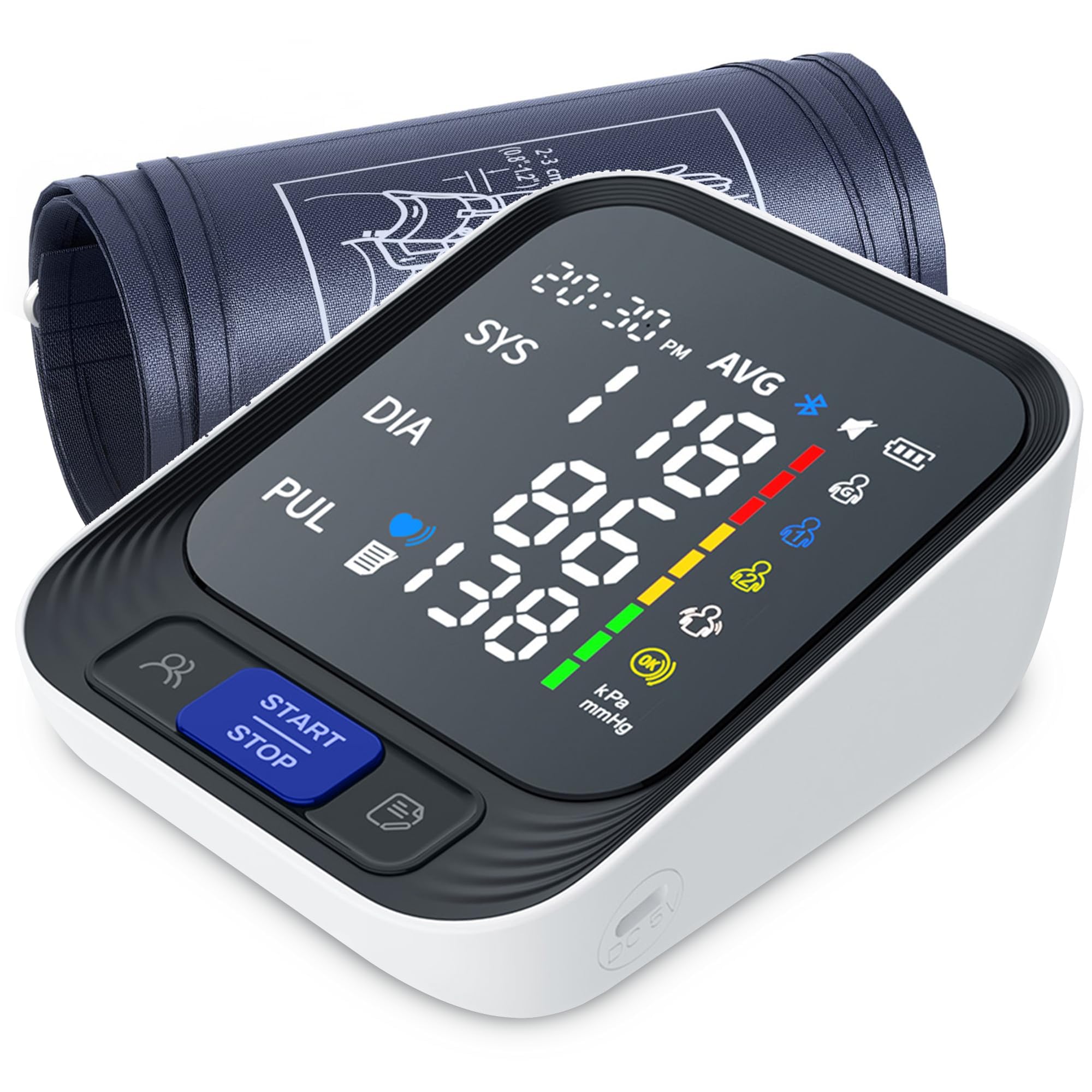
Acenis built this monitor specifically for users who struggle with small text and complicated menus. The large color screen is genuinely oversized, with numbers that remain crisp from several feet away, and the one-touch operation means you press a single button to start a reading cycle that finishes in roughly 40 seconds. The large adjustable cuff fits a wide range of upper arm sizes comfortably, and the device includes a dedicated power cord in the box for users who prefer not to rely on batteries.
The dual-user memory is straightforward: each user gets their own storage bank, and the machine automatically identifies which profile is active based on the selection at startup. Accuracy is consistent with clinical expectations for this price bracket, and the unit has a solid feel without being overly heavy. The 1.1-pound weight makes it easy to move from bedside to living room without strain.
The instruction manual is clear for basic operation, but setting the date and time uses a slightly unintuitive sequence that some users find confusing. If you don’t set the correct date initially, the timestamp on stored readings will be off—a minor annoyance if you rely on memory timestamps for doctor visits. Overall, the Acenis is a premium-feeling mid-range device that prioritizes legibility and ease of use above all else.
Why it’s great
- Extra-large color screen ideal for low vision or seniors
- One-touch operation with fast 40-second measurement cycle
- Includes AC power cord plus batteries for flexible use
Good to know
- Date/time setup is confusing for some users
- No Bluetooth or app connectivity for data sharing
4. Microlife BPM2 Automatic Digital Monitor
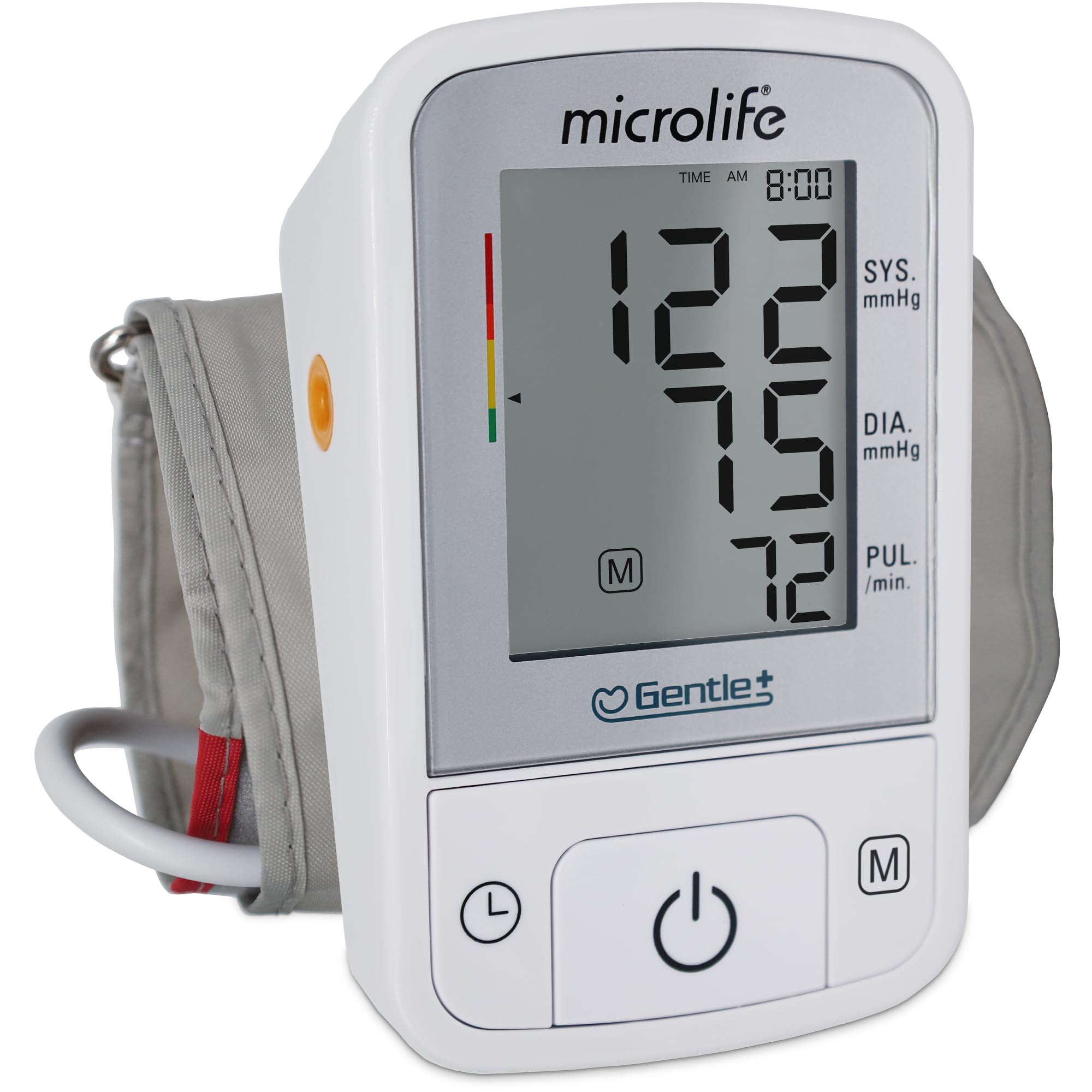
The Microlife BPM2 has been on the market since 2015, and in the world of consumer medical devices, longevity equals reliability. This monitor earned the highest possible rating (AA) from the British Hypertension Society, meaning its accuracy against a mercury sphygmomanometer is clinically proven. The wide-range contoured cuff fits 8.7 to 16.5 inches and uses Gentle+ Technology, which inflates to a lower initial pressure and adds increments only as needed—a much more comfortable experience than cuffs that blast to 180 mmHg every time.
Storage holds 60 readings, and the average calculation across all stored memories gives a useful snapshot without manual math. The irregular heartbeat detector and hypertension risk indicator add clinical depth without complicating the interface. The unit comes with a storage bag, four AA batteries, and a bilingual manual, and it is compatible with a separately sold AC adapter if you want to skip battery changes.
The one drawback is that the monitor uses an older-generation algorithm that produces slightly slower measurement cycles than newer competitors. A full reading takes about 35 to 45 seconds versus the 25 to 30 seconds of newer models. This is negligible for most users but worth noting if you take multiple readings back-to-back. For sheer durability and proven clinical accuracy, the BPM2 is a workhorse.
Why it’s great
- Highest BHS AA rating for clinical accuracy
- Gentle+ inflation is quieter and more comfortable
- Proven durability with a decade of consistent user reviews
Good to know
- Measurement cycle is slightly slower than newer models
- No Bluetooth or app connectivity
5. iHealth Track Smart Upper Arm Monitor
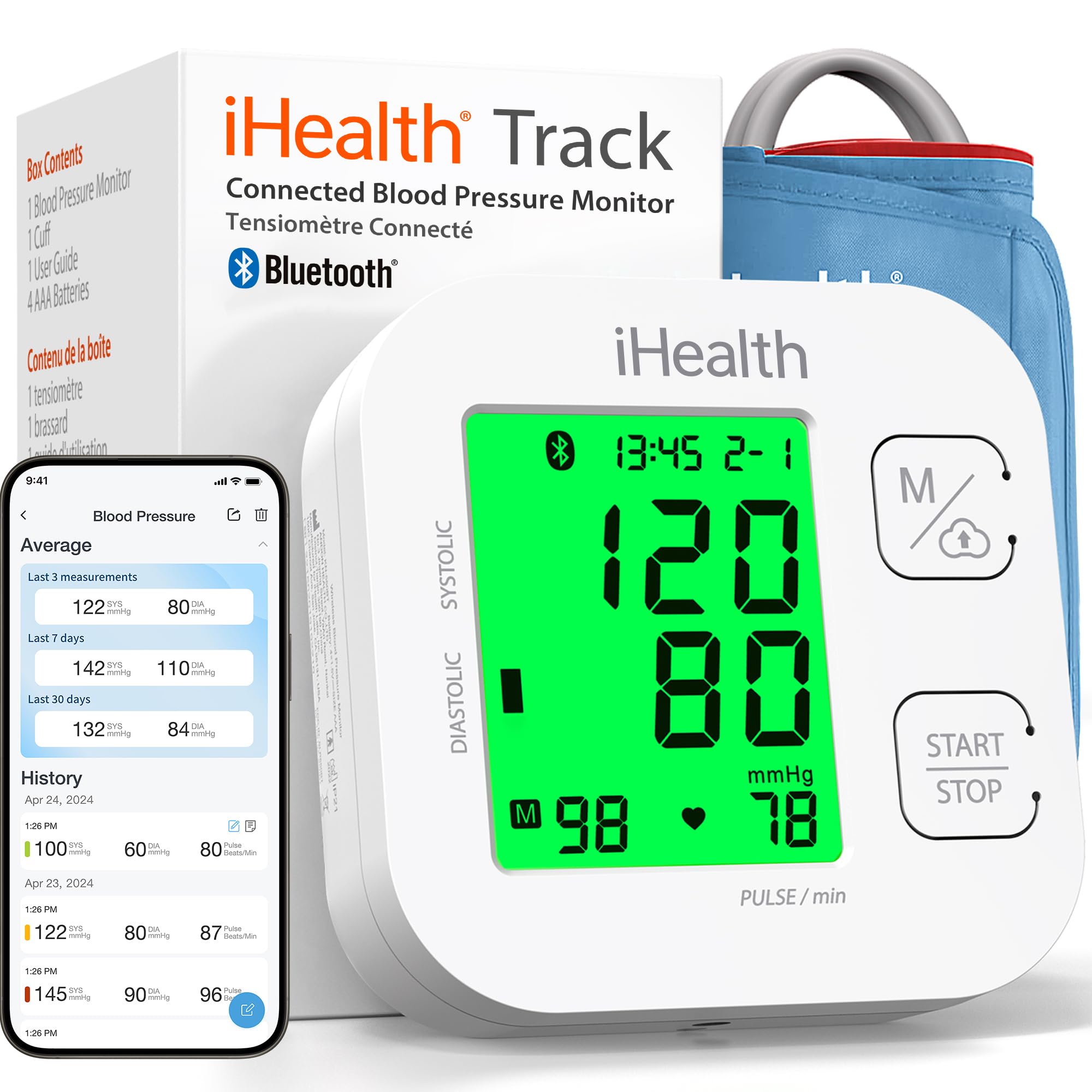
The iHealth Track is the smartest monitor in the mid-range group, pairing Bluetooth 4.0 connectivity with a free companion app that logs unlimited readings on your smartphone. The large multi-color backlit display uses green, yellow, and red indicators to instantly classify your systolic and diastolic values, and the unit automatically detects heart rhythm disturbances, displaying a warning symbol if it finds irregularities. The wide-range cuff fits 8.7 to 16.5 inches, covering standard to large adult arms without needing a separate purchase.
On-device memory stores 99 readings, but the real value is in the app, where you can track trends over months and export data for your doctor. The app works with both iOS and Android and integrates with Apple Health and Google Fit. The unit itself is lightweight at 15.45 ounces and runs on four AAA batteries that are included in the box. The initial setup is straightforward, and the two-button interface is intuitive enough for daily use.
The primary frustration is the app’s ad experience. The free version includes persistent, intrusive ads that can interfere with the logging workflow. Many users end up using the monitor for readings and manually recording results rather than engaging with the app. Additionally, some units have shown reliability issues after roughly three years of use, with Bluetooth connectivity failing or the monitor ceasing to power on. For the price, it’s a solid smart monitor as long as you set your app expectations accordingly.
Why it’s great
- Bluetooth sync with free app for unlimited reading history
- Color-coded display and heart rhythm disturbance detection
- Lightweight and comfortable wide-range cuff
Good to know
- App contains intrusive ads during use
- Some units experience connectivity failure after 2-3 years
6. Braun ExactFit 2 Blood Pressure Monitor
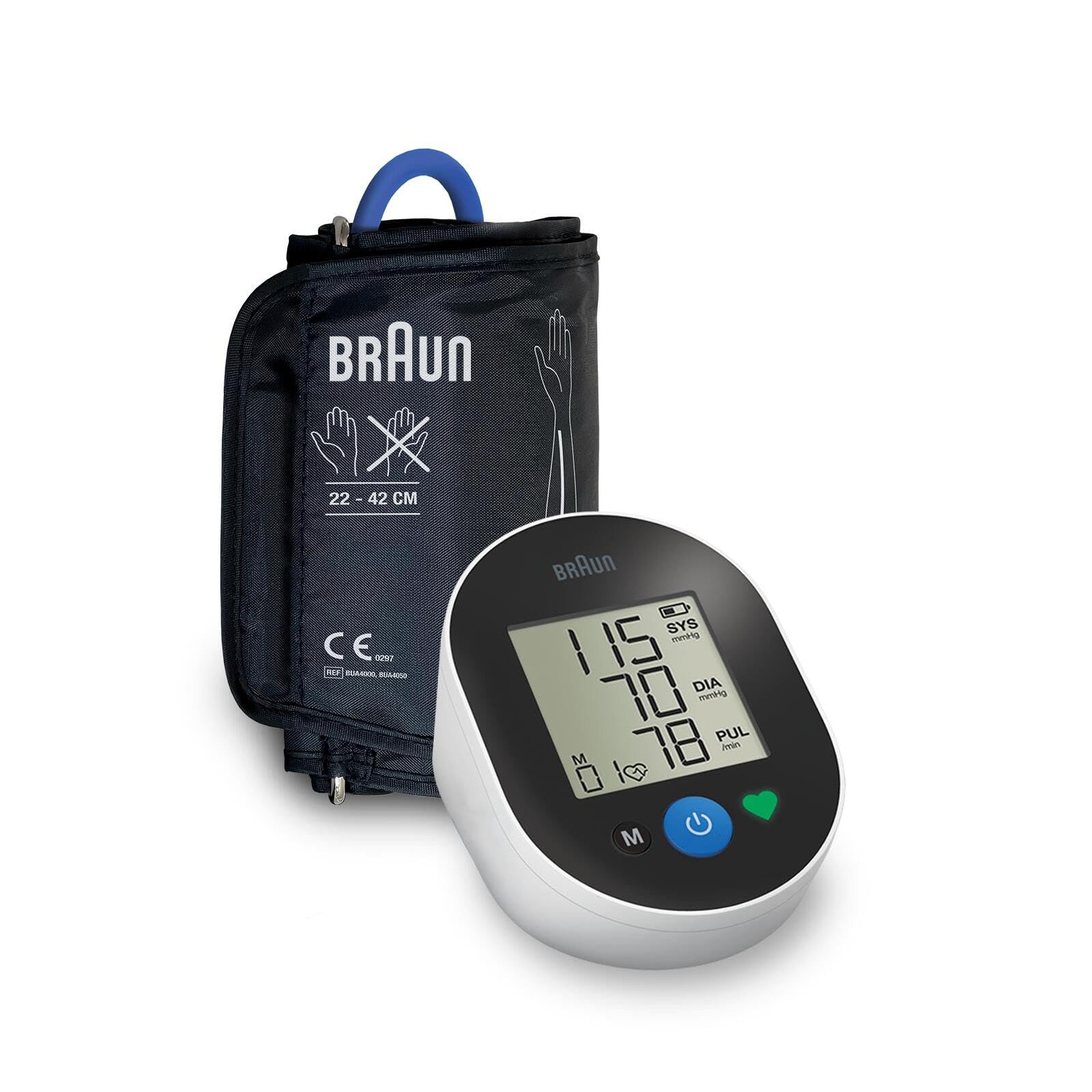
Braun’s ExactFit 2 rethinks the inflation process. Instead of tightening to a preset level and then releasing, it takes readings as the cuff inflates and stops the moment it has enough data. This means the cuff never over-tightens, making it the most comfortable monitor on this list for users who find the squeezing sensation unpleasant or painful. The universal cuff fits arms from 8.6 to 16.5 inches, and the color-coded display instantly categorizes results with a simple traffic-light indicator.
The 30-reading memory is on the lower side compared to competitors that store 60 or 90 readings, but for a single user tracking weekly trends, it’s sufficient. The device uses four AA batteries that are included, and the product dimensions are compact enough for easy travel storage. Braun leverages its experience from hospital-grade devices, and the clinical validation follows internationally recognized protocols.
A minority of users report difficulty getting consistent readings, often due to improper cuff placement. The instructions emphasize positioning the cuff at heart level with the artery marker aligned over the brachial artery, and skipping this step leads to unreliable data. This monitor is best for someone who will follow the positioning guidance closely. For users with significant arm circumference variation, the tighter range may also feel restrictive compared to wider cuffs on other models.
Why it’s great
- Inflation-sensing technology stops cuff tightening early for comfort
- Clinically validated accuracy with color-coded result display
- Compact and portable with included AA batteries
Good to know
- 30-reading memory is limited compared to mid-range peers
- Proper cuff placement is critical for consistent readings
7. Medline Digital Blood Pressure Monitor

The Medline MDS4001 is a no-nonsense entry-level monitor that focuses on the essentials: accurate readings, large digital display, and simple one-button operation. What sets it apart from bargain-bin cuffs is the proprietary programming that automatically customizes inflation levels for each individual user. Rather than using a one-size-fits-all inflation algorithm, the Medline senses the optimal pressure for your specific arm and adjusts accordingly, reducing over-inflation discomfort.
The memory capacity of 90 readings is generous for a budget-tier device, making it easy to track two weeks of three-times-daily measurements without filling the storage. The adult upper arm cuff fits arms with a circumference of 8.5 to 12 inches, which is narrower than most competitors. This is the critical limitation: users with larger arms will find the cuff too snug, leading to falsely elevated readings. Measure your arm before buying.
The LCD display is large and easy to read, showing systolic, diastolic, and pulse simultaneously. The unit comes with four AA batteries included, and the device is lightweight enough to toss in a bag. The main compromise is build quality—the plastic housing feels less substantial than mid-range or premium models, and the battery compartment door can feel flimsy over time. For someone with smaller arms who needs a dependable budget option, the Medline delivers consistent results without complication.
Why it’s great
- Custom inflation algorithm adjusts to each user for comfort
- 90-reading memory is well above average for budget tier
- Simple one-button operation and large clear display
Good to know
- Cuff fits only 8.5 to 12 inches—not suitable for larger arms
- Plastic housing feels less durable than premium options
FAQ
How do I know if the cuff size is right for my arm?
Can I use a BP cuff on my wrist instead of my upper arm?
How many readings should I take per session for a reliable average?
Final Thoughts: The Verdict
For most users, the best bp cuff winner is the OMRON Gold because it combines AFib detection, Bluetooth trend tracking, and the most trusted brand name in home blood pressure monitoring. If you want a family hub that fits everyone from a slim adult to a large arm, grab the AQESO 3-Cuff Kit. And for a simple, reliable daily monitor with the highest clinical accuracy rating, nothing beats the Microlife BPM2.

Mo Maruf
I created WellFizz to bridge the gap between vague wellness advice and actionable solutions. My mission is simple: to decode the research and give you practical tools you can actually use.
Beyond the data, I am a passionate traveler. I believe that stepping away from the screen to explore new environments is essential for mental clarity and physical vitality.