Our readers keep the lights on and my smoothie glass nicely filled. As an Amazon Associate, I earn from qualifying purchases.
A newborn’s first feeding is a moment of trust, and the wrong bottle can turn it into a battle against gas, leaks, and latch frustration. The central tension for new parents isn’t just about finding a nipple shape—it’s about managing the delicate balance between flow rate and air intake that determines whether your baby drinks calmly or fights each swallow. This guide dissects the specific vent systems, nipple materials, and flow dynamics that separate a peaceful feeding from a colicky one.
I’m Mohammad Maruf — the founder and writer behind WellFizz. Across years of analyzing feeding hardware for infants, I have studied the engineering behind anti-colic vents, nipple durometers, and glass borosilicate ratings to help parents make an informed choice rather than a hopeful guess.
From the top-tier anti-colic specialists to budget-friendly glass options, I have carefully evaluated the real-world performance of the five leading contenders to deliver your definitive resource for choosing the absolute best bottles for newborns.
How To Choose The Best Bottles For Newborns
The wrong bottle creates more than just mess—it can cause your baby to swallow air, leading to painful gas, extended fussiness, and even a refusal to feed. When you’re already sleep-deprived and worried, the last thing you need is a bottle that leaks from the collar or a nipple that drowns your newborn with milk. You need to understand four specific technical features before any purchase.
Anti-Colic Vent Systems: The Air-Break Mechanism
The internal vent system is the single most important differentiator. Bottles like Dr. Brown’s use a full vent tube that extends to the bottom of the bottle, allowing air to bypass the milk and enter the baby’s mouth separately. This reduces the vacuum that causes colic. Smilo uses a patented disc-based system that accomplishes similar results with fewer parts. If your baby is prone to gas or reflux, prioritize bottles with a dedicated air-vent pathway over simple top-venting designs.
Nipple Flow Rate and Material Hardness
“Slow flow” is not a regulated term—some brands deliver a much slower trickle than others. For a newborn, especially a breastfed one, you want a nipple that resists collapse and allows the baby to pause without milk flowing continuously. Look for nipples made from LSR (Liquid Silicone Rubber), which offers a more natural feel than standard silicone. The Shore durometer (hardness) also matters: softer nipples (around 30-40 Shore A) allow better latching for premature or weak-sucking babies.
Material: Borosilicate Glass vs. BPA-Free Plastic
Glass bottles like the Gulicola models are made from borosilicate glass, which resists thermal shock—meaning you can pour boiling water directly into a cold bottle without cracking it. However, they are heavier and can break if dropped from a high chair. BPA-free plastic, like the polypropylene used in Dr. Brown’s and Smilo bottles, is lighter and shatter-resistant but may develop micro-scratches over time that harbor bacteria. Many experts start with plastic for portability and graduate to glass for home use.
Quick Comparison
On smaller screens, swipe sideways to see the full table.
| Model | Category | Best For | Key Spec | Amazon |
|---|---|---|---|---|
| Dr. Brown’s Options+ 4oz (4-Pack) | Premium Plastic | Severe colic relief | Clinically proven vent system | Amazon |
| Philips Avent Natural 4oz (2-Pack) | Mid-Range Plastic | Breastfeeding transition | Natural Response nipple (Flow 2) | Amazon |
| Smilo Bottle Set 5oz (3-Pack) | Mid-Range Plastic | Gentle anti-colic on a budget | Patented disc vent system | Amazon |
| Gulicola Small Glass 3oz (2-Pack) | Premium Glass | Premature & preemie babies | Extra slow flow nipple (0m+) | Amazon |
| Gulicola Natural Glass 5oz (2-Pack) | Premium Glass | Breastfeeding moms using glass | Borosilicate glass & slow flow nipple | Amazon |
In‑Depth Reviews
1. Dr. Brown’s Natural Flow Anti-Colic Options+ 4oz (4-Pack)
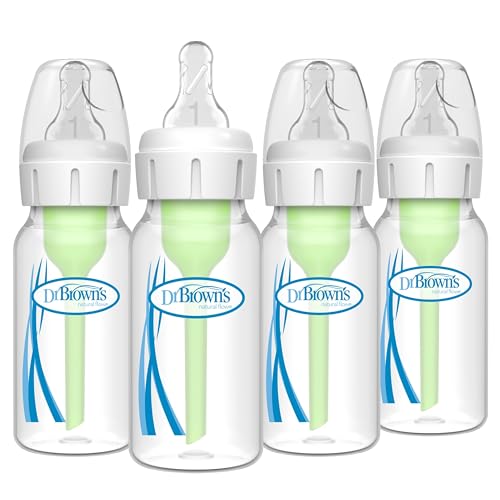
Dr. Brown’s has built a clinical reputation around its internal vent system that works like a straw—it channels air from outside the bottle down to the base, completely bypassing the milk. The result is vacuum-free feeding that drastically reduces the air your baby swallows. The 4oz size with Level 1 slow flow nipples is ideal for the first months of life, and the Options+ design means you can remove the vent system later as your baby’s feeding matures without buying new bottles.
Real-world feedback confirms the vent system works: parents report noticeably less gas and fewer spit-ups compared to standard bottles. The narrow neck is easy for small hands to hold, and the silicone nipple maintains a consistent flow rate even when the bottle is tilted. However, the trade-off is the cleaning burden—you have to wash the vent tube and collar separately, which adds about a minute per bottle. Many parents invest in a dishwasher basket to manage the parts.
The plastic is durable BPA-free polypropylene, and the bottles are lightweight enough to pack for daycare. The ounce and milliliter markings are molded clearly into the side for easy reading. A common caution: do not fill the bottle above the indicated maximum line, or the vent system may leak milk from the cap area during feeding. When assembled correctly, this bottle is arguably the most effective colic-fighting tool on this list.
Why it’s great
- Clinically proven vent system reduces colic and gas
- Vacuum-free feeding preserves milk nutrients
- Options+ design allows vent removal as baby develops
Good to know
- Multiple parts requires more cleaning time
- Can leak if filled above the maximum line
- Vent tube may warp with repeated sterilizing
2. Philips Avent Natural Baby Bottles 4oz (2-Pack)

The defining feature of the Philips Avent Natural bottle is the Natural Response nipple—a wide, breast-shaped silicone tip with a unique opening that only releases milk when your baby actively drinks. This “responsive” design means that when your baby pauses to swallow or breathe, the milk flow stops. That mimics breast behavior better than any other plastic bottle here, making it exceptional for combination feeding without nipple confusion.
Parents consistently report zero leaking, which is rare among anti-colic bottles. The absence of a complex vent tube or disc also simplifies cleaning—you have just a bottle, collar, and nipple. The anti-colic valve is integrated into the nipple itself, keeping air away from the tummy without extra parts. The 4oz size with the included Flow 2 nipple is slow enough for most newborns, though some very premature babies may need an even slower Flow 1 nipple sold separately.
The wide neck makes pouring breastmilk easy, and the clear polypropylene body lets you see the milk level at a glance. This bottle won the “Best of The Bump” award for a reason—it delivers the most frustration-free experience for parents who switch back and forth between breastfeeding and bottle feeding. However, if your baby already has severe colic, you may find the Avent’s nipple-integrated vent less aggressive than a dedicated tube system.
Why it’s great
- Natural Response nipple mimics breastfeeding flow
- Zero leaks even when shaken or stored sideways
- Very few parts for easy cleaning
Good to know
- Flow 2 may be too fast for some preemie newborns
- No separate vent tube for maximum colic relief
3. Smilo Baby Bottle Set 5oz (3-Pack)
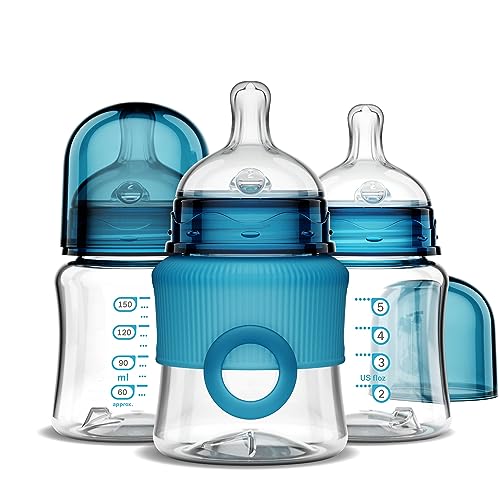
Smilo takes a different approach to colic reduction—rather than a tube, it uses a patented disc vent system positioned at the base of the nipple. This disc creates a one-way air channel that lets air into the bottle without letting milk leak out, which dramatically reduces gassiness. The 5oz size with a Stage 0 slow flow nipple is calibrated specifically for 0-3 month old newborns, delivering a gentle trickle that mimics natural breastfeeding rhythm.
The 3-pack is a smart value proposition: you get three bottles for roughly the same price as two Philips Avent or two Gulicola glass bottles. The polypropylene is BPA-free and the bottles are noticeably skinnier than the Como Tomo style, making them easier for small hands to grip. Parents note that the Stage 0 nipples are slightly firmer than Dr. Brown’s silicone, which can be a pro for babies who are already proficient at sucking but may be a con for preemies.
One limitation is that the lid can be stiff to open and close initially, and the thinner plastic heats up quickly in warm water—a positive for temperature control but something to watch for if you use a bottle warmer. The bottle also collects some water in the nipple collar when drying upright. Overall, Smilo offers one of the most affordable anti-colic solutions without major compromises in performance, though replacement nipples are sold separately for higher flow stages.
Why it’s great
- Patented disc vent system effectively reduces colic
- Great value with 3 bottles in one pack
- Stage 0 nipple is perfect for 0-3 months
Good to know
- Nipples are firmer than some competitors
- Lid can be stiff to open until worn in
- Thinner plastic heats quickly but is durable
4. Gulicola Small Glass Baby Bottle 3oz (2-Pack)

When you need the absolute slowest flow available for a preemie or a newborn with a weak suck, the Gulicola Small Glass 3oz bottles deliver with their extra slow flow (SS) nipple. The 3oz capacity is perfect for the tiny feedings required in the first weeks—typically 1-2 ounces per feed. The borosilicate glass construction means no plastic leaching concerns, and it survives rapid temperature changes without cracking, a critical safety feature when sterilizing multiple times daily.
The nipple design includes guiding points that help the baby learn correct latch positioning, similar to what a lactation consultant would teach. The ultra-soft silicone mimics the flex and movement of a breast, and the anti-colic vents are integrated into the nipple collar—no separate tube or disc to misplace. The wide neck makes filling and cleaning straightforward, and the four-piece construction (bottle, collar, nipple, cap) is as simple as it gets for a glass bottle.
The trade-off is availability: because Gulicola is a smaller brand, replacement collars and nipples may be harder to find locally, and the ounce markings can be hard to read in low light. But the glass itself is tough—parents report drops from counter height without cracking. The smaller 3oz size also means you’ll need to size up to the 5oz version (next in this list) as your baby enters the 3-month mark and starts taking larger feeds.
Why it’s great
- Extra slow flow nipple ideal for preemies
- Borosilicate glass resists thermal shock
- Only 4 parts make cleaning fast and easy
Good to know
- Smaller brand means fewer replacement parts
- Ounce markings difficult to read in dim light
- You will need the 5oz version for older babies
5. Gulicola Natural Glass Baby Bottle 5oz (2-Pack)
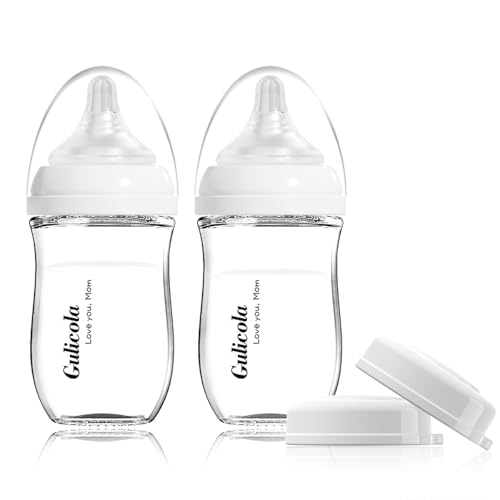
The 5oz sibling of the previous Gulicola bottle solves the capacity problem: it holds enough milk for a 3-6 month old who is drinking 4-5 ounces per feeding. It shares the same borosilicate glass construction—which resists thermal shock, is free of BPA and phthalates, and stays clean without developing scratches—but features a slow flow (not extra slow) nipple for newborns who have grown past the preemie stage.
This set includes two storage caps, a small but meaningful addition that lets you prep bottles hours ahead or store expressed milk directly in the bottle without attaching a nipple. The ultra-soft silicone nipple maintains the same breast-like feel and anti-colic vents as the 3oz version, so your baby won’t experience any flow difference when you switch sizes. Wide necks simplify pouring breastmilk from a breast pump collection bottle, reducing spills.
The smooth glass surface cleans easier than any plastic bottle—no micro-scratches to trap milk residue. However, the glass is heavy, so you’ll need to hold the bottle for your baby rather than letting them grab it independently until they’re much older. Replacement rings and nipples are compatible with Evenflo collars, which slightly expands your options. If you want a glass bottle that grows with your baby from birth through the first year, this is the most complete package in the Gulicola lineup.
Why it’s great
- Borosilicate glass is scratch-resistant and easy to clean
- Includes two storage caps for meal prep
- Soft silicone nipple works well for breastfed babies
Good to know
- Glass is heavier than plastic alternatives
- Replacement nipples not widely available in stores
- Limited to 2-pack; multiple sets needed for rotation
FAQ
How often should I replace newborn bottle nipples?
Can I use these bottles with a breast pump?
Final Thoughts: The Verdict
For most users, the best bottles for newborns winner is the Dr. Brown’s Options+ 4oz (4-Pack) because its clinically proven vent system offers the most aggressive colic relief while preserving milk nutrients. If you want a bottle that makes breastfeeding combination feeding seamless, grab the Philips Avent Natural 4oz (2-Pack). And for a preemie or a baby with a sensitive latch, nothing beats the Gulicola Small Glass 3oz (2-Pack) with its extra slow flow nipple and borosilicate glass safety.

Mo Maruf
I created WellFizz to bridge the gap between vague wellness advice and actionable solutions. My mission is simple: to decode the research and give you practical tools you can actually use.
Beyond the data, I am a passionate traveler. I believe that stepping away from the screen to explore new environments is essential for mental clarity and physical vitality.