Our readers keep the lights on and my smoothie glass nicely filled. As an Amazon Associate, I earn from qualifying purchases.
Switching between breast and bottle introduces a specific tension that most new parents underestimate: a standard silicone nipple delivers milk faster than the breast, and a baby who suddenly gets a flood of milk instead of a steady, effort-dependent stream can quickly develop a preference—or outright rejection. The wrong nipple geometry, flow rate, or internal pressure system teaches a breastfed baby that the bottle is an entirely different feeding experience, which is why so many parents end up with a drawer full of failed bottles before they find one that works.
I’m Mohammad Maruf — the founder and writer behind WellFizz. I’ve spent years analyzing the mechanical design of baby feeding systems, focusing specifically on how nipple shape, vent engineering, and flow physics affect a breastfed infant’s natural latch and swallow rhythm.
This guide examines five purpose-built feeding systems engineered to preserve a breastfed baby’s natural feeding behavior. The goal is to help you identify the best bottle for breastfed baby based on latch mechanics, anti-colic efficiency, and material safety—without forcing your little one to learn a different sucking technique.
How To Choose The Best Bottle For Breastfed Baby
A breastfed baby feeds using a specific sequence: they open wide, latch deep, create a vacuum, and use a tongue wave to draw milk. A bottle that disrupts this sequence—by flooding the mouth with fast-flowing milk or requiring a shallow bite-down latch—encourages the baby to unlearn their breastfeeding technique. This guide breaks down the three most critical factors to consider.
Nipple Shape and Material Texture
Look for a nipple with a wide, rounded base that mimics the areola area, forcing the baby to open their mouth wide before latching. The material must be ultra-soft, preferably liquid silicone, with a slight texture or a defined latch line that gives the baby’s palate a tactile cue. A nipple that is too firm or too narrow teaches a breastfed baby to bite rather than suckle.
Venting System and Air Separation
A breastfed baby is accustomed to feeding without swallowing air. The ideal bottle uses either a base vent or an internal stem system that separates air from liquid before it reaches the nipple. Systems that force air through the milk create bubbles that enter the baby’s stomach, causing gas and discomfort. A venting system that works without requiring the nipple to be full of liquid also prevents vacuum lock.
Flow Rate Control
A bottle for a breastfed baby ideally comes with an extra-slow flow nipple that delivers milk only when the baby actively sucks. Multi-hole nipples that depend on gravity to flow liquid (even when the baby is not sucking) are counterproductive. The best design uses a single pinhole or a multi-micro-opening system that paces the flow to match the baby’s natural suck-swallow-breathe cycle.
Quick Comparison
On smaller screens, swipe sideways to see the full table.
| Model | Category | Best For | Key Spec | Amazon |
|---|---|---|---|---|
| Thyseed Anti-Colic Glass Bottle | Base Vent / Premium | Fussy & Gassy Breastfed Infants | 5-hole micro nipple / 3 parts total | Amazon |
| Dr. Brown’s Natural Flow Options+ | Internal Stem / Classic | Reducing Colic & Spit-up | Internal vent system / 4 oz capacity | Amazon |
| Gulicola Natural Glass (5 oz) | Wide Neck / Glass | Budget-Conscious Clean-Freaks | Borosilicate glass / 4-piece assembly | Amazon |
| Gulicola Small Glass (3 oz) | Wide Neck / Mini | Preemie & Extra Slow Transitions | 3 oz capacity / extra-slow flow nipple | Amazon |
| Pigeon PPSU Nursing Bottle | Japanese PPSU / Research-Based | Durability & Seamless Breast Switch | PPSU construction / 3-movement nipple design | Amazon |
In‑Depth Reviews
1. Thyseed Anti-Colic Glass Baby Bottle
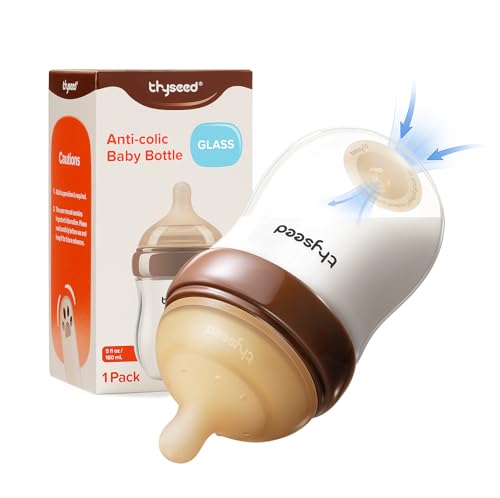
The Thyseed bottle uses a base vent design—the air enters through a separate pathway at the bottom of the bottle rather than through the nipple or an internal stem. This physical separation between air and milk is the key reason it appears in clinical literature, including research published in JAMA. The anti-colic base disc sits flush with the glass and prevents air from bubbling through the liquid, which means less air in the stomach and fewer micro-bubbles in the nipple during feeding.
The nipple itself is the most breast-like option in this list: it uses five micro-openings rather than a single pinhole or a cut X-slit. A single pinhole forces milk out in a stream; multiple micro-openings create a diffuse, steady flow that matches the breast’s natural milk ejection pattern. The silicone is ultra-soft, sourced from WACKER in Germany, and the wide base forces a deep latch. Parents who have dealt with bottle refusal often report that the 5-week-old who rejected every other bottle took this one on the first try.
Cleaning is straightforward because the entire system uses only three parts—bottle, nipple, vent disc—and the wide neck accommodates a standard brush. The borosilicate glass is thick and odor-resistant, and the bottle has survived drops without shattering according to multiple verified reviews. The main drawback is the absence of a smaller 3 oz size for newborns, and the premium materials place it at a higher price point.
Why it’s great
- Base vent prevents air from mixing with milk, reducing gas and reflux
- Five micro-openings create paced flow that mimics natural letdown
- Only 3 parts to wash; wide neck for easy cleaning
Good to know
- No 3 oz mini size for preemies or early newborns
- Higher price point may push some budgets
2. Dr. Brown’s Natural Flow Anti-Colic Options+ Narrow Baby Bottle
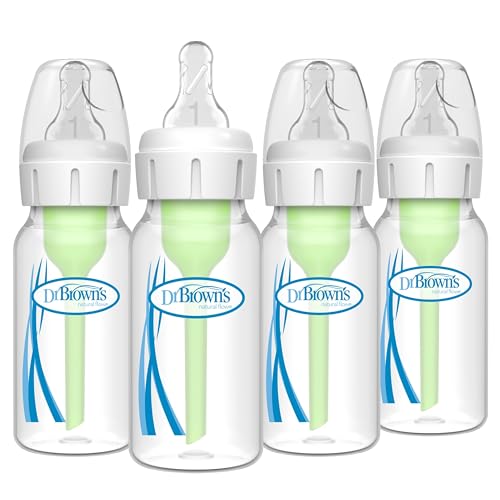
Dr. Brown’s Options+ is the most clinically proven anti-colic system in the baby bottle market, and the narrow-neck design is specifically engineered to be vacuum-free. The internal vent stem runs from the bottom of the bottle up into the nipple; air travels through the stem and enters the bottle above the liquid line, so the nipple cavity never experiences vacuum pressure. This prevents the nipple from collapsing and allows the baby to feed at a consistent pace without having to break suction to reset airflow.
The Level 1 slow flow nipple is designed for newborns and breastfed babies, delivering milk only when the baby actively sucks. The nipple shape is wider at the base than a standard narrow bottle, encouraging a deeper latch, though it is not as wide as a full breast-shaped nipple. Parents report that this bottle significantly reduces spit-up and gas compared to standard bottles, and the nipple material is soft enough that most breastfed babies will accept it without a prolonged struggle.
The trade-off is cleaning complexity: the vent stem and nipple require a small brush designed specifically for the internal tube. The stems can bend or discolor over time with repeated sterilization. The 4 oz size is excellent for small feeds, but the bottle itself is plastic (PP), not glass, which some parents may prefer to avoid. When assembled incorrectly, the system can leak—specifically if the stem is not fully seated or if liquid is filled above the recommended fill line.
Why it’s great
- Vacuum-free feeding prevents nipple collapse and inconsistent flow
- Clinically proven reduction in colic, spit-up, and gas
- Lightweight plastic design is ideal for on-the-go use
Good to know
- Vent stem and nipple require additional cleaning parts
- Leaks can occur if filled above the line or assembled incorrectly
3. Gulicola Natural Glass Baby Bottle (5 oz, 2 Pack)
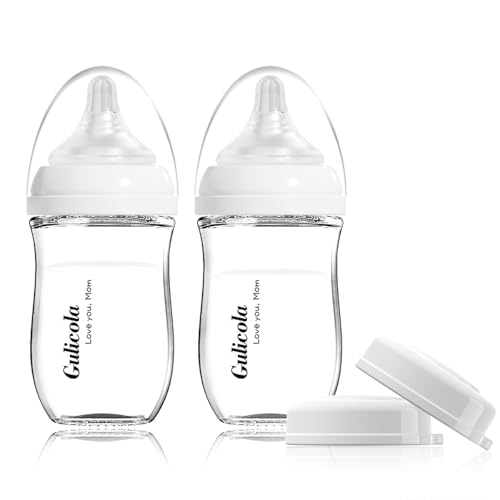
The Gulicola 5 oz glass bottle uses borosilicate glass, which is thermally resistant and does not degrade with repeated sterilization in boiling water or microwave steamers. The wide neck provides easy access for brushing, and the ultra-soft silicone nipple is designed with a gentle slope that mimics the natural shape of the breast during latch. The slow flow nipple is intended for 0-3 months and is narrow enough to force the baby to use their tongue and cheek muscles correctly.
The anti-colic vent system in the Gulicola is a simple side-slit mechanism inside the nipple collar. It is less complex than the Dr. Brown’s stem but still manages to reduce bubble intake compared to a solid-collar bottle. The textured inner ledge at the nipple base can trap a small amount of milk, so parents will need to ensure the collar is fully tightened and angled correctly during feeding to minimize waste. The glass is heavier than PPSU or PP alternatives, making it less ideal for a baby who is learning to hold their own bottle.
Customers confirm that the glass survives drops onto tile floors without shattering, and the 4-piece assembly (bottle, collar, nipple, cap) is easier to clean than stem-based systems. The ounce markings are printed rather than engraved, and several parents note they become difficult to read in dim nursery lighting. The 2-pack value is strong for a glass bottle set, and the nipple collars are compatible with Evenflo pump flanges, which adds pumping-to-bottle convenience for breastfeeding mothers.
Why it’s great
- Borosilicate glass resists thermal shock and repeated sterilization
- Wide neck and 4-piece design are easy to clean thoroughly
- Nipple collars fit Evenflo pump flanges for direct pumping
Good to know
- Printed ounce markings fade and are hard to read in low light
- Glass weight makes it less practical for self-feeding practice
4. Gulicola Small Glass Baby Bottle (3 oz, 2 Pack)
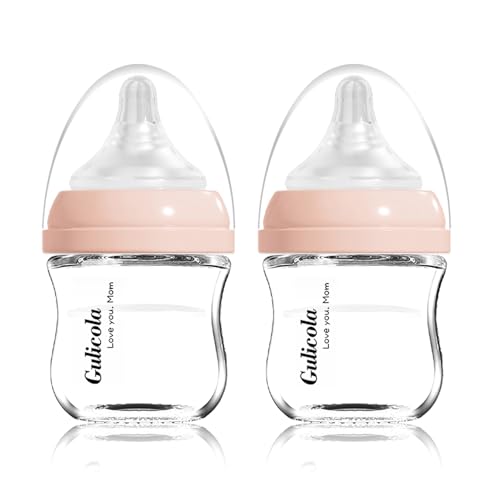
The 3 oz version of the Gulicola glass bottle fills a specific gap for parents of preemies, small newborns, or breastfed babies who only take small volumes per feed. The extra-slow flow (SS) nipple is slower than the standard slow flow, which matters enormously for a breastfed baby who is still learning to coordinate sucking, swallowing, and breathing. The 3 oz size also reduces milk waste: a 5 oz bottle with 2 oz of milk leaves a large air pocket that can accelerate cooling and make the baby work harder to access the liquid.
The nipple is identical in shape and material to the 5 oz version—ultra-soft silicone with a contour that guides the baby’s tongue to the correct position. The anti-colic vent slits in the collar are identical as well. Because the bottle is narrower and shorter, the glass surface area is smaller, which makes it warm up faster in a bottle warmer and cool down faster if the baby takes a break mid-feed. The borosilicate glass is the same thermally resistant material used in the larger version.
The small bottle shares the same limitations as the 5 oz Gulicola: the ounce markings are printed and difficult to read in dim light, and the glass is heavier than PPSU or plastic. The 3 oz size may be outgrown quickly if your baby transitions to larger feeds within the first two months, though the SS nipple can still be used on the 5 oz bottle since the collars are interchangeable.
Why it’s great
- Extra-slow SS nipple delivers the slowest possible flow for preemies
- 3 oz size minimizes milk waste and warms up quickly
- Borosilicate glass is free of BPA, BPS, and phthalates
Good to know
- Printed ounce markings are hard to read in low nursery light
- Small capacity may be outgrown within 1-2 months
5. Pigeon PPSU Nursing Baby Bottle Wide Neck (5 oz, 2 Pack)
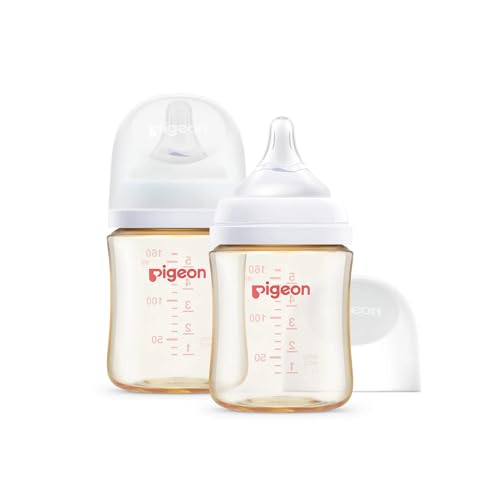
Pigeon’s PPSU bottle is engineered around research on infant sucking movements—specifically the three natural motions (sucking, swallowing, and breathing coordination) that Japanese researchers identified as essential for maintaining breastfeeding behavior after bottle introduction. The nipple is designed with a “latch-on line” that runs along the tip, giving the baby a visual and tactile cue to open wide and position the nipple against the hard palate for proper suction.
The PPSU material is the key differentiator: it is amber-colored, heat-resistant up to 180°C, lighter than glass, and virtually unbreakable. It does not degrade with repeated sterilization, dishwasher cycles, or boiling. The wide neck makes scooping formula powder and brushing straightforward. The SS nipple (0 months+) provides a slow flow, but the flow is slightly faster than the Gulicola SS or the Thyseed multi-opening system, which means some breastfed babies may prefer it while others may feel overwhelmed.
Customer feedback consistently highlights the bottle’s leak-proof performance and the fact that babies need fewer burping breaks compared to other bottles. The nipple collar is compatible with Medela pump flanges, simplifying the pumping-to-bottle transfer. The main downside is the lack of an integrated anti-colic vent: air passes through the milk via the nipple hole, which can create more bubbles than a base vent or stem system. The two-pack pricing is competitive for a premium material like PPSU.
Why it’s great
- PPSU is lightweight, shatterproof, and heat-resistant to 180°C
- Latch-on line guides proper positioning for natural tongue movement
- Compatible with Medela pump flanges for direct pumping
Good to know
- No dedicated anti-colic vent; air mixes with milk during feeding
- SS nipple flow is slightly faster than ultra-slow flow options
FAQ
Will a bottle with a fast flow nipple cause my breastfed baby to reject the breast?
How do I know if the bottle’s anti-colic vent is actually working?
Final Thoughts: The Verdict
For most parents, the bottle for breastfed baby winner is the Thyseed Anti-Colic Glass Bottle because its base vent separates air from milk without adding cleaning complexity, and the five-micro-opening nipple delivers a slow, diffuse flow that feels familiar to a breastfeeding infant. If you want the highest engineering rigor for colic and reflux reduction, grab the Dr. Brown’s Natural Flow Options+. And for a lightweight, shatterproof material that lasts through multiple children, nothing beats the Pigeon PPSU Nursing Bottle.

Mo Maruf
I created WellFizz to bridge the gap between vague wellness advice and actionable solutions. My mission is simple: to decode the research and give you practical tools you can actually use.
Beyond the data, I am a passionate traveler. I believe that stepping away from the screen to explore new environments is essential for mental clarity and physical vitality.