Our readers keep the lights on and my smoothie glass nicely filled. As an Amazon Associate, I earn from qualifying purchases.
Frozen toes are the fastest way to ruin a perfect powder day. Once numbness sets in, your carving turns sloppy, your focus shifts from the run ahead to the pain in your boots, and the only thing you’ll remember about that black diamond is the shivering ride down. Dedicated warmers are the only real fix, and they’ve evolved far beyond flimsy foot pads that lose heat before lunch.
I’m Mohammad Maruf — the founder and writer behind WellFizz. I’ve spent hundreds of hours analyzing electrical heating elements, battery chemistries, and fabric thermal retention specs for winter gear, ensuring every recommendation here survives a full day of chairlifts and wind chill.
Whether you ski resort groomers back-to-back or hike deep into the backcountry, choosing the right best boot warmers for skiing means matching heat output, battery endurance, and boot fit to your specific terrain and tolerance for cold.
How To Choose The Best Boot Warmers For Skiing
The ski boot environment is uniquely hostile: tight plastic shells pinch around the foot, reducing blood flow, while freezing wind whips across the outside. A warmer that works well in a loose winter boot may fail completely here. Focus on three primary variables before buying.
Heating Coverage and Element Design
Toe-only heating is the most common approach because toes are furthest from the heart and coldest first. However, full-foot or wrap-around heating that also warms the ball of the foot and the arch prevents a cold sole from radiating chill upward. Check whether the elements use carbon fiber or metal composite fibers — carbon fiber is thinner, more flexible, and distributes heat more evenly without creating pressure points underfoot.
Battery Capacity vs. Ski Day Runtime
A standard ski day lasts 6 to 8 hours on the mountain. If you ski two sessions with a lunch break, you need at least 5 hours of active heat on medium. Batteries in the 2200mAh to 5000mAh range per pair can cover this, but double-check whether the advertised runtime is on the lowest or highest setting. Many brands quote the low-setting number, which can drop by half or more once you turn up to 131°F or 140°F. Look for a battery that lasts at least 4 hours on high — that’s the only number that matters for cold days.
Boot Fit and Bulk Management
Inside a performance ski boot, you have zero spare volume. Thick heated socks with chunky battery pouches can compress your foot, cut circulation, and actually make you colder. Choose designs with slim battery packs that nestle against the calf above the boot cuff, or insoles that integrate the battery strapped to the shin. If you need extra room, some skiers remove the factory insole to create space for a heated insole without raising foot height.
Quick Comparison
On smaller screens, swipe sideways to see the full table.
| Model | Category | Best For | Key Spec | Amazon |
|---|---|---|---|---|
| WAMOVAL Heated Socks | Premium Socks | All-day backcountry & resort | 10,000mAh / 158°F max | Amazon |
| SURGOAL Merino Wool Socks | Merino Mid-Range | Long, cold days with wicking | 8,500mAh / 15-hour low | Amazon |
| NASOLZIK Heated Insoles | Value Insoles | Replacing bulky boot liners | 5,000mAh / full-foot heating | Amazon |
| Black Squid Heated Socks | Mid-Range Socks | Light hiking & moderate days | 4,000mAh / 140°F high | Amazon |
| ZUOYI Heated Socks | Budget Socks | First-time warmer buyers | 5,000mAh / 149°F high | Amazon |
| SAVIOR HEAT Socks | Premium Socks | Tech-heavy users needing app | 2,200mAh / Coolmax fabric | Amazon |
| BARCHI HEAT Boots | Heated Boots | Lodge-to-lift & casual use | 2×2200mAh / IP65 | Amazon |
In‑Depth Reviews
1. WAMOVAL Heated Socks with APP Control, 10000mAh
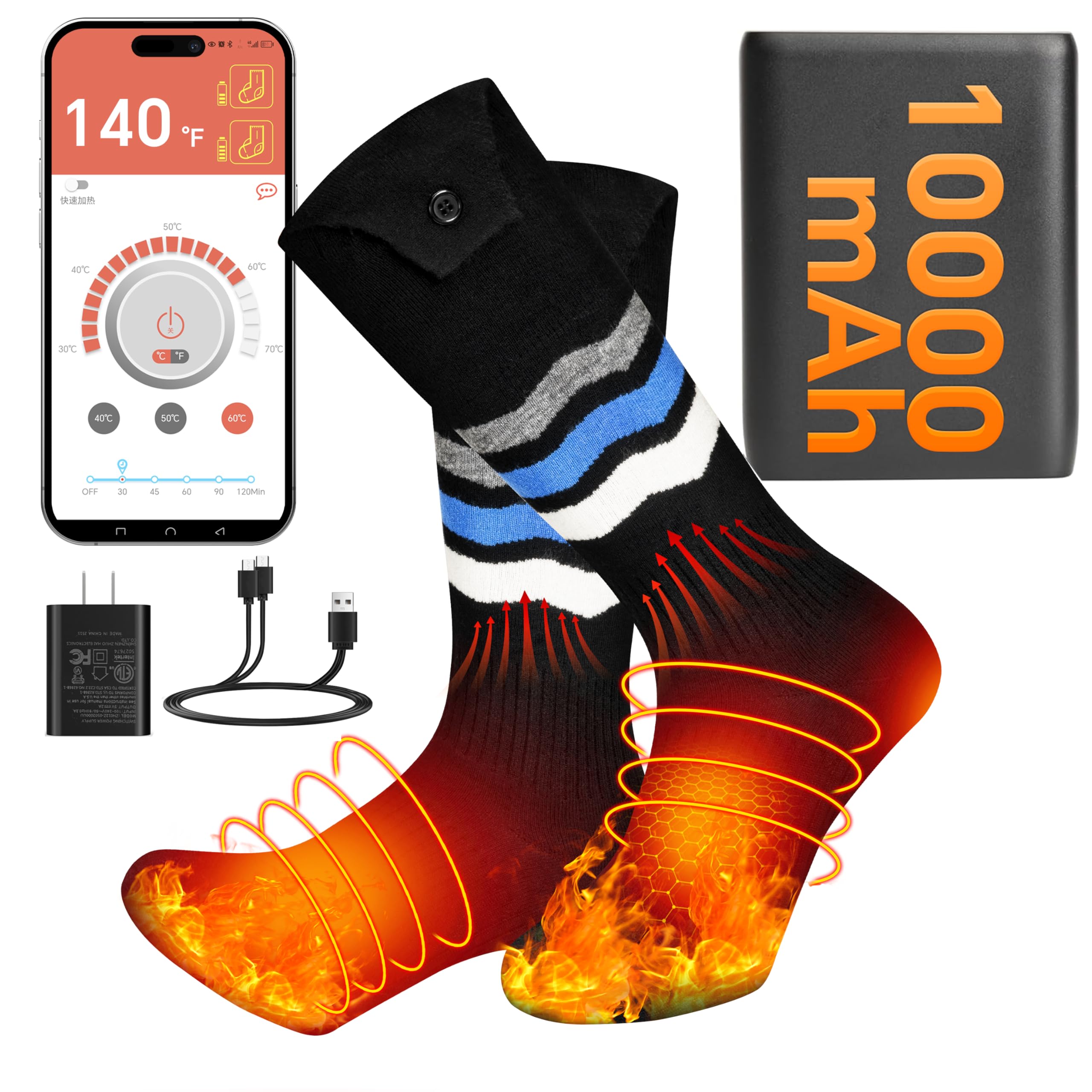
WAMOVAL brings a monstrous 10,000mAh total battery capacity (two 5,000mAh packs) that delivers up to 5 hours on high heat and a claimed 13 hours on the lowest normal setting. For a skier hitting the lifts at 8 AM and packing up at 4 PM, that means you can run medium-high all day without reaching for a charger. The carbon fiber heating elements wrap the toe area and ramp up to temperature in about 20 seconds, which is noticeably faster than most competitors that take a full minute to feel warm.
The big highlight is the dual control system: a physical button on each battery pack and a smartphone app called “Warm Uping” that lets you adjust temperature anywhere from 86°F to 158°F by sliding a digital bar. This is huge for skiing — once your boots are buckled, reaching down to fiddle with a button is nearly impossible with gloves on, but you can tweak heat from your pocket. The socks themselves are a blend of viscose, nylon, polyester, and spandex, which gives them good stretch but less natural insulation than a wool-based sock.
Some users note that the battery packs are slightly bulky and may press against the back of a tight ski boot if you have a narrow cuff. The one-size-fits-most design works better for medium to large feet; women with smaller feet have reported the socks running very large. The simultaneous charging cable is a minor convenience, charging both batteries in about 4 hours from a standard 5V2A adapter.
Why it’s great
- Massive 10,000mAh capacity handles a full ski day on high without recharge
- App control allows temperature adjustment without unbuckling boots
- Carbon fiber elements heat up in 20 seconds flat
Good to know
- Runs very large; unsuitable for smaller women’s feet without overstuffing
- Battery packs are somewhat bulky for tight performance boots
- App requires account creation and sometimes self-discharges when unused for weeks
2. SURGOAL Merino Wool Heated Socks, 8500mAh
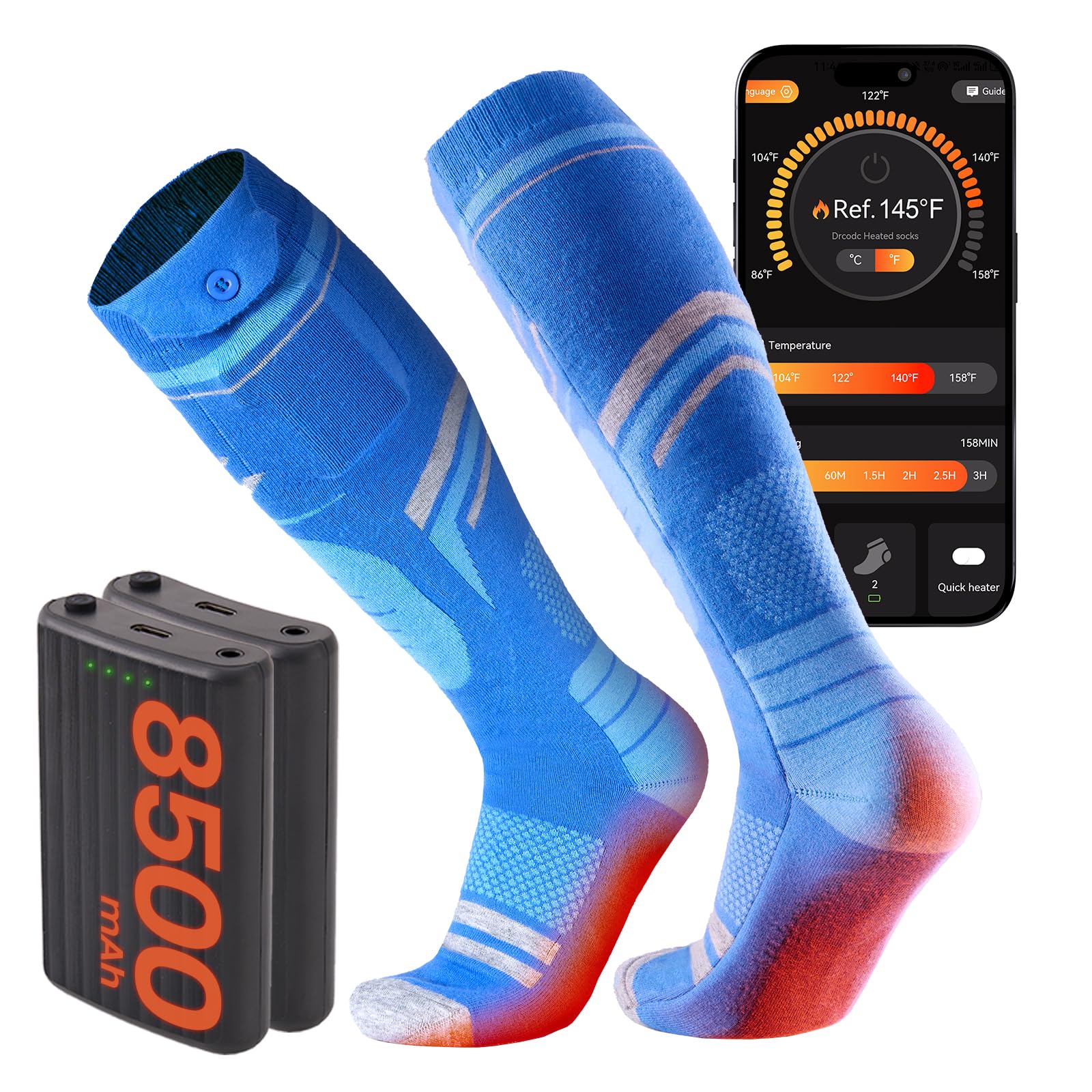
SURGOAL combines a premium 35% Merino wool upper with an 8,500mAh battery that on the lowest energy-saving setting (104-113°F) runs up to 15 hours. That runtime is twice what most skiers need, but it means you can ski multiple days on a single charge without plugging in. The high setting hits 131-145°F for about 6 hours, which still covers a full day if you don’t mind turning down for the last run.
The heating technology here is a full-sole composite metal fiber element embedded in a mid-layer concealed wiring system. Unlike designs that only heat a patch under the toes, SURGOAL covers the entire bottom of the foot from heel to toe. The wiring is sandwiched inside the fabric rather than surface-mounted, so you don’t feel the wires underfoot — a common complaint with cheaper socks. The Merino blend (35% Merino, 30% nylon) boosts heat retention by about 50% compared to plain polyester and wicks moisture away from your skin, keeping feet dry even after hours of aggressive skiing.
A few users report that the app connection process is finicky, requiring a barcode scan and installation from a source outside the major app stores, which raises security concerns. The socks fit a size 8.5-9 well, but some reviewers note they run slightly large. The battery pocket sits at the top of the calf, which is above the boot line for most people, so the weight doesn’t pull the sock down during the day.
Why it’s great
- 35% Merino wool for natural warmth, breathability, and moisture wicking
- Full-sole heating covers toes through heels without detectable wires
- 15-hour low setting practically eliminates recharging during multi-day trips
Good to know
- App installation requires side-loading from an unknown source
- Battery module has occasional Bluetooth connectivity drops
- One-size design may feel roomy for size 8.5 feet and under
3. NASOLZIK Heated Insoles, 5000mAh

NASOLZIK takes a different route: instead of a heated sock, you get a heated insole that replaces the factory footbed inside your ski boot. This matters because ski boots already have minimal internal volume, and adding a sock layer on top of a thick insole can elevate your foot height, changing the ramp angle and creating pressure points. With an insole-only system, you simply pull out the stock insole and drop this in, keeping the same volume.
The heating elements here cover the entire sole — not just the toe but the arch and ball of the foot too. This is beneficial for skiers who stand on their edges for extended periods, transferring heat directly into the boot sole rather than relying on warm air rising inside the sock. The 5,000mAh battery straps to your calf with an elastic band and Velcro, with a 65cm charging cable that gives you freedom of movement. On low heat, you get 8-9 hours of runtime; on high, expect 3-4 hours.
The insoles are made from polyethylene and soft velvet fabric, which feels comfortable against the foot but is thicker than most stock insoles. Some users who trimmed the insole with scissors reported that the heating element doesn’t extend into the toes after trimming, losing warmth at the precise spot you need it most. They are machine-washable after removing the battery, but the battery pack is external and may catch on boot liners when pulling your foot in.
Why it’s great
- Replaces stock footbed, preserving boot volume for a proper fit
- Full-sole heating warms arch and ball of foot, not just toes
- 50cm cable allows easy routing up the leg without restricting motion
Good to know
- Trimming the insole may cut heating element reach to toes
- External battery pack can snag on boot liner during entry/exit
- Thicker than many stock orthotics; may feel too elevated for sensitive skiers
4. Black Squid Heated Socks, 4000mAh
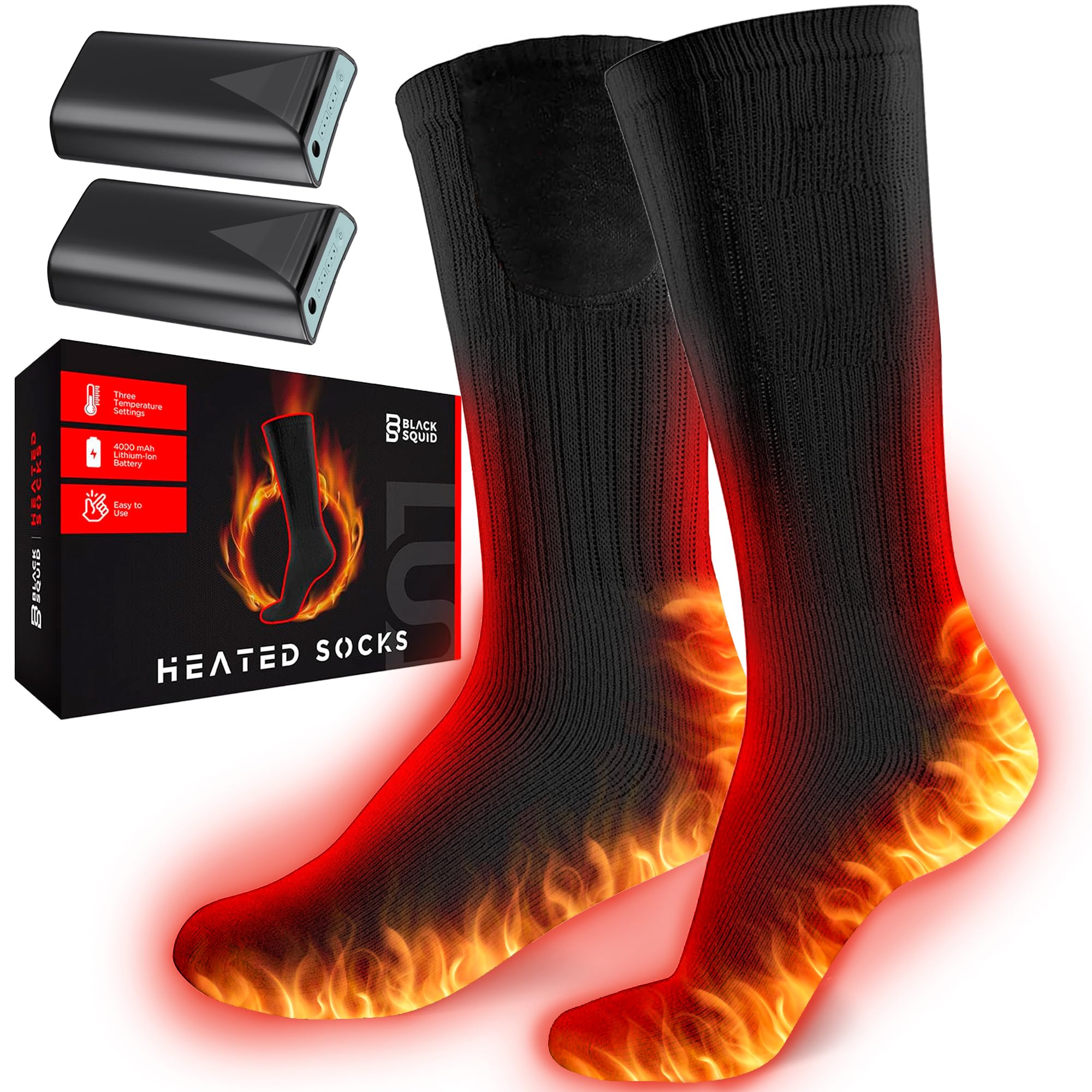
Black Squid delivers a solid mid-range entry point with a cotton and spandex blend that balances softness and stretch. The three heat settings — low (104°F), medium (122°F), and high (140°F) — are controlled by a button on each battery pack, with no app required. On high, you get about 4 hours of heat; on low, up to 9 hours. That’s enough for a moderate ski day if you start on medium and taper to low after lunch.
The heating elements are concentrated in the toe area. While this works well for targeting the part of your foot that freezes fastest, it leaves the midfoot and heel unheated. In a cold boot, that means your sole can still feel cold even with warm toes. The socks fit women’s shoe sizes 4-10 and men’s 3-9, which is a relatively narrow range that fits small-to-medium feet best. The battery packs are lightweight and unobtrusive, using a lithium-ion chemistry that holds a charge well even when stored between trips.
Several users mention the socks fit snugly around the calf, which helps with heat transfer but may be tight for larger calves. The battery pocket lacks a Velcro strap to secure the pack during active movement, so it can shift or pop out when you’re hiking quick turns or skating across flats. For skiing, this is a minor annoyance, but it’s worth knowing that the pack may move around inside your ski pants leg.
Why it’s great
- Cotton-spandex blend is soft, breathable, and comfortable for all-day wear
- Three simple heat settings without fiddling with a smartphone app
- Good for smaller feet — fits women’s 4-10 and men’s 3-9
Good to know
- No full-foot heating — only the toe area gets warm
- Battery pocket lacks a closure strap, allowing pack to shift during active skiing
- Calf fit may be too snug for skiers with larger leg muscles
5. ZUOYI Heated Socks, 5000mAh

ZUOYI offers the most accessible price point in this roundup, with a 5,000mAh battery that delivers up to 8 hours on low (104°F) and 3-4 hours on high (149°F). The socks use a breathable polyester mix fabric that dries faster than cotton, reducing the risk of moisture-related foot issues — a legitimate concern after a day of sweating inside ski boots. The carbon fiber heating elements are concentrated on the toe area, and the company explicitly markets them for protecting against frostbite in severe cold.
One standout feature is temperature marking: ZUOYI labels its four levels by exact Fahrenheit — 104°F, 113°F, 131°F, and 149°F — rather than using vague “low, medium, high” labels. This helps you dial in a precise heat that you know works for your personal cold tolerance without guessing. The battery pocket is secured by a button flap, which is more reliable than an open sleeve during high-motion activities like skiing. The socks are machine-washable in the included laundry bag after removing the batteries.
The size range is unisex and one-size-fits-most, covering sizes 6-14. While this accommodates a broad audience, it doesn’t fit perfectly for either end of the spectrum — small feet have excess fabric bunching, and very large feet may find the socks stretching thin. The charging time is about 4 hours, but some users report the charge time feels slower, closer to 6 hours, after extended use.
Why it’s great
- Exact temperature markings (104°F, 113°F, 131°F, 149°F) instead of vague levels
- Moisture-wicking polyester fabric reduces fungal and frostbite risks
- Secure battery pocket with button flap keeps packs in place during movement
Good to know
- Toe-only heating leaves midfoot and heel unheated
- One-size-fits-most design is loose on smaller feet and tight on larger ones
- Charging can take up to 6 hours with some battery units
6. SAVIOR HEAT Heated Socks with APP Control

SAVIOR HEAT positions itself as a premium option with a strong focus on app integration and fabric quality. The socks are built with Coolmax performance knit, a moisture-wicking fiber that pulls sweat away from the skin three times faster than cotton. Combined with carbon fiber heating elements and neoprene at the cuff, these socks are designed for high-exertion skiing where sweat management is as important as heat output.
The two included 7.4V 2200mAh lithium-polymer batteries deliver roughly 2-2.5 hours on high (131-149°F), 5-6 hours on medium (122-131°F), and 9-10 hours on low (104-113°F). While the high setting runtime is short, the medium setting covers a full day for most skiers. The app controls are responsive and allow you to switch between the three temperature modes and check battery level without reaching for your boot. The physical button on the sock serves as a backup, but it’s small and hard to operate with thick ski gloves.
Fit is unisex in four sizes (S/M/L/XL) covering US 5-14, with smooth inside seams that don’t chafe. The battery pocket sits comfortably above the boot shaft, and the packs are slim enough to hide under ski pants. Some users report that the battery compartment is difficult to open and that the wire can come out of the connection during insertion, which is frustrating on a cold morning. The whole setup is machine-washable in a laundry bag after removing batteries.
Why it’s great
- Coolmax knit is highly effective at wicking sweat and preventing chills
- Four unisex sizes (S-2XL) provide a better fit than one-size options
- Physical on-sock switch serves as backup when phone is unavailable
Good to know
- 2,200mAh battery runs only 2-2.5 hours on high heat setting
- Battery compartment can be difficult to open and wire may disconnect
- Higher price point for a shorter battery capacity than competing options
7. BARCHI HEAT Heated Boots for Women and Men
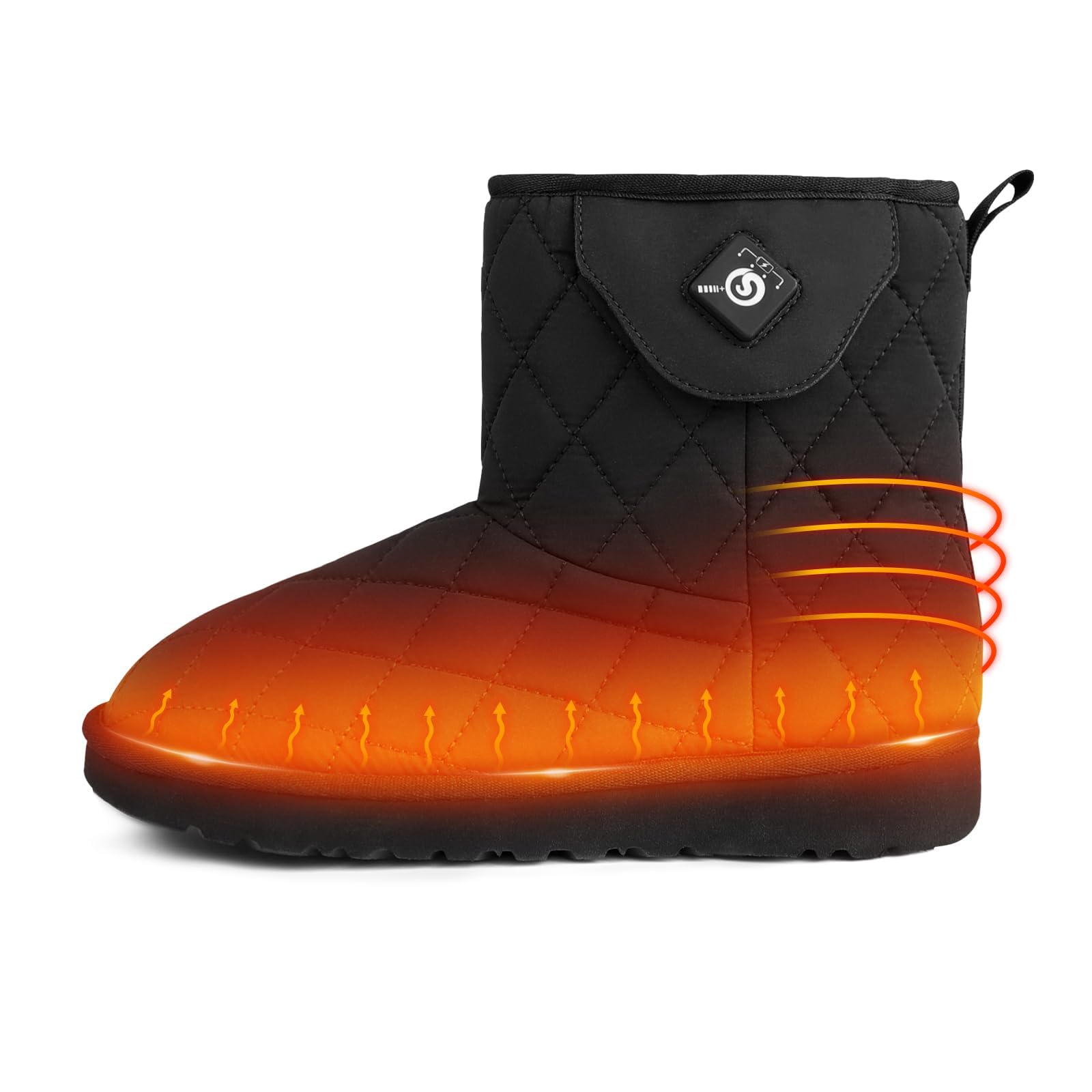
BARCHI HEAT solves the problem differently — instead of a separate sock or insole, it is a complete heated boot. The boot itself has built-in heating elements controlled by a button on the side, with three heat levels and two removable 2200mAh battery packs. The IP65 rating means it is resistant to snow, slush, and moisture ingress, making it suitable for wearing from the lodge to the car and for casual outdoor use, though it lacks the ankle support and binding compatibility for downhill skiing.
The boot interior is lined with what BARCHI describes as wool, though the tag indicates polyester wool rather than natural Merino. Users with Raynaud’s syndrome or diabetic neuropathy report that these boots maintain warmth longer than microwaveable booties and are more comfortable than heating pads. The batteries recharge in about 3 hours and last for several hours of continuous use, though they don’t match the multi-day runtime of a sock-based system.
These boots are best thought of as après-ski footwear — something to throw on after you take off your ski boots to keep your feet warm during lunch breaks, lodge time, or walking to and from the parking lot. They are not boot-pack compatible with ski bindings. The sizing runs wide and accommodates thick socks underneath, which improves overall warmth but means the boots are not suitable for activities requiring precise foot control.
Why it’s great
- Integrated heated boot eliminates the need for a separate sock or insole
- IP65 waterproof rating repels snow and slush effectively
- Wide fit accommodates thick sock layering and sensitive circulation conditions
Good to know
- Not compatible with ski boot bindings; for après-ski use only
- Lining is polyester wool, not authentic Merino wool as implied
- Battery runtime is shorter than dedicated sock-based systems
FAQ
Can I wear heated socks inside my ski boots without making the boot too tight?
How do I wash heated socks without damaging the heating wires?
Do I need app-controlled heated socks for skiing, or is a simple button enough?
Final Thoughts: The Verdict
For most users, the best boot warmers for skiing winner is the SURGOAL Merino Wool Heated Socks because its 8,500mAh battery delivers full-day heat while the 35% Merino wool composition provides natural insulation and wicking that keeps feet dry even in sweaty ski boots. If you need massive battery capacity for backcountry missions or hate fiddling with buttons, grab the WAMOVAL Heated Socks with the 10,000mAh battery and reliable app control. And for skiers who want to avoid adding volume inside the boot, nothing beats the NASOLZIK Heated Insoles, which replace the stock footbed and warm the entire sole.

Mo Maruf
I created WellFizz to bridge the gap between vague wellness advice and actionable solutions. My mission is simple: to decode the research and give you practical tools you can actually use.
Beyond the data, I am a passionate traveler. I believe that stepping away from the screen to explore new environments is essential for mental clarity and physical vitality.