Our readers keep the lights on and my smoothie glass nicely filled. As an Amazon Associate, I earn from qualifying purchases.
The wrong pair of inserts turns a demanding shift into a genuine foot punishment. Quality boot inserts, however, can transform the interior of your work boot, providing targeted arch support and shock absorption that keeps your legs feeling fresh even on concrete floors.
I’m Mohammad Maruf — the founder and writer behind WellFizz. I’ve spent years analyzing the material science and biomechanical specs of orthotic inserts, measuring foam density, arch height, and heel cup depth against real-world wear data.
This guide breaks down the key specs and real reviews to help you find a pair that actually delivers relief. We compare five top contenders to identify the absolute best boot inserts for long days on your feet.
How To Choose The Best Boot Inserts
Your work boots are only as good as what’s inside them. A standard factory footbed offers minimal support, leaving your arches and heels to absorb every shock. The right aftermarket insert addresses three core areas that directly impact your comfort and joint health.
Arch Support Type and Height
The most critical factor is how the insert aligns with your foot’s natural arch. Low-arch (flat feet) needs a supportive structure that cradles the entire foot, while high-arch requires a pronounced, rigid support to prevent the foot from collapsing. Medium-arch wearers have the most flexibility but still need a contoured shape. A mismatch here will cause new pain patterns rather than fixing old ones.
Cushioning Material and Shock Absorption
Look for a dual-layer design: a firm base layer for structural support paired with a softer top layer for impact dampening. Gel pads at the heel and ball-of-foot zones are especially valuable for anyone standing on concrete or asphalt. Polyurethane and TPU offer long-lasting resilience, while basic foam compresses quickly and loses its bounce within weeks.
Heel Cup Depth and Boot Fit
A deep heel cup locks the fat pad under your heel bone, providing stability and reducing the strain on your Achilles tendon. However, thick inserts take up internal volume. If your boots are already snug, a 3/4-length insert saves toe space, while a full-length design provides better total foot coverage. Always measure the available space before you commit.
Quick Comparison
On smaller screens, swipe sideways to see the full table.
| Model | Category | Best For | Key Spec | Amazon |
|---|---|---|---|---|
| Timberland PRO Insite Technology AFT Footbed | Full Length | Long shifts in tight boots | Plastic arch support frame | Amazon |
| Welnove Work Orthotic Insoles | Full Length | All-day concrete floors | PU foam + TPU + GEL triple layer | Amazon |
| Dr. Scholl’s Work Insoles | Full Length | Heavy impact absorption | Massaging gel technology | Amazon |
| ARIAT Energy Max Work Insole | Full Length | Moisture and odor control | Agion antimicrobial liner | Amazon |
| OUOKK Plantar Fasciitis Inserts | 3/4 Length | High arch / tight toe boxes | 30mm TPU arch support | Amazon |
In‑Depth Reviews
1. Timberland PRO Insite Technology AFT Footbed

The Timberland PRO footbed stands out for its rigid plastic arch support that provides consistent structural stability under heavy loads. Users working 10–13 hour shifts report that these inserts make boots feel like they were never even worn, thanks to the firm base that prevents arch collapse over a full day.
The build quality is exceptional for a full-length footbed, holding its shape far longer than standard foam competitors. The slight price premium is offset by durability that keeps the insert performing for months without noticeable compression loss in the heel and metatarsal zones.
Some users noted a sizing mismatch on delivery, so double-check your size selection. The firm feel may also feel aggressive for those who prefer a plush, cloud-like step. For anyone needing genuine foot and ankle alignment in work boots, this is the pick.
Why it’s great
- Rigid plastic frame holds arch shape all day
- Durable construction outlasts foam-only inserts
- Great for high-mileage construction environments
Good to know
- Might feel too firm for casual wearers
- Occasional sizing discrepancies reported
2. Welnove Work Orthotic Insoles for Plantar Fasciitis
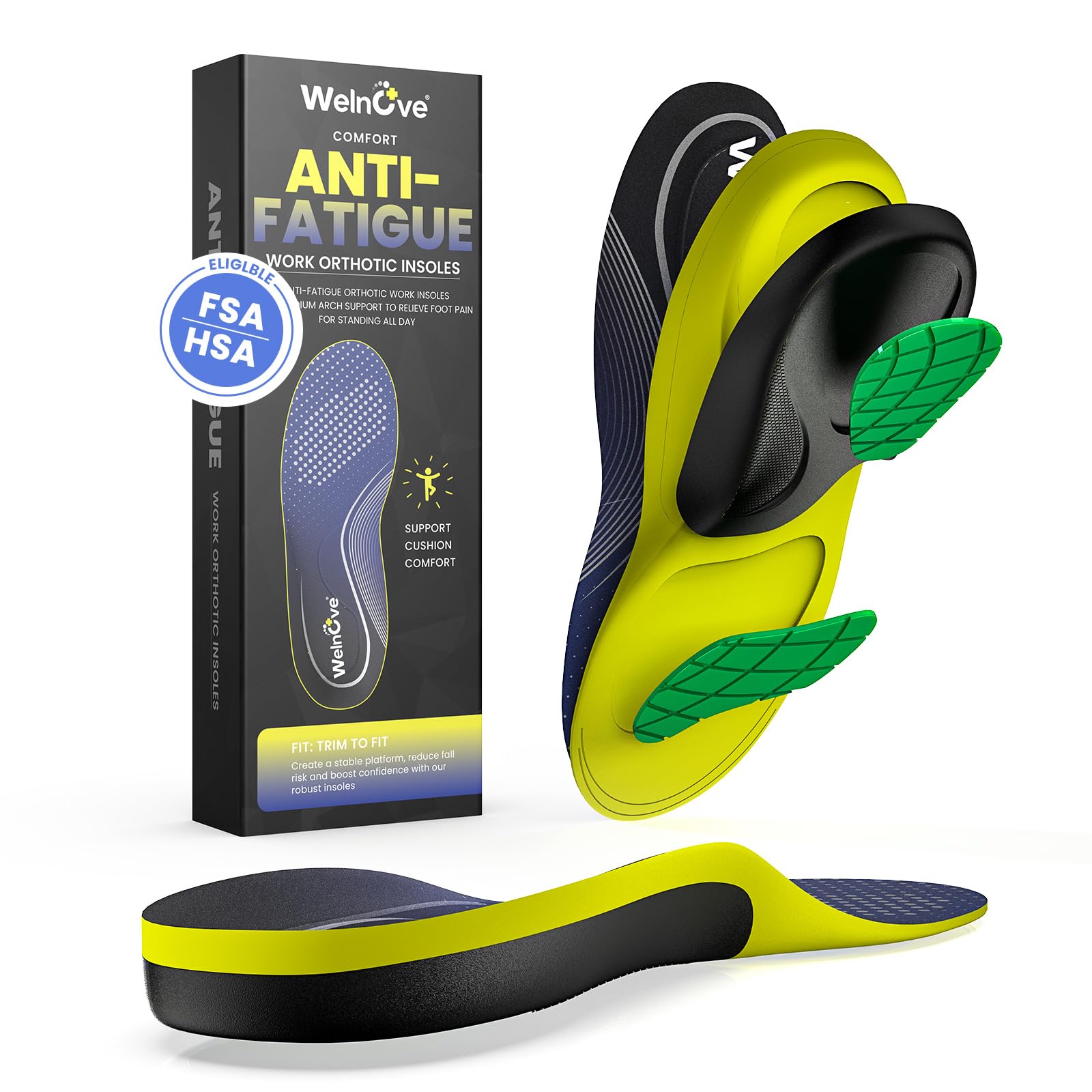
The Welnove work insole combines a PU foam cushioning layer, a 3D dynamic TPU arch support, and gel pads at both the heel and ball-of-foot. This triple-layer approach is rare in the mid-range segment and directly addresses the needs of users standing on concrete floors for 10-hour shifts.
Reviewers consistently note that this insert allows them to work a full day without the burning sensation that factory insoles cause. The deep U-cup heel provides noticeable stability, reducing the strain on lower legs and knees. Compared to custom orthotics at double the price, users find these surprisingly effective.
One catch is that the listed “2 pack” actually refers to a single pair (left and right). Also, these are fairly thick, which may require removing the original insole or lacing boots more loosely. For the performance delivered, the comfort-to-cost ratio is excellent.
Why it’s great
- Triple-layer construction (PU+TPU+GEL) for serious shock dampening
- Deep heel cup locks foot in place for stability
- Competes with expensive orthotics in performance
Good to know
- Packaging says 2 pack but ships as one pair
- Thick build requires extra boot volume
3. Dr. Scholl’s Work Insoles

Dr. Scholl’s Work insoles leverage massaging gel technology that is particularly effective at absorbing shock from hard surfaces like asphalt and concrete. The adaptive cushioning responds to movement, returning energy with each step and significantly reducing the joint strain that contributes to lower back pain.
The Polygiene StayFresh lining is a standout feature for anyone dealing with sweaty boots at the end of a shift. Reviewers report that these inserts make Doc Martens and steel-toe boots far more wearable, with no blisters or slipping during long city walks or workdays.
Some users find the insoles to be relatively flat and thin, offering only moderate arch support. For wearers with high arches or a history of plantar fasciitis, the support may not be enough. These are best suited for those needing plush cushioning rather than rigid correction.
Why it’s great
- Clinically proven gel cushioning for hard surfaces
- Polygiene technology reduces moisture and odors
- Trim-to-fit design for easy customization
Good to know
- Thin profile offers limited arch support
- Not ideal for severe pronation or high arches
4. ARIAT Men’s Energy Max Work Insole
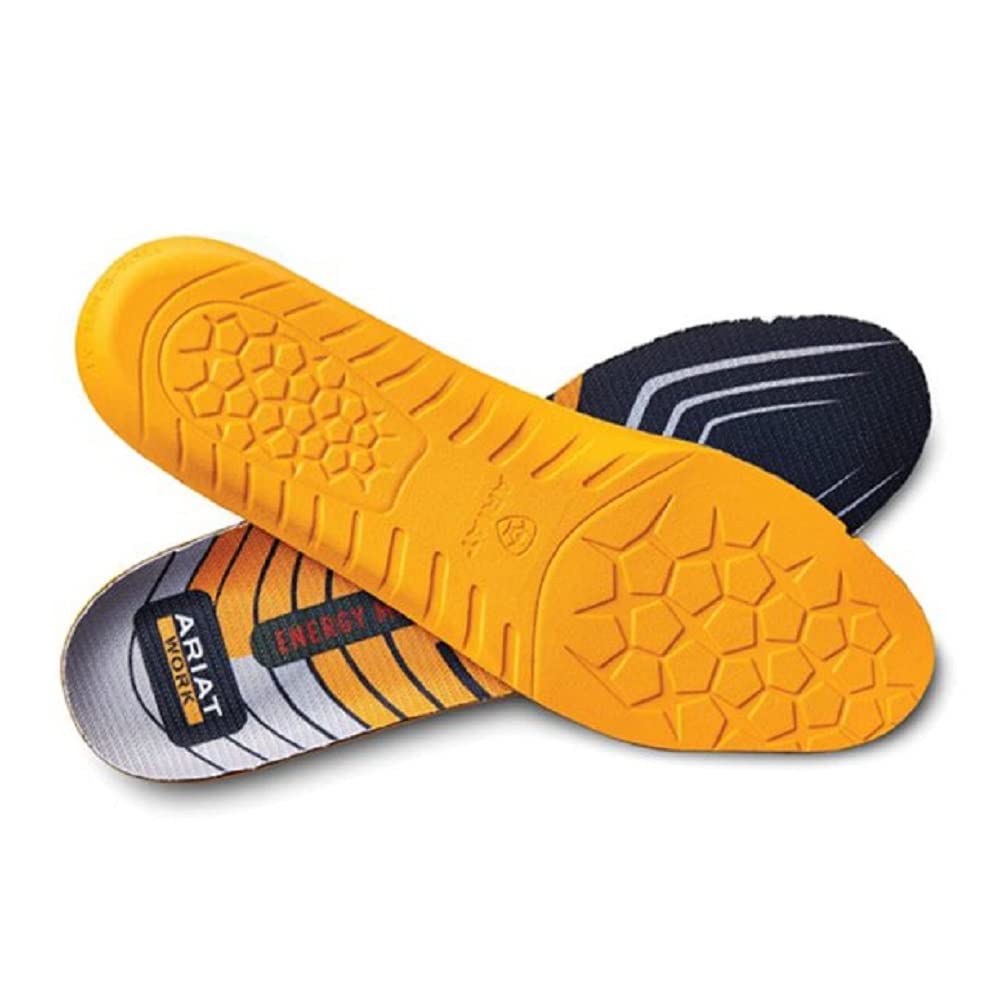
ARIAT’s Energy Max insole is built with a durable, moisture-wicking liner that uses Agion technology for intense odor defense — a strong advantage for anyone wearing boots in hot environments or for multiple days in a row. The rebound foam layer cradles the foot and dissipates pressure evenly across the sole.
Users report these are a near-perfect replacement for the original ARIAT boot insoles, fitting the shoe size exactly without requiring trimming. The open-cell foam effectively regulates temperature, keeping feet noticeably cooler and drier compared to denser foam competitors.
While the arch support is adequate for moderate needs, those with severe plantar fasciitis or high arches may require a more aggressive orthotic design. The cushioning leans toward medium firmness, which suits most work environments but may feel too soft for heavy-impact industrial settings.
Why it’s great
- Agion antimicrobial liner controls odor effectively
- Open-cell foam for temperature regulation
- True-to-size fit with no trimming needed
Good to know
- Rebound foam may compress faster than TPU supports
- Not designed for severe overpronation
5. OUOKK Plantar Fasciitis Relief Inserts

The OUOKK insert is a 3/4-length orthotic that focuses entirely on arch correction. The 30mm TPU arch support is rigid and high, providing long-lasting correction for those with medium to high arches. This design is ideal for tight shoes or boots where a full-length insole would crowd the toe box.
Users with flat feet and those suffering from plantar fasciitis report immediate relief from sole pressure and reduced foot fatigue after a full day on their feet. The lightweight construction makes it easy to move between shoes, and the lack of a heel cup means it fits easily into boots with existing cushioning.
Because of the pronounced arch, placement can be tricky — the insert may shift slightly during wear, especially in loose-fitting boots. Also, the 3/4-length offers no heel cushioning, so those who need shock absorption at the back of the foot should pair this with a gel heel pad.
Why it’s great
- Aggressive 30mm TPU arch for high arches and flat feet
- 3/4 length saves space in tight toe boxes
- Effective for plantar fasciitis pain relief
Good to know
- May shift inside loose boots without a heel cup
- No forefoot or heel gel padding
FAQ
Should I remove my boot’s original insole before inserting aftermarket insoles?
How often should I replace boot inserts used for daily manual labor?
Final Thoughts: The Verdict
For most users, the best boot inserts winner is the Timberland PRO Insite Technology AFT Footbed because its rigid plastic arch frame provides unmatched all-day support for demanding work environments. If you want a triple-layer cushioning system that rivals custom orthotics, grab the Welnove Work Orthotic Insoles. And for targeted high-arch correction in tight boots, nothing beats the OUOKK Plantar Fasciitis Inserts.

Mo Maruf
I created WellFizz to bridge the gap between vague wellness advice and actionable solutions. My mission is simple: to decode the research and give you practical tools you can actually use.
Beyond the data, I am a passionate traveler. I believe that stepping away from the screen to explore new environments is essential for mental clarity and physical vitality.