Our readers keep the lights on and my smoothie glass nicely filled. As an Amazon Associate, I earn from qualifying purchases.
For anyone tired of earbuds that block out traffic, conversations, or the sound of your own footsteps, bone conduction glasses offer a unique solution: open-ear audio built directly into eyewear. These glasses use tiny transducers resting on your cheekbones to send sound vibrations through your skull to your inner ear, leaving your ear canals completely free to hear everything around you. Whether you’re a cyclist who needs to hear approaching cars, a runner who wants to stay alert on trails, or someone who simply dislikes the occlusion feeling of in-ear buds, this category delivers hands-free audio, voice calls, and often a camera or AI assistant—all in a frame that looks like standard eyewear.
I’m Mohammad Maruf — the founder and writer behind WellFizz. I’ve spent years analyzing wearable tech hardware, from audio transducers and frame materials to battery capacity and camera sensor specs, to help buyers find gear that actually works for their real-world routines.
With multiple models now offering 4K video capture, real-time translation across dozens of languages, and AI voice assistants, the market has matured quickly. This guide breaks down the best bone conduction glasses by build quality, audio performance, camera capability, and battery endurance so you can pick the pair that fits your life.
How To Choose The Best Bone Conduction Glasses
Before you buy, three factors separate a useful pair from a frustrating one: audio delivery method, camera quality and storage, and battery life relative to your daily wear window.
Open-Ear Audio vs. True Bone Conduction
Most glasses in this category use open-ear speakers that sit just above the ears, projecting sound inward. True bone conduction uses transducers pressed against the temple. For the clearest audio without disturbing people nearby, look for directional open-ear designs or direct vibration transducers. The tradeoff is bass response—bone conduction naturally lacks deep low-end compared to in-ear buds.
Camera Resolution and Stabilization
If you plan to capture video, an 8MP lens (usually marketed as 4K) is the entry point for decent detail. Electronic image stabilization (EIS) matters a great deal when walking or cycling—without it, footage becomes shaky. Review the storage capacity; built-in storage of 4GB to 64GB determines how long you can record before needing to offload.
Battery Endurance and Charging
Music playback time ranges from 6 to 15 hours depending on the model. Quick charging (10 minutes for an hour of use in some models) can rescue a dead unit before a commute. If you wear glasses all day, look for 8+ hours of mixed-use battery and a low-power idle mode.
Quick Comparison
On smaller screens, swipe sideways to see the full table.
| Model | Category | Best For | Key Spec | Amazon |
|---|---|---|---|---|
| Meta Ray-Ban (Gen 2) Skyler | Premium | Long daily wear + full feature set | 12MP camera, 48hr charging case | Amazon |
| Meta Ray-Ban (Gen 2) Headliner | Premium | Low bridge fit, extended battery | 12MP camera, 8hr battery | Amazon |
| Ray-Ban Meta (Gen 1) Wayfarer | Premium | Iconic style, real-time translation | 12MP ultra-wide, 5-mic array | Amazon |
| EarlySincere 4K AI Smart Glasses | Mid-Range | Longest battery, photochromic lenses | 410mAh, 15hr playback | Amazon |
| EGQINR AI Smart Glasses | Mid-Range | Interchangeable lenses, 130-language translation | 8MP camera, 300mAh battery | Amazon |
| GetD AI Glasses | Value | Budget-friendly photochromic daily wear | 11hr music, TR90 frame | Amazon |
| Plunthorn AI Smart Glasses | Entry-Level | Full features at lowest entry price | 4K camera, 290mAh battery | Amazon |
In‑Depth Reviews
1. Meta Ray-Ban (Gen 2), Skyler, Shiny Black
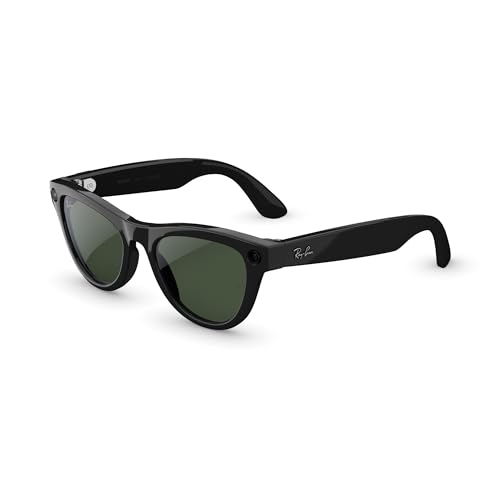
The second generation of Ray-Ban Meta brings the most polished all-day experience in the category. The 12MP ultra-wide camera records 3K Ultra HD video with noticeably richer detail than the 8MP competition, and the open-ear speakers deliver clear mids and highs for music and calls without blocking ambient sound. Battery life jumps to 8 hours of moderate use—a major leap over Gen 1—and the included charging case provides up to 48 hours of reserve power, so you rarely hit a dead pair during a full day out.
The Skyler frame uses a half-frame cat eye design with Transitions Graphite Green lenses that darken automatically in sunlight. The frame is heavier than standard optical glasses due to the embedded electronics, but the low bridge fit option (also available in the Headliner model) helps keep them secure. Touchpad controls on the temple are responsive, though some users find them overly sensitive during adjustment.
Real-time translation works offline for several language pairs, and Meta AI answers questions about what you’re looking at—useful for identifying landmarks or reading signs. The privacy LED that lights up during recording is a thoughtful transparency feature, though it can’t be disabled. For anyone who wants premium build quality, the best camera, and the longest ecosystem support, this is the pair to beat.
Why it’s great
- 2x battery over Gen 1 with charging case
- Best 12MP camera and 3K video clarity
- Transitions lenses for indoor/outdoor use
Good to know
- Heavier frames may slide on oily skin
- Touchpad can register accidental taps
2. Meta Ray-Ban (Gen 2), Headliner Low Bridge Fit, Shiny Black
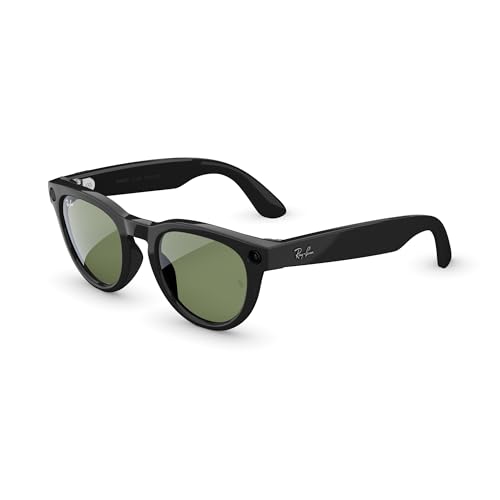
The Headliner is essentially the same Gen 2 hardware as the Skyler but optimized for users with lower nose bridges. The round frame shape and 23mm bridge width sit more securely on flatter nasal profiles, reducing the sliding issue common with standard Wayfarer or cat-eye shapes. The 3K Ultra HD camera and five-microphone array produce the same excellent video and call clarity as the Skyler.
Battery performance is identical to the Skyler model: up to 8 hours with moderate music and photo use, and the charging case extends total runtime to 48 hours. The green lenses are fixed-tint rather than photochromic, so you get consistent sunglass darkness outdoors but need to swap frames for indoor use. The open-ear speakers are the best in class for spatial awareness—you can hold a conversation while listening to a podcast.
One downside is the weight distribution; the electronics are concentrated in the temples, making the arms noticeably thicker than standard glasses. This can cause pressure points behind the ears during extended wear. The Meta AI live translation works reliably for Spanish, French, Italian, and English without needing WiFi, a standout feature for travelers. If you need a low bridge fit and want the best camera and battery available, this is the purpose-built choice.
Why it’s great
- Low bridge design prevents slipping
- Same 12MP/3K camera as the Skyler
- Offline live translation for 4 languages
Good to know
- Fixed green tint, no photochromic option
- Heavy temple arms cause pressure over time
3. Ray-Ban Meta (Gen 1), Wayfarer, Shiny Black

The Gen 1 Ray-Ban Meta Wayfarer established the blueprint that others follow. The 12MP ultra-wide camera captures photos with excellent dynamic range, and the five-microphone system records spatial audio that makes POV videos feel immersive. The open-ear speakers are well-tuned for spoken word and phone calls, with sufficient volume to hear over city traffic without maxing out.
Battery life is the biggest downgrade from Gen 2—about 4 hours of heavy camera use or a half day of mixed music and calls. The charging case provides multiple top-ups, but you’ll reach for it more frequently. The clear lenses can be swapped for prescription or tinted options at any optician, a significant advantage over some competing models that use proprietary lens mounts.
Meta AI works well for object identification and simple questions, though accuracy drops for more obscure subjects. The live translation feature supports fewer languages than some dedicated translation glasses. The Gen 1 also lacks the low bridge fit option, so users with flatter noses may experience sliding. Still, for the iconic Wayfarer styling and the best-in-class microphone array for clear calls, this remains a strong choice for someone who prioritizes audio quality over battery endurance.
Why it’s great
- Classic Wayfarer design, works with any prescription
- 5-mic array delivers best call clarity in category
- 12MP camera with excellent dynamic range
Good to know
- Battery drains fast with heavy video use
- No low bridge fit option
4. EarlySincere 4K AI Smart Glasses with Photochromic Lenses
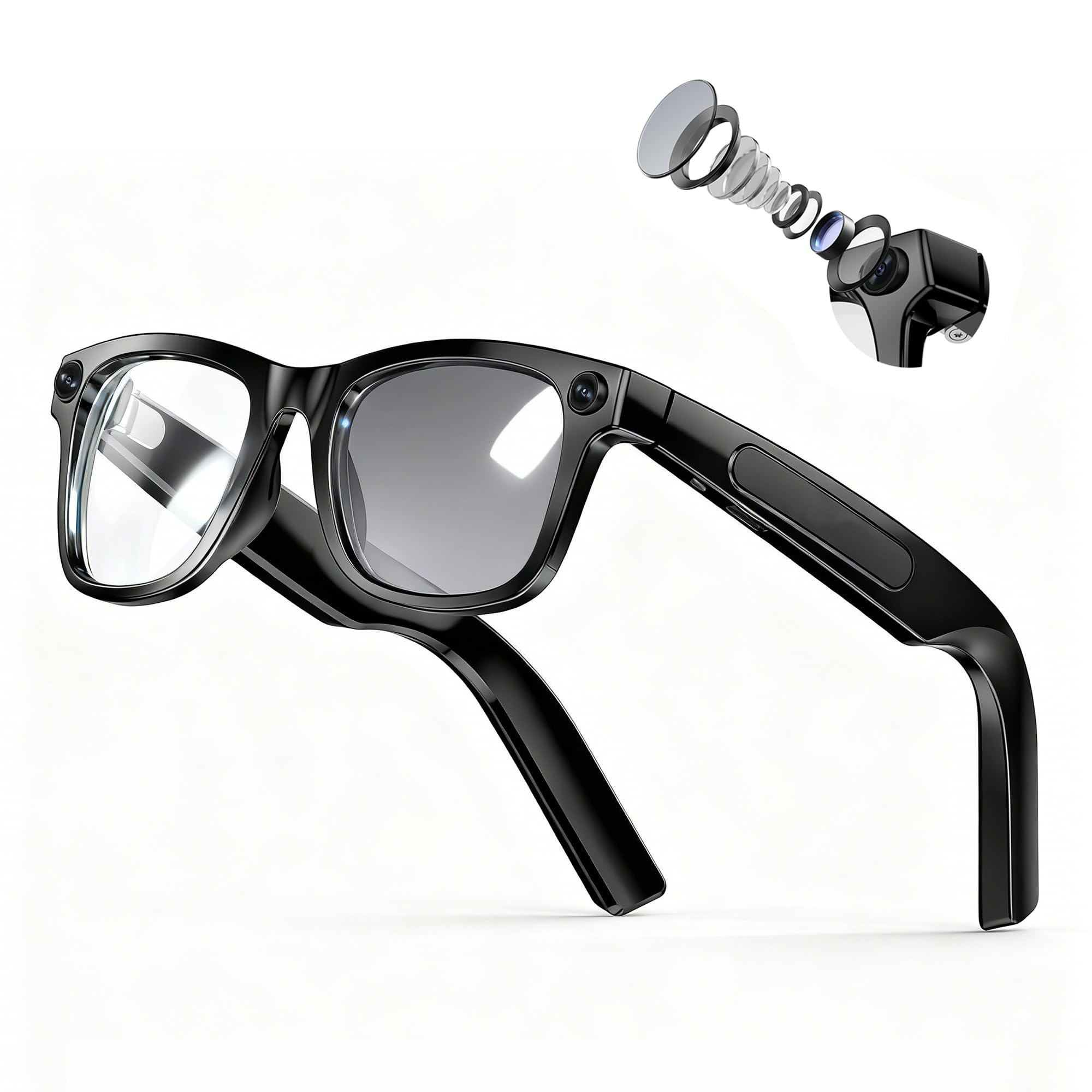
The EarlySincere model prioritizes endurance above everything else. With a 410mAh battery and Bluetooth 5.4, it delivers up to 15 hours of continuous music playback or 10 days of standby—easily the longest runtime in this roundup. The 8MP camera with electronic image stabilization captures smooth 4K video, and the photochromic lenses automatically darken under UV light, blocking 100% of UV400 rays.
The TR90 frame is flexible and lightweight, but the aluminum alloy heat dissipation channels in the temples add noticeable bulk. The 30° adjustable temple arms allow a custom fit for wider heads, and the powder-metallurgical stainless steel hinges are rated for 10,000 folds. The AI translation works through the companion app and supports real-time conversation, though accuracy depends on internet connectivity in the same way as most budget translation services.
The biggest tradeoff is the camera quality; while the 4K EIS footage is smooth, the sensor’s dynamic range and low-light performance are not comparable to the 12MP unit in the Ray-Ban Meta. Nighttime recordings appear noisy. The app interface uses some Chinese language prompts out of the box, which may confuse non-Chinese speakers. If your priority is all-day battery, photochromic convenience, and hands-free video capture on a budget, this pair delivers tremendous value.
Why it’s great
- Best battery life: 15hr playback, 10-day standby
- EIS keeps 4K video smooth during action
- Automatic photochromic UV400 lenses
Good to know
- Camera struggles in low light
- App includes some Chinese-language prompts
5. EGQINR AI Smart Glasses with 8MP Camera and 130-Language Translation
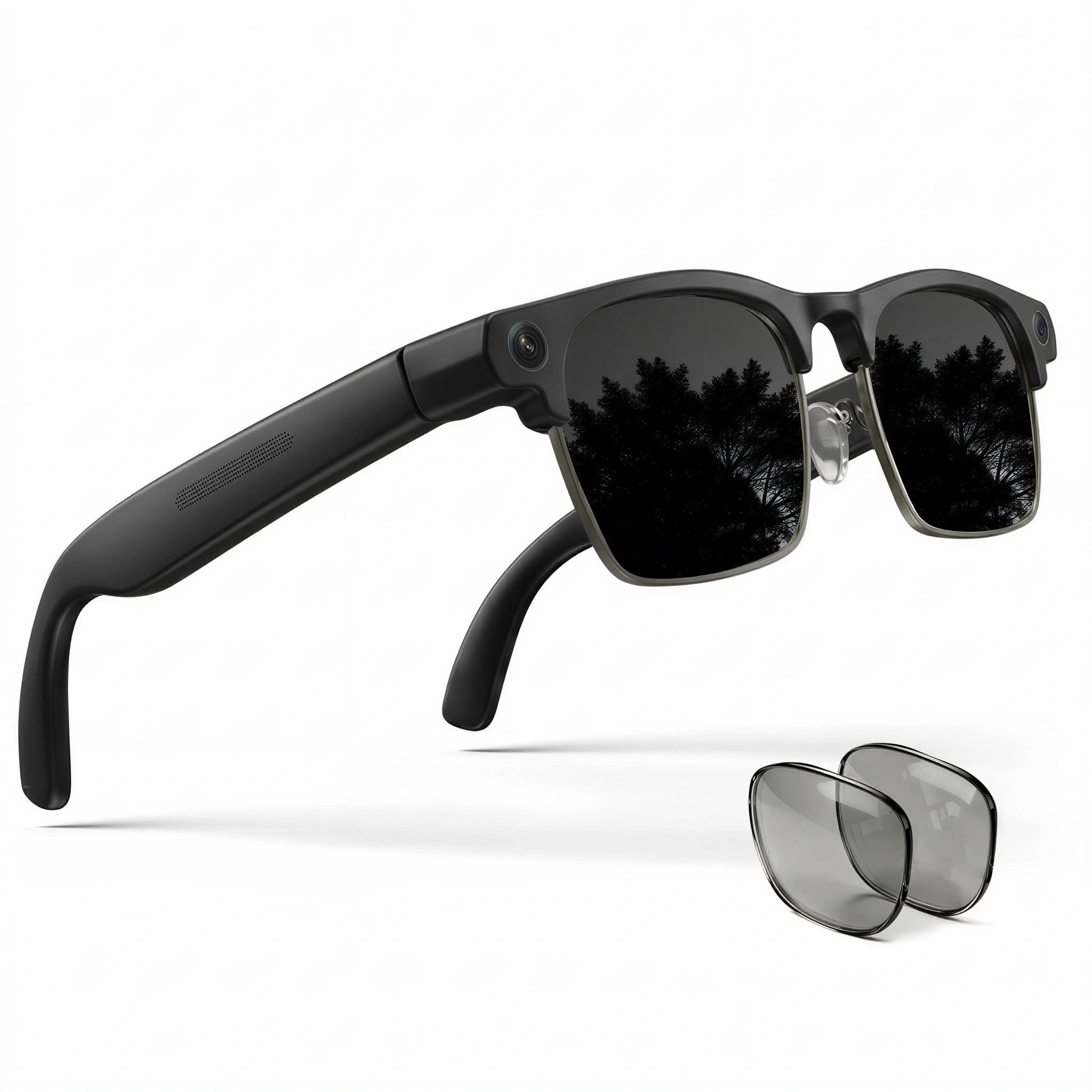
The EGQINR glasses offer the widest language support of any model in this list, with real-time two-way translation across 130 languages and a claimed 0.1-second response time. The built-in 8MP camera records 4K video with decent color accuracy, and the 4GB of internal storage holds roughly an hour of footage before you need to transfer via the app. The dual-microphone ENC (environmental noise cancellation) handles windy calls well, a common pain point for outdoor users.
A standout feature is the interchangeable lens system. The package includes a pair of standard sunglasses and a pair of photochromic lenses, both of which can be easily swapped using the detachable TR90 frame design. You can also bring the empty frames to an optician for custom prescription lenses. The AI voice assistant activates with a custom wake word (“Hey Cyan”) and can answer questions, set reminders, or trigger the camera.
The 300mAh battery provides up to 7 hours of music or 6.5 hours of call time, which is adequate for a workday but not all-day travel. The frame feels noticeably flimsy at the bridge—some users report the center bows when opening the glasses wide, raising durability concerns. The touch-sensitive temple controls are intuitive for volume and playback, but the physical camera button is small and requires precise pressure. For frequent international travelers who need translation in dozens of languages on a budget, the EGQINR is a versatile tool.
Why it’s great
- 130-language real-time translation
- Two lens sets plus prescription-friendly frame
- 3-way translation modes: face-to-face, simultaneous, meeting record
Good to know
- Bridge feels fragile during wide opening
- 4GB storage fills quickly at 4K
6. GetD AI Glasses with Photochromic Lens and ChatGPT
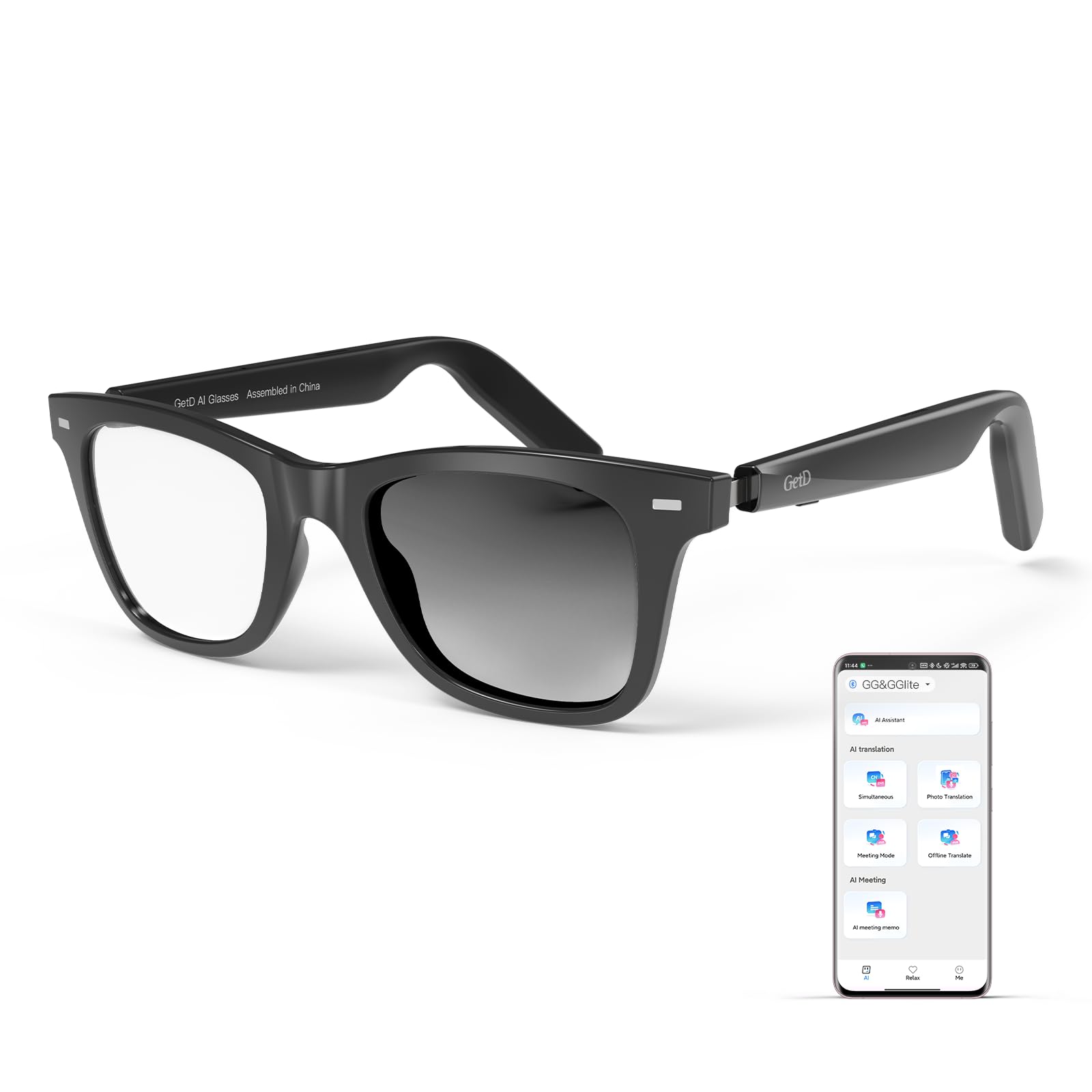
The GetD glasses hit a sweet spot for budget-conscious buyers who still want photochromic lenses and ChatGPT integration. The TR90 frame is lightweight at 150 grams, and the photochromic lenses offer 100% UV protection, darkening automatically in bright outdoor conditions. The “GDirect Directional Open-Ear” design delivers stereo sound that stays clear at moderate volumes while leaking minimal audio to bystanders.
The AI assistant is accessed through the GetD companion app and supports 145-language bidirectional translation. In practice, translation accuracy is sufficient for basic travel phrases and simple conversations, though it struggles with complex sentences or regional slang. The dual 115mAh batteries provide 11 hours of music playback and 9 hours of talk time at 50% volume, with a quick-charge feature that gives 1 hour of use from 10 minutes of charging.
IP54 water resistance means the glasses can handle light rain and sweat but not full submersion. Bluetooth 5.4 ensures stable connections within 10 meters without the dropouts seen on older Bluetooth 5.0 models. The main complaint from users is that the temple arms are too short for larger head sizes, causing the glasses to sit too high on the ears. The audio quality is good for calls but lacks bass for music enthusiasts. If you want ChatGPT-powered translation and photochromic convenience at an approachable price, the GetD is a solid entry point.
Why it’s great
- Photochromic lenses with UV400 protection
- 145-language translation via ChatGPT app
- Quick charge: 10 min = 1 hour use
Good to know
- Arm length may be short for large heads
- Audio lacks bass for music enjoyment
7. Plunthorn AI Smart Glasses with Camera and 4K Recording
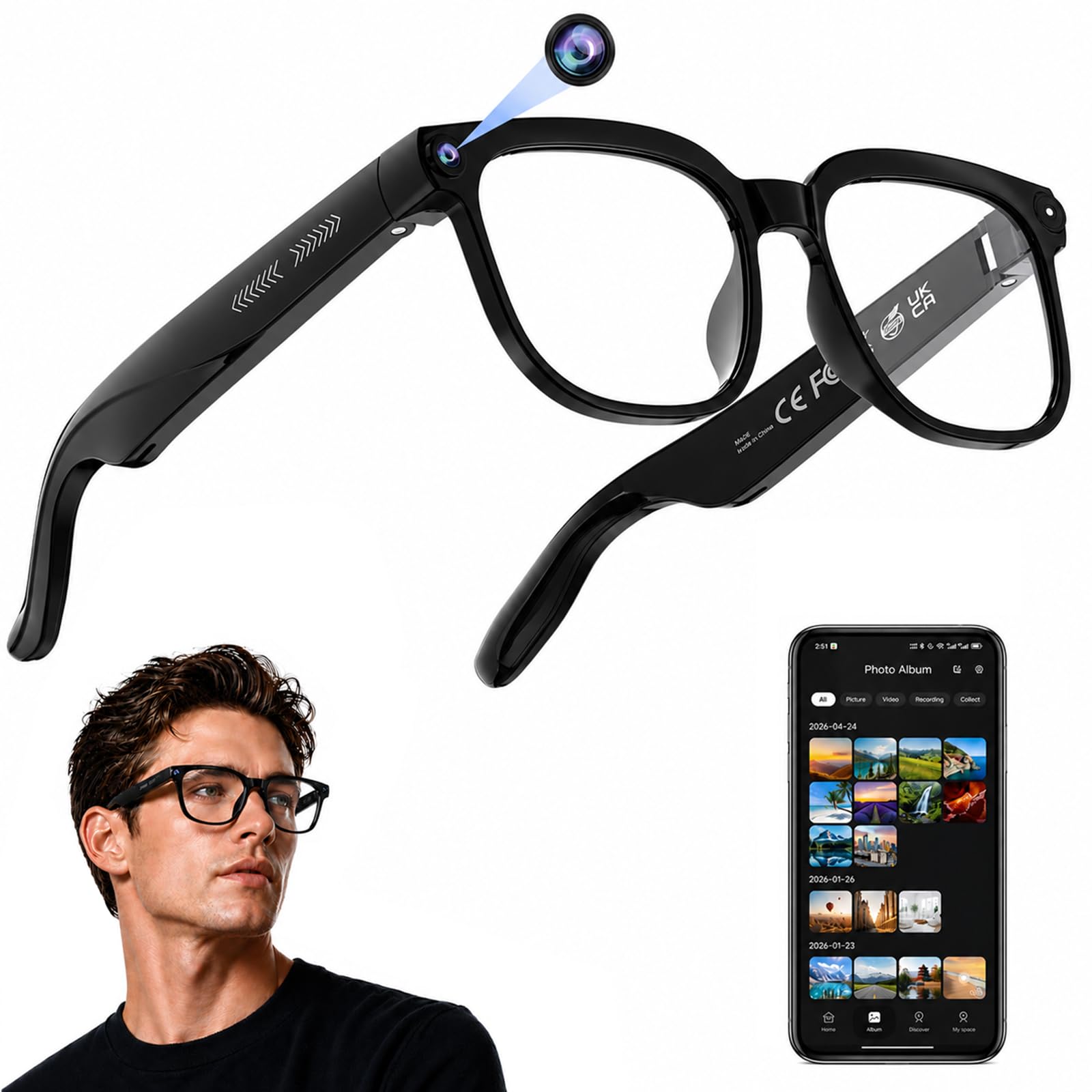
The Plunthorn glasses pack an impressive feature set at the most aggressive price point in this guide. The built-in 4K camera records from a first-person perspective, and the open-ear Bluetooth audio handles calls and music without sealing off your ears. The IP65 rating means these glasses survive sweat, rain, and dusty environments—useful for outdoor workers and active commuters alike.
The 290mAh battery delivers a full workday of mixed use, though heavy video recording drains it faster—expect about 2 hours of continuous 4K capture. The silicone band material around the frame makes prolonged wear comfortable, and the transparent lens option keeps the design neutral enough for daily office use. The companion app integrates AI object recognition that can identify items you’re looking at, and the real-time translation works for travel and basic business conversations.
The camera’s video quality is soft compared to 12MP sensors—fine for social media but not for professional content. The touch controls on the arm are occasionally unresponsive, and the voice assistant accuracy drops in noisy environments. Some units have shipped with a pink shadow artifact in the camera’s corner, suggesting inconsistent quality control. For buyers who want to explore the smart glasses category with minimal financial commitment and still get hands-free video, translation, and voice AI, the Plunthorn is the most accessible gateway.
Why it’s great
- Best entry-level price for full feature set
- IP65 dust and water resistance
- AI object recognition and real-time translation
Good to know
- Video quality is soft, no stabilization
- Quality control issues on some units
FAQ
Can I wear bone conduction glasses with prescription lenses?
How does real-time translation work on these glasses?
Will the open-ear audio disturb people next to me?
Final Thoughts: The Verdict
For most users, the best bone conduction glasses winner is the Meta Ray-Ban (Gen 2) Skyler because it pairs the best camera available (12MP, 3K Ultra HD video, EIS) with 8-hour battery life, a full-featured AI ecosystem, and a charging case that makes the battery effectively unlimited for a full day out. If you want the absolute longest battery and photochromic convenience without spending for the premium tier, grab the EarlySincere 4K AI Glasses. And for budget-conscious buyers who need translation in over 100 languages and interchangeable lenses, the EGQINR AI Smart Glasses deliver the most feature-dense package at the lowest entry price.

Mo Maruf
I created WellFizz to bridge the gap between vague wellness advice and actionable solutions. My mission is simple: to decode the research and give you practical tools you can actually use.
Beyond the data, I am a passionate traveler. I believe that stepping away from the screen to explore new environments is essential for mental clarity and physical vitality.